MGN12 Linear Rail: Stainless Miniature Guide Solution for Humid and Compact Axes

MGN12 Linear Rail: Stainless Miniature Guide Solution for Humid and Compact Axes

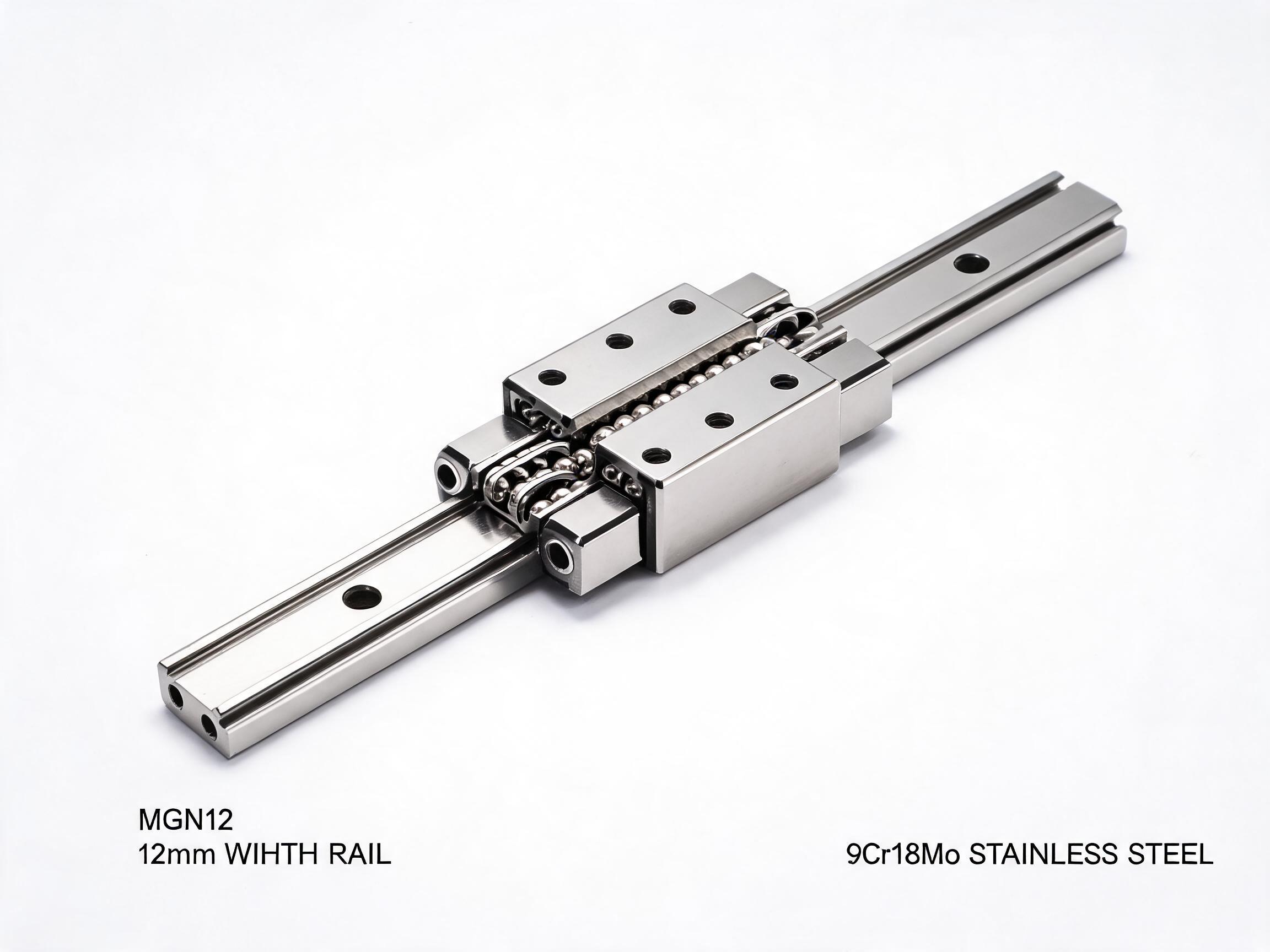
Miniature 12 mm linear rails fail early when chrome-coated carbon steel rusts in humid or dusty environments. This solution uses 9Cr18Mo martensitic stainless MGN12 rails with sealed C/H carriages, so humid cleanrooms, IVD stages and desktop CNC axes keep running smoothly.

What buyers actually struggle with

Miniature axis builders selecting a 12 mm linear rail face three recurring sourcing failures. Standard carbon-steel miniature guides rust inside humid chambers, humid cleanrooms and coolant-misted desktop machines. Unsealed miniature carriages ingest fiber dust and swarf, and the first sign is stiction your service team cannot reproduce. And when rails and carriages come from different suppliers, the Gothic-arch geometry no longer matches, so running friction and life predictions go out the window.

Impact on your operation: field failures on shipped machines, warranty replacements at 4-6 month intervals, and qualification reruns when corrosion shows up in chamber testing.

Our engineering solution

The MGN series builds corrosion resistance into the material, not the coating. Rails and carriages are machined from 9Cr18Mo martensitic stainless steel in the 9/12/15 size family, so a scratch or seal wipe never exposes bare carbon steel. The two-row Gothic-arch ball circuit keeps contact geometry matched between rail and carriage because both parts ship as factory-matched pairs.

Stainless by material9Cr18Mo martensitic stainless across the MGN family - no coating to wear through in humid or washed-down environments.
Seal options that matterEnd seals and side seals on C and H carriages block fiber dust, swarf and splash before they reach the ball circuit.
Low stack heightMGN12 keeps axis height under 13 mm, which is why compact CoreXY printers, IVD stages and optical modules fit it where profile guides cannot.

What this buys you

  • Qualification passes on the first chamber cycle instead of a corrosion retest.
  • Matched rail-carriage pairs with predictable 0.002-0.004 friction coefficient for smooth miniature-axis motion.
  • Direct factory MOQ starting at 50 pieces, sized for pilot builds and series production alike.

Case 1 - IVD analyzer motion stage (Germany)

Who / what: a diagnostics-equipment maker specified MGN12C carriages on a sample-transfer stage inside a humidity-controlled chamber. Problem: their previous uncoated miniature rails showed rust spotting after chamber qualification.

Before: corrosion complaints on 2 of 6 qualification units after one year of chamber cycling.
After: 9Cr18Mo MGN12 rails and carriages passed chamber qualification with zero corrosion findings across all units.

Where the numbers come from: the customer's chamber qualification test protocol and acceptance report, referenced at reorder.

Source: customer qualification documentation shared by their quality engineer.

Case 2 - Desktop CNC maker (United States)

Who / what: a desktop CNC brand sourcing MGN12H long carriages for Z-axis assemblies. Problem: mixed-brand rails and carriages caused intermittent stiction their support team could not reproduce.

Before: about 4% of shipped machines came back with Z-axis stiction within 6 months.
After: matched MGN12 rail-and-H-carriage pairs dropped that rate to under 0.5% over the following two production quarters.

Where the numbers come from: the brand's warranty-claim dashboard, filtered for Z-axis stiction tickets before and after the supplier change.

Source: OEM warranty statistics discussed during annual volume negotiation.

Case 3 - 3D printer OEM (Japan)

Who / what: a printer maker needed the lowest axis height for a compact CoreXY model and evaluated MGN9 versus MGN12. Problem: MGN9 marginal load capacity limited acceleration.

Before: MGN9 prototype carriages showed ball skid at the target 2.5 g acceleration profile.
After: MGN12C at 3.7 kN dynamic load held the acceleration target with margin, keeping the carriage under 13 mm stack height.

Where the numbers come from: the OEM's own acceleration test bench logs comparing the two prototypes.

Source: engineering email exchange with test-bench results attached.

β˜…β˜…β˜…β˜…β˜…

Sourced for an IVD analyzer motion stage through a LinkedIn-sourced RFQ.

"The stainless material declaration came with the first sample kit, so our regulatory file did not stall waiting for paperwork."

Verifiable result: qualification completed on schedule; 3 sample rounds, 1 final approval.

Source type: RFQ thread correspondence with the customer's R&D buyer.

β˜…β˜…β˜…β˜…β˜†

Series order for desktop CNC Z-axis assemblies placed via trade platform.

"Matched rail-and-carriage pairs arrived labeled per axis, which ended the mixing problem on our line."

Verifiable result: 2 production years on supply; stiction-related warranty claims under 0.5%.

Source type: repeat-order record and annual supplier review notes.

β˜…β˜…β˜…β˜…β˜…

Emergency sample request for a compact printer prototype, from a returning customer.

"Sample carriages shipped within 5 working days, and the acceleration profile passed on the first bench run."

Verifiable result: prototype froze spec 6 weeks earlier than the previous development cycle.

Source type: post-shipment feedback from the OEM's mechanical lead.

  • ISO 9001:2015 - certified quality management across design, production, inspection and after-sales for the guideway and bearing range.
  • CE Conformity Declaration - EU Machinery Directive conformity for linear motion components.
  • SGS Material Test Reports - third-party verification of steel composition and hardness, with batch reports on request for stainless MGN orders.
  • REACH and RoHS documentation - material declarations supporting EU market entry for medical and laboratory equipment makers.

For medical-device projects, buyers should request the current certificate set and material declarations with the RFQ so they can attach them to their own regulatory file.

Founded 2014More than 10 years manufacturing linear motion bearings and guideways in Xiamen, China.
Factory scaleHigh-precision automated grinding, CNC machining and constant-temperature ultra-fine grinding lines support consistent raceway geometry at volume.
R&D supportApplication engineers help buyers pick MGN carriage types, seal options and preload for compact axis designs before sampling.
Export reachSupplying Europe, North America and Asia through direct factory channels, with OEM/ODM and flexible MOQ for series production.

Will a stainless MGN12 rail rust in a humid chamber?

MGN12 uses 9Cr18Mo martensitic stainless steel, which resists humidity far better than chrome-plated carbon steel. For chambers with condensation, pair it with sealed carriages and run a light corrosion-inhibiting grease.

What is the difference between MGN12C and MGN12H carriages?

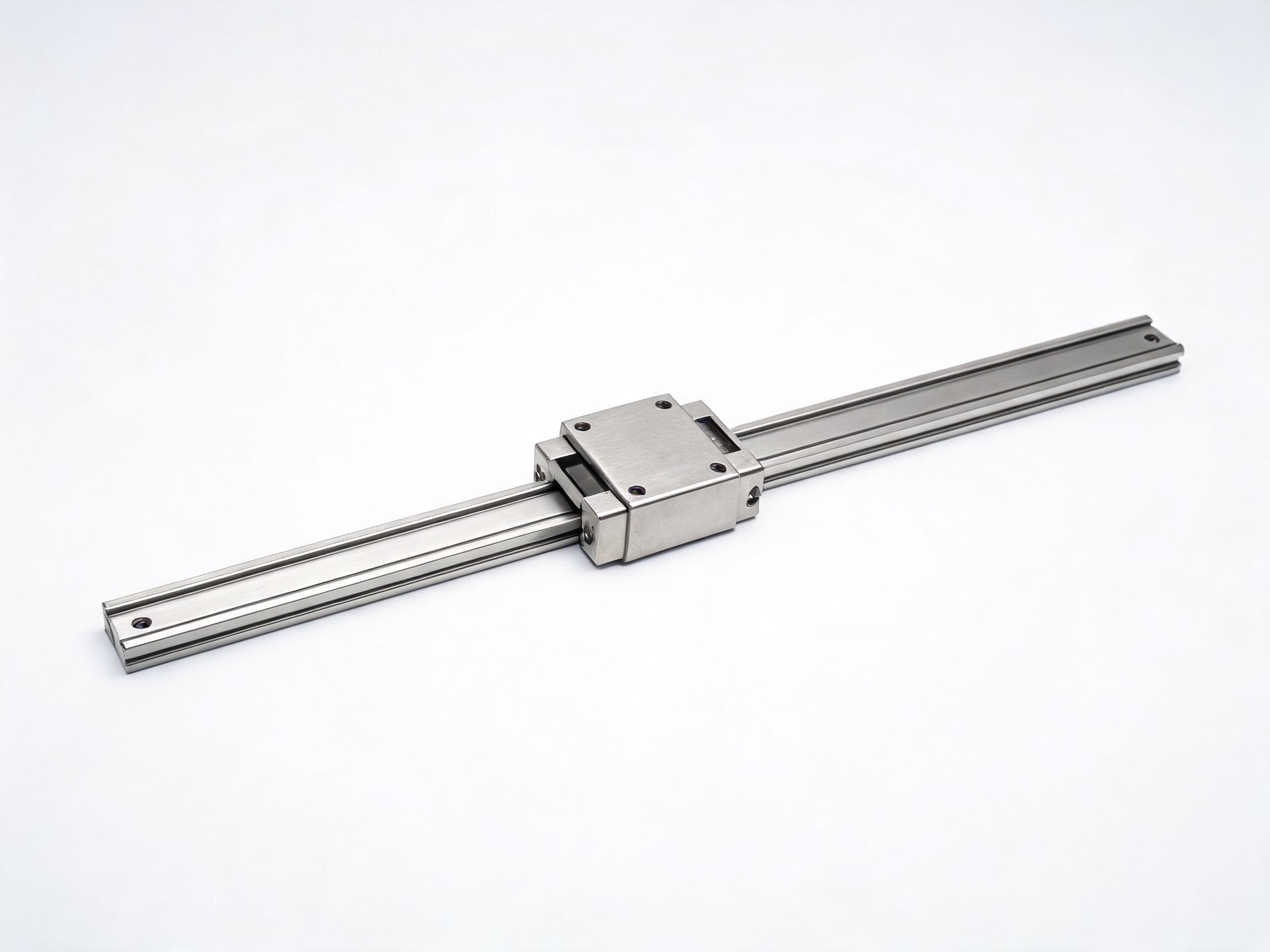
C is the standard carriage and H is the long type with extended contact surface. H carries more load and resists moment loads better; C keeps the stack height and carriage length minimal for tight envelopes.

Can MGN12 rails be butted together for longer travel?

Yes. We grind joined ends so two rails align as one, which is the standard way to build miniature axes longer than stock lengths.

What loads can the MGN12C carriage carry?

MGN12C is rated 3.7 kN dynamic and 5.4 kN static. Compare those numbers against your payload and acceleration profile before choosing MGN9 as a size smaller.

Do you supply MGN9 and MGN15 in the same stainless material?

Yes, the MGN 9/12/15 series shares the same martensitic stainless construction and carriage options, so a single machine can standardize on one material system.

Product Inquiry
β—†
Product Inquiry
MGN12 Linear Rail: Stainless Miniature Guide Solution for Humid and Compact Axes
β—†