
Un ghid metalurgic aprofundat despre oțelul pentru rulmenți GCr15, care acoperă compoziția chimică, procesul de tratament termic în trei etape, comparația cu alternativele din oțel inoxidabil și cementat, precum și verificarea certificatului de material pentru inspecția la recepție.
What Makes GCr15 the Standard Bearing Steel
GCr15 (Chinese standard GB/T 18254) is the high-carbon chromium bearing steel equivalent to AISI 52100 (US), DIN 100Cr6 (Germany), and JIS SUJ2 (Japan). It accounts for an estimated 90% of all linear motion bearing and guideway production worldwide. Its dominance is not accidental - the material's specific combination of carbon content, chromium content, and heat treatment response creates a microstructure uniquely suited to rolling contact applications.
Chemical Composition and Material Properties
The defining composition of GCr15 is:
- Carbon (C): 0.95–1.05% - provides high baseline hardness through martensitic transformation.
- Chromium (Cr): 1.30–1.65% - increases hardenability and forms chromium carbides that resist wear and provide high-temperature stability.
- Manganese (Mn): 0.20–0.45% - improves hardenability and hot workability.
- Silicon (Si): 0.15–0.35% - acts as a deoxidizer and improves elastic limit.
- Sulfur (S) and Phosphorus (P): Both ≤ 0.025% - kept low because they form brittle inclusions that initiate fatigue cracks.
The material in its annealed state has a hardness of 170–207 HB. After through-hardening (quench and temper), it reaches 60–64 HRC - the target range for bearing raceways. This hardness provides the surface compressive strength necessary to withstand Hertzian contact stresses of 1.5–3.0 GPa without plastic deformation.
Heat Treatment Process for Linear Motion Components
The heat treatment of GCr15 for bearing applications is a precisely controlled three-stage process.
Stage 1: Austenitizing
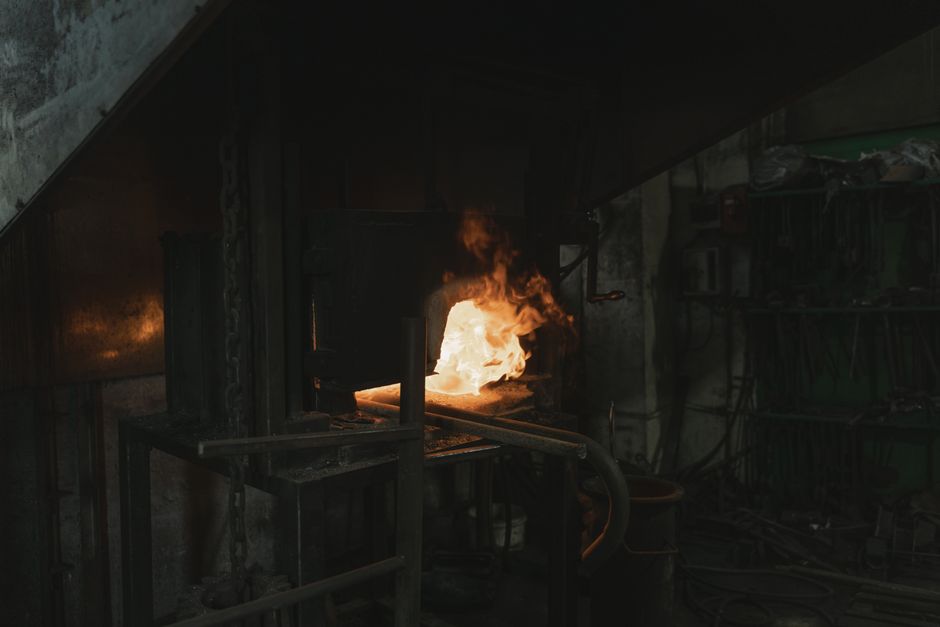
The component is heated to 820–860°C in a controlled-atmosphere furnace (endothermic gas or vacuum to prevent decarburization). At this temperature, the microstructure transforms to austenite, dissolving carbon and chromium into solid solution. Soaking time is 20–40 minutes per 25 mm of section thickness. Under-soaking leaves undissolved carbides that reduce hardenability; over-soaking causes grain coarsening, which reduces toughness.
Stage 2: Quenching
The component is quenched in oil at 60–80°C. Oil quenching (rather than water) provides a moderate cooling rate sufficient to form martensite in GCr15's relatively shallow hardenability window, while minimizing distortion and cracking risk. For thin-section components (linear bearing races under 5 mm wall thickness), a martempering process at 120°C oil bath can further reduce distortion.
Stage 3: Tempering
Immediately after quenching, the component is tempered at 150–180°C for 2–4 hours. This relieves quenching stress, transforms retained austenite (which is dimensionally unstable) to tempered martensite, and stabilizes the microstructure. The tempering temperature is carefully chosen: too low (below 120°C) leaves excessive retained austenite that will transform over time, causing dimensional growth; too high (above 200°C) reduces hardness below the 60 HRC threshold.
Final hardness target: 60–64 HRC at the surface, with a case depth of 0.8–2.5 mm depending on component size and load rating.
Why Not Stainless Steel or Case-Hardened Steel?
Stainless Steel (AISI 440C)
440C stainless steel is used for corrosion-resistant bearings in food, marine, and medical applications. It achieves 58–60 HRC - slightly lower than GCr15 - and has lower load capacity due to reduced carbide volume. It costs 2.5–4 times more than GCr15 and is specified only when corrosion resistance is a functional requirement, not as a general upgrade.
Case-Hardened Steel (20CrMnTi)
Case-hardened steel is used for large-diameter bearings and heavy-duty slewing rings where the core must absorb shock loads. The carburizing process creates a hard case (58–62 HRC) over a tough, low-carbon core (30–35 HRC). For standard linear motion bearings and guideways, through-hardened GCr15 provides more uniform hardness distribution and simpler quality control - case hardening adds process complexity that is not justified for the load profiles of typical linear motion applications.
Material Certificate Verification
When receiving GCr15 components from a supplier, the material certificate (mill cert) should include: heat number, chemical composition analysis (spectrometric), and a statement of compliance with GB/T 18254 or the equivalent international standard. Cross-reference the heat number against the supplier's heat treatment records to confirm that the specific lot received the documented thermal cycle. A material cert without a heat number is not traceable and should be rejected for quality-critical applications.