
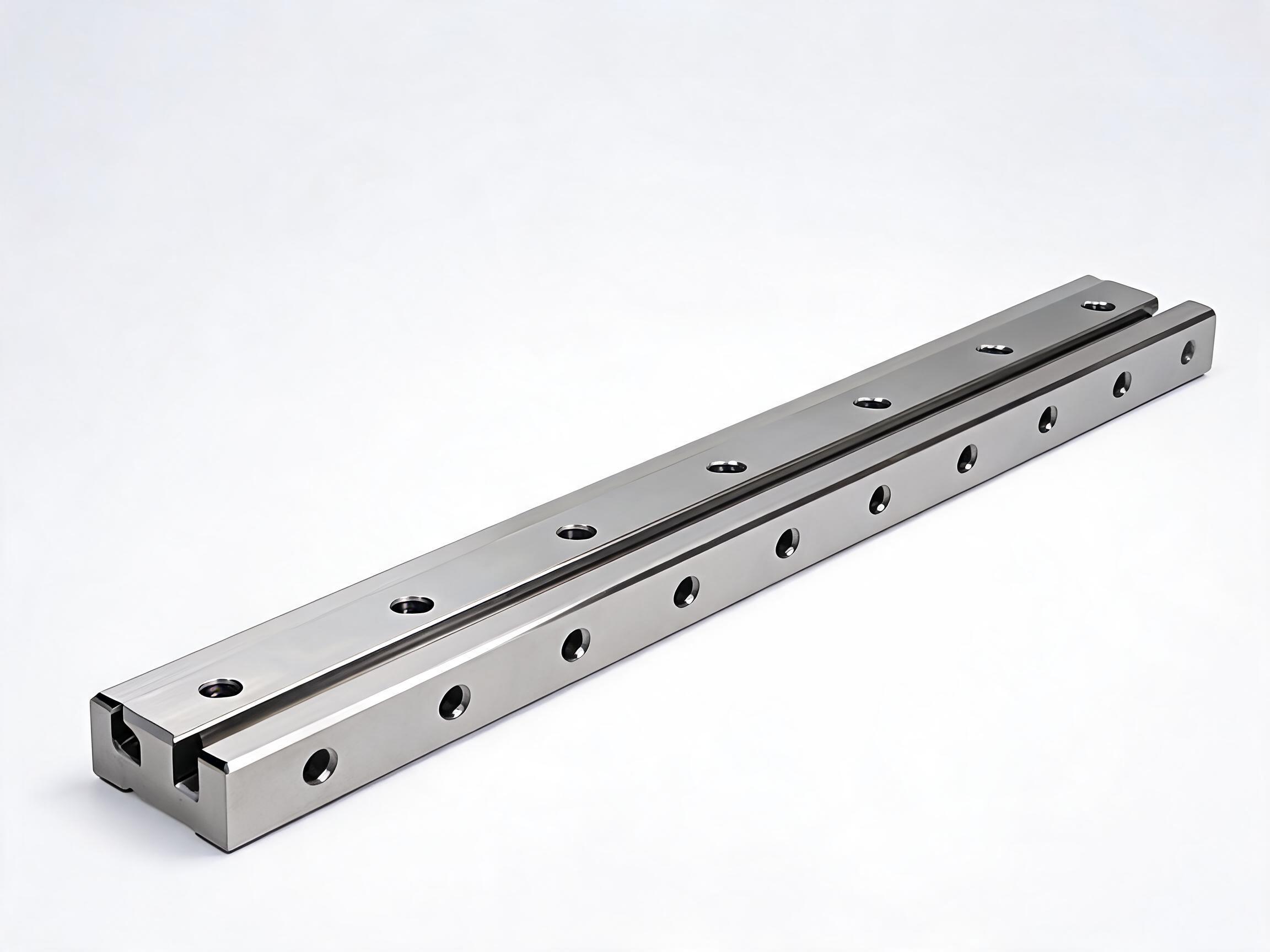
A procurement guide for machine builders sourcing long linear rails: which product families actually ship in one piece at 3000 mm, where the standard maximum sits at 4000 mm, when you move to precision splice joints, how straightness is held across a splice, and how 2500 mm and longer rails are crated and shipped.
Procurement guide
Buyers searching for a 3000mm linear rail usually have one question behind the query: does a three-metre rail arrive as a single piece, or is it joined, and what does that mean for straightness at the joint and for freight? The answer depends on the product family, not on the length alone.
Key takeaways
- A 3000 mm rail is available as one piece in at least two families: the SBR20 integrated unit (standard to 3000 mm, custom to 4000 mm) and the HGR profile rail series (standard maximum 4000 mm).
- Precision splice joints start where the standard maximum ends — for HGR that is above 4000 mm; joined sections allow axes of roughly 8+ m from 2×4000 mm.
- Straightness across a splice is held to the same grade as the individual rail; HGR45 ground (P5) is ≤0.02 mm/m.
- Rails of 2500+ mm ship in wooden crates with V-block or steel-reinforced supports; oversized cargo surcharges can apply at 4000 mm.
- Miniature rail joins far sooner: MGN12 stops at 1000 mm and uses splicing beyond that.
Why 3000 mm is the length buyers actually ask about
Three metres sits right in the middle of a common machine class. A 3000 mm SBR20 unit covers mid-size CNC router X and Y axes with 1.5–3 m travel without a splice joint, which is why the length appears so often in sourcing enquiries. On a router, the rail is the datum the gantry and carriage ride on; a joint in the wrong place means a step or a stiffness change exactly where the cutting load passes.
Above 3000 mm the question changes from "which length" to "which construction." Below the standard maximum for a given family, you get one continuous piece. Above it, you get joined sections with precision splice joints — and the procurement job becomes verifying joint straightness, crate design, and freight terms.
Standard lengths by product family
The table below reflects what each family is offered at, based on current product data. Lengths are the rail or unit length offered, not the travel of the finished axis — travel depends on carriage width and end clearances.
| Family | Standard maximum | Custom / beyond standard | What the buyer should know |
|---|---|---|---|
| SBR20 integrated unit | 3000 mm | Custom to 4000 mm, MOQ 20 sets above 3000 mm | One-piece 3000 mm covers 1.5–3 m router travel without a splice |
| HGR series profile rail | 4000 mm | Custom lengths on request; above 4000 mm produced as joined sections with precision splice joints | Splice straightness held to the same grade as the individual rail |
| HGR45 (ground P5) | 4000 mm | Joined sections; 2×4000 mm enables axes of approximately 8+ m | Straightness ≤0.02 mm/m; bolt pitch 60 mm, M12 bolts |
| MGN12 miniature rail | 1000 mm | Splicing available | Small sections join much sooner — the contrast case |
The pattern is that rail section size and grade set the practical limit. A heavy profile rail in a ground grade is produced in longer single pieces than a miniature rail because the manufacturing and handling route supports it. Exact length tolerances and splice pitch details for a specific order are available on request — confirm them against the datasheet before releasing a machine frame drawing.
One piece or spliced: where the decision lands
For an axis under 3000 mm of travel, an SBR20 unit at 3000 mm keeps the mounting surface continuous from end to end. That removes splice alignment from your assembly sequence entirely. The specification is worth checking against your actual travel, because carriage length and end stops consume rail length.
For longer axes on profile rail, the HGR route is to order the longest standard single rail (up to 4000 mm) and join sections only where the axis demands it. If your design needs roughly 8 m of travel, the arithmetic is 2×4000 mm joined — one joint per axis rather than several, which keeps the number of alignment steps down.
Where the axis length is genuinely uncertain at design stage, it is cheaper to fix the rail construction before the frame is drilled. Half a metre of travel added after the fact can push a design from one piece into a spliced arrangement, changing both the mounting plan and the freight class.
Straightness across a splice joint
The common worry about a joined rail is a visible or measurable step at the joint. On HGR series, rails longer than 4000 mm are produced as joined sections with precision splice joints, and straightness tolerance across the splice is held to the same grade as the individual rail. For HGR45 in ground P5 grade, that grade is ≤0.02 mm/m.
That statement is about the tolerance the rail is held to — it is not a guarantee about your assembled axis, which also depends on the flatness and stiffness of the mounting surface you bolt to and on how the rail is bedded during installation. Two practical consequences follow:
- Plan the joint position away from the highest-load region of the stroke where the machine layout allows it.
- Check the rail seat with a straightedge or dial indicator before final torque, and record the reading at the joint, not only at mid-span.
- Use the specified bolt pattern — HGR45 uses a 60 mm pitch with M12 bolts — so clamping force is uniform on both sides of the splice.
For ground and precision-graded rails, ask the supplier for the inspection record that accompanies the shipment so the grade claim can be traced to the rail you receive.
Packing and shipping for long rails
Length changes the freight problem more than weight does. Rails of 2500+ mm are shipped in wooden crates with V-block supports, which hold the rail section in a fixed orientation and stop it from bowing or taking a set in transit. For 3000–4000 mm HGR45 rails, the packing is custom wooden crates with steel-reinforced supports.
Practical points for the purchase order:
- Expect an oversized cargo surcharge to be possible on 4000 mm rails — confirm whether it applies to your route and Incoterm before comparing landed cost.
- Ask for the crate dimensions and gross weight so you can book the right truck or container position; a 3 m crate rarely fits a standard pallet rack.
- Confirm how the crate is opened and whether the rail is supported at more than two points, since lifting a long crate by the ends loads the rail itself.
- Keep the crate until installation. A 3000 mm ground rail stored leaning against a wall is a rail that may not be straight when it goes on the machine.
For custom SBR20 lengths above 3000 mm, note the MOQ of 20 sets alongside the packing question — the two are usually quoted together.
Cost and lead-time drivers on long rails
Four factors move price and schedule once you go long, and each is worth separating in the quotation so you can compare suppliers on the same basis:
- Length class. Standard lengths inside the family maximum are ordered as catalogue items; custom lengths above it are made to order.
- Joint count. Each precision splice joint is additional machining and inspection. A 2×4000 mm solution has one joint; a design built from shorter sections has more.
- Grade. Ground P5 rail is a different production route from rolled grade; if your application does not need ≤0.02 mm/m, say so before quoting.
- Freight class. Crate design, oversize surcharge, and handling at both ends can outweigh the rail price difference between suppliers.
Ask each supplier to quote length, joint count, grade, crate dimensions, and freight terms as separate lines. A single lump price for a 3 m rail hides exactly the variables that decide whether the axis works.
What to put in the enquiry
A long-rail enquiry that gets a usable answer quickly usually states: required travel (not just rail length), the axis and its load, whether a splice is acceptable and where, the straightness grade you need, bolt size and pitch if already fixed, mounting surface material and flatness, quantity per machine and annual volume, and the destination port or site. If the design is still open, say which lengths you are comparing — 3000 mm one piece versus a longer joined arrangement — and ask for both.
For the heavy-duty case, the HGR45 large linear guideway rail page carries the ground P5 straightness and bolt data; the wider HGR series profile rail range covers the 4000 mm standard maximum and the joined-section route beyond it. For a self-supporting shaft arrangement on mid-size router axes, the SBR20 heavy-duty guide unit with dual bearing blocks is the 3000 mm one-piece option.
FAQ
Can I get a 3000 mm linear rail as a single piece?
Yes, in more than one family. The SBR20 integrated unit is standard to 3000 mm, and HGR series profile rail is standard to 4000 mm. For those families, a 3 m rail does not need a splice.
At what length do I have to accept a splice joint?
For HGR series, above 4000 mm — rails longer than that are produced as joined sections with precision splice joints. For MGN12 miniature rail, the split point is far lower: maximum rail length is 1000 mm, with splicing available beyond it.
Does a splice reduce straightness?
On HGR series, straightness tolerance across the splice is held to the same grade as the individual rail. The assembled axis result still depends on your mounting surface and installation method, so check the rail seat at the joint during fitting.
How long can a joined HGR45 axis be?
Two 4000 mm sections joined enable axes of approximately 8+ m. Confirm the joint position and the number of joints with the supplier against your travel and load case.
How are 3 m rails shipped?
Rails of 2500+ mm ship in wooden crates with V-block supports. HGR45 rails of 3000–4000 mm use custom wooden crates with steel-reinforced supports, and an oversized cargo surcharge may apply at 4000 mm.
Next step
Send your travel, load, grade requirement and destination, and state whether a splice is acceptable. We can quote a 3000 mm one-piece arrangement and a longer joined alternative side by side, with crate dimensions and freight terms shown separately.