A practical comparison guide for automation buyers deciding between low-profile SBS bearing linear slides and standard slide rails. Covers dimensional trade-offs, load capacity, rigidity, speed, and application fit—with a comparison table and selection checklist.
BUYER GUIDE · LINEAR MOTION
When you are designing a compact automation cell—an assembly fixture, a pick-and-place gantry, a test station—the linear axis often decides whether the whole layout fits. The question comes up in almost every RFQ: should we use a low-profile SBS bearing linear slide, or stick with a standard slide rail?
Both are valid. They serve different envelope and load conditions. This article compares them on the dimensions that matter in procurement: overall height, load capacity, rigidity, speed, sealing, and total installed cost. You will get a clear selection path, not a generic "both are good" answer.
- Low-profile SBS units save 30–50% of mounting height versus standard rail blocks—critical when Z-axis space is tight.
- Standard slide rails carry higher moment loads and tolerate misalignment better; SBS units suit lighter, cleaner, higher-speed duty.
- Choose by envelope first, then load, then environment. Sealing and lubrication differ significantly between the two.
- For custom lengths or preload options, confirm with the supplier—these are not one-size-fits-all components.
What Is a Low-Profile SBS Bearing Linear Slide?
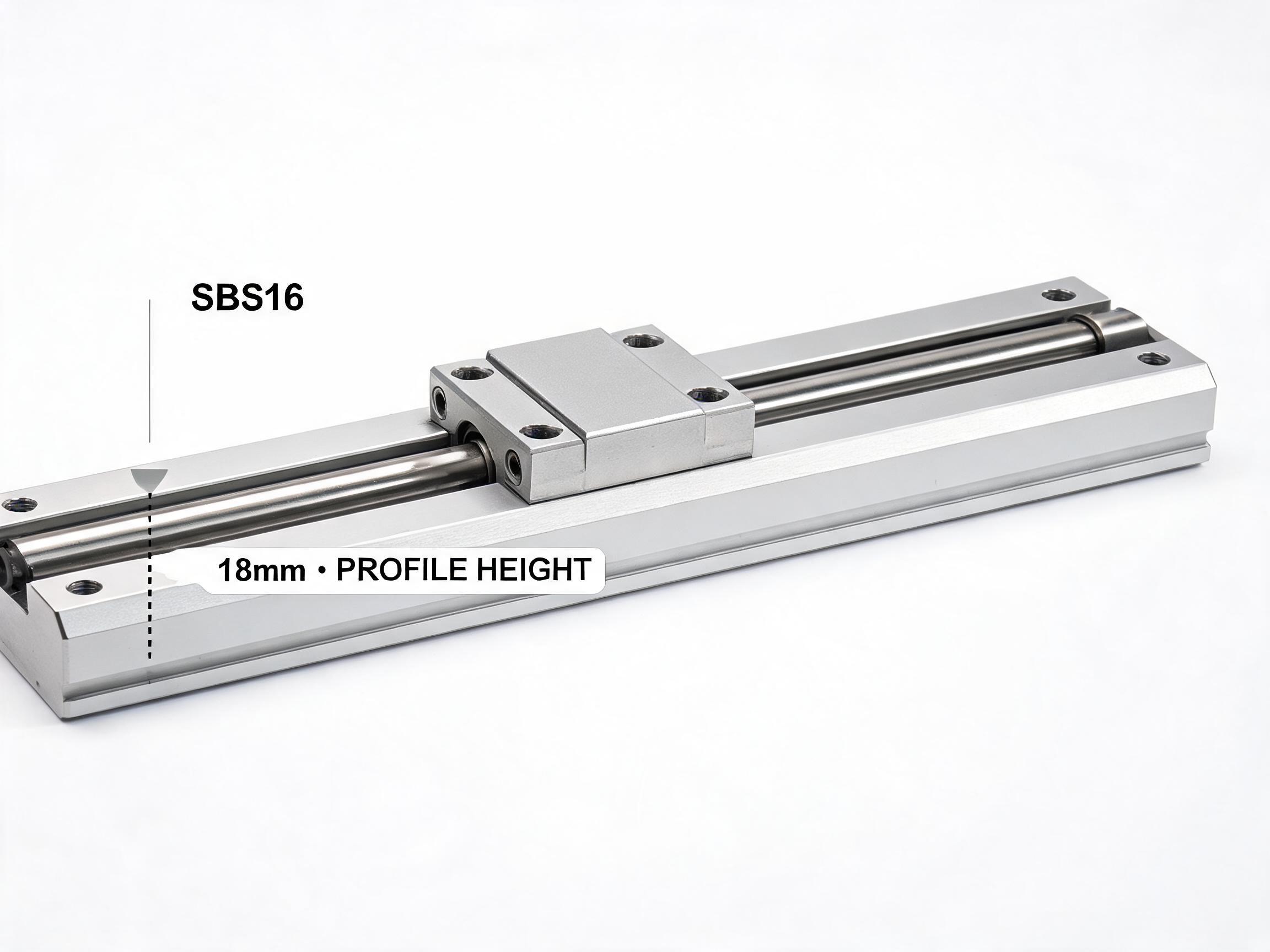
SBS stands for slide bushing system—a linear ball bearing slide design where the recirculating balls run directly on a hardened and ground steel shaft. The carriage (bushing) wraps around the shaft, and the whole assembly sits much lower than a profile rail system of similar width.
A typical low-profile SBS unit has a total height of 10–28 mm depending on shaft diameter, whereas a standard profile rail of comparable load rating sits 24–45 mm tall. That difference is exactly why compact machine builders choose SBS: you gain vertical space without sacrificing stroke length.
These units are available as pre-assembled, ready-to-mount slides—shaft, bushing, base plate, and end seals in one package. That is the "bearing linear slide" form factor: you bolt it down, connect the load, and it runs.
Standard Slide Rails: The Baseline for Heavier Duty
Standard slide rails (profile rail guides) use a rectangular rail with ground raceways and a carriage with recirculating ball or roller elements. They are the industry default when you need high rigidity, high moment capacity, and long service life under heavy or uneven loads.
The rail is bolted to the machine base, the carriage carries the load. Because the raceways are ground into the rail itself, the system handles much higher loads per unit size than a shaft-and-bushing arrangement.
For a 20 mm rail, typical dynamic load rating is in the 10–20 kN range. A 20 mm SBS shaft unit, by comparison, rates around 3–8 kN dynamic. That is not a flaw—it is a design boundary. SBS units are built for light-to-medium loads in tight spaces.
Head-to-Head: SBS vs Standard Slide Rail
| Parameter | Low-Profile SBS Bearing Linear Slide | Standard Slide Rail |
|---|---|---|
| Overall height (typical) | 10–28 mm | 24–45 mm |
| Dynamic load capacity (20 mm size) | ≈ 3–8 kN | ≈ 10–20 kN |
| Moment rigidity | Moderate—suited to centered loads | High—handles offset and moment loads well |
| Misalignment tolerance | Low—requires aligned mounting | Moderate—some self-alignment in certain series |
| Speed capability | High (low mass, low friction) | Good, but heavier carriages |
| Sealing options | Standard wipers; limited heavy-duty sealing | Wide range: scrapers, bellows, metal covers |
| Mounting effort | Low—pre-assembled unit | Moderate—rail alignment required |
| Typical cost per axis | Lower for short strokes | Higher for equivalent size |
| Best application | Compact assembly, pick-and-place, test fixtures | CNC, heavy automation, high-moment loads |
When to Choose a Low-Profile SBS Unit
Choose the SBS bearing linear slide when your design is constrained by height, not by load. The most common scenarios:
- Compact Z-axis stages. A pick-and-place head with 50 mm stroke fits in a 70 mm envelope with an SBS unit; a standard rail would push the assembly 20 mm taller.
- Light payloads under 50 kg. Sensor positioning, camera slides, small gripper axes—these rarely need the moment capacity of a profile rail.
- High-speed indexing. The low mass of the SBS carriage reduces inertia, allowing faster acceleration and deceleration cycles.
- Clean environments. SBS units with wiper seals handle light dust and dry conditions well. They are not the first choice for heavy contamination.
- Short strokes under 500 mm. For short travel, the cost and installation simplicity of SBS wins over rail alignment work.
Rule of thumb: if the total moving mass is under 50 kg and the load is centered over the slide, a low-profile SBS unit will usually meet the spec at a lower installed height and lower cost.
When to Stick with Standard Slide Rails
Standard rails are the right call when the load case is demanding, not just the envelope. Consider them when:
- Moment loads are significant. If the load is offset from the carriage center, the rail's wider raceway spacing resists tipping far better than a shaft-and-bushing unit.
- Rigidity is critical. Milling, drilling, or any cutting operation needs the stiffness of a profile rail to avoid vibration and deflection.
- Heavy payloads above 100 kg. Standard rails scale up to much larger sizes (25–65 mm) with proportional load ratings.
- Harsh environments. Welding spatter, coolant, abrasive dust—profile rails offer better sealing options and replaceable wipers.
- Long strokes above 1,000 mm. Rails maintain straightness better over long travel, and the rail itself acts as the reference surface.
Mounting and Alignment: A Practical Difference
One difference buyers often underestimate is installation effort.
A low-profile SBS slide arrives as a complete unit—shafts, bushings, base plate, and end supports already aligned. You bolt it to the machine frame, attach the moving plate, and you are done. There is no rail straightness to check, no carriage preload to adjust. For a machine builder assembling dozens of axes, that saves hours per axis.
A standard slide rail requires the mounting surface to be machined flat, the rail to be aligned to the travel axis, and the carriage bolts to be torqued in sequence. Skilled fitters handle this well, but it is a slower process. For one-off prototypes or small batches, the labor cost difference is real.
Load Ratings: Read Them Correctly
When comparing catalogs, check the dynamic load rating (C) and static load rating (C0). The dynamic rating determines bearing life under motion; the static rating matters for shock loads and stationary positions.
For SBS units, the load rating applies to a single bushing on a single shaft. If you use two parallel shafts with two bushings each, the system capacity does not simply double—load distribution depends on the rigidity of the carriage plate. In practice, derate the theoretical capacity by 30–50% for multi-shaft arrangements unless the supplier provides a system rating.
Standard rails, by contrast, are rated per carriage. A single carriage on a single rail has a defined C value, and using two rails with two carriages each follows a more predictable load-sharing model—provided the mounting surfaces are parallel.
Speed, Acceleration, and Lubrication
SBS units have lower moving mass, which directly improves acceleration. A typical SBS carriage for a 16 mm shaft weighs around 0.3 kg; a comparable 20 mm rail carriage weighs 0.8–1.2 kg. At 1 g acceleration, that difference is 5–9 N of extra force per axis—small, but it adds up on multi-axis gantries running 24/7.
Lubrication intervals differ too. SBS units with sealed bushings can run 3,000–5,000 km before re-lubrication in clean conditions. Standard rails typically need grease every 1,000–2,000 km depending on load and speed. If your maintenance schedule is a concern, factor this in.
For high-speed applications, both types work, but the SBS unit's lower inertia and lower friction coefficient (0.001–0.003) give it an edge in cycle time.
Cost Considerations for Procurement
Price per axis depends on stroke, size, and quantity. As a general trend:
- For strokes under 500 mm, SBS units are typically 20–40% cheaper than a comparable standard rail assembly—mostly because installation is faster and the components are simpler.
- For strokes above 1,000 mm, the price gap narrows. Long SBS shafts become expensive to grind and straighten, while rails are produced in standard lengths with modest cost per meter.
- Replacement parts: SBS bushings are inexpensive and quick to swap. Rail carriages cost more but last longer under heavy loads.
For a full cost comparison on your specific stroke and load, it is worth sending the drawing to the supplier—the difference is often in the details of the mounting plate and end supports.
Customization and Supplier Confirmation
Both product families offer customization, but the options differ:
- SBS units: custom shaft lengths, preload levels (light, medium, heavy), wiper materials, and base plate machining. Confirm the maximum stroke the supplier can produce with consistent straightness.
- Standard rails: rail lengths in 10 mm increments, carriage preload classes, and sealing options. Custom drilling patterns are available on request.
If your application needs a non-standard stroke, a special preload, or an unusual mounting pattern, ask the supplier directly—most linear motion manufacturers handle these as standard engineering requests. Do not assume a catalog part number covers your exact requirement.
Selection Checklist for Compact Automation
Use this checklist when comparing quotes for your next axis:
- Define the total moving mass and its center of gravity relative to the slide.
- Measure the available height envelope—this alone often decides SBS vs rail.
- Calculate the dynamic load at maximum speed and acceleration.
- Check moment loads: if the load center is offset more than 30 mm from the carriage, prefer a standard rail.
- Assess the environment: dust, coolant, temperature. Choose sealing accordingly.
- Estimate installation labor: SBS saves time on short-stroke, multi-axis machines.
- Request life calculation from the supplier—do not guess.
Final Recommendation
For compact automation with light-to-medium loads, short strokes, and height constraints, the low-profile SBS bearing linear slide is the pragmatic choice. It saves space, reduces installation time, and lowers cost per axis without sacrificing precision at the speeds these machines run.
For heavy loads, significant moment forces, or harsh environments, standard slide rails remain the correct engineering decision. The extra height and cost buy rigidity and durability that an SBS unit cannot match.
When in doubt, send the load diagram and envelope drawing to your supplier. A good linear motion partner will tell you which type fits—and which one will fail early. That conversation is worth having before you commit to a design.
If you are evaluating options for your next automation project, contact us with your stroke, load, and available mounting height. We will help you confirm the right bearing linear slide configuration for your machine.