
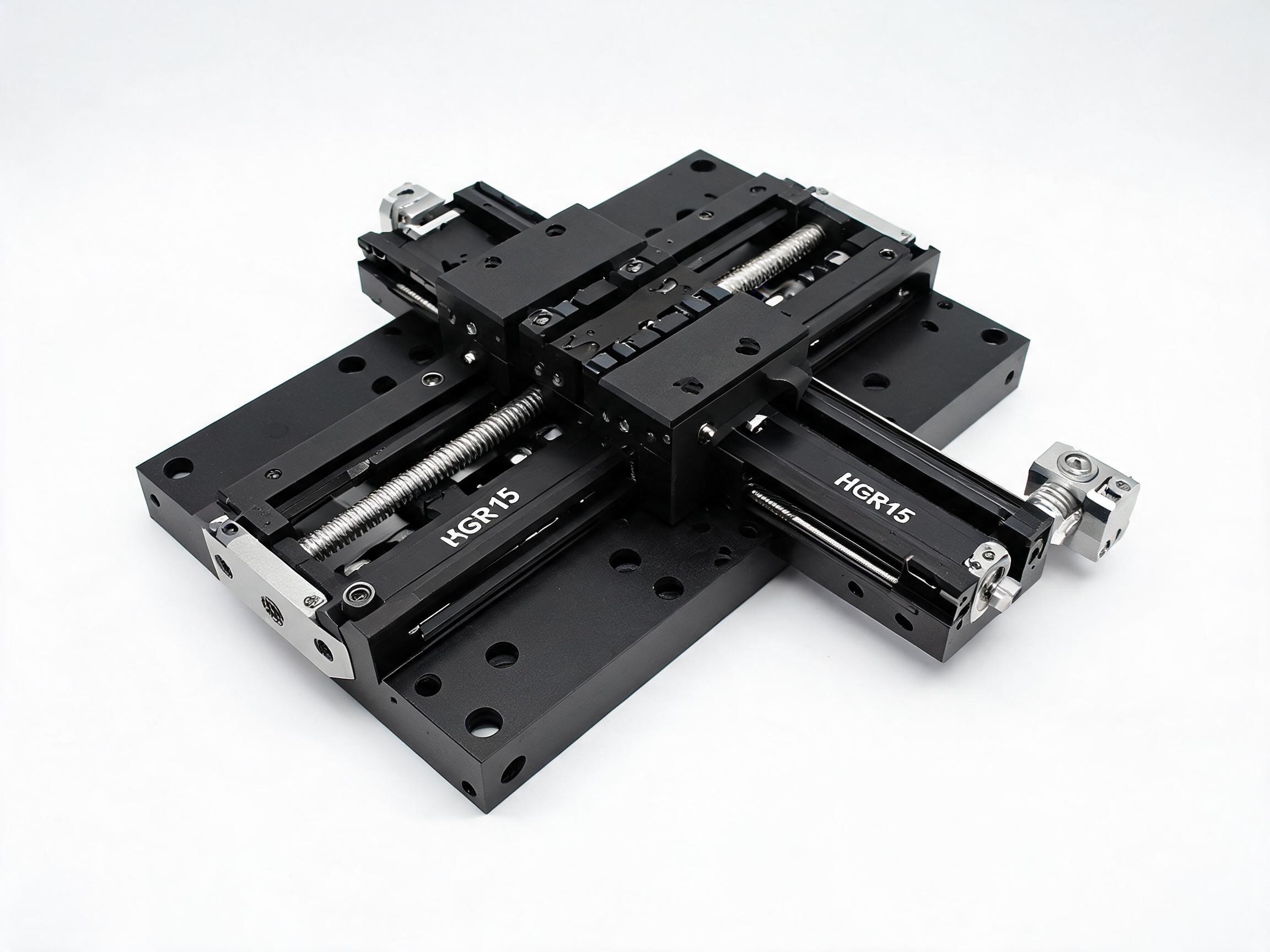
A column-by-column guide to reading integrated linear module spec sheets — stroke, guide, drive, load, repeatability, motor interface and MOQ — using the Dongfeng Bearing SKF20 slide module and XY200 cross slide table as worked examples, plus the details a spec sheet does not settle before you request a quote.
Linear Motion System Catalog: Comparing Module Spec Sheets
When you shortlist integrated slide modules from a linear motion system catalog, the spec sheet is the first filter and the last place to get tripped up. Two modules can share a guideway and a ball screw and still differ on stroke limits, load direction, motor fit and what ships with the goods. This guide walks through the columns that matter on a linear module spec sheet, using two Dongfeng Bearing modules as worked examples: the SKF20 aluminum profile slide module and the XY200 precision cross slide table.
- Reading each spec column: stroke, guide, drive, load, repeatability, motor interface, MOQ
- Two worked examples: SKF20 and XY200
- What the spec sheet does not settle before a quote
Start with the module type, not the numbers
The SKF20 is a single-axis slide built on 2020 T-slot aluminum profile. The XY200 is a two-axis cross slide table with dual ball-screw drives. They belong in the same catalog because both are integrated modules, but they answer different layout problems: one moves a load along a line, the other positions it in a plane. Before comparing any column, confirm which frame you actually need, because stroke and load figures are not transferable between the two.
Column by column: what each field tells you
Stroke: standard versus custom
Stroke is the usable travel, not the overall rail length. The SKF20 lists 100–500 mm as standard travel, with 1000 mm available as a custom build. The XY200 lists a 200 mm stroke. The distinction matters at inquiry stage: standard stroke is a catalog item, custom stroke is a design and machining question. If your requirement falls outside the standard band, state the target stroke and the mounting envelope in the first message, so the supplier can respond on feasibility rather than a catalog number.
Guide type inside the module
Both modules use an HGR15 guideway with an HGH15CA carriage. The carriage rating is 11.2 kN dynamic and 17.5 kN static per carriage. That figure belongs to the guide component, and the spec sheet presents it as such — it is not a blanket rating for the assembled module in every mounting orientation. Note how many carriages each module carries per axis, since the XY200 applies the guide per axis and the carriage count per axis is a configuration detail to confirm.
Drive screw and grade
Both examples use an SFU1605 C7 ball screw. The 1605 designation fixes diameter and lead; C7 is the accuracy grade of the screw. The XY200 uses dual SFU1605 C7 drives because two axes each need their own screw. Read the drive column together with the stroke column: a longer custom stroke on the same screw diameter changes the screw length, and that is a specification you should confirm rather than assume.
Load and moment ratings
Catalog sheets usually give the guide carriage rating, not a moment-load table for the assembled module. Both modules list 11.2 kN per axis. That is the HGH15CA carriage dynamic rating applied per axis; the 17.5 kN static figure is the rating of the same carriage as a component, and how it applies to your assembled configuration depends on carriage count and load direction — confirm it with the supplier for the module you order. If your application applies an offset load — a cantilevered tool, an overhanging fixture, a load whose center of gravity sits above the carriage — the carriage rating alone does not settle whether the module is adequate. Raise the load mass, the offset distance and the direction of the force when you inquire.
Repeatability and accuracy
These are different figures and should be read as separate columns. The XY200 lists repeatability of ±0.01 mm, perpendicularity of 90°±0.02° verified by CMM, and base plate flatness within 0.01 mm. The SKF20 sheet, as described here, is a travel and construction specification; do not carry the XY200’s precision figures across to it. If your process depends on a repeatability value, ask which module and which axis the figure applies to.
Motor interface
The SKF20 and XY200 both list a NEMA 17 motor interface, and the SKF20 also lists NEMA 23. The interface column tells you the mounting frame the module accepts. It does not, by itself, confirm that a specific motor will match the screw’s torque demand, coupling, and required speed. Treat the interface as the mechanical starting point, not the whole drive train.
MOQ
The SKF20 lists MOQ 30; the XY200 lists MOQ 20. MOQ applies per model and per configuration in most catalogs, so a mixed order of two strokes or two module types may not combine into one MOQ figure. State quantities per line item when you inquire.
Side-by-side: the two worked examples
| Column | SKF20 slide module | XY200 cross slide table |
|---|---|---|
| Frame | 2020 T-slot aluminum profile, single axis | Cross slide, two axes |
| Guide | HGR15 + HGH15CA | HGR15 + HGH15CA |
| Guide rating | 11.2 kN dynamic / 17.5 kN static (per carriage) | 11.2 kN dynamic per axis (carriage static rating 17.5 kN; apply per configuration) |
| Drive | SFU1605 C7 | Dual SFU1605 C7 |
| Stroke | 100–500 mm standard; 1000 mm custom | 200 mm |
| Repeatability | Not stated in the cited sheet | ±0.01 mm |
| Geometry | — | Perpendicularity 90°±0.02° (CMM); base flatness within 0.01 mm |
| Motor interface | NEMA 17 / 23 | NEMA 17 |
| MOQ | 30 | 20 |
Figures as listed in the Dongfeng Bearing catalog. Guide ratings apply to the HGH15CA carriage as a component.
What the spec sheet does not settle
A spec sheet is a description of a build, and a quote is a commitment to a build. Between the two sit four points that a column cannot answer on its own. Settle them before you send the inquiry, or expect to re-open the conversation after the first reply.
1. Motor compatibility beyond the interface
The NEMA frame tells you which motor bolts on. It does not tell you whether a given motor’s torque curve moves your load at your required speed on an SFU1605 C7 screw at your stroke. For a custom 1000 mm stroke on the SKF20, the screw length changes, and so does the inertia the motor sees. Give the supplier the load, the required speed and the motor’s rated torque and speed; then the answer is about the drive train rather than the mounting plate.
2. Custom stroke and machining
The SKF20’s 1000 mm custom stroke is the clearest example. A custom build may require a longer rail, a longer screw, and changes to the end blocks or the profile cut. Each of these is a machining bracket you should define: profile length, screw length, end-block position, and any through-holes or mounting features your frame needs. The catalog will not list a custom configuration’s inspection dimensions, so specify what you will check on receipt.
3. Delivery of inspection reports
The XY200 is described with a CMM report shipping with the goods as a per-shipment commitment. That is a documented delivery term, and it should appear in the quote — including which axes and which figures the report records (repeatability, perpendicularity, base flatness) — not just in the catalog. For a module whose accuracy you are buying, the report is part of the product. If you need a report on a custom-configured SKF20, request it explicitly and have the supplier confirm whether it is available for that build.
4. Exact load direction assumptions
The 11.2 kN dynamic figure for the HGH15CA carriage is a component rating under a defined load direction. Your application’s load direction may not match it. A tool hanging off the end of a vertical axis, a gantry with the load above the carriage, or a side-mounted fixture all produce moment loads that a single rating column does not resolve. Describe the load’s mass, its center of gravity relative to the carriage, and the direction of travel. That description is what lets the supplier respond on whether the module is suitable, rather than simply restating the carriage rating.
Building the inquiry
A shortlist built from a catalog is only as useful as the inquiry that follows it. The practical order is: fix the module type and axis count, pin the stroke to a standard or custom figure, state the load with its direction and offset, give the motor’s torque and speed, and list the quantity per line item. Add the inspection requirement — which report, on which module, per shipment or per first article — and the delivery term you need it under. With those points in the first message, the supplier can quote a configuration rather than a catalog page.
For a single-axis build, start from the SKF20 module page. For a two-axis positioning requirement, start from the XY200 cross slide table page. Where a module references ball screw support blocks, those are confirmed per inquiry rather than as a standalone catalog item — state the screw length, stroke and mounting direction so the confirmation comes back as a checked set.
Dongfeng Bearing — send your stroke, load direction, motor data and quantity per line item, and the reply can address the custom points a spec sheet leaves open.