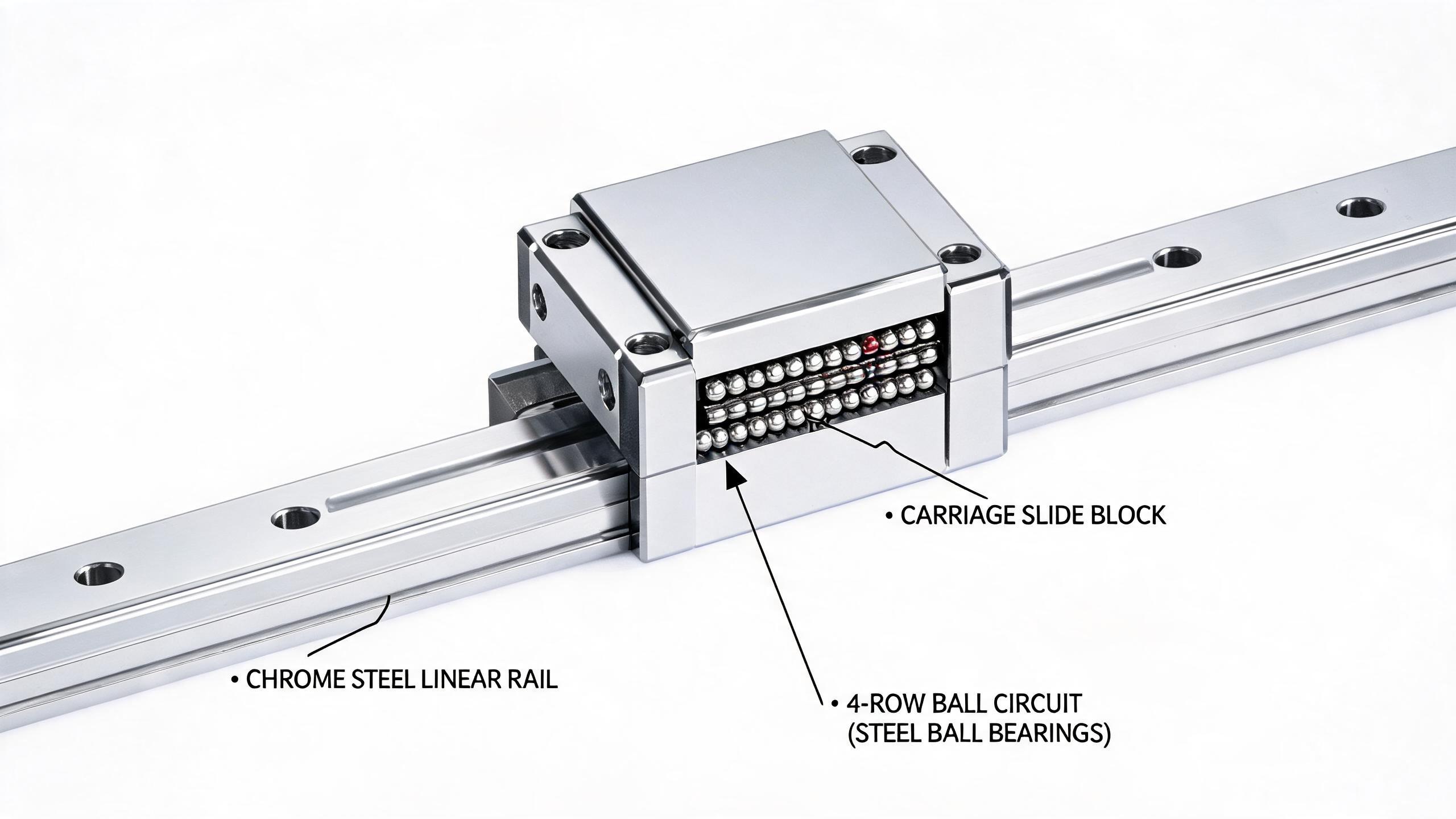
A practical selection guide for engineers and procurement teams choosing linear roller bearings, linear motion bearings, and linear guide bearings for automation equipment. Covers load capacity calculation, rigidity requirements, preload classes, application matching, and common specification mistakes — written for B2B buyers who need to specify components that will perform reliably over years of duty cycles.
BUYER GUIDE · LINEAR MOTION COMPONENTS
Every automation line has one: a linear axis that fails after eight months, loses positioning accuracy, or starts making noise that the maintenance team learns to ignore. In most cases the problem is not manufacturing quality — it is that the linear roller bearing was selected for the wrong load, the wrong rigidity class, or the wrong operating environment.
This guide covers the three decisions that matter most when specifying a linear roller bearing for industrial automation: how to calculate real load capacity, how to match rigidity and preload to your application, and how to avoid the specification mismatches that cause premature failure. It is written for engineers and procurement teams who need to translate machine requirements into a component that will hold tolerance for years, not months.
- Static load safety factor should be 1.5–2.0 for normal automation, 3.0+ for shock or vibration loads — most field failures trace back to safety factors below 1.5.
- Rigidity is set by preload class, not by rail size alone. Choose C0 (no preload) only for low-precision, low-load axes; use C1 or C2 for machining and high-speed positioning.
- Application matching is about environment and duty cycle, not just load. Contamination, temperature, and stroke length change the bearing type you should specify.
- Never select a bearing by dynamic load rating alone. The rating assumes a 50 km life — your machine may need 100 km or more.
Why Linear Roller Bearings Fail in Automation Equipment
A linear motion bearing fails for one of four reasons:
- Overload — the applied load exceeds the rated capacity, causing brinelling (indentations) on the raceway.
- Misalignment — the rail and block are not parallel, creating edge loading that concentrates stress on one side of the rolling elements.
- Contamination — abrasive particles enter the raceway and wear the rolling elements and rail surface.
- Incorrect preload — too little preload causes play and loss of positioning accuracy; too much preload generates heat and shortens life.
In our experience reviewing failed automation components, overload and preload errors account for the majority of premature failures. Both are preventable at the specification stage.
Step 1: Calculate Load Capacity Correctly
The first specification decision is load capacity. The two values on every datasheet are:
- Dynamic load rating (C) — the load at which 90% of a population of bearings will achieve a rated life of 50 km of travel.
- Static load rating (C₀) — the load at which permanent deformation of the rolling elements or raceway reaches 0.0001× the rolling element diameter.
For automation equipment, the static load rating matters more than most engineers assume. Positioning axes, clamping mechanisms, and vertical axes spend significant time stationary under load. That is a static condition, and it is governed by C₀, not C.
Static Load Safety Factor
The static safety factor (fs) is calculated as:
fs = C₀ / P₀
where P₀ is the maximum applied static load. Recommended minimum values:
| Application Type | Load Conditions | Minimum fs |
|---|---|---|
| General automation, positioning axes | Smooth, no impact | 1.5–2.0 |
| Machining centers, milling axes | Slight impact, vibration | 2.5–3.0 |
| Press equipment, clamping units | Heavy impact, shock loads | 3.0–5.0 |
| Vertical axes with counterweight failure risk | Emergency stop, drop load | 4.0+ |
If your machine has a vertical axis, calculate the safety factor for the worst case: power loss, brake failure, or tool crash. A vertical axis that drops under gravity load can exceed the static rating in milliseconds.
Dynamic Load and Life Calculation
For moving axes, the rated life (L, in km) is calculated as:
L = (C / P)³ × 50 km
where P is the equivalent dynamic load. The exponent is 3 for ball-type linear guide bearings and 10/3 for roller-type. This is a critical difference: roller-type linear guide bearing systems handle higher loads but are less forgiving of overload conditions.
Example: a linear roller bearing with C = 30 kN carrying a 10 kN load gives:
L = (30/10)³ × 50 = 27 × 50 = 1,350 km
If your machine cycles 1 meter per cycle, 20 cycles per minute, 16 hours per day, that is 19.2 km per day. The calculated life is about 70 working days. If you need 3 years of service, you need a life of roughly 15,000 km — which means either a larger bearing or a lower applied load.
Most buyers under-specify because they compare the dynamic rating to the static applied load without accounting for duty cycle. The correct approach is to work backward from required life.
Step 2: Match Rigidity and Preload to the Application
Rigidity in a linear motion bearing system is determined by three factors:
- Rail and block stiffness — a function of cross-section size and material.
- Preload — the internal force applied between rolling elements and raceway before external load is applied.
- Mounting surface stiffness — the machine frame that carries the rail.
Preload is the variable most often misunderstood. It is classified in ISO and JIS standards as:
| Preload Class | Clearance / Interference | Typical Application |
|---|---|---|
| C0 (no preload) | Small positive clearance | Low-precision axes, light load, single-axis positioning |
| C1 (light preload) | Slight interference | General automation, high-speed pick-and-place, multi-axis systems |
| C2 (medium preload) | Moderate interference | Machining centers, grinding machines, high-rigidity positioning |
| C3 (heavy preload) | High interference | Heavy cutting, high-impact applications (rare in automation) |
For most industrial automation — assembly machines, testing equipment, packaging lines — C1 is the right starting point. It provides enough rigidity for positioning accuracy while keeping friction low enough for smooth motion. C2 is appropriate when you need machining-level rigidity or when the axis carries a cantilevered load that creates moment forces.
One common mistake: specifying C0 to reduce friction and then discovering the axis has measurable play under load. If your application requires repeatability better than ±0.01 mm, do not use C0. The play in a C0 system under load will be visible in positioning accuracy.
Moment Loads and Rigidity
Most automation axes do not load the bearing purely vertically. A tool mounted on an overhang creates pitch, roll, and yaw moments. Each moment component reduces effective rigidity and increases the stress on one side of the bearing block.
When calculating loads, include the moment components. The datasheet for each linear guide bearing lists allowable static moments (M₀) for pitch, roll, and yaw. The applied moment must be below these values with the same safety factor as the direct load.
If your application has significant moment loads, consider:
- Using a wider rail (larger cross-section) to increase moment capacity.
- Using two blocks per rail to distribute the moment.
- Increasing the preload class to compensate for reduced effective rigidity.
Step 3: Match the Bearing Type to the Application Environment
Load and rigidity are the mechanical requirements. But the operating environment determines whether a standard linear roller bearing will survive in service.
Contamination Exposure
Automation lines in packaging, woodworking, and metalworking generate dust, chips, and abrasive particles. A standard bearing with felt seals will fail faster than a bearing with:
- Double-lip contact seals (nitrile rubber or polyurethane).
- Scraper plates for heavy contamination.
- Positive internal pressure (air purge) for cleanroom or dust-heavy environments.
If your machine operates near grinding or cutting operations, specify a sealed linear motion bearing with scrapers. The cost difference is small compared to the cost of a mid-line failure.
Temperature Range
Standard bearings are rated for 0–60 °C continuous operation. For higher temperatures:
- Check the seal material — standard nitrile seals degrade above 80 °C.
- Verify the lubricant — standard lithium grease has a dropping point around 180 °C, but continuous operation above 70 °C accelerates oxidation.
- Consider steel retainers instead of polymer retainers above 100 °C.
For low-temperature applications (below 0 °C), standard grease becomes viscous and increases starting torque. Specify low-temperature grease or a lubrication system that can deliver oil at operating temperature.
Stroke Length and Speed
Long-stroke axes (above 2 meters) have different requirements than short-stroke axes:
- Rail straightness — longer rails amplify straightness errors. Specify higher straightness grades for strokes above 3 meters.
- Thermal expansion — a 4-meter steel rail expands about 0.05 mm per 10 °C. For precision axes, consider aluminum rails (higher expansion, lower weight) or mounting that allows thermal growth.
- High speed — above 2 m/s, the rolling elements generate heat. Verify the bearing's maximum speed rating and consider oil lubrication instead of grease.
Common Specification Mistakes
Based on application reviews across automation projects, the most frequent errors are:
| Mistake | Consequence | Correct Approach |
|---|---|---|
| Selecting by dynamic rating alone | Bearing fails early under static or shock load | Check both C and C₀ with appropriate safety factors |
| Ignoring moment loads | Edge loading, premature raceway wear | Calculate pitch/roll/yaw moments and verify against M₀ |
| Using C0 preload for precision axes | Play under load, poor repeatability | Specify C1 or C2 based on accuracy requirement |
| Oversizing the rail "to be safe" | Higher cost, heavier machine, more friction | Calculate required life and select the smallest bearing that meets it |
| Ignoring seal requirements | Contamination ingress, rapid wear | Match seal type to the contamination level of the environment |
| Not accounting for thermal expansion on long strokes | Binding or loss of preload at temperature extremes | Verify rail mounting allows thermal growth |
How to Write a Correct Bearing Specification
When you send an inquiry to a supplier, include these details so they can confirm the selection:
- Applied loads — vertical, horizontal, and moment loads (in N and N·m).
- Duty cycle — strokes per minute, stroke length, operating hours per day.
- Required life — target service life in km or years.
- Accuracy requirement — positioning repeatability in mm.
- Environment — temperature range, contamination level, humidity.
- Speed — maximum linear velocity in m/s.
- Mounting orientation — horizontal, vertical, or inclined.
A supplier that asks for this information is doing proper engineering. A supplier that quotes a bearing from just a rail size and load figure may be under-specifying your application.
FAQ
What is the difference between a linear roller bearing and a linear ball bearing?
A linear roller bearing uses cylindrical rollers, which have line contact with the raceway. A ball-type linear motion bearing uses balls with point contact. Rollers carry 2–3× higher load for the same footprint but generate more friction and are less tolerant of misalignment. Use rollers for heavy loads and high rigidity; use balls for high speed and lower friction.
Can I replace a ball-type linear guide bearing with a roller type?
Only if the mounting dimensions are identical and the application can tolerate higher friction and lower speed. Roller-type bearings also require more precise mounting surface flatness. If the rail and block dimensions match, the upgrade improves load capacity and rigidity — but verify the mounting surface meets the flatness requirement (typically 0.005 mm over 500 mm for roller types).
How do I know if I need C1 or C2 preload?
Use C1 for general automation where positioning repeatability is ±0.01–0.05 mm. Use C2 when you need repeatability better than ±0.01 mm, when the axis carries significant moment loads, or when the machine performs cutting operations. If you are unsure, C1 is the safer default — it provides good rigidity without excessive friction.
What lubrication interval should I specify?
For standard grease lubrication, re-lubricate every 50–100 km of travel or every 6 months, whichever comes first. For clean environments with light duty, annual lubrication may suffice. For heavy contamination or high-speed operation, use an automatic lubrication system with a central grease line. The supplier can recommend a specific grease type based on your operating temperature and speed.
How important is rail straightness for long strokes?
Critical. A 4-meter rail with standard straightness (typically 0.05 mm/m) can have cumulative error that affects positioning. For strokes above 3 meters, specify high-precision straightness (0.03 mm/m or better) and verify the mounting surface flatness. Thermal expansion also becomes a factor — discuss allowable thermal growth with the supplier before finalizing the design.
Next Steps
Selection of a linear roller bearing is an engineering decision, not a catalog lookup. The correct choice depends on load, duty cycle, rigidity, and environment — and getting it wrong costs far more than the bearing itself.
If you are specifying bearings for a new automation line or replacing components on an existing machine, send us your application details — loads, duty cycle, accuracy requirement, and environment. We will confirm the selection and provide the specification sheet for your review before you commit to an order.
For standard sizes and load ratings, our team can provide datasheets and cross-reference information on request. Custom rail lengths, preload classes, and seal options are available based on your project requirements.
Contact us with your application parameters to get a selection recommendation tailored to your machine.