
A practical comparison for builders of pick and place machines and small gantries: how to choose between a low-profile shaft-based unit and a miniature profile guide based on stroke, load, and overhang. Includes a side-by-side table of key specifications and a checklist for sending an inquiry.
When you are specifying the mechanical linear axis for a pick and place machine or small gantry, the choice between a low-profile shaft-based unit and a miniature profile guide is not a matter of brand preference. It follows directly from three numbers: the total stroke, the moving mass including the gripper, and the distance from the guide to the centre of that mass. This article works through those numbers for one shared duty case and shows where each option fits.
Key takeaways
- The low-profile shaft unit (SBS16) offers an 18 mm total height, 5.2 kN dynamic load, and a 25 mm mounting pitch for compact frames.
- The miniature profile guide (MGN12C) provides a two-row Gothic arch circuit, stainless steel standard, and 3.7 kN dynamic load in a much smaller cross-section.
- Cantilever moment often governs the choice on fast pick and place heads more than payload alone.
- Final selection must follow the actual load case; use the comparison table as a starting point, not a decision.
The three numbers that decide the axis before any component is named
Before you look at a catalogue, define the duty case. For a pick and place axis, the relevant numbers are:
- Total stroke: the maximum travel required, including any overtravel for safe zones.
- Moving mass: the sum of the carriage, tooling, gripper, and any payload. This is the mass that the guide must accelerate and decelerate.
- Overhang distance: the horizontal distance from the centre of the guide rail to the centre of gravity of the moving mass. This creates a moment load on the carriage.
These three numbers determine whether a low-profile shaft unit or a miniature profile guide will meet the application. The following sections compare the two options on the same duty case.
Option one: the low-profile shaft-based unit
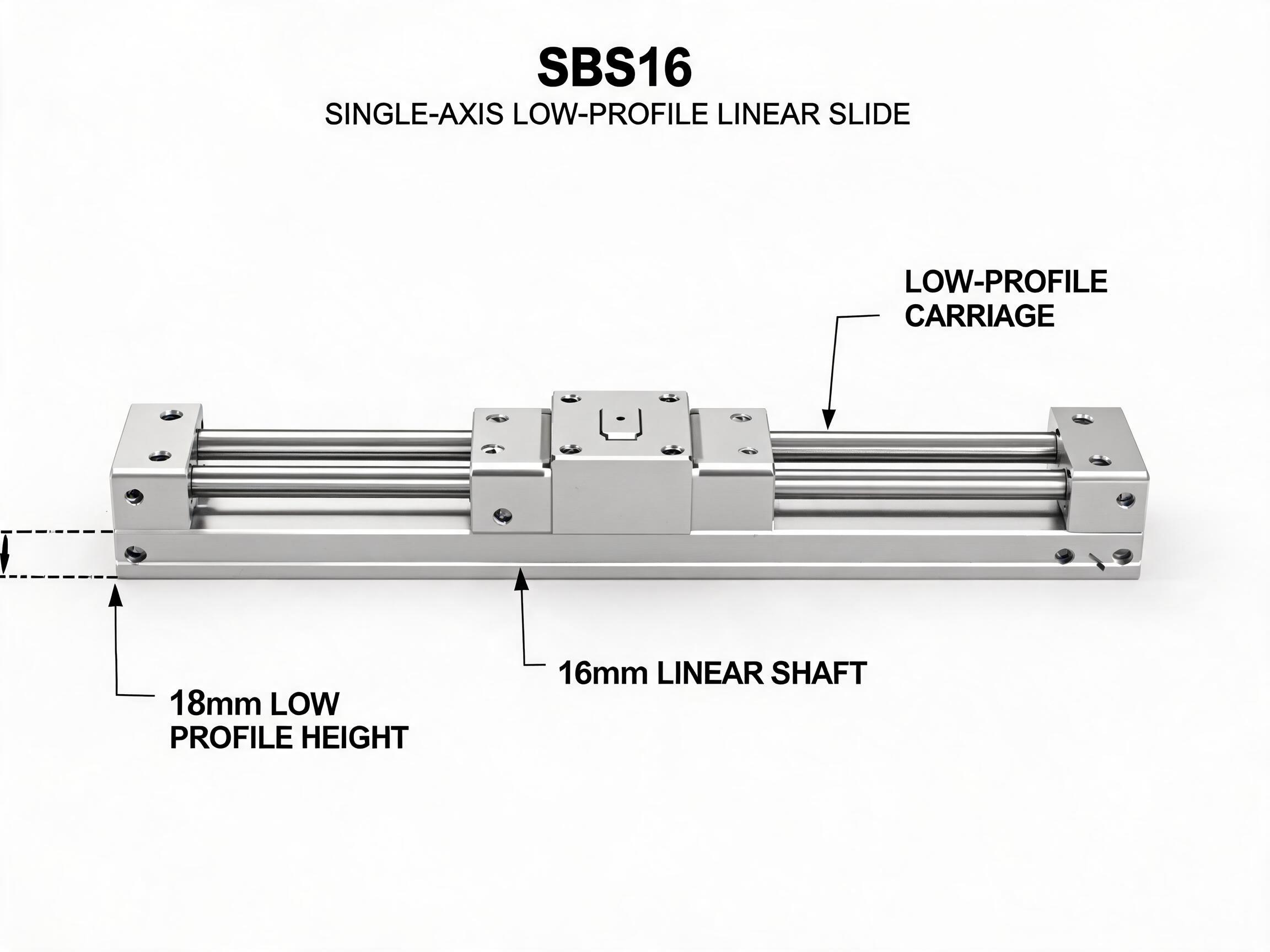
The SBS16 is a single-axis linear motion slide unit with a low-profile carriage. Its record states a 16 mm shaft made of GCr15 chrome steel, induction hardened to HRC 58-62, running in a single low-profile bearing block. The support rail is anodized aluminium 6063-T5. The total system height is 18 mm, which the record notes is 40 percent lower than the SBR16 series. Standard lengths are 150, 200, 300, and 500 mm, with custom lengths up to 1000 mm.
What does this height and mounting pitch buy the machine? The 18 mm profile allows the axis to sit close to the frame, reducing the overall height of the gantry or the machine envelope. The mounting holes are spaced every 25 mm along the support rail, which suits compact frames where space is tight. The carriage has four M4 top-face mounting bolts for attaching the tooling. The unit arrives pre-assembled and aligned with the shaft, rail, and carriage, which simplifies installation.
The SBS16 record lists a dynamic load of 5.2 kN and a static load of 8.0 kN. These figures are higher than the miniature guide discussed below, but the round-shaft design has limitations. The single bearing block may have less stiffness in moment loading compared to a profile guide with multiple ball rows. Also, the round shaft is supported along its length, but the open design may be more susceptible to debris ingress in dirty environments. For clean environments and moderate overhangs, the SBS16 offers a compact, ready-to-mount solution. You can see the full specifications on the SBS16 product page.
Option two: the miniature profile guide
The MGN series miniature linear guide is available in rail sizes 9, 12, and 15. The standard material is stainless steel 9Cr18Mo, with a chrome steel option. The carriage types include the MGN-C standard flange and the MGN-H long carriage with higher load capacity. The ball circuit is a two-row Gothic arch design. For the MGN12C, the dynamic load is 3.7 kN and the static load is 5.4 kN. The maximum rail length is 1000 mm, with splice available. The carriage weight is 0.025 kg, and the friction coefficient is 0.002 to 0.004. End seals are standard.
The two-row Gothic arch circuit provides contact in four directions, which gives good stiffness for moment loads. The stainless steel standard material offers corrosion resistance in humid or washdown environments. The low friction coefficient means less heat generation and potentially longer life without additional lubrication in light-duty applications. However, the smaller load figures compared to the SBS16 mean that the MGN12C may be the binding constraint if the moving mass or overhang is large. For a pick and place head with a heavy gripper or a long overhang, the 3.7 kN dynamic load might be exceeded under shock or acceleration. In such cases, a larger size or the MGN-H long carriage should be considered. More details are available on the MGN series product page.
Side-by-side comparison
The table below compares the two options on the facts available from each product record. Where a field is marked as not stated, the figure belongs to the individual model drawing rather than to the series description, so ask for it for the exact size before committing.
| Specification | SBS16 low-profile unit | MGN12C miniature guide |
|---|---|---|
| Total height | 18 mm | Not stated in the series record; confirm on the size drawing |
| Shaft / rail material | GCr15 chrome steel, HRC 58-62 | Stainless steel 9Cr18Mo (standard), HRC 54-58; chrome steel option HRC 58-62 |
| Dynamic load | 5.2 kN | 3.7 kN |
| Static load | 8.0 kN | 5.4 kN |
| Mounting pitch | 25 mm along support rail | Not stated in the series record; varies by rail size |
| Carriage mounting | Four M4 top-face bolts | Not stated in the series record |
| Standard lengths | 150, 200, 300, 500 mm; custom up to 1000 mm | Max rail length 1000 mm, splice available |
| Carriage weight | Not stated in the series record | 0.025 kg (MGN12C) |
| Friction coefficient | Not stated in the series record | 0.002 to 0.004 |
| Pre-assembled | Yes (shaft, rail, carriage aligned) | Not stated in the series record |
| Rated moment / permissible moment | Ask the supplier for the M0 / M1 / M2 values for the size | Ask the supplier for the M0 / M1 / M2 values for the size |
The comparison is based on available records for the SBS16 and MGN12C. Actual performance depends on the specific load case, including acceleration and moment loads.
Cantilever and moment: why the overhang matters more than the payload on a fast pick and place head
On a pick and place head, the payload is often a small component, but the gripper and tooling extend outward from the guide. The overhang distance creates a moment load that is often several times the moment produced by the payload alone at the same distance. Work the arithmetic on the actual hardware rather than on a catalogue payload figure: a gripper assembly weighing 0.5 kg with its centre of gravity 100 mm from the guide centre produces roughly 0.49 N·m of moment, while a 0.1 kg part at the same 100 mm produces roughly 0.098 N·m. The tooling dominates.
That arithmetic only becomes a selection decision when it is compared with the rated moment of the guide. The sequence is short:
- Calculate the static moment from the moving mass and its overhang, as above.
- Multiply by a dynamic factor for the acceleration and shock of the actual cycle. The factor depends on the machine and the duty, so it has to be agreed with the supplier rather than assumed from a table.
- Ask for the permissible moment values of the exact size and carriage, and compare the factored figure against them.
- If the factored moment exceeds the permissible value, step up in rail size, switch to a longer carriage, or use two carriages on one rail. Re-check the load per carriage after any of those changes.
For that reason the comparison table carries a row for rated moment that is deliberately left to the supplier. A dynamic load figure alone does not answer a moment question, and the two must be checked separately.
The HGH series carriage is a larger profile guide and is not a candidate in this comparison. It appears here only as a structural reference for how ball rows and preload influence moment resistance: its record describes a four-row ball recirculation design that carries radial, reverse radial, and both lateral directions from one carriage, a self-aligning tolerance of plus/minus 0.5 degrees, and preload grades C0, C1, and C2. The principle transfers, the load figures do not. For the miniature MGN, the two-row Gothic arch circuit provides four-point contact, which helps with moment stiffness, but the overall load rating is lower. If your overhang is large relative to the carriage size, you may need to step up to a larger guide or add a second carriage. See the HGH series carriage page for how preload options are specified on that range.
What to send with the inquiry so the axis is quoted correctly
To get an accurate quotation and recommendation, provide the following information with your inquiry:
- Total stroke required (mm).
- Moving mass, including gripper and payload (kg).
- Overhang distance from guide centre to centre of gravity (mm).
- Maximum acceleration and velocity (if known).
- Mounting orientation (horizontal, vertical, or inclined).
- Environmental conditions (cleanroom, dust, humidity, washdown).
- Any preference for shaft-based or profile guide based on existing designs.
- Required rail length and mounting hole pattern.
- Expected duty cycle and lifetime requirement.
With these details, the supplier can check the load case against the dynamic and static load ratings, check the moment against the permissible values, and recommend the appropriate size and preload. Without them, any recommendation is a guess.
FAQ
Can I use the SBS16 for a vertical axis in a pick and place machine?
The SBS16 is a single-axis slide unit with a low-profile carriage. Its load ratings are given for radial loads. For vertical applications, the load direction and holding force must be considered. Consult the supplier with your specific load case.
Is the MGN12C suitable for high-speed pick and place?
The MGN12C has a low friction coefficient and a lightweight carriage, which can be advantageous for high-speed applications. However, the dynamic load rating of 3.7 kN must be checked against the actual moving mass and acceleration. If the load case exceeds the rating, a larger size or the MGN-H long carriage should be considered.
How do I check the moment load against the guide rather than just the payload?
Calculate the moment from the moving mass, its overhang and the acceleration of the cycle, then compare it with the permissible moment values for the exact size and carriage. Ask the supplier for those values and for the dynamic factor that applies to your duty. A 5.2 kN dynamic rating does not by itself mean a 5 kg tool at 200 mm overhang is acceptable.
Can I get custom lengths for the SBS16?
Yes, the SBS16 record states standard lengths of 150, 200, 300, and 500 mm, with custom lengths up to 1000 mm. Provide your required stroke and mounting constraints for a quotation.
To confirm the right axis for your pick and place machine, send the stroke, payload, and overhang distance to the supplier for a load-case review.