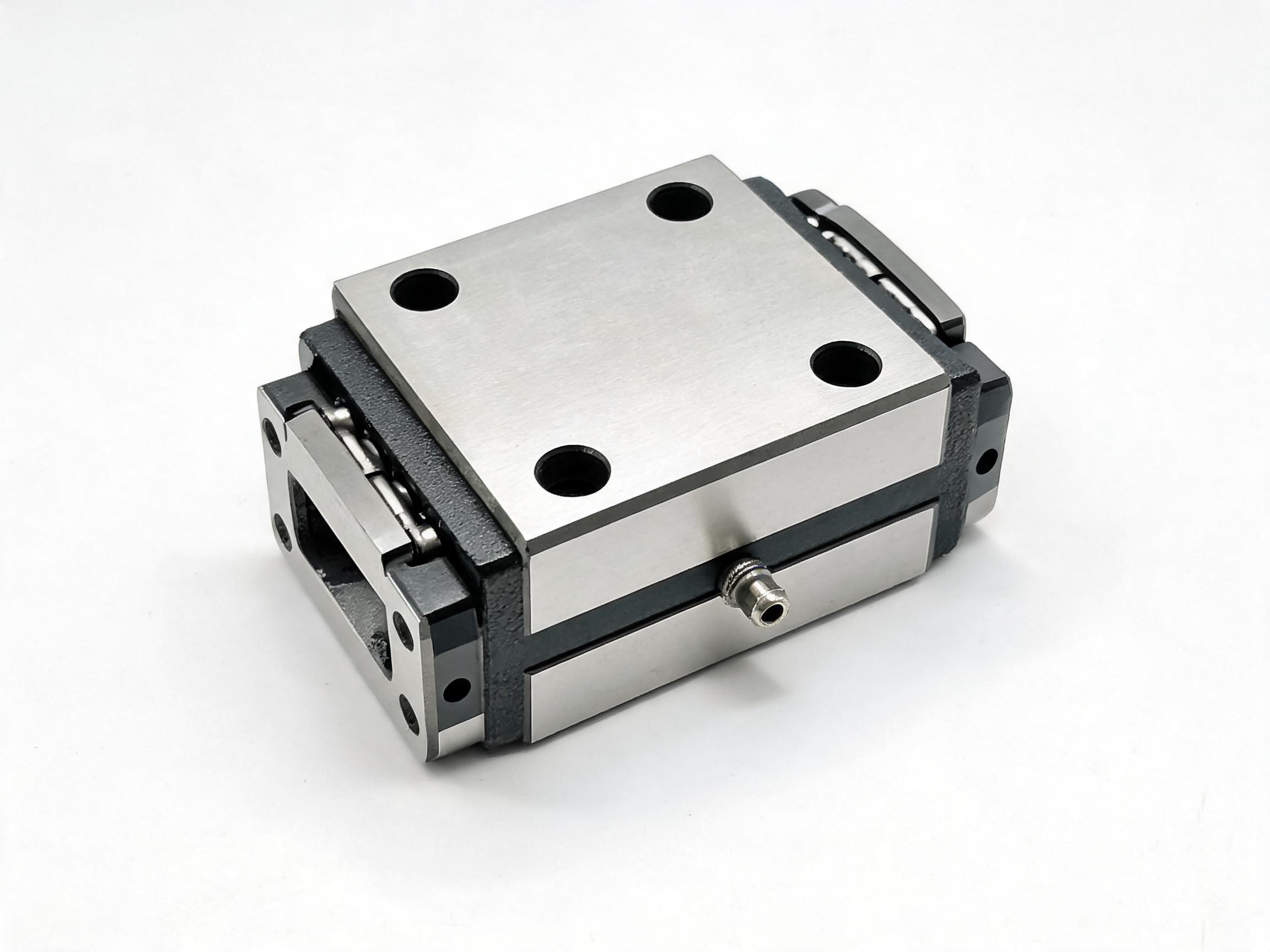
Selecting the right linear guide bearing block is critical for precision, load capacity, and service life in automation and machine tool applications. This guide breaks down carriage types, preload classes, interchangeability standards, and practical selection criteria for B2B buyers.
TECHNICAL SELECTION GUIDE
• Carriage type (flanged, square, compact) determines mounting interface and stiffness profile.
• Preload class (Z0–Z3) directly affects positioning accuracy, friction, and service life — choose based on load direction and duty cycle.
• Interchangeability between brands is limited by rail profile, bolt pattern, and seal design; always verify critical dimensions.
• A linear ball bearing slide offers lower friction than plain-bearing guides but requires proper lubrication and sealing in dirty environments.
Why the Linear Guide Bearing Block Matters
In any linear motion system — from CNC routers and gantry pick-and-place machines to semiconductor handling equipment — the linear guide bearing block is the component that carries the load and dictates repeatability. A mismatched block leads to premature wear, vibration, or outright failure. For B2B buyers sourcing linear guideways in volume, understanding the three core selection dimensions — carriage type, preload class, and interchangeability — is the difference between a reliable machine and a warranty claim.
This guide covers the technical facts a procurement or engineering team needs to specify the correct block the first time.
1. Carriage Types: Flanged, Square, and Compact
The carriage (or "block") is the moving part that rides on the rail. Three main profiles dominate the market:
| Carriage Type | Typical Profile | Mounting Interface | Best For |
|---|---|---|---|
| Flanged (F) | Wide, with bolt-through flanges on both sides | Top-mount from above; bolts pass through flange | Heavy loads, high rigidity, general automation |
| Square (S) | Narrow, flat top surface; tapped holes in top | Top-mount with bolts from below into tapped holes | Space-constrained assemblies, multi-axis stages |
| Compact (C) | Low-profile, reduced width and height | Similar to square but with smaller footprint | Miniature applications, light payloads, tight Z-heights |
Flanged carriages are the most common in industrial linear guideways because the flange distributes load over a larger bolt pattern, improving moment stiffness. Square carriages save space — they are often used in multi-axis gantries where the block must fit between rails. Compact carriages trade load capacity for envelope, making them suitable for medical devices or small pick-and-place heads.
When comparing a linear ball bearing slide from different suppliers, always check the carriage width and mounting hole pattern — even nominal "same size" blocks can differ by 1–2 mm, causing assembly rework.
2. Preload Classes: What They Mean and How to Choose
Preload is the internal axial force applied between the ball bearings and the raceway. It eliminates clearance and increases stiffness, but also increases friction. Preload classes are standardized across most major brands (ISO 10285 or JIS B 1557).
| Preload Class | Clearance | Friction | Typical Applications |
|---|---|---|---|
| Z0 (Normal / Clearance) | 0–5 µm | Lowest | General positioning, light loads, low-duty cycle |
| Z1 (Light Preload) | 0–2 µm | Low | Medium accuracy, moderate load, single-axis stages |
| Z2 (Medium Preload) | 0–1 µm | Medium | High accuracy, machining centers, gantry robots |
| Z3 (Heavy Preload) | 0–0.5 µm | Highest | Ultra-precision (grinding, EDM), heavy intermittent loads |
Rule of thumb: Use Z0 or Z1 when the load direction is constant (e.g., vertical axis with counterbalance) and friction must be minimized. Use Z2 for most horizontal axes with variable loads. Reserve Z3 for applications where stiffness is critical and higher friction is acceptable — but note that Z3 blocks generate more heat and require better lubrication.
For a bearing linear slide in a clean-room environment, Z1 or Z2 is typical. In a dirty workshop, Z0 may be preferred because clearance allows contaminants to pass without jamming.
3. Interchangeability: Can You Mix Brands?
Interchangeability is a frequent question from buyers looking to reduce cost or lead time. The short answer: partial interchangeability exists, but full compatibility is rare.
Most major manufacturers (THK, HIWIN, NSK, IKO, Bosch Rexroth, and ISO-compliant Chinese producers) follow similar dimensional standards for rail width, height, and bolt spacing within a given size series — for example, a 25 mm rail from Brand A and Brand B may share the same rail width and bolt pitch. However, the following differences often prevent direct swap:
- Raceway profile: Gothic arch vs. circular groove — affects ball contact angle and load rating.
- Seal design: Lip seals, scraper seals, and bellows differ in shape and retention, affecting compatibility with the rail end.
- Bolt pattern on carriage: Even if the rail matches, the carriage mounting hole position or thread size may differ.
- Lubrication port location: Grease nipples or oil ports may be offset, requiring adapter fittings.
Practical advice: If you need to replace a linear guide bearing block on an existing machine, always request a dimensional drawing of the replacement block and compare it against the original. At minimum, verify:
- Rail width (W) and height (H)
- Carriage length (L) and mounting hole center distance (A, B)
- Bolt thread size and depth
- Seal clearance (especially if the rail has a wiper groove)
For new designs, it is safer to source both rail and block from the same manufacturer. If you plan to mix brands, order a sample first and test fitment.
4. Load Ratings and Life Calculation
Every linear guideways catalog publishes two load ratings:
- Dynamic load rating (C): The load that gives a theoretical life of 50 km under constant load and standard conditions.
- Static load rating (C0): The maximum load the block can withstand without permanent deformation.
Life is calculated as:
L = (C / P)^3 × 50 km
where P is the equivalent dynamic load (including moment loads). For a bearing linear slide with multiple blocks on one rail, the load distribution is rarely equal — use the most heavily loaded block for life calculation.
Most industrial applications target a life of 10,000–20,000 km. If your calculation yields less than 5,000 km, consider a larger size or higher preload class.
5. Common Selection Mistakes
Buyers often make these errors when specifying a linear guide bearing block:
- Ignoring moment loads: A block experiences pitch, roll, and yaw moments. A single block on a rail can handle only limited moment — use two blocks per rail for stability.
- Over-specifying preload: Z3 on a low-load, high-speed application causes excessive friction and heat. Stick to Z1 or Z2 unless stiffness demands more.
- Forgetting environmental sealing: In metalworking or woodworking, chips and dust enter the block. Specify a sealed or scraper-equipped block, and plan for regreasing intervals.
- Assuming all "25 mm" blocks are the same: Rail width 25 mm is common, but carriage height, bolt pattern, and seal type vary. Always check the drawing.
6. Frequently Asked Questions
Q: Can I use a linear ball bearing slide in a vertical application?
A: Yes, but you must account for gravity. Use a preload of Z1 or higher to prevent the block from dropping when unpowered. Also consider a brake or counterweight.
Q: How often should I lubricate a linear guide bearing block?
A: Typical interval is every 100–200 km of travel or every 3 months, whichever comes first. In dirty environments, reduce to monthly. Use lithium-based grease (NLGI grade 2) for general purpose.
Q: What is the difference between a linear guide and a linear ball bearing slide?
A: A linear guide uses recirculating ball bearings in a profiled rail system. A linear ball bearing slide typically refers to a simpler assembly with ball bushings on a shaft. The guide offers higher rigidity and load capacity; the slide is lower cost and easier to install but less precise.
Q: Do you offer custom machining on the carriage?
A: Many suppliers, including our factory, can provide custom bolt patterns, special coatings, or modified seal configurations. Minimum order quantities and lead times vary — please inquire with your specific drawing.
Final Checklist for Buyers
Before placing an order for linear guideways or a bearing linear slide assembly, confirm:
- Carriage type (flanged, square, compact) matches your mounting interface.
- Preload class matches your load direction and duty cycle.
- Rail and block are from the same manufacturer (or interchangeability is verified).
- Dynamic load rating (C) is at least 3× the actual load for safety margin.
- Sealing and lubrication are appropriate for the operating environment.
If you need technical datasheets or dimensional drawings for a specific linear guide bearing block series, contact our engineering team. We can provide 2D/3D files and application support for your next project.