
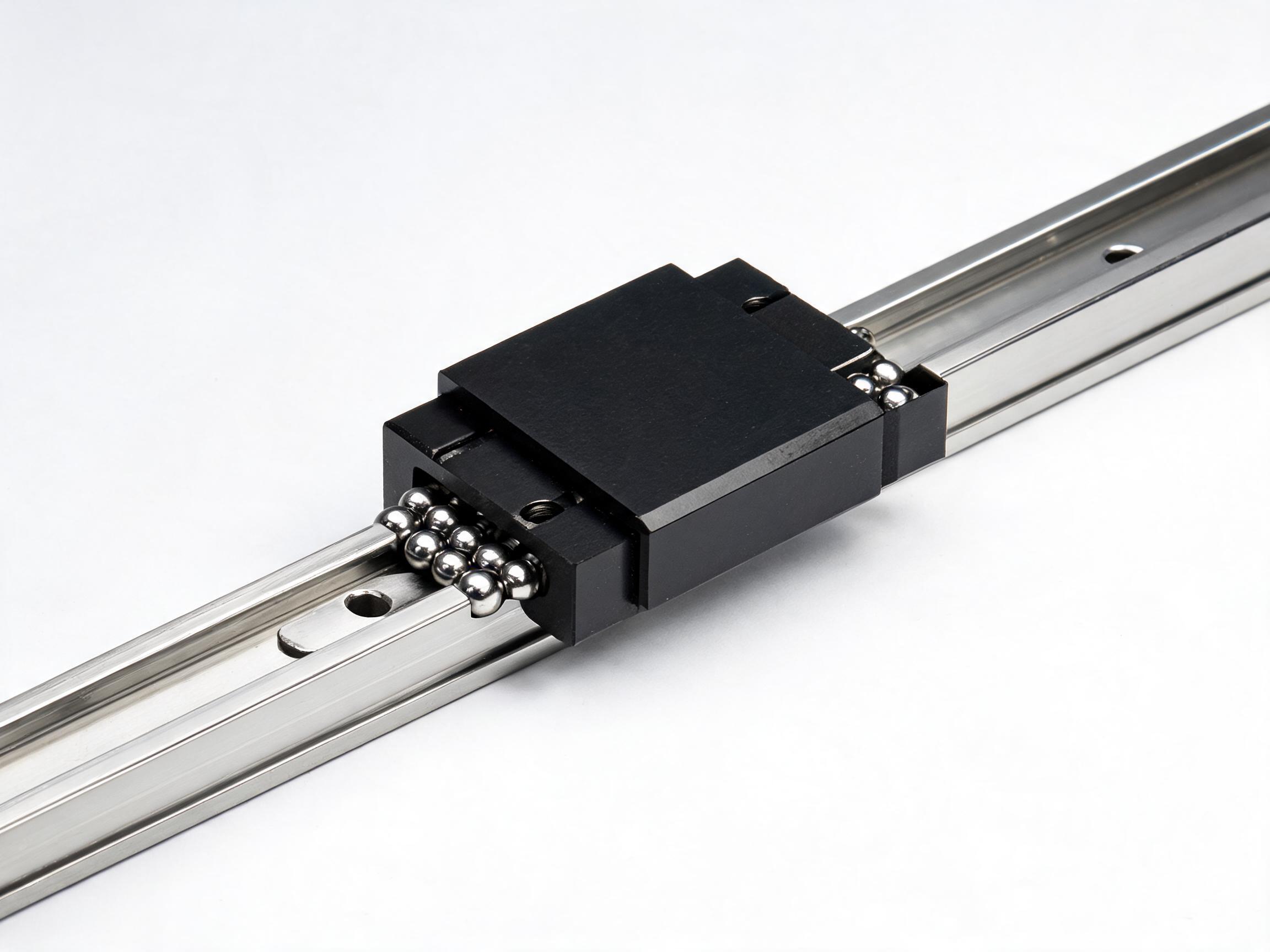
A practical guide for B2B buyers and engineers choosing linear guide rails. Compare HGR, HGH, and HGW series by load capacity, rigidity, and application fit. Learn how to read load ratings, select preload classes, and specify the right rail for your machine.
BUYER GUIDE
If you are sourcing linear guide rails for CNC machines, automation equipment, or precision positioning systems, the first question is usually the same: which series do I actually need?
This guide compares the three most common square-type linear guide rail series — HGR, HGH, and HGW — explains how to read load ratings, and walks through preload selection. The goal is to help you specify the right rail the first time, avoid costly rework, and communicate clearly with your supplier.
- HGR is the general-purpose square rail for medium loads; HGH offers higher rigidity for heavier loads; HGW is the wide-rail option for moment load resistance.
- Load ratings are not interchangeable — always compare basic dynamic load rating (C) and static load rating (C₀) at the same block size.
- Preload class affects rigidity and friction. Choose Z0 for general use, ZA for light preload, and ZB for high rigidity with higher friction.
- Rail width, block height, and mounting hole spacing differ across series — verify dimensions before designing the carriage.
- For export orders, confirm tolerance class (normal vs. high precision) and whether the rail comes with end seals, scrapers, or lubrication fittings.
Understanding the Series: HGR vs HGH vs HGW
All three series share the same basic design: a profiled rail with ground raceways and a block containing recirculating steel balls. The difference is in the block geometry and the number of ball circuits, which changes how the block handles load in different directions.
HGR Series — General Purpose
The HGR series is the most common square linear guide rail used in general machinery. It has a compact block design with two ball circuits and offers a balanced load capacity in the radial (downward), reverse radial (upward), and lateral (side) directions.
Typical applications include:
- CNC routers and plasma cutting machines
- Packaging machinery
- General automation and material handling
- 3D printers and light-duty positioning stages
HGR is usually the default choice when the load is moderate and the machine does not experience significant moment forces. It is also the most cost-effective option of the three.
HGH Series — High Rigidity
The HGH series uses a taller block with additional ball circuits compared to HGR at the same rail width. This increases the contact area between the balls and the raceway, which translates to higher load capacity and greater rigidity.
Choose HGH when:
- The machine experiences heavy cutting forces (e.g., CNC milling or turning)
- You need higher stiffness to reduce deflection under load
- The application involves vibration or impact loading
- You are working with a larger machine where rigidity is critical
HGH blocks are physically larger and heavier than HGR blocks of the same rail width. This is a trade-off: you gain rigidity but lose some compactness.
HGW Series — Wide Block
The HGW series features a significantly wider block. The increased width provides a larger mounting surface and better distribution of load across the rail, which gives the HGW series superior moment load resistance.
Moment loads occur when the force is applied off-center — for example, when a tool head extends beyond the carriage. HGW is the right choice when:
- The load is applied at a distance from the rail centerline
- The application involves high overturning moments (pitch, roll, or yaw)
- You need a wider mounting footprint for stability
- The machine has a single rail supporting a long cantilevered load
HGW is common in heavy-duty gantry machines, vertical machining centers, and large-format laser cutters where the cutting head is offset from the rail.
| Feature | HGR | HGH | HGW |
|---|---|---|---|
| Block profile | Compact, standard width | Taller block, more ball circuits | Wide block, maximum stability |
| Load capacity | Moderate | High | High, especially for moment loads |
| Rigidity | Standard | High | High |
| Moment resistance | Fair | Good | Excellent |
| Typical applications | Routing, cutting, automation | Milling, turning, heavy cutting | Gantry machines, cantilevered loads |
| Relative cost | Lowest | Moderate | Highest |
How to Read Load Ratings
Every linear guide rail block is rated with two key numbers: the basic dynamic load rating (C) and the basic static load rating (C₀). These values are published in the manufacturer's specification table for each block size.
Basic Dynamic Load Rating (C)
The dynamic load rating is the load that gives a rated service life of 50 km of travel under consistent conditions. In practice, the actual load on the block should be well below this value — typically 10–20% of C for long service life.
When comparing rails from different suppliers, make sure you compare the C value at the same block size and same number of ball circuits. A larger C value does not automatically mean a better rail if the block is physically larger.
Basic Static Load Rating (C₀)
The static load rating is the maximum load the block can withstand without permanent deformation of the raceway or balls. This is important for machines that experience shock loads, or when the rail is stationary under load for extended periods.
As a rule of thumb:
- For continuous operation: keep the applied load below 20–30% of C
- For shock or impact loads: keep the peak load below C₀
- For moment loads: check the moment ratings (M₀) in the specification table
Preload Selection: Z0, ZA, ZB
Preload refers to the internal force applied between the balls and the raceway during manufacturing. Preload removes internal clearance, which improves rigidity but increases friction.
Standard preload classes are:
| Preload Class | Clearance | Rigidity | Friction | Best For |
|---|---|---|---|---|
| Z0 | Small clearance | Standard | Lowest | General use, low-friction applications |
| ZA | Light preload | Moderate | Low | Light cutting, positioning, single-rail systems |
| ZB | Medium preload | High | Medium | Heavy cutting, high-rigidity requirements |
Z0 — No Preload
Z0 blocks have a small positive clearance. They offer the smoothest motion and lowest friction, which makes them ideal for:
- Light-duty positioning
- Applications with minimal external load
- Systems where smooth motion is more important than rigidity
ZA — Light Preload
ZA is the most common choice for general machinery. It provides a small amount of internal force, which eliminates clearance and improves rigidity without significantly increasing friction. It is suitable for:
- CNC routers and plasma cutters
- Single-rail systems where some moment resistance is needed
- Applications with moderate cutting forces
ZB — Medium Preload
ZB provides a higher internal force, which maximizes rigidity. The trade-off is higher friction and heat generation. Use ZB when:
- The machine experiences heavy cutting forces
- Deflection must be minimized
- The application involves vibration or chatter
A common mistake is specifying ZB preload for every application "to be safe." Higher preload increases motor load, generates heat, and reduces service life. Match the preload to the actual rigidity requirement.
Matching the Rail to Your Application
Here is a practical decision path:
- Calculate the applied load — include the weight of the moving parts, the cutting force, and any acceleration forces.
- Check the moment loads — if the load is offset from the rail centerline, calculate the moment and compare it to the block's moment rating.
- Select the series — HGR for general use, HGH for higher rigidity, HGW for moment-heavy applications.
- Determine the rail width — start with the manufacturer's load table and pick the smallest size that gives you at least 3–5× safety factor on the dynamic load.
- Choose the preload — Z0 for smooth motion, ZA for general machinery, ZB for high-rigidity cutting.
- Specify the tolerance class — normal grade for most applications, high-precision grade (H or P) for measuring equipment and high-end CNC.
Common Specification Mistakes
Buyers often make these errors when specifying linear guide rails for import:
- Mixing series names — HGR and HGH are not interchangeable even at the same rail width. The block dimensions and mounting hole patterns differ.
- Ignoring the rail length tolerance — rails are supplied with a length tolerance (typically +0/−1 mm for standard lengths). If your machine requires a tight fit, specify the exact tolerance class.
- Forgetting the end seals — in dusty environments, specify blocks with double seals or scrapers. This is a low-cost upgrade that significantly extends service life.
- Not checking the mounting hole pitch — the counterbore spacing on the rail must match your machine bed. Verify the dimension before placing the order.
Questions to Ask Your Supplier
When you send an RFQ for linear guide rails, include these details so the supplier can quote accurately:
- Series and size (e.g., HGH25)
- Rail length and number of rails per set
- Number of blocks per rail
- Preload class (Z0, ZA, ZB)
- Tolerance class (normal, H, P)
- Block configuration (flange type, mounting direction)
- Accessories (end seals, scrapers, lubrication fittings)
- Quantity and target lead time
If you are unsure about the load calculations, provide your supplier with the machine weight, cutting forces, and duty cycle. A reputable supplier can help you select the correct size — but the more accurate your input data, the better the recommendation.
Final Recommendation
Start with the application, not the rail. Define the load, the moment forces, and the rigidity requirement. Then choose the series:
- Choose HGR for standard automation and light-to-medium cutting.
- Choose HGH when you need higher rigidity at the same rail width.
- Choose HGW when moment loads dominate or you need a wider mounting footprint.
For preload, use ZA as the default for general machinery. Move to ZB only when rigidity testing shows deflection is a problem. Use Z0 for applications where smooth, low-friction motion is the priority.
Finally, always confirm the load ratings and dimensions with your supplier's specification sheet before ordering. The numbers in this guide are typical values for standard blocks — the exact figures for the specific size and manufacturer should be verified against the official catalog.
Need help selecting the right linear guide rail for your project? Send us your application details — machine type, load, and travel length — and we will recommend a suitable series and size.