
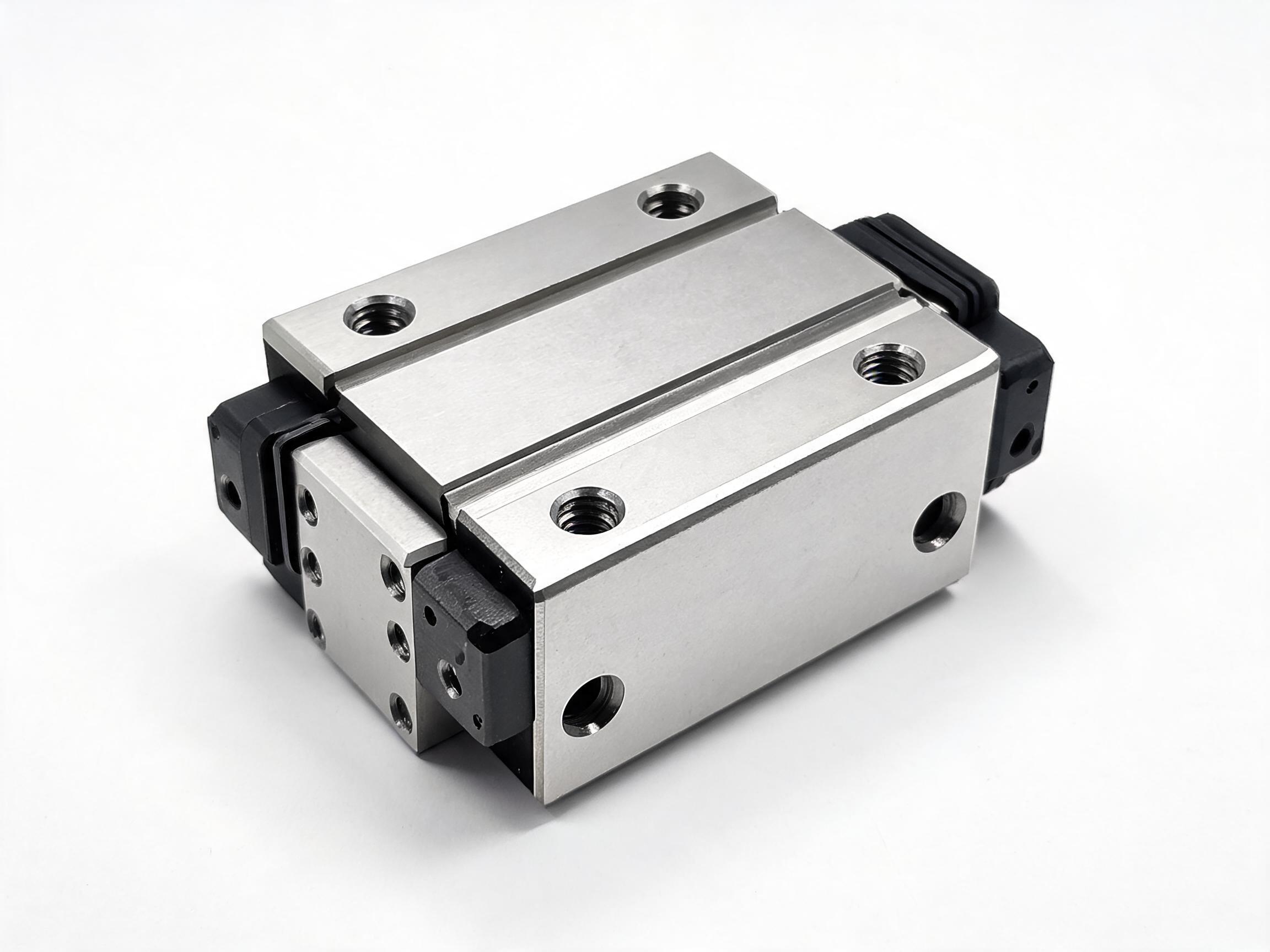
A buyer's decision guide on linear rail carriage replacement: the four things a carriage block must match (series, size, preload grade, seal set), when swapping only the block is reasonable, when replacing the rail-and-carriage pair is safer, and how to verify compatibility across brands without relying on unverified interchange claims.
Yes, a linear rail carriage block is normally available as a separate part. The harder question is whether a new block will actually fit the rail already bolted to your machine — and that depends on four things, not on the brand name printed on the housing.
Key takeaways
- A carriage must match the rail on series profile, size, preload grade and seal set. Miss any one and the fit or the running behaviour changes.
- Swapping only the block is reasonable when the rail is undamaged, the original part is identifiable, and you can verify the bore and profile dimensions.
- Replacing the rail-and-carriage pair is the safer call when the rail is worn, the block is unidentifiable, or the machine depends on a matched precision grade.
- Cross-brand mounting exists where the rail profile is the same, but it must be verified by measurement, not by catalogue similarity.
- What a carriage actually has to match
- When swapping only the block is reasonable
- When replacing the pair is the safer call
- How to verify compatibility across brands
- Reading a spec sheet before you order
- FAQ
What a carriage actually has to match
Buyers often search for a "linear rail carriage" expecting a single part number to be enough. In practice the carriage is one half of a matched rolling system, and four attributes have to line up before it will run correctly on an existing rail.
1. Series profile
The series defines the geometry of the rail cross-section and the corresponding bore of the carriage. A wide-body flange block and a heavy-duty block are not interchangeable even when the nominal size looks the same, because the rail profile they ride on is different. Within the HGW Series, for example, the carriages are wide-body flange types offered in sizes HGW15, HGW20, HGW25, HGW30, HGW35 and HGW45 — the number is the size, and the letter family is the profile.
2. Size
Size sets the rail width and height and therefore the carriage bore. A size 25 block belongs on a size 25 rail. This is the dimension most often checked and most often assumed rather than measured — which is where mismatched replacements come from.
3. Preload grade
Preload is the internal clearance or interference between the rolling elements and the raceway. In the HGW series, preload grades are designated C0 (clearance), C1 (light) and C2 (medium); other suppliers use different designation systems, so match the marking convention of your original part rather than assuming a universal code. Two blocks of the same size but different preload will both bolt onto the rail, yet they will not feel or behave the same: a C0 block runs with clearance, a C2 block runs tighter. If one axis of a machine carries a C2 block and the other a C0 block, the two axes are no longer matched. On smaller profiles the choice may be limited to light or medium preload — the MGN12, for instance, is offered in light or medium.
4. Seal set
End seals, side seal strips and bottom scrapers protect the raceway from chips, coolant and dust. Sealing is part of the carriage construction, not an accessory you can assume is identical across suppliers. HGW Series carriages use a triple sealing arrangement — end seal, side seal strip and bottom scraper. If a replacement block carries a different seal configuration, contamination resistance changes even though the mechanical fit looks correct. Whether a specific seal stack suits your environment is a question for the datasheet and the supplier, not for a visual comparison of the two blocks.
The fourth attribute buyers forget
Precision grade is often recorded separately from preload. Every rail and carriage is assembled and tested according to its precision grade, so a replacement block should be ordered at the grade the machine was built to. Precision grade designations vary between suppliers, so state the grade recorded for your original assembly when you enquire and let the supplier map it — confirm the final designation against the datasheet. Mixing grades within one axis is a fit problem today and a positioning problem later.
When swapping only the block is reasonable
Replacing just the carriage block makes sense in a fairly narrow but common set of situations:
- The rail itself is undamaged — no scoring, brinelling, corrosion pits or visible wear marks on the raceway.
- The original carriage is still identifiable by part number, marking or the machine's documentation, so series, size, preload and seal set are known rather than guessed.
- The failure is confined to the block: worn seals, a damaged housing, contamination ingress, or mechanical damage from a crash.
- The machine does not depend on a matched rail-and-carriage pair for its positioning accuracy.
- You can confirm the replacement's dimensions against the datasheet before ordering.
In these cases a block-only swap is faster and cheaper, and it avoids disturbing a rail that is already aligned and bolted to the machine bed. Replacing a rail means re-aligning and re-torquing the whole axis, which is real downtime.
For a like-for-like replacement on an existing HGW rail, the matching part is the HGW Series wide-body linear guideway carriage block, available in sizes HGW15 through HGW45 and in C0, C1 and C2 preload grades.
When replacing the pair is the safer call
There are situations where buying only the block creates a second failure. Replace the rail-and-carriage pair together when any of the following is true:
- The rail is worn or damaged. A new block on a worn raceway will not restore the original running behaviour, and the fresh seals will not fix geometry that has already changed.
- The block cannot be identified. If you cannot establish series, size and preload from markings or documentation, matching a new block becomes guesswork.
- Accuracy matters more than speed of repair. Because rails and carriages are assembled and tested to a precision grade, treating them as a matched set is the conservative choice for machines where positioning is critical.
- The application is heavy-duty. On high-load axes, replacing one half of a worn system shifts load onto parts already past their best. The HGR Series heavy-duty linear guideway rail is the rail half of such a pair.
- Downtime cost is high and a repeat visit is expensive. If a second intervention would be costly, replacing both reduces the chance of going back in.
How to verify compatibility across brands
Cross-brand mounting is possible where the rail profile is genuinely the same, and the HGR Series is a useful concrete case. Its rail cross-section follows the standard Taiwanese HGR profile, and carriage blocks from brands using that same profile — including our HGH Series — mount directly. Even so, confirm the rail width and height, mounting-hole pitch and lubrication port position against the datasheet before ordering: a shared nominal profile does not remove those checks.
For third-party carriages, the confirmation is dimensional: check the rail width and height against the carriage bore specification. Do this with measured dimensions from the rail on your machine, not with a catalogue photograph.
| Check | What to measure or obtain | Why it matters |
|---|---|---|
| Rail profile | Cross-section shape and series marking | Determines whether the bore geometry can match at all |
| Rail width | Measured rail width | Must agree with the carriage bore specification |
| Rail height | Measured rail height | Second dimension of the same bore check |
| Preload grade | Preload designation of the new block in the original part's marking system | Keeps the axis matched to its original running behaviour |
| Seal configuration | Seal stack from the datasheet | Contamination protection is part of the block, not an add-on |
| Precision grade | Grade recorded for the original assembly | Rails and carriages are tested to their grade |
One caveat worth stating plainly: an identical-looking profile in a photograph is not proof of interchangeability. Mounting-hole pitch, lubrication port position and seal geometry can differ between suppliers using the same nominal profile. Confirm against the datasheet, and where the datasheet is silent on a dimension that matters to your fit, ask the supplier before ordering.
Reading a spec sheet before you order
A carriage datasheet carries both the values you need for matching and the values you need for load checking. They serve different purposes, and both are worth reading before a purchase order goes out.
Take the HGW25CA as an example: dynamic load rating 28.4 kN, static load rating 42.1 kN, carriage weight 0.72 kg. The load figures let you compare the block against the working load on that axis; the weight matters for inertia on fast-moving gantries. At the small end, the MGN12C delivers 3.7 kN dynamic and 5.4 kN static with a carriage weight of 0.025 kg, and the MGN12 is supplied with either the MGN-C standard carriage or the MGN-H long carriage — a length choice that changes mounting footprint, so it belongs in the same matching check as size and preload.
What a datasheet will not tell you is whether the rail in your machine is still within its useful condition. That judgement is visual and dimensional, and it is the single biggest factor in deciding block-only versus pair replacement.
A practical decision order
For a maintenance buyer facing a failed carriage, the sequence below keeps the decision grounded in evidence:
- Identify the existing rail and block — markings, documentation, or measurement.
- Inspect the rail raceway for wear, scoring and corrosion before assuming the block is the only problem.
- Record series, size, preload grade and seal set from the datasheet of the original part.
- If the block is identifiable and the rail is sound, request a block-only replacement at the same specification.
- If the block is unidentifiable, the rail is worn, or accuracy is critical, request the rail-and-carriage pair.
- For any cross-brand substitution, verify rail width and height against the carriage bore specification and confirm seal and preload configuration against the datasheet.
For small-format applications, the MGN12 linear rail is supplied with its carriage as a tested assembly, which removes the matching question entirely when the whole axis is being replaced.
FAQ
Can I buy just the carriage block without the rail?
Yes, carriage blocks are supplied as separate parts. What you need before ordering is the series, size, preload grade and seal set of the existing block, so the replacement matches the rail already installed.
Will a block from another brand fit my rail?
Only if the rail profile is the same and the dimensions check out. Where the rail follows the standard Taiwanese HGR profile, blocks from brands using that profile mount directly, but third-party carriages should be confirmed by checking rail width and height against the carriage bore specification.
Can I mix preload grades on the same machine?
They will physically mount, but the axes will no longer behave the same. C0, C1 and C2 describe different internal clearance, so a replacement should be ordered at the grade the axis was built to — confirm against the datasheet.
What load rating should I compare against?
Use the dynamic rating for moving applications and the static rating for stationary or shock-loaded conditions. The HGW25CA, for reference, is rated 28.4 kN dynamic and 42.1 kN static.
Do I need to replace the rail if only the seals are worn?
Not necessarily. Worn seals alone are a block-level issue if the rail raceway is undamaged. Inspect the rail first — if it shows scoring, brinelling or corrosion, replacing the pair is the safer route.
Next step
Send the series, size, preload grade and seal set from your original carriage — or, if the block is unmarked, the measured rail width and height and the machine's duty — and we can quote a matching block, or a rail-and-carriage pair where that is the safer call. The HGW Series carriage page lists the size and preload options to check against your original part.