A practical buying guide to linear shafting for automation engineers and procurement professionals. Learn how to specify material grade, surface hardness, straightness, and diameter tolerance on linear shafts, and how these specs affect load capacity, service life, and total cost in real automation applications.
BUYER GUIDE · LINEAR MOTION
If you are sourcing linear shafts for an automation line, the datasheet tells you three things that matter: the material, the hardness, and the precision grade. Everything else—price, lead time, supplier reliability—sits on top of those three. Get them right and the linear bearing shaft will run for tens of thousands of hours. Get them wrong and you are debugging premature wear, noise, or seizure on the production floor.
This guide is written for buyers and engineers who need to specify linear shafting with confidence. We cover the standard material grades, what hardness numbers actually mean, how precision classes are defined, and how to match these specifications to real applications.
- Material grade determines corrosion resistance and hardness depth — choose 440C for wet or washdown environments, 1060/1045 hard-chromed steel for general automation.
- Surface hardness of 58–62 HRC is the industry standard for bearing-grade shafts; below 55 HRC, expect reduced wear life with case-hardened products.
- Straightness and diameter tolerance are the two specs that affect smooth travel most — specify g6 tolerance and 0.05 mm/m straightness for standard applications.
- Induction-hardened shafts offer a hard case with a tough core; through-hardened shafts offer uniform hardness but can be more brittle under shock loads.
- Always confirm the effective hardened depth and the raw material traceability with your supplier before committing to large orders.
Why the material grade is the first decision
The base material of a linear shaft determines what happens after years of rolling contact. The ball bearings in a linear bearing block roll over the shaft surface thousands of times per minute. Each pass creates microscopic stress. If the material is too soft, the raceway deforms. If it is too brittle, it can spall under impact.
Three material families dominate the market:
| Material | Typical Hardness | Corrosion Resistance | Common Applications |
|---|---|---|---|
| SAE 1060 / 1045 carbon steel, hard-chromed | 58–62 HRC (case) | Low — relies on chrome layer | General automation, packaging, pick-and-place |
| AISI 440C stainless steel | 56–60 HRC | High — suitable for washdown | Food processing, medical, semiconductor wet areas |
| AISI 52100 bearing steel | 60–64 HRC | Low — must be coated or oiled | High-load, high-speed precision machines |
For most automation buyers, the choice comes down to carbon steel versus 440C stainless. Carbon steel with a hard chrome layer is the workhorse. It is cost-effective, widely available, and performs well in dry or lightly lubricated environments. The chrome layer adds corrosion resistance and reduces friction.
440C stainless is the go-to when washdown chemicals or humidity are involved. It costs more, but it removes the risk of rust-induced pitting that can destroy a bearing surface in a wet environment. If your line runs a caustic washdown cycle, do not specify carbon steel even if the price is tempting.
Hardness: what the numbers mean for your application
Hardness is measured on the Rockwell C scale (HRC) for shafting. The number tells you the material's resistance to indentation. For linear motion, it directly correlates with wear life.
Here is the practical range you will encounter:
- Below 50 HRC: Too soft for bearing-grade use. You will see brinelling (surface dents) where the balls sit when the shaft is stationary under load.
- 55–58 HRC: Acceptable for light-duty applications, but expect reduced life with high cycle counts.
- 58–62 HRC: The industry standard for precision linear shafting. This is the sweet spot for most automation.
- Above 62 HRC: Harder, but increasingly brittle. Rarely needed and harder to machine.
One critical detail: hardness is not uniform through the cross-section. There are two manufacturing routes:
Induction-hardened shafts have a hard outer case (typically 2–4 mm deep) over a softer, tougher core. The core absorbs shock and bending loads without cracking. This is the most common method for carbon steel shafts.
Through-hardened shafts are hardened all the way through. They offer uniform hardness but less toughness. They are typically used in smaller diameters where the whole cross-section needs to resist wear.
Ask your supplier for the effective case depth on induction-hardened shafts. A shaft with 58 HRC surface hardness but only 1 mm of case depth will fail early under heavy point loads.
Precision specifications: straightness, roundness, and tolerance
Hardness tells you how long the shaft will last. Precision tells you how smoothly it will move. Three geometric specifications matter most:
Diameter tolerance
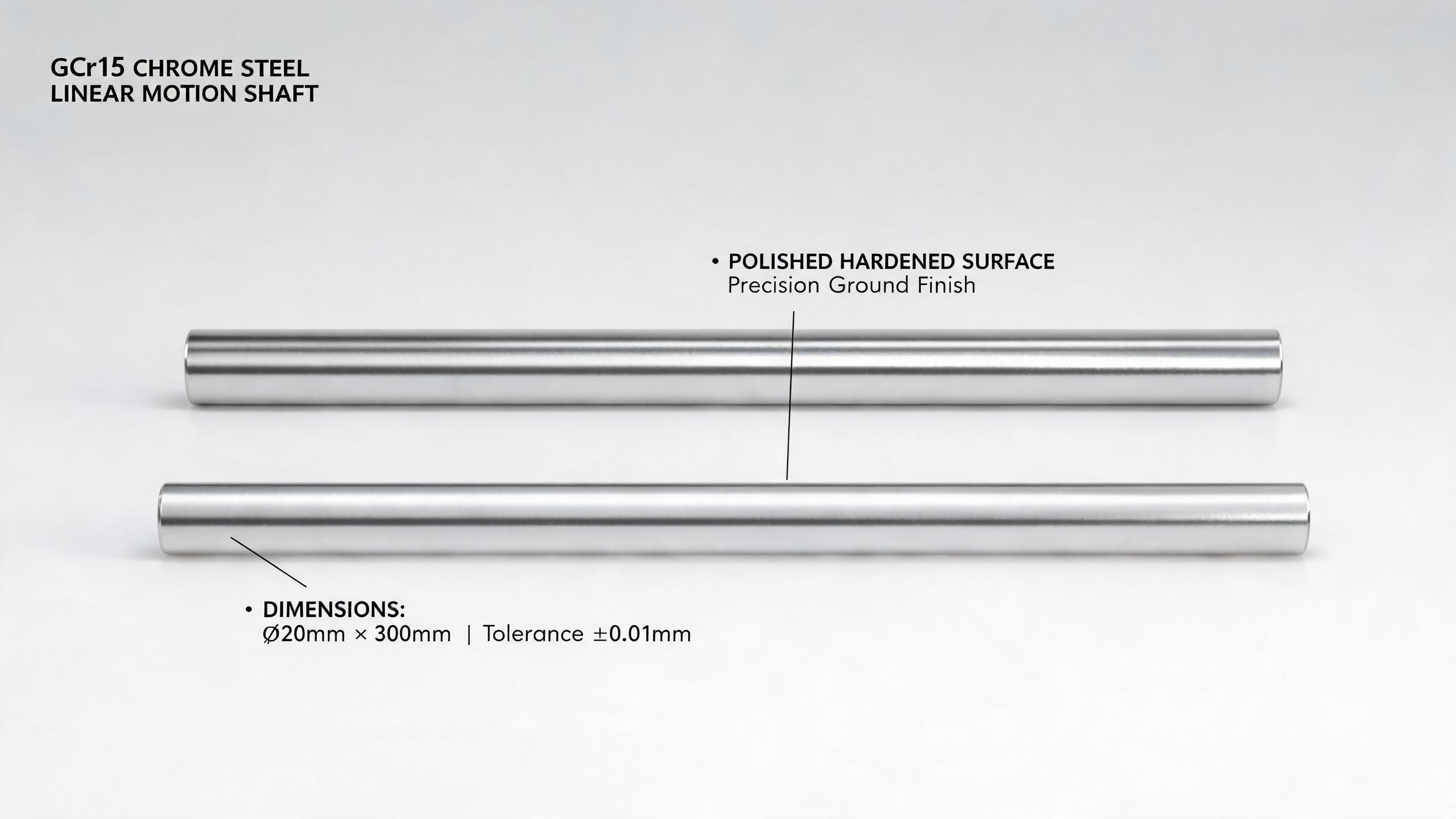
Linear bearings are manufactured to fit shafts within a specific diameter range. The most common fit is g6 tolerance. For a 20 mm shaft, g6 allows a diameter between 19.980 mm and 19.993 mm. This clearance allows the bearing balls to roll freely while maintaining contact.
If the shaft diameter is too large, the bearing preloads and drag increases. If it is too small, the balls lose contact and the carriage rattles. Always match the shaft tolerance class to the bearing manufacturer's recommendation.
Straightness
Straightness is measured as the maximum deviation over a given length, typically expressed in mm per meter (mm/m). Standard precision shafting offers 0.05 mm/m. High-precision grades reach 0.02 mm/m or better.
Straightness affects smoothness of travel and bearing life. A bent shaft forces the balls to constantly re-align, creating uneven wear and increased friction. For long travel lengths, straightness becomes the dominant factor in system performance.
Surface finish
Surface roughness (Ra) on the shaft affects friction and lubrication retention. Typical bearing-grade shafts have an Ra of 0.4 µm or better. A smoother surface reduces friction but can also reduce oil retention. The 0.4 µm range balances both.
| Specification | Standard Grade | High-Precision Grade |
|---|---|---|
| Diameter tolerance | g6 | h5 or tighter |
| Straightness | 0.05 mm/m | 0.02 mm/m |
| Surface finish (Ra) | 0.4 µm | 0.2 µm |
| Hardness | 58–62 HRC | 60–64 HRC |
Thomson shaft and brand compatibility
Many buyers reference Thomson shaft as a de facto standard for 60 Case® shafting. Thomson's 60 Case is a specific grade of induction-hardened, chrome-plated shafting known for consistent hardness and straightness. When buyers specify "Thomson-equivalent," they mean a shaft that matches those mechanical properties, not necessarily the brand itself.
If your existing system uses Thomson shafts, you can source equivalent linear bearing shafts from other manufacturers provided the material grade, hardness, case depth, and tolerance class match. The key is to verify the actual specifications rather than assuming brand equivalence.
What to confirm with any supplier:
- Raw material mill certificate and grade
- Hardness test report (surface HRC and case depth)
- Straightness measurement method and report
- Diameter measurement at multiple points along the length
- Chrome layer thickness (for hard-chromed shafts)
Matching shaft specifications to application demands
Not every application needs the highest precision grade. Over-specifying raises cost without adding value. Here is a practical decision framework:
| Application Type | Recommended Spec | Rationale |
|---|---|---|
| Light pick-and-place, low cycle rates | 1060 hard-chromed, 58 HRC, g6, 0.05 mm/m | Cost-effective, adequate for moderate duty |
| High-speed packaging, continuous operation | 52100 or 1060, 60 HRC, g6, 0.02 mm/m | Higher hardness and straightness reduce vibration and wear |
| Washdown / food processing | 440C stainless, 56 HRC, g6, 0.05 mm/m | Corrosion resistance is the priority; hardness is secondary |
| Precision measurement / semiconductor | 52100, 62 HRC, h5, 0.02 mm/m | Ultra-tight tolerances for positional accuracy |
Common specification mistakes to avoid
In our experience working with automation buyers, these errors appear repeatedly:
1. Confusing surface hardness with case depth. A shaft can read 60 HRC on the surface but have only a thin hardened layer. If the application involves heavy point loads, the case can crack or crush through to the soft core. Always ask for the effective case depth in millimeters.
2. Ignoring the chrome layer on carbon steel. Hard-chromed shafts have a chrome layer typically 0.02–0.05 mm thick. This layer provides corrosion resistance and low friction. If it is too thin, it wears through quickly and exposes the steel to rust. If it is too thick, it can flake. Confirm the layer thickness with your supplier.
3. Specifying stainless steel without checking hardness. Not all stainless grades can be hardened to bearing grade. 304 stainless, for example, cannot be hardened significantly and is unsuitable for linear bearing shafts. 440C is the correct choice because it is martensitic and hardenable.
4. Assuming longer shafts are straight. A 2-meter shaft with 0.05 mm/m straightness can deviate up to 0.1 mm total. For long travel applications, discuss straightness over the full length with your supplier, not just the per-meter spec.
Quality verification checklist for buyers
Before placing a purchase order, use this checklist to evaluate a linear shafting supplier:
- Do they provide material certificates with heat numbers?
- Can they supply hardness test reports per batch?
- Do they measure straightness with a laser or dial gauge, and can they share the report?
- What is their diameter tolerance verification process?
- Do they offer cutting, end-machining, and drilling services for custom lengths?
- What is their lead time for standard and custom specifications?
- Do they package shafts to prevent bending and surface damage during shipping?
These are not optional extras. They are the difference between a shaft that works on arrival and one that causes downtime.
Frequently asked questions
Q: Can I use a linear bearing shaft without lubrication?
Some coated shafts (e.g., those with special low-friction coatings) can run dry for short periods, but for continuous operation, lubrication is required. Confirm the lubrication requirements with both the shaft and bearing manufacturers.
Q: What is the maximum length available for linear shafts?
Standard supply lengths typically range from 2 to 6 meters, depending on the manufacturer. Longer shafts may require special transport and handling. Custom lengths are usually available upon request.
Q: How do I choose between a support rail and a linear shaft?
Shafts are simpler and more cost-effective for moderate loads and travel lengths. Support rails offer higher rigidity and load capacity for heavy-duty applications. The choice depends on your load, speed, and accuracy requirements.
Q: Are Thomson shafts and generic shafts interchangeable?
Yes, provided the material, hardness, case depth, and tolerance class match the Thomson 60 Case specifications. Verify the actual mechanical properties rather than assuming brand equivalence.
Final recommendations
When you request a quote for linear shafting, provide the supplier with these five parameters: material grade, surface hardness with case depth, diameter tolerance class, straightness per meter, and surface finish. If you are replacing an existing shaft, measure the current shaft's diameter and length, and check the bearing part number for its recommended tolerance.
If you are unsure about the right specification for your application, ask your supplier for guidance. A reputable manufacturer will ask about your load, speed, environment, and expected service life before recommending a grade. If they quote you without asking these questions, treat that as a warning sign.
For custom machining services—cutting to length, end drilling, tapping, or keyway cutting—confirm these capabilities with your supplier in advance. Many automation projects require shafts that are not off-the-shelf lengths, and the supplier's ability to machine accurately affects your assembly time.
If you are sourcing linear shafting for an ongoing automation project and need specification support, contact our team with your drawings or bearing part numbers. We can help you match the correct material, hardness, and precision grade to your application.