
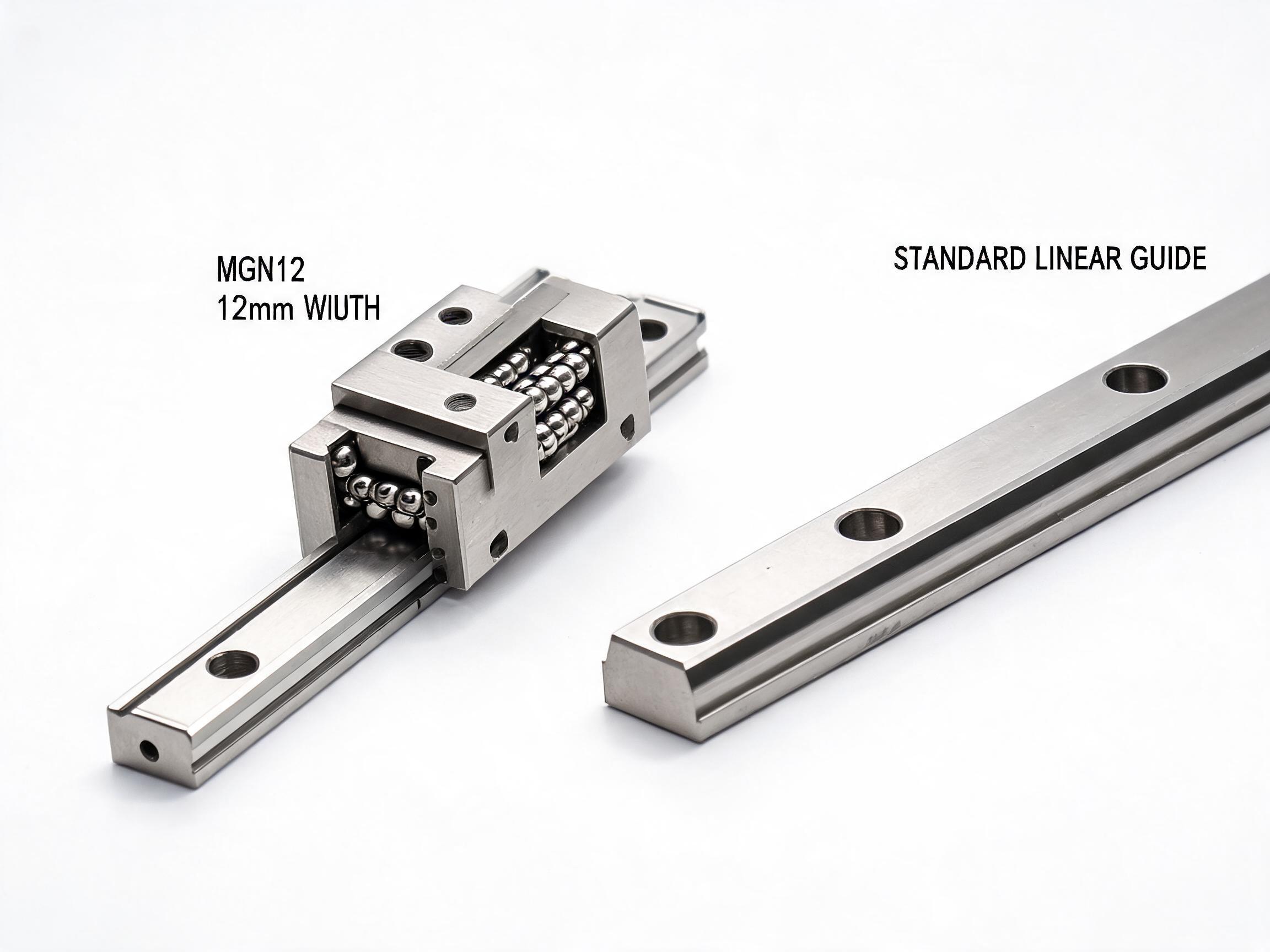
A practical selection guide for MGN and EGH miniature linear guides used in precision instruments. Compare load capacity, accuracy, stiffness, and typical applications to choose the right linear guide bearing block, linear guideways, and linear ball bearing slide for your project.
PRECISION LINEAR MOTION GUIDE
- MGN series uses a 2-row ball circuit design — compact, low profile, best for light-load precision instruments.
- EGH series uses a 4-row ball circuit design — higher load capacity and stiffness, suited for medium-load automation and measuring equipment.
- Rail width range: MGN typically 7–15 mm; EGH typically 15–20 mm. Choose based on space envelope and load requirements.
- Accuracy grades available: C (normal), H (high), P (precision) — confirm with your supplier before ordering.
- Both series are pre-lubricated and interchangeable with major global brands, but verify mounting dimensions and bolt patterns.
Why Miniature Linear Guides Matter in Precision Instruments
In precision instruments — coordinate measuring machines, optical inspection systems, semiconductor handling equipment, and laboratory automation — the linear guide bearing block and rail linear assembly directly determines positioning repeatability and service life. A wrong selection leads to vibration, premature wear, or dimensional drift.
Two of the most widely used miniature series are MGN (Miniature Guide, Narrow) and EGH (Economic Guide, High-load). Both are available as complete sets: a linear guideways rail and matching linear ball bearing slide blocks. This guide compares them on dimensions, load capacity, accuracy, and typical use cases, so you can make a confident sourcing decision.
MGN Series: Compact and Light-Duty
The MGN series is designed for applications where space is tight and loads are light. The linear guide bearing block uses a 2-point contact ball circuit, which reduces friction and allows a very low profile.
Key Specifications (Typical)
| Parameter | MGN 7 | MGN 9 | MGN 12 | MGN 15 |
|---|---|---|---|---|
| Rail width (mm) | 7 | 9 | 12 | 15 |
| Block height (mm) | 8 | 10 | 13 | 16 |
| Ball circuit count | 2 | 2 | 2 | 2 |
| Basic dynamic load rating (C, kN) | 0.49 | 0.72 | 1.15 | 1.65 |
| Basic static load rating (C0, kN) | 0.62 | 0.95 | 1.50 | 2.20 |
Note: Values are typical for standard steel blocks. Confirm exact ratings with your supplier for each model variant.
Best Applications for MGN
- Optical stages — low profile fits into narrow Z-axis stacks.
- Microscope XY tables — light load, high positioning repeatability.
- Small pick-and-place units — compact rail linear guides for gripper axes.
- Laser marking heads — minimal space, moderate speed.
Advantages
- Very compact — saves space in multi-axis assemblies.
- Low friction — suitable for high-speed indexing.
- Cost-effective for light-duty precision tasks.
Limitations
- Lower load capacity — not for heavy or shock-loaded axes.
- Less stiffness under moment loads — require careful mounting.
EGH Series: Higher Load, Greater Stiffness
The EGH series (sometimes called EG or HGH in larger sizes) uses a 4-row ball circuit in the linear ball bearing slide block. This doubles the number of load-bearing balls, increasing both dynamic and static load capacity by approximately 60–100% compared to an equivalent MGN size.
Key Specifications (Typical)
| Parameter | EGH 15 | EGH 20 |
|---|---|---|
| Rail width (mm) | 15 | 20 |
| Block height (mm) | 24 | 30 |
| Ball circuit count | 4 | 4 |
| Basic dynamic load rating (C, kN) | 2.72 | 4.35 |
| Basic static load rating (C0, kN) | 3.80 | 6.20 |
Note: EGH 15 rail width is 15 mm, same as MGN 15, but the block is taller and wider to accommodate the extra ball circuits.
Best Applications for EGH
- Coordinate measuring machines (CMM) — higher stiffness improves measurement accuracy.
- Semiconductor wafer handling — moderate load, high cycle life.
- Automated inspection systems — multiple axes with varying load distribution.
- Medical diagnostic equipment — reliable performance under continuous use.
Advantages
- Higher load capacity — handles heavier carriages and payloads.
- Better stiffness — resists moment and twisting forces.
- Smoother motion under load — less vibration at speed.
Limitations
- Larger footprint — may not fit into ultra-compact designs.
- Higher cost per set compared to MGN of same rail width.
How to Choose: MGN vs EGH Decision Matrix
Use the following criteria to decide which series fits your precision instrument project.
| Decision Factor | Choose MGN | Choose EGH |
|---|---|---|
| Available space (Z-height) | Under 16 mm block height | 24 mm or more acceptable |
| Load per block | Under 1.5 kN dynamic | 1.5–4.5 kN dynamic |
| Moment load (pitch/yaw) | Low — use two blocks spaced apart | Moderate — single block can handle |
| Required accuracy grade | C or H sufficient for most | H or P available |
| Speed | Up to 2 m/s typical | Up to 3 m/s with proper lubrication |
| Budget sensitivity | Lower cost per set | Higher cost, but longer life under load |
Accuracy Grades and Preload
Both MGN and EGH series are available in multiple accuracy grades. The most common are:
- C (Normal) — general purpose, positioning tolerance ±12 µm per 100 mm.
- H (High) — improved parallelism, ±7 µm per 100 mm.
- P (Precision) — tightest tolerance, ±3 µm per 100 mm.
For precision instruments, H or P grade is typical. Preload (light or medium) is also available to eliminate clearance. Confirm the grade and preload with your supplier, as they affect both cost and lead time.
Mounting and Interchangeability
MGN and EGH series from different manufacturers often share the same mounting dimensions (rail width, bolt pitch, block length). However, always verify:
- Bolt hole pattern — MGN 15 and EGH 15 both use M4 bolts, but spacing may differ.
- Block length — EGH blocks are longer due to extra ball circuits.
- Rail cross-section — EGH rails are slightly taller to match the block profile.
If you are replacing an existing linear guide bearing block or rail linear from another brand, request a dimension drawing from your supplier before ordering.
Lubrication and Maintenance
Both series come pre-lubricated with lithium soap grease. For cleanroom or medical applications, specify low-outgassing or food-grade grease. Standard maintenance intervals:
- Light duty (under 10,000 cycles/month): re-grease every 6 months.
- Medium duty (10,000–50,000 cycles/month): re-grease every 3 months.
- Heavy duty or dusty environment: consider an automatic lubrication system or wiper seals.
Common Mistakes When Sourcing Miniature Linear Guides
- Choosing by rail width only — MGN 15 and EGH 15 have the same rail width but very different load capacities. Always check the block's dynamic load rating.
- Ignoring moment load — A single MGN block cannot handle significant off-center force. Use two blocks on one rail or switch to EGH.
- Assuming all brands are identical — Rail hardness, ball grade, and seal material vary. Ask for material certificates if your application requires traceability.
- Ordering the wrong accuracy grade — C grade may cause positioning drift in precision instruments. Confirm the required tolerance before placing an order.
Frequently Asked Questions
Q: Can I use an MGN block on an EGH rail?
A: No. The rail profile and block groove geometry differ. They are not interchangeable.
Q: What is the typical lead time for MGN and EGH sets?
A: For standard sizes (MGN 7–15, EGH 15–20) in C or H grade, lead time is typically 15–25 working days. Custom lengths or P grade may take 30–40 days. Confirm with your supplier.
Q: Do you offer custom machining on the rail?
A: Many suppliers can cut rails to length, drill additional mounting holes, or add end caps. These modifications are available upon request — specify your drawing and tolerance.
Q: How do I calculate the required dynamic load for my application?
A: Calculate the total mass on the carriage, multiply by the acceleration factor (usually 2–4x for precision instruments), then divide by the number of blocks. Compare this value to the basic dynamic load rating (C) of the block. A safety factor of 1.5–2 is recommended.
Next Steps
Selecting the right linear guideways and linear ball bearing slide is a balance of space, load, accuracy, and budget. For light-duty precision instruments, MGN offers a compact, cost-effective solution. For higher loads and stiffness, EGH delivers better performance and longer life.
If you need help matching a specific instrument axis to the correct linear guide bearing block, send us your load, space, and accuracy requirements. We can recommend a series, size, and grade — and provide a dimension drawing for your review.
For more information on our miniature linear guide product range, including MGN and EGH series with accuracy grades up to P, please contact our sales team or request a quote through the product page.