Choosing the right screw drive linear actuator for an automation project is a technical decision that affects accuracy, cycle time, and total cost of ownership. This guide walks through screw types, load and speed calculations, environmental ratings, and supplier evaluation criteria—written for buyers who need to compare options and send a clear RFQ.
BUYER GUIDE · LINEAR MOTION
Screw Drive Linear Actuator: Comprehensive Selection Guide for Automation Equipment Buyers
If you are sourcing a screw drive linear actuator for a pick-and-place station, a packaging line, or a CNC axis, the core question is not "which brand is famous." It is: which configuration will hold the required accuracy at the required speed, for the required life, within the budget you have.
This guide covers the selection criteria that matter in a B2B purchase decision: screw type, load and speed math, repeatability classes, environmental sealing, and the supplier documents you should request before placing an order.
- Ball screw vs. lead screw is a cost-vs-accuracy trade-off—define your repeatability target first, then choose.
- Dynamic load rating (C) and service life are calculable—ask the supplier for the calculation, not just a brochure.
- IP rating and ingress protection are not optional if your line has coolant, dust, or washdown.
- Request a dimension drawing and a performance curve before you commit to a frame size.
1. Why the Screw Type Is the First Decision
The screw is the heart of the actuator. It converts motor rotation into linear motion, and its geometry determines almost every performance limit of the unit. For a linear screw drive, you will typically choose between two families:
Lead screw (also called sliding screw or trapezoidal screw). The nut slides directly on the screw thread. It is simple, low-cost, and can be self-locking depending on lead angle. It suits moderate speeds, intermittent duty, and applications where positional accuracy in the ±0.05 mm range is acceptable.
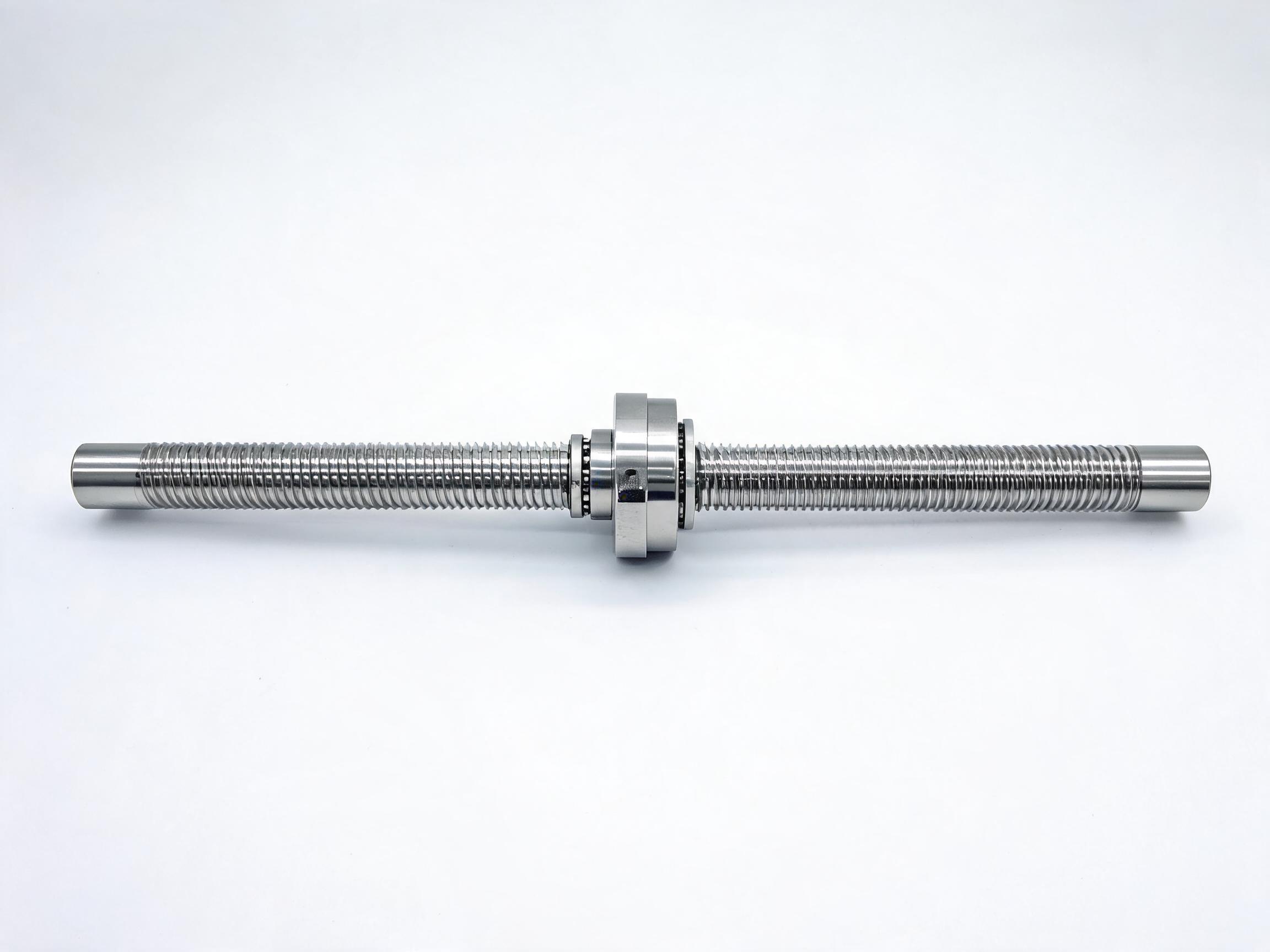
Ball screw. Recirculating steel balls sit between the screw shaft and the nut, converting sliding friction into rolling friction. This cuts friction dramatically, raises efficiency to roughly 90% (vs. 30–50% for lead screws), and allows higher speeds and longer life. It is the standard choice for CNC machines, semiconductor equipment, and any axis that runs continuously.
| Parameter | Lead Screw | Ball Screw |
|---|---|---|
| Efficiency | 30–50% | ~90% |
| Typical repeatability | ±0.05 mm | ±0.01 mm or better |
| Max speed | Moderate | High (limited by critical speed) |
| Self-locking | Yes (low lead angles) | No—requires a brake or motor holding torque |
| Relative cost | Low | 2–4× a lead screw of same size |
| Typical application | Adjusters, light pick-and-place, valve actuation | CNC axes, high-cycle automation, precision positioning |
Rule of thumb: if your cycle time is under 1 second or your positioning tolerance is tighter than ±0.03 mm, start with a ball screw. If the axis moves a few times per minute and cost is the constraint, a lead screw will do the job.
2. Load, Speed, and Life: The Three Numbers You Must Calculate
A supplier can quote you a model only after you define three values. Do not expect an accurate recommendation if you only say "medium load, medium speed."
Dynamic load rating (C). This is the load in Newtons that gives a rated life of 1 million revolutions of the screw. It is the basis for the life calculation. Ask the supplier for the C value of the screw they propose.
Service life (L). For ball screws, the basic rating life formula is:
> L = (C / P)³ × 10⁶ revolutions
where P is the equivalent dynamic load. For lead screws, wear life depends on surface pressure and sliding speed, so the calculation is different—ask for the supplier's wear-life estimate based on your duty cycle.
Critical speed. A long, thin screw rotating fast will whip like a jump rope. The maximum safe speed depends on the screw diameter, the unsupported length, and the bearing configuration. If your stroke is over 500 mm and you need high speed, this is often the limiting factor—not the motor.
3. Accuracy Classes: What the Numbers Actually Mean
Accuracy in a screw drive actuator is specified at two levels: positioning accuracy and repeatability.
- Positioning accuracy is how close the carriage gets to the commanded position, relative to a true reference. It includes screw lead error, backlash, and thermal drift.
- Repeatability is how close the carriage returns to the same position when commanded to the same point many times. For automation, repeatability is usually the more important number.
Ball screws are ground to different accuracy grades (typically C3, C5, C7, C10 in ISO notation). C7 is common for general automation; C5 for precision; C3 for high-end machine tools. The grade affects cost significantly, so do not over-specify. If your process tolerates ±0.02 mm, a C7 screw with a good nut preload will often meet it at a much lower price than a C3.
Backlash is the lost motion between the nut and the screw when direction reverses. For bidirectional positioning, you need a preloaded nut to remove backlash. A single nut with preload is standard; a double-nut arrangement gives higher stiffness for heavy cutting loads.
4. Frame Size, Motor, and Mounting: The Integration Questions
The actuator is rarely a standalone part. It must interface with a motor, a controller, and a machine frame. These integration points are where projects stall, so clarify them early.
Frame size. The actuator's cross-section (e.g., 40×40 mm, 60×60 mm, 80×80 mm) determines the screw diameter, the rail size, and the load capacity. Bigger is not better—a larger frame costs more and moves more mass. Match the frame to the calculated load plus a safety factor of 1.5–2×.
Motor mounting. Most screw drive actuators accept a NEMA or metric flange motor mount. Confirm the motor shaft diameter and keyway match the actuator's coupling. A mismatch here causes vibration and premature wear.
Guide system. The carriage rides on either a profile rail (linear guide) or a slide bushing. Profile rails are stiffer and more accurate; bushings are cheaper and quieter. For cantilevered loads, always choose a profile rail.
Mounting orientation. Horizontal, vertical, or inclined? Vertical applications need a brake or a self-locking screw to hold the load when power is off. Confirm this with the supplier before ordering—it changes the bill of materials.
5. Environment: IP Rating, Temperature, and Contamination
A clean, dry, temperature-controlled lab is one thing. A machining cell with coolant mist is another. The environment determines the sealing and lubrication requirements.
- IP rating. IP54 protects against dust and splashing water; IP65/67 is washdown-capable. For food or pharmaceutical lines, look for stainless steel screws and food-grade grease.
- Wipers and scrapers. A good actuator has wipers on the carriage and seals on the screw ends to keep chips and dust out of the nut. Ask whether the standard unit includes them or if they are an option.
- Temperature range. Standard seals and grease are rated for roughly 0–60°C. Outside that range, you need special lubricants and seal materials. Confirm the operating range with the supplier.
- Corrosion. For humid or chemical environments, a chrome-plated or stainless screw is available. It costs more but prevents early failure.
6. Supplier Evaluation: What to Ask Before You Commit
Price is one line of the total cost. The rest is in the documentation and the supplier's ability to support you after the sale. When evaluating a supplier of screw drive linear actuators, request these items:
- Dimension drawing (DWG or PDF) — confirms the envelope fits your machine.
- Performance curve — thrust vs. speed for the model, at the rated voltage.
- Life calculation — based on your load and duty cycle, not a generic number.
- Material and finish specs — screw material, hardness, and surface treatment.
- Certificates — ISO 9001 for the factory, and any specific certifications your market requires (CE, RoHS, etc.). Note that a factory ISO certificate does not automatically mean the product is CE-marked—verify per product.
- Lead time and MOQ — confirm stock items vs. made-to-order, and the production lead time for your quantity.
- Customization capability — can they modify stroke, add a custom flange, or provide a special voltage? If your project needs it, ask before ordering.
| Checklist Item | Why It Matters | Red Flag If Missing |
|---|---|---|
| Dimension drawing | Confirms mechanical fit | "We'll send after order" |
| Performance curve | Verifies thrust at your speed | Only nominal specs given |
| Life calculation | Predicts maintenance interval | No formula or method provided |
| Material certificate | Confirms screw hardness and coating | No material data |
| CE / RoHS docs | Required for EU market entry | Vague "we comply" statement |
| Lead time | Affects your project schedule | "Depends" without a date |
7. Common Mistakes Buyers Make
Overspecifying accuracy. A C3 ground screw costs significantly more than a C7. If your process tolerates ±0.02 mm, a C7 with a preloaded nut is often sufficient. Define the requirement, then pick the grade that just meets it.
Ignoring critical speed. A 1-meter stroke with a 16 mm screw will not run at 500 mm/s—the screw will whip. Check the critical speed chart before you finalize the stroke and speed.
Forgetting the brake for vertical axes. When power drops, a vertical load will back-drive a ball screw. You need a holding brake or a self-locking lead screw. This is a safety issue, not a convenience.
Buying on price alone. A low-cost actuator with no documentation, no life data, and no support will cost more in downtime than the price difference. Evaluate the supplier, not just the quote.
8. Frequently Asked Questions
Q: What is the difference between a screw drive actuator and a belt drive actuator? A: A screw drive offers higher accuracy and stiffness, and it holds position without power (with a self-locking screw or brake). A belt drive is faster, quieter, and cheaper for long strokes, but it has lower accuracy and needs a brake or servo hold for vertical loads.
Q: How do I know if I need a ball screw or a lead screw? A: If you need repeatability better than ±0.03 mm, continuous duty, or speeds above ~200 mm/s, choose a ball screw. For intermittent, low-speed, cost-sensitive applications, a lead screw is sufficient.
Q: Can I use a screw drive actuator vertically? A: Yes, but you must add a brake or select a self-locking lead screw. Confirm the holding torque with the supplier.
Q: What is the typical lead time for a custom stroke? A: This varies by supplier. Standard stroke units are often in stock; custom strokes require a production slot. Confirm the lead time in writing before ordering.
Q: How do I maintain a screw drive actuator? A: Regular lubrication of the screw and guide is the main task. The interval depends on duty cycle and environment. Ask the supplier for their lubrication schedule and recommended grease type.
Next Steps
A screw drive linear actuator is a well-understood, mature component. The risk in a project is not the technology—it is unclear specifications and missing documentation. Define your load, speed, accuracy, and environment; send those numbers to a supplier; and ask for the drawings, curves, and life calculations before you commit.
If you are comparing options and need a unit with a specific stroke, motor flange, or environmental rating, send your RFQ with the six inputs listed in Section 2. A good supplier will come back with a model number, a dimension drawing, and a price—not a vague "we can do it."
Linear Motion Automation Components Buyer Guide