A practical buyer's guide to flanged linear bearings — covering the difference between linear sleeve bearings and linear ball bearings, flange mounting styles, load/life calculations, and common sizing mistakes in precision automation.
BUYER GUIDE · LINEAR MOTION COMPONENTS
Flanged Linear Bearing: Types, Mounting Configurations, and Sizing for Precision Automation
If you are sourcing linear motion components for an assembly line, a packaging machine, or a custom automation rig, the flanged linear bearing is likely on your BOM. It is one of the most common ways to guide a shaft with a simple, repeatable mounting interface.
This guide covers the three questions buyers ask most: which type of bearing fits the application, which flange style suits the housing, and how to size the bearing so it does not fail early. We keep the numbers concrete — if a parameter depends on your specific load case, we say so and tell you what to measure.
- Flanged linear bearings come in two main families — linear sleeve bearings (plain, low cost) and linear ball bearings (recirculating balls, higher load and speed).
- Flange styles — round, square, and oval — affect bolt spacing, housing machining, and alignment. Choose based on your mounting plate, not just on shaft diameter.
- Sizing is a load-and-life calculation, not a shaft-diameter guess. Misalignment and missing lubrication are the two most common causes of premature failure.
- For precision automation, the shaft hardness and surface finish matter as much as the bearing itself.
What Is a Flanged Linear Bearing?
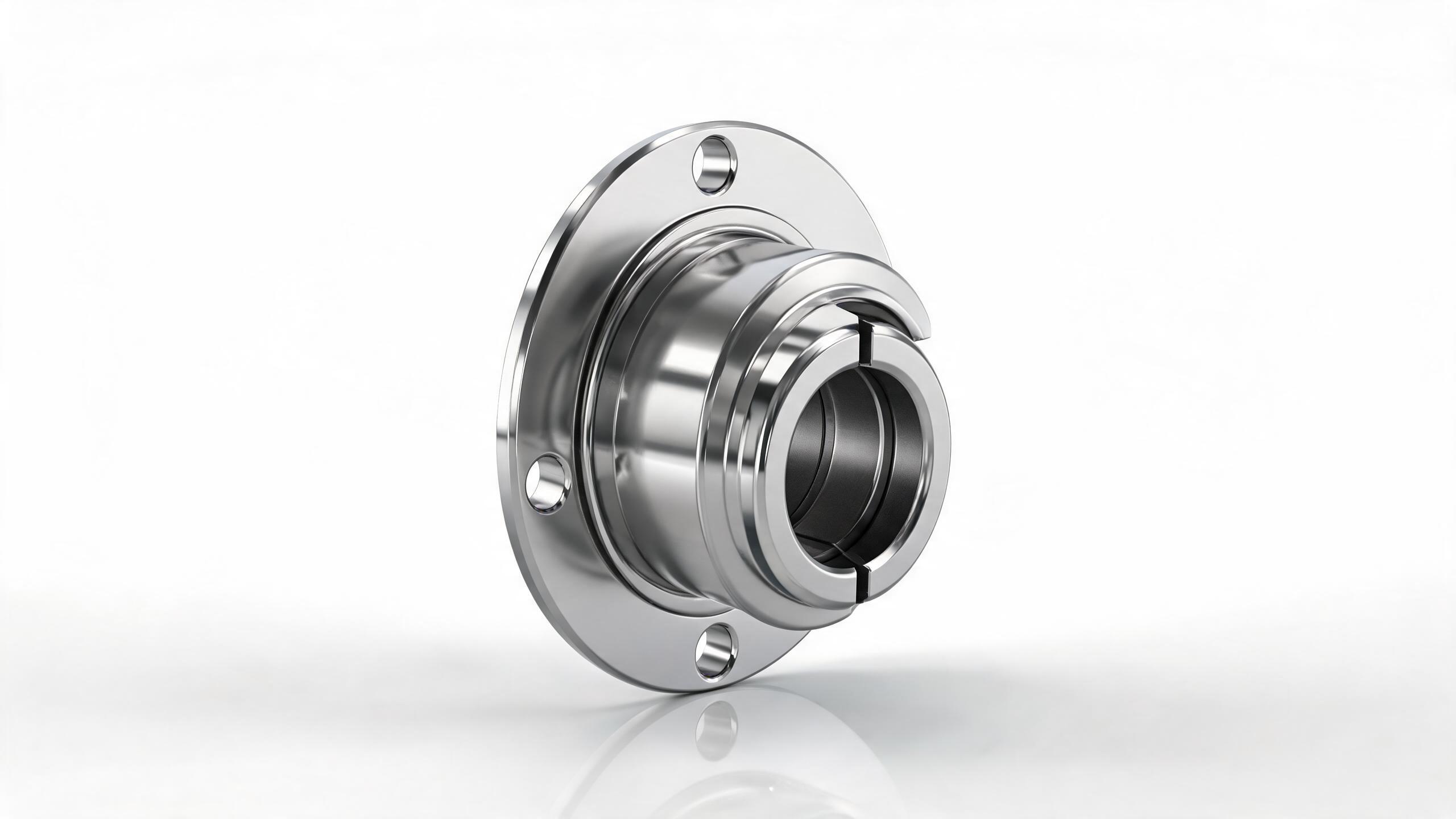
A flanged linear bearing is a linear motion component with an integrated flange at one end. The flange provides a mounting face with bolt holes, so the bearing can be bolted directly to a machine plate or housing. The bearing body slides along a hardened shaft, guiding linear movement with low friction.
The flange serves two purposes: it locates the bearing axially and it transfers load into the mounting structure. This is different from a plain cylindrical bearing (no flange), which needs a separate retaining ring or a machined pocket to stay in place.
Flanged versions are preferred in automation because they simplify assembly — one bolt pattern, no extra retention hardware, and easy replacement during maintenance.
Linear Sleeve Bearing vs. Linear Ball Bearing
Under the "flanged linear bearing" umbrella, there are two distinct product families. Buyers often confuse them because they look similar from the outside. The internal construction is completely different.
| Parameter | Linear Sleeve Bearing | Linear Ball Bearing |
|---|---|---|
| Contact type | Sliding contact (plain) | Recirculating balls |
| Typical materials | Bronze, PTFE composite, polymer | Hardened steel shell + ball retainer |
| Load capacity | Moderate; good for static or low-speed | Higher dynamic load ratings |
| Speed | Lower; friction generates heat | Higher; rolling friction runs cooler |
| Lubrication | Often self-lubricating or grease-packed | Requires grease or oil; some are sealed |
| Cost per unit | Lower | Higher |
| Typical use | Positioning slides, low-cycle automation | High-cycle pick-and-place, CNC, packaging |
Linear Sleeve Bearing: When to Use It
A linear sleeve bearing is a plain bearing. The shaft slides directly against the bearing surface, which is made from a low-friction material such as bronze, a PTFE-filled composite, or an engineered polymer. There are no rolling elements.
This design has three practical advantages:
- Compact and lightweight — no ball retainer, so the wall thickness is smaller.
- Quieter operation — no ball recirculation noise.
- Better shock absorption — the sliding contact dampens vibration.
The trade-off is friction. At higher speeds, a sleeve bearing generates heat, which limits duty cycle. For a machine that moves a light load a few times per minute, a sleeve bearing is often the most cost-effective choice. For continuous high-speed cycling, it is the wrong part.
Linear Ball Bearing: When to Use It
A linear ball bearing (often called a linear bushing) uses recirculating balls that roll between the shaft and the bearing shell. The balls carry the load and recirculate through a return channel, which is why these bearings are sometimes called "ball bushings."
Because rolling friction is much lower than sliding friction, a linear ball bearing handles higher speeds and longer duty cycles without overheating. It also offers higher dynamic load capacity for the same envelope size.
The main requirements are a hard shaft (typically 60 HRC minimum for full rated life) and proper lubrication. Run a ball bearing on a soft shaft, and the balls will brinell the shaft surface — the bearing will fail early, and so will the shaft.
Flange Mounting Configurations
The flange shape determines how the bearing mounts to your machine. Three configurations dominate the market: round, square, and oval. Each has a specific purpose.
Round Flange
The round flange is the classic configuration. The flange is a circular disc with bolt holes on a bolt circle. It is compact and fits into a counterbored pocket or mounts directly against a flat plate.
Use a round flange when space is tight and the mounting plate can accept a circular bolt pattern. It is the most common choice for compact linear slides and small automation modules.
Square Flange
The square flange has a square or rectangular mounting face. The bolt holes are positioned at the corners, which gives a wider bolt spread for the same shaft diameter. This improves moment load resistance — the bearing can handle more tilting force before the flange deforms.
Use a square flange when the bearing will see off-center loads or when the housing is machined from a plate with a square pocket. Many European and Asian automation suppliers standardize on square flanges for medium-duty applications.
Oval Flange
The oval flange is an intermediate option. It is longer than a round flange but narrower than a square one. The bolt holes sit along the long axis, which allows a narrower mounting footprint while still providing some moment resistance.
Use an oval flange when the mounting plate is narrow — for example, when two bearings run side by side on parallel shafts with limited center distance.
| Flange Type | Bolt Pattern | Moment Resistance | Best For |
|---|---|---|---|
| Round | Bolt circle | Low | Compact slides, light loads |
| Square | Four corners | High | Off-center loads, medium-heavy duty |
| Oval | Two along long axis | Medium | Narrow plates, parallel shaft spacing |
How to Size a Flanged Linear Bearing
Sizing is where most sourcing errors happen. The common mistake is to pick a bearing by shaft diameter alone — "I have a 20 mm shaft, so I need a 20 mm bearing." That is a starting point, not a selection.
The correct process has four steps.
Step 1: Determine the Applied Load
Calculate the actual load on the bearing. For a horizontal slide, this is the weight of the payload plus the carriage, divided by the number of bearings. For a vertical axis, add the acceleration force. For an inclined axis, use the component of gravity along the shaft.
If the load is not centered — for example, a cantilevered payload — calculate the moment on the bearing. Moment loads reduce effective bearing life significantly. In this case, a square flange with a wider bolt spread is the safer choice.
Step 2: Check the Dynamic Load Rating
Every linear ball bearing has a dynamic load rating (C value) published by the manufacturer. This is the load at which the bearing achieves a rated life of 100 km of travel under standardized conditions. Compare your applied load to this rating.
As a rule of thumb, the applied load should not exceed 10–15% of the dynamic load rating for continuous operation. If it does, either select a larger bearing or use more bearings on the shaft.
Step 3: Calculate the Life Expectancy
For linear ball bearings, the basic life equation is:
L = (C / P)³ × 100 km
Where C is the dynamic load rating and P is the equivalent applied load. The cubic exponent means that a small increase in load causes a large drop in life. Doubling the load reduces life to one-eighth.
For sleeve bearings, life is not calculated the same way. Instead, check the PV value (pressure × velocity). Each sleeve bearing material has a maximum PV rating. Exceed it, and the bearing will overheat and wear rapidly. The supplier should provide PV limits for each material grade.
Step 4: Verify Shaft Requirements
The shaft is half of the bearing system. For a linear ball bearing, the shaft should be:
- Hardened to at least 58–60 HRC for full rated life
- Ground to a surface finish of Ra 0.2–0.4 µm
- Straight to within the bearing manufacturer's tolerance
For a sleeve bearing, the shaft hardness requirement is lower, but the surface finish still matters. A rough shaft will wear the sleeve material quickly, even if the bearing is self-lubricating.
Common Sizing Mistakes in Precision Automation
We see the same four mistakes repeatedly in field returns and application reviews.
- Ignoring moment loads. A bearing that looks correctly sized for radial load fails early because the actual load is off-center. The flange bends, the balls jam, or the shaft deflects.
- Soft shafts. Using a standard precision shaft (45 HRC) instead of a hardened shaft (60 HRC) with a linear ball bearing. The bearing life drops dramatically, and the shaft develops wear tracks.
- Missing lubrication. Linear ball bearings are not maintenance-free. They need grease or oil at regular intervals. A sealed bearing lasts longer, but it is not permanently lubricated.
- Misalignment. Two bearings on the same shaft must be aligned. If the flange bolt holes are not machined to tolerance, the bearings bind. This is why we recommend self-aligning or adjustable housings for long travel lengths.
Flanged Linear Bearing in Precision Automation: Practical Selection Checklist
Before you send an RFQ, run through this checklist. It will save a round of samples and a re-design.
- Travel length — longer travel increases alignment difficulty; consider a supported shaft.
- Cycle rate — high cycles per minute favor a linear ball bearing over a sleeve bearing.
- Load direction — radial, axial, or moment? A moment load changes the flange choice.
- Environment — dust, coolant, or washdown? Sealed bearings or stainless options may be required.
- Shaft material and hardness — confirm the shaft spec matches the bearing type.
- Lubrication access — can the operator reach the bearing for re-lubrication? If not, choose a sealed or self-lubricating type.
- Mounting tolerance — the flange bolt pattern and housing pocket must be machined to the bearing manufacturer's recommended tolerance.
FAQ: Flanged Linear Bearings
Can I use a flanged linear bearing without a housing?
Yes. The flange is designed to bolt directly to a flat plate or bracket. You do not need a separate pillow block. Just ensure the plate is flat and the bolt holes are positioned accurately.
What is the difference between a flanged linear bearing and a pillow block?
A pillow block is a complete housing unit that contains a bearing. A flanged linear bearing is the bearing itself, with an integrated flange for mounting. Pillow blocks are easier to install but take more space. Flanged bearings are more compact and allow tighter machine design.
How do I know if I need a sleeve bearing or a ball bearing?
Ask two questions: What is the cycle rate? What is the load? If the machine cycles more than 10–20 times per minute, or the load is above the sleeve bearing's PV limit, choose a linear ball bearing. For slow, light-duty positioning, a sleeve bearing is more economical.
Can a flanged linear bearing handle axial loads?
Yes, but only moderate axial loads. The flange transfers axial force into the mounting plate. For significant axial loads, use a thrust bearing or a dedicated axial bearing in addition to the linear bearing.
Do you offer custom flange patterns?
Custom flange machining is available upon request for volume orders. Share your bolt pattern and housing dimensions with our engineering team, and we will confirm feasibility and lead time.
Next Step: Send Us Your Load Case
If you are selecting a flanged linear bearing for a new automation project, send us the following information with your inquiry:
- Shaft diameter and travel length
- Applied load (including any moment or off-center load)
- Cycle rate and duty cycle
- Operating environment (temperature, dust, washdown)
- Preferred flange type, or a drawing of your mounting plate
We will confirm the bearing type, flange configuration, and shaft specification for your application. Custom bore sizes and flange patterns can be quoted on request.