
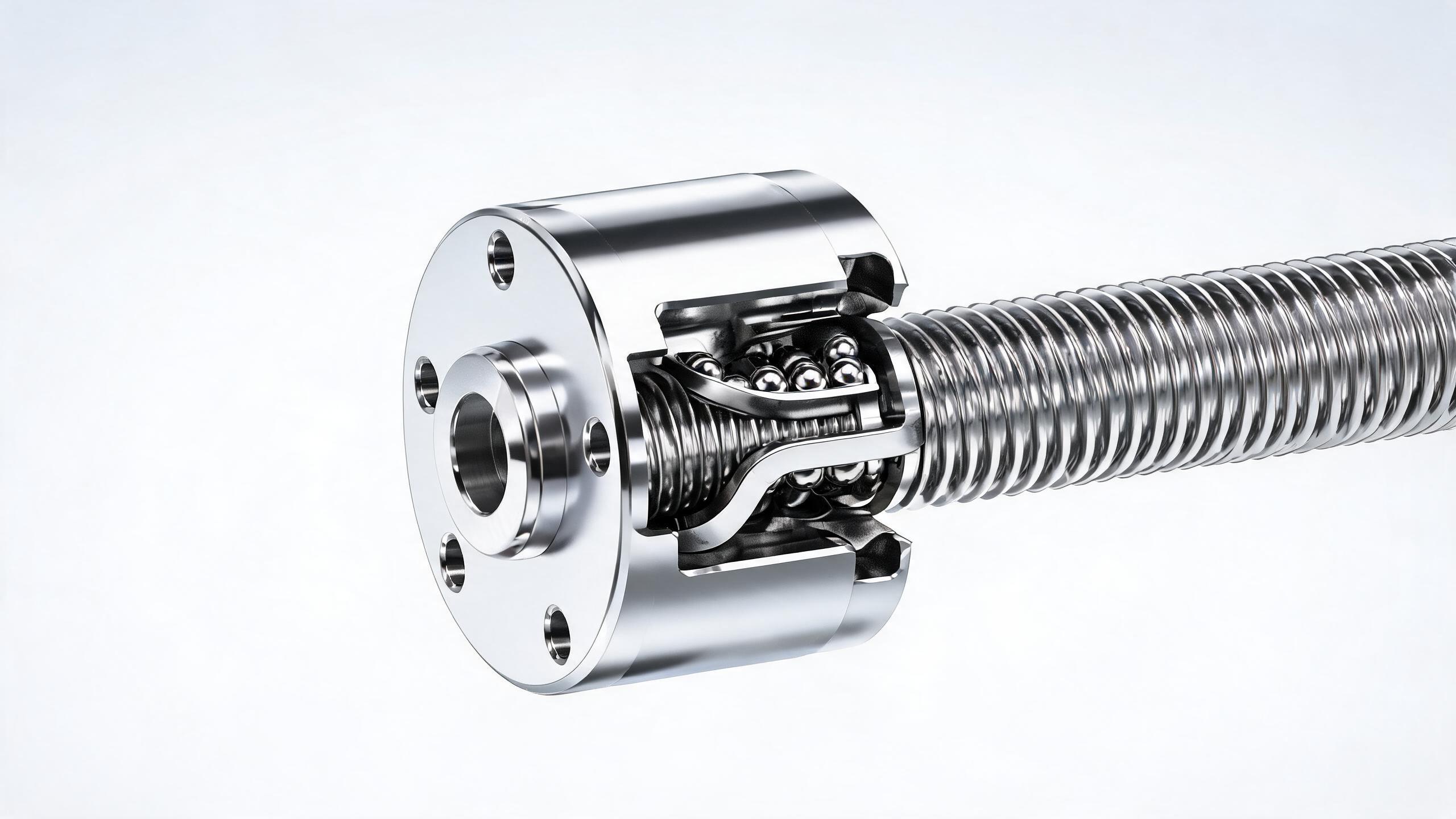
Choosing between SFE ground ball screws and SFU rolled ball screws affects positioning accuracy, cost, and service life in your automation system. This guide compares manufacturing processes, precision grades, surface finish, and practical application fit—so you can specify the right linear motion screw for your machine.
BUYER GUIDE · LINEAR MOTION SCREWS
When you are sourcing a ball screw drive for a new machine, the first question is usually the same: ground or rolled? The answer decides your positioning accuracy, your lead time, and roughly 30–50% of your motion component budget.
This guide compares SFE ground ball screws and SFU rolled ball screws across manufacturing process, precision classes, surface finish, and real application fit. The goal is not to declare one "better"—it is to help you specify the right screw actuator for your load, speed, and duty cycle.
- SFU rolled screws are the cost-effective standard for general automation and material handling—typically ISO class 7–10 accuracy.
- SFE ground screws deliver class C3–C5 accuracy and smoother motion, but at a higher unit cost and longer lead time.
- Surface finish and hardness differ by process: ground screws have a smoother raceway, which directly affects noise, wear, and preload stability.
- Your choice should follow the machine's positioning requirement, not the other way around.
- For quantities above a few hundred pieces, ask your supplier about rolled-to-order lead times and ground-screw minimums—both vary by manufacturer.
How Each Type Is Manufactured
The manufacturing process is the root of every difference between SFE and SFU screws.
SFU rolled ball screws are produced by thread rolling. A hardened blank is passed between rotating dies that form the thread profile in a single, continuous operation. This is a cold-forming process: the material is displaced, not cut. It is fast, material-efficient, and well suited to mass production. The resulting thread surface has a characteristic as-rolled finish—functional, but not mirror-smooth.
SFE ground ball screws start as a rolled or turned blank, then go through additional machining: the thread is cut or ground to final profile, followed by heat treatment and a precision grinding pass on the raceway. Grinding removes material to achieve tight lead accuracy and a fine surface finish. This is a slower, multi-step process, which is why ground screws cost more and take longer to produce.
| Process Step | SFU Rolled | SFE Ground |
|---|---|---|
| Thread formation | Cold rolling (displacement) | Cutting + grinding (material removal) |
| Typical lead accuracy | ISO class 7–10 | ISO class C3–C5 |
| Surface finish (Ra) | Roughly 0.8–1.6 µm | Roughly 0.2–0.4 µm |
| Relative cost | Baseline (1x) | 1.5–3x depending on grade |
| Lead time | Shorter, stock-friendly | Longer, often made to order |
Precision and Positioning Accuracy
For automation buyers, precision is usually the deciding factor. The question is: how accurate does your machine actually need to be?
A rolled SFU screw in class C7 has a lead error of roughly ±50 µm per 300 mm. That is perfectly adequate for a conveyor indexer, a packaging machine lift, or a basic pick-and-place axis where the final position is confirmed by a mechanical stop or a separate sensor.
A ground SFE screw in class C3 holds lead error to about ±8 µm per 300 mm—roughly six times tighter. More importantly, ground screws offer consistent pitch error over the full travel length, which matters when the screw is the only positioning element in the loop, as in a CNC axis or a precision dispenser.
One more point: backlash and preload. Ground screws are easier to manufacture with consistent ball-circuit geometry, so they hold preload more uniformly along the travel. Rolled screws can also be preloaded, but the variation in thread profile along the length means preload torque tends to drift more over the stroke. For applications requiring low and stable drag torque, ground is the safer choice.
Surface Finish and Its Practical Effect
Surface finish is not just a cosmetic metric. On a ball screw drive, the raceway finish affects three things you will feel in operation:
- Noise: A smoother raceway produces less vibration as balls recirculate. Ground screws run noticeably quieter, which matters for lab equipment and medical devices.
- Wear and life: A finer finish reduces friction between balls and raceway, which slows wear and helps maintain preload longer. This is why ground screws are preferred for high-cycle, high-speed axes.
- Lubrication film: A smooth surface holds a more uniform oil film, reducing the risk of metal-to-metal contact at high speed.
That said, the rolled SFU finish is not "bad"—it is simply appropriate for a different duty. In a low-cycle, moderate-speed application, a rolled screw with proper lubrication will run for years without issue. The finish only becomes a limiting factor at high speeds, high loads, or when the machine runs continuously.
Application Selection: Which Screw for Which Machine?
Here is a practical breakdown by application type. Use this as a starting point, then confirm with your supplier's engineering team.
| Application | Recommended Type | Why |
|---|---|---|
| CNC machine tools (milling, lathe, EDM) | SFE ground | High positioning accuracy, preload stability, low thermal drift |
| Precision dispensing / gluing systems | SFE ground | Consistent pitch over short strokes; smooth, quiet motion |
| Medical devices, lab automation | SFE ground | Low noise, smooth motion, repeatability |
| Packaging machinery | SFU rolled | Cost-effective; accuracy class C7 is sufficient |
| Material handling / conveyors | SFU rolled | High load capacity, lower cost, longer stroke available |
| General pick-and-place robots | SFU rolled | Speed and cost matter more than sub-10 µm accuracy |
| Semiconductor / high-end inspection | SFE ground | Sub-micron repeatability requirements |
There is also a middle path: some suppliers offer rolled screws with ground lead—a hybrid that improves lead accuracy without the full cost of a ground raceway. This is worth asking about if you are between classes C5 and C7 and want to save cost. Availability varies by manufacturer, so treat it as an option to request, not a standard.
Cost and Lead Time Considerations
For a typical 16 mm diameter, 500 mm stroke screw, a rolled SFU unit might cost you one-third to one-half of a ground SFE equivalent. The gap narrows as diameter increases, because the grinding cost does not scale linearly with size—but it never disappears.
Lead time is a separate issue. Rolled screws are often stocked in standard diameters and leads, so you can get samples in days. Ground screws are almost always made to order, with lead times of 4–8 weeks depending on the factory's schedule. If you are prototyping, a rolled screw can get you moving while you wait for the ground version.
For volume buying, ask your supplier for:
- Minimum order quantity (MOQ) for each type
- Lead time for custom lengths and end machining
- Whether they offer preloaded nut assemblies (single or double nut)
- Certification of lead accuracy (inspection report per piece)
Common Mistakes When Specifying
Three errors come up repeatedly when buyers select linear motion screws:
1. Overspecifying accuracy. Buying C3 ground screws for a machine that only needs C7 is a direct cost overrun. Match the screw class to the machine's actual positioning budget—not to a marketing brochure.
2. Ignoring the nut assembly. The screw is half the system. A rolled screw with a high-quality preloaded nut can outperform a ground screw with a loose nut. Specify the nut assembly together with the screw, and ask for the dynamic load rating (C value) and preload torque range.
3. Forgetting end machining and mounting. The screw's precision is useless if the ends are not machined to match your bearing mounts. Confirm the journal diameters, thread tolerances, and concentricity with your supplier before ordering.
How to Confirm Quality from a Supplier
When you receive a quote, ask for these specific items:
- Lead accuracy grade (ISO class) and the inspection method
- Surface roughness (Ra) of the raceway, if ground
- Hardness (typically 58–62 HRC for the raceway)
- Dynamic and static load ratings (C and C0)
- Preload type and torque range for the nut
- Material grade (typically 55Cr3 or equivalent for the screw shaft)
A reliable supplier will provide an inspection report per batch. If they cannot, treat that as a red flag regardless of price.
FAQ
Q: Can I use an SFU rolled screw for a CNC retrofit?
Only if your positioning tolerance is above ±50 µm and you accept some backlash. For most CNC work, a ground SFE screw is the safer choice.
Q: Are ground screws always quieter?
Generally yes, due to the smoother raceway. But noise also depends on nut design, preload, and lubrication. Ask for a noise comparison test if this is critical.
Q: What about corrosion resistance?
Both types can be supplied with a protective coating (e.g., black oxide, electroless nickel). Ground screws are more commonly coated because the application justifies the added cost. Confirm the coating type with your supplier—do not assume.
Q: Do I need a ground screw for vertical applications?
Not necessarily. Vertical axes often use a brake or counterweight, so the screw's accuracy class is less critical. Focus on the nut's holding torque and the screw's critical speed instead.
Q: What is the typical life difference?
At the same load and speed, a ground screw typically has a longer service life due to better surface finish and more consistent preload. But the difference is meaningful only in high-cycle applications. For low-cycle machines, the rolled screw will wear out at a similar rate.
Final Recommendation
Here is a simple rule for your next RFQ:
- If your machine needs better than ±20 µm positioning accuracy, or runs at high speed continuously, or must be quiet—specify SFE ground.
- If your machine operates at ±50 µm or coarser, runs at moderate speed, and cost matters—specify SFU rolled.
- If you are unsure, request both quotes and compare the total cost of ownership: screw price + nut assembly + expected life + downtime risk.
Finally, talk to your supplier early. Share your load, speed, duty cycle, and accuracy requirement. A good supplier will help you avoid both overspecification and premature failure—that is worth more than any price advantage.
If you are working on a new automation project and need help selecting a ball screw drive, send us your application parameters. We can recommend a screw actuator that fits your accuracy and budget requirements.