
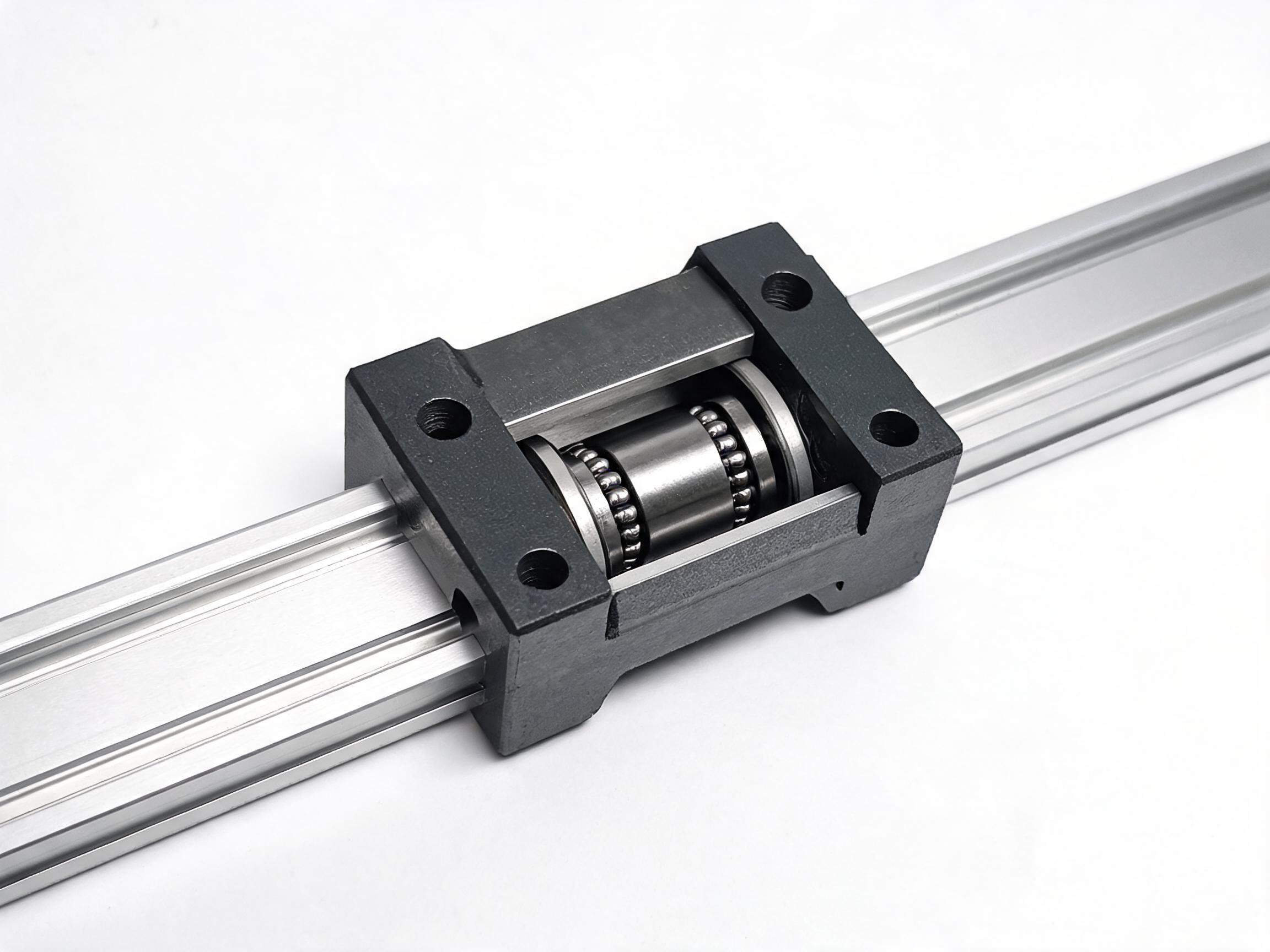
A practical guide for international buyers and design engineers on selecting ball screw nuts. This article breaks down the structural differences between single and double nut assemblies, explains preload and backlash concepts, and provides actionable criteria for accuracy class matching in CNC, automation, and precision machinery applications.
BUYER GUIDE / PRECISION MOTION CONTROL
Why Nut Selection Decides Machine Performance
When a procurement engineer or machine designer specifies a ball screw assembly, the nut is often where the real performance battle is won or lost. The screw shaft defines travel accuracy, but the nut determines axial rigidity, backlash, and service life under load. Choose the wrong nut configuration, and even a C3-ground screw will deliver poor positioning repeatability or fail prematurely due to heat generation.
This guide focuses on the two most common decisions buyers face: single nut vs. double nut preload, and how to match accuracy classes (C5, C3, C1) to your actual application requirements. We will keep the explanation practical—no theoretical padding—so you can translate these criteria directly into a purchase specification.
- Double nut preload is mandatory for zero-backlash, high-rigidity axes (milling, grinding, high-speed positioning).
- Single nut designs are cost-effective for light loads and unidirectional positioning, but they cannot eliminate axial play completely.
- Accuracy class (C5 vs. C3) is about lead error, not backlash. Do not confuse the two—buyers frequently over-specify accuracy while under-specifying preload.
- Preload level directly affects temperature rise and life. "More preload" is not always better; it must match the duty cycle.
- Always request the supplier's preload torque test data and lead deviation chart before mass ordering.
1. The Core Difference: Where Does Backlash Come From?
Backlash in a ball screw is the axial play between the nut and the screw shaft when the direction of travel reverses. In a non-preloaded nut, the balls sit in the raceway with a small clearance. When the load reverses, the nut moves a few microns before the balls re-establish contact. In positioning terms, that is lost motion—and it directly kills contouring accuracy and repeatability.
Preloading eliminates this clearance by forcing the balls into constant contact with both the screw and nut raceways. There are two structural ways to achieve this: oversized ball diameter (internal preload, single nut) or two nuts forced apart axially (double nut preload).
2. Single Nut: Cost-Effective, But Know Its Limits
A single nut assembly uses one nut body. Preload, if any, is achieved by using balls that are slightly larger than the raceway groove. This is called oversized ball preload or internal preload.
Advantages of Single Nut
- Lower cost: Fewer components, simpler machining, shorter overall length.
- Compact design: Critical for space-constrained axes (e.g., small robot arms, compact linear modules).
- Lower torque: Less friction than a heavily preloaded double nut, which suits high-speed, light-load applications.
Disadvantages and Limitations
- Limited preload capacity: Internal preload via ball oversize is typically light to moderate. Heavy preload risks ball jamming or excessive heat.
- Backlash can reappear: As the nut wears over time, the preload diminishes. In a single nut, there is no way to re-tighten it—replacement is the only fix.
- Lower axial rigidity: For milling or heavy cutting, the deflection under load will be higher than a double nut assembly.
Typical applications for single nut: General-purpose positioning tables, 3D printers, light-duty pick-and-place machines, and any axis where the load is consistent and reversal is infrequent.
3. Double Nut Preload: The Standard for Zero Backlash
In a double nut configuration, two separate nut bodies are mounted on the same screw shaft. A preload mechanism (spacer, spring, or disc spring stack) pushes them apart axially, taking up all clearance between the balls and raceways. This creates a rigid, zero-backlash system.
Why Double Nut Wins for Rigidity
The axial force from the preload mechanism forces the balls in both nuts to contact opposite flanks of the screw thread. The result is a system that behaves like a rigid block—no lost motion, no reversal dead zone. This is non-negotiable for:
- CNC milling and machining centers (cutting forces reverse constantly).
- Grinding machines requiring micron-level repeatability.
- EDM machines and precision laser cutting tables.
- Heavy-duty automation with high dynamic loads.
Preload Methods in Double Nut Designs
| Preload Method | How It Works | Typical Preload Ratio | Best For |
|---|---|---|---|
| Spacer (Fixed) | A precision ground spacer between two nuts sets a fixed preload. | 5–10% of dynamic load | General CNC, constant load direction |
| Spring / Disc Spring | Spring force maintains preload even as wear occurs. | Light–medium (2–5%) | Vertical axes, applications with thermal variation |
| Adjustable (Lock Nut) | User can re-tighten preload after wear. | Variable | Maintenance-friendly designs, high-wear environments |
Important note for buyers: The preload ratio is expressed as a percentage of the dynamic load rating (Ca). A common starting point is 5–8% preload. Going above 10% can cause significant temperature rise, which leads to thermal expansion of the screw and loss of positioning accuracy—the opposite of what you want.
4. Zero-Backlash vs. Zero Clearance: What You Can Actually Achieve
Buyers often ask for "zero backlash." Technically, a preloaded nut achieves zero clearance, but friction and elastic deformation still exist. What you are really buying is predictable, repeatable stiffness, not a frictionless ideal.
Specify "preloaded to eliminate axial clearance" rather than "zero backlash." The former is a measurable, testable standard; the latter is a marketing phrase.
When requesting quotes, ask the supplier for:
- Axial clearance (μm): Should be "0" or "negative" (preload) for double nut assemblies.
- Preload torque value (N·cm): Measured at the screw shaft with the nut locked. This gives you a baseline for incoming inspection.
- Dynamic runout: Indicates manufacturing consistency.
5. Accuracy Class: Matching C5, C3, and C1 to Reality
Accuracy class (JIS B1192 or ISO 3408) refers to the maximum lead error over a given travel length. It does not describe backlash. A C5 screw can have zero backlash if paired with a preloaded double nut; a C1 screw can have terrible backlash if the nut is loose.
| Accuracy Class | Lead Error (per 300mm) | Typical Applications | Relative Cost |
|---|---|---|---|
| C7 | ±50 μm | General transport, simple positioning | Lowest |
| C5 | ±23 μm | Standard CNC, injection molding machines, general automation | Baseline |
| C3 | ±8 μm | High-precision CNC, semiconductor equipment, measuring machines | 1.5–2x C5 |
| C1 | ±5 μm | Ultra-precision grinding, metrology, aerospace actuators | 2.5–3x C5 |
How to Choose: Don't Over-Specify
The most common mistake in ball screw procurement is over-specifying accuracy while under-specifying rigidity. A C3 screw with a single nut and no preload will perform worse in a milling application than a C5 screw with a properly preloaded double nut. The machine's positioning error is dominated by mechanical play and deflection, not by the screw's lead error.
Practical selection rule:
- If your positioning tolerance is ±0.05 mm, C5 is sufficient. Spend your budget on a double nut preload instead.
- If your positioning tolerance is ±0.01 mm, C3 with a preloaded double nut is the safe choice.
- If you are building a measuring machine or a precision grinder, C1 or C3 with a light preload (to avoid heat) is appropriate.
6. Preload vs. Heat: The Trade-off You Must Manage
Preload increases friction, and friction generates heat. Heat causes the screw shaft to expand (typically 12 μm per meter per °C for steel). If your machine runs continuously, thermal growth will shift the zero point.
For high-speed, low-load applications (e.g., a gantry pick-and-place running at 2 m/s), a heavy preload will overheat the nut and shorten life. In these cases, use a light preload (2–3%) or a spring-loaded double nut that can accommodate thermal expansion without locking up.
For heavy cutting (e.g., a vertical machining center), a medium preload (5–8%) is recommended to maintain rigidity under varying load directions. The machine's cooling system or duty cycle usually handles the heat.
7. Decision Matrix: Which Nut Should You Specify?
| Application Profile | Recommended Nut Type | Preload Level | Accuracy Class |
|---|---|---|---|
| Light-duty positioning, unidirectional | Single nut | None or light | C5 or C7 |
| General automation, bidirectional positioning | Single nut (if budget-constrained) or double nut | Light–medium | C5 |
| CNC milling / machining center | Double nut | Medium (5–8%) | C5 or C3 |
| High-speed gantry, light load | Double nut (spring preload) | Light (2–3%) | C5 |
| Precision grinding / measuring | Double nut | Light (to limit heat) | C3 or C1 |
| Vertical axis (Z-axis) | Double nut (spring or adjustable) | Medium | C5 or C3 |
8. What to Send in Your RFQ
To get accurate quotes from ball screw suppliers, include these five data points:
- Shaft diameter and lead (e.g., 25 mm diameter, 10 mm lead).
- Nut type: Single, double, or flanged—and whether preload is required.
- Preload specification: Either a target preload ratio (e.g., 5% of Ca) or a required axial clearance value (e.g., ≤0.005 mm).
- Accuracy class: C5, C3, or C1, and the travel length for lead error measurement.
- Operating conditions: Load (kgf or N), speed (m/min), duty cycle (%), and expected life (hours or km of travel).
Suppliers can recommend a preload method based on your duty cycle, but the more precise your input, the more reliable the quote. If you are unsure about the preload ratio, request the supplier's test data for temperature rise at your operating speed—this is a concrete number that separates a good supplier from a reseller.
9. Common Specification Mistakes to Avoid
- Specifying C3 accuracy but no preload: You will get a precise screw with backlash. The machine will still have positioning error on reversal.
- Over-preloading for high-speed applications: Heat will distort the screw, and the nut may seize. Check the temperature rise at maximum speed.
- Choosing a single nut for a vertical axis: Without preload, the weight of the axis can cause the nut to drift when the motor is off. A double nut with spring preload is safer.
- Ignoring the mounting support: A preloaded nut transfers axial forces to the bearing blocks. If the end supports are not rigid, the preload is wasted.
10. Final Recommendation for Buyers
For 80% of industrial automation and CNC applications, the safe default is: C5 accuracy, double nut, medium preload (5%). This combination offers a balanced cost, reliable rigidity, and acceptable heat generation. Upgrade to C3 only when the application demands it, and always pair high accuracy with proper preload—otherwise, you are paying for precision you cannot use.
When evaluating suppliers, ask for a preload torque test report and a lead deviation chart for the specific batch you are ordering. These two documents confirm that the nut assembly matches the spec. A supplier who cannot provide them is likely not manufacturing to a controlled standard.
If you are currently sourcing ball screw assemblies and need help translating your machine requirements into a nut specification, send us your application details—load, speed, and accuracy target—and we will provide a configuration recommendation based on your operating envelope.