A practical buyer's guide to linear bush bearings for precision automation. Covers the main types (standard, closed, open, self-aligning), seal options and their trade-offs, how to read dynamic/static load ratings, and what to specify when sourcing from a manufacturer. Written for engineers and procurement teams who need to make a defensible selection, not a sales pitch.
BUYER GUIDE — LINEAR MOTION COMPONENTS
What a Buyer Actually Needs to Know About Linear Bush Bearings
If you are sourcing a linear bush bearing for a pick-and-place machine, a packaging line, or a CNC axis, the catalog page alone will not tell you what you need. The datasheet lists dimensions, load ratings, and seal types — but the real questions are about fit: Will this bearing survive the duty cycle? Does the seal add too much drag for a servo-driven axis? Is the load rating calculated for static or dynamic conditions?
This guide is written for engineers and procurement teams who need to make a defensible selection. We cover the main types, the seal trade-offs, how to read load ratings correctly, and what to put on your RFQ so the supplier quotes the right part the first time.
- Choose the bearing type by motion path and mounting constraints — open and closed types are not interchangeable.
- Seals protect against contamination but add friction; match the seal to the environment, not to the cheapest option.
- Dynamic load rating (C) is for moving loads; static load rating (C0) is for stationary loads. Using the wrong one under-specifies the bearing.
- For precision automation, specify shaft hardness and surface finish — the shaft is half the bearing system.
- Always request the load-life calculation from the supplier with your actual mass, speed, and duty cycle.
What Is a Linear Bush Bearing?
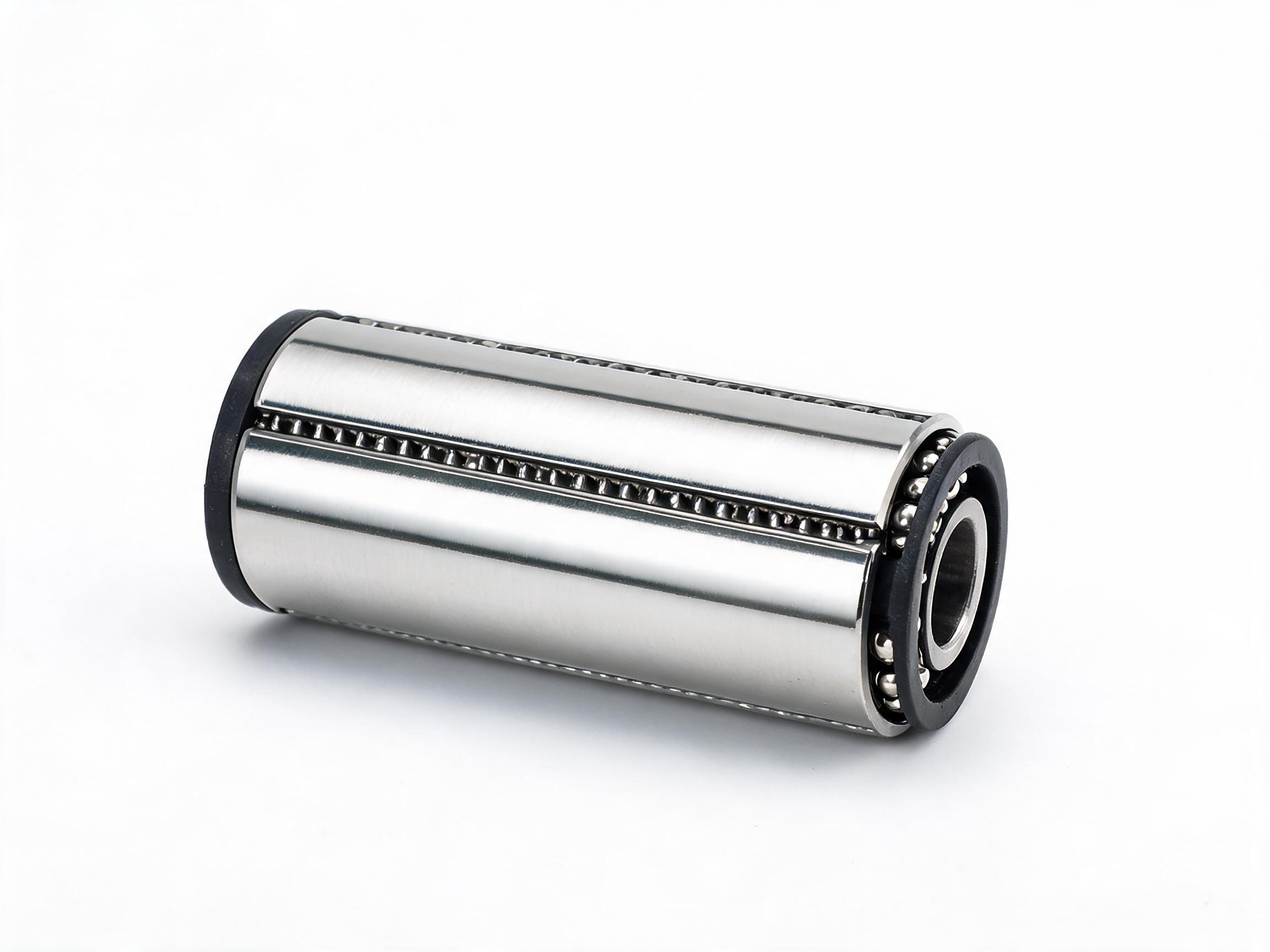
A linear bush bearing (also called a linear ball bushing) is a recirculating ball bearing that allows linear motion along a hardened shaft. Unlike a plain bearing, it uses balls that recirculate through a circuit, which gives low friction and high speed capability. The balls contact the shaft and the bearing race, and the cage keeps them evenly spaced.
The key specification points are:
- Shaft diameter — the bore size matches the shaft, typically metric (8, 12, 16, 20, 25, 30, 40, 50 mm) or inch series.
- Outer diameter and length — determines the housing bore and the load-carrying length.
- Ball circuit count — more circuits mean higher load capacity but a longer bearing.
- Seal configuration — contact or non-contact, single or double lip.
A linear bush bearing is almost always used with a hardened and ground shaft. The shaft surface finish and hardness directly affect the bearing's life and load capacity. A soft shaft will brinell the balls and fail early, regardless of the bearing quality.
Types of Linear Bush Bearings
There are four main configurations. Each solves a specific mounting or motion problem.
1. Standard Closed Type (LM Series)
This is the most common type. The bearing is a full cylinder with a bore, and it requires a housing with a cylindrical bore. It is used for simple linear motion on a single shaft. The closed type gives the best radial load distribution because the balls are arranged around the full circumference.
Typical part designation: LM12UU (12 mm shaft, standard length, double seal).
2. Open Type (LME / LM-OP Series)
The open type has a longitudinal cut in the outer sleeve. This allows the bearing to be used on a shaft that already has a support rail, or where a wiper or sensor needs to pass through. The open section reduces the ball contact area, so load capacity is lower than a closed type of the same diameter. Use it only when the shaft must pass through a support or when space constraints require it.
Typical part designation: LM12UU-OP.
3. Self-Aligning Type (LM...A Series)
This type has a spherical outer surface that fits into a matching housing. It compensates for shaft deflection, housing misalignment, or mounting inaccuracies. If your frame is welded or has loose tolerances, the self-aligning type prevents binding. The trade-off is slightly higher cost and a larger housing requirement.
Typical part designation: LM12UUAJ (adjustable clearance, self-aligning).
4. Adjustable / Clearance-Adjustable Type (LM...AJ Series)
This type has a slit in the outer sleeve with a threaded hole, allowing the bearing to be tightened or loosened to adjust radial clearance. It is useful when you need to fine-tune preload or compensate for wear over time. It is often used in pairs on a single shaft to eliminate play in a precision axis.
Typical part designation: LM12UU-AJ.
| Type | Best For | Trade-Off | Common Series |
|---|---|---|---|
| Closed (Standard) | Simple single-shaft motion, highest radial load | Requires cylindrical housing bore | LM, LME |
| Open | Shafts with support rails, wipers, sensors | Lower load capacity due to cut section | LM-OP, LME-OP |
| Self-Aligning | Misaligned frames, shaft deflection | Larger housing, higher cost | LM...A |
| Adjustable Clearance | Preload tuning, wear compensation | Requires periodic adjustment | LM...AJ |
Seal Types and What They Mean for Your Application
The seal is not an accessory — it is a functional part that determines the bearing's operating envelope. The wrong seal will either let contamination in or add so much drag that the axis cannot reach its speed spec.
Non-Contact Seal (Clearance Type)
This is a metal or plastic shield that leaves a small gap between the seal and the shaft. It keeps out large particles but does not contact the shaft, so friction is minimal. Use it in clean environments: assembly robots, semiconductor equipment, lab automation.
Friction: Negligible. Protection: Low.
Contact Seal (Rubber Lip, Single or Double)
A nitrile or rubber lip presses against the shaft. It keeps out fine dust and moisture, and it also retains the internal grease. The trade-off is friction: a double-lip seal can add significant drag, which matters on small servo axes with low available torque.
Friction: Moderate to high. Protection: High.
Scraper / Wiper Seal
Used in dirty environments — woodworking, metal cutting, packaging with dust. A scraper removes debris from the shaft before it enters the bearing. It is often combined with a contact seal. Expect higher friction and a slight reduction in max speed.
Friction: High. Protection: Very high.
| Seal Type | Environment | Friction | Max Speed Impact |
|---|---|---|---|
| Non-contact (shield) | Clean rooms, lab, assembly | Minimal | Negligible |
| Single-lip contact | General industrial, light dust | Low-moderate | Slight reduction |
| Double-lip contact | Moisture, fine dust | Moderate-high | Noticeable reduction |
| Scraper / wiper | Heavy dust, chips, debris | High | Significant reduction |
Rule of thumb: if your axis is servo-driven and needs to hit a speed above 1 m/s, start with a single-lip seal and verify the drag torque against your motor's continuous torque rating. Double-lip seals are for protection, not speed.
Load Ratings: How to Read Them Correctly
This is where most specification errors happen. Linear bush bearings have two load ratings, and they are not interchangeable.
Dynamic Load Rating (C)
This is the load that gives a calculated basic rating life of 50,000 meters of travel (for linear bushings, the life formula is based on distance, not revolutions as in rotary bearings). It is expressed in Newtons (N). Use this for applications where the bearing moves under load.
The life equation is:
L = (C / P)³ × 50,000 meters
Where P is the equivalent dynamic load. The cubic exponent means that doubling the load reduces life to one-eighth. This is why over-specifying the load is costly — the bearing life drops off dramatically.
Static Load Rating (C0)
This is the maximum load the bearing can withstand without permanent deformation of the balls or raceway. It applies when the bearing is stationary under load — for example, a fixture that holds a part in place, or a locked axis. Exceeding C0 causes brinelling (indentations on the raceway), which will cause vibration and premature failure once motion resumes.
For most automation applications, you will size using the dynamic load rating. Use C0 only to verify that a stationary load does not exceed the material's yield limit.
Equivalent Load Calculation
In a real application, loads are rarely purely radial. If there is a moment load (e.g., an overhung load on a cantilevered axis), you must convert it to an equivalent radial load. The formula depends on the bearing geometry and the distance from the load point to the bearing center. Ask the supplier to do this calculation — it is a standard part of the sizing service, and any competent manufacturer will provide it with a quotation.
- Total moving mass (kg) and its center of gravity position.
- Duty cycle: strokes per minute, stroke length, acceleration/deceleration.
- Required life in meters or hours.
- Environment: dust, moisture, temperature range.
- Shaft material and hardness, if already specified.
With these inputs, a supplier can calculate the required bearing size and life, and quote the correct part. Without them, you will get a generic quote that may be under-specified.
Practical Selection Checklist for Precision Automation
- Define the motion path. Single shaft, dual shaft, or supported rail? This decides closed vs. open type.
- Check the mounting tolerance. If the housing bore is not precision-machined, use the self-aligning type.
- Estimate the equivalent dynamic load. Include acceleration forces, not just the static weight.
- Calculate the required life. Use the C/P³ formula with your actual duty cycle.
- Select the seal. Match it to the environment, then verify the drag torque against the motor.
- Specify the shaft. Minimum 58 HRC hardness, ground finish of Ra 0.4 or better. A cheaper shaft will destroy an expensive bearing.
- Confirm lubrication. Most linear bushings are grease-packed at the factory. If your application needs food-grade or low-outgassing grease, state it on the RFQ.
Common Mistakes When Sourcing Linear Bush Bearings
Mistake 1: Using static load rating for a moving application. This under-specifies the bearing and leads to early failure. Always use dynamic load rating (C) for moving loads.
Mistake 2: Ignoring the shaft. A bearing is only as good as the shaft it rides on. A shaft with 40 HRC hardness will wear out the bearing raceway quickly, even if the bearing is high quality.
Mistake 3: Over-sealing. A double-lip seal on a clean-room application adds unnecessary drag and heat. Match the seal to the environment.
Mistake 4: Not accounting for moment loads. An overhung load creates a moment that multiplies the effective radial load. If your load point is far from the bearing center, get the equivalent load calculated.
Mistake 5: Buying on price alone without a life calculation. The cheapest bearing will fail faster, and the downtime cost will exceed the price difference. Ask for the calculated life in the quotation.
Frequently Asked Questions
Q: Can I use a linear bush bearing without a hardened shaft?
A: No. The balls will brinell a soft shaft, and the bearing will fail quickly. Use a shaft with at least 58 HRC hardness and a ground finish.
Q: What is the difference between LM and LME series?
A: LM series is metric, LME series is inch-based. The outer diameter and length differ. Always match the series to your housing bore.
Q: How do I know if I need a self-aligning type?
A: If your frame is welded, has loose tolerances, or the shaft may deflect under load, use the self-aligning type. It prevents binding and premature wear.
Q: Can I adjust preload on a standard linear bush bearing?
A: No. Preload adjustment requires the adjustable-clearance type (AJ series). Standard types have fixed clearance.
Q: What is the typical life of a linear bush bearing?
A: Life is calculated using the C/P³ formula and is expressed in meters of travel. It depends entirely on the applied load, speed, and lubrication. A correctly sized bearing in a clean environment can achieve millions of meters; an under-sized one can fail in weeks.
Final Recommendation for Buyers
When you send an inquiry for a linear bush bearing, do not just send a part number. Send the application data: mass, speed, duty cycle, environment, and required life. A reputable manufacturer will respond with a bearing size, a calculated life, and a seal recommendation. If a supplier quotes a price without asking for this information, treat it as a red flag — they are quoting a generic part, not a solution for your application.
For precision automation systems, the linear bush bearing is a small component with a large impact on machine reliability. Get the type, seal, and load rating right, and the bearing will outlast the machine. Get it wrong, and you will be replacing it during commissioning.
Need help selecting the right linear bush bearing for your automation project? Send us your application parameters — mass, speed, duty cycle, and environment — and we will provide a sizing recommendation with calculated life.