
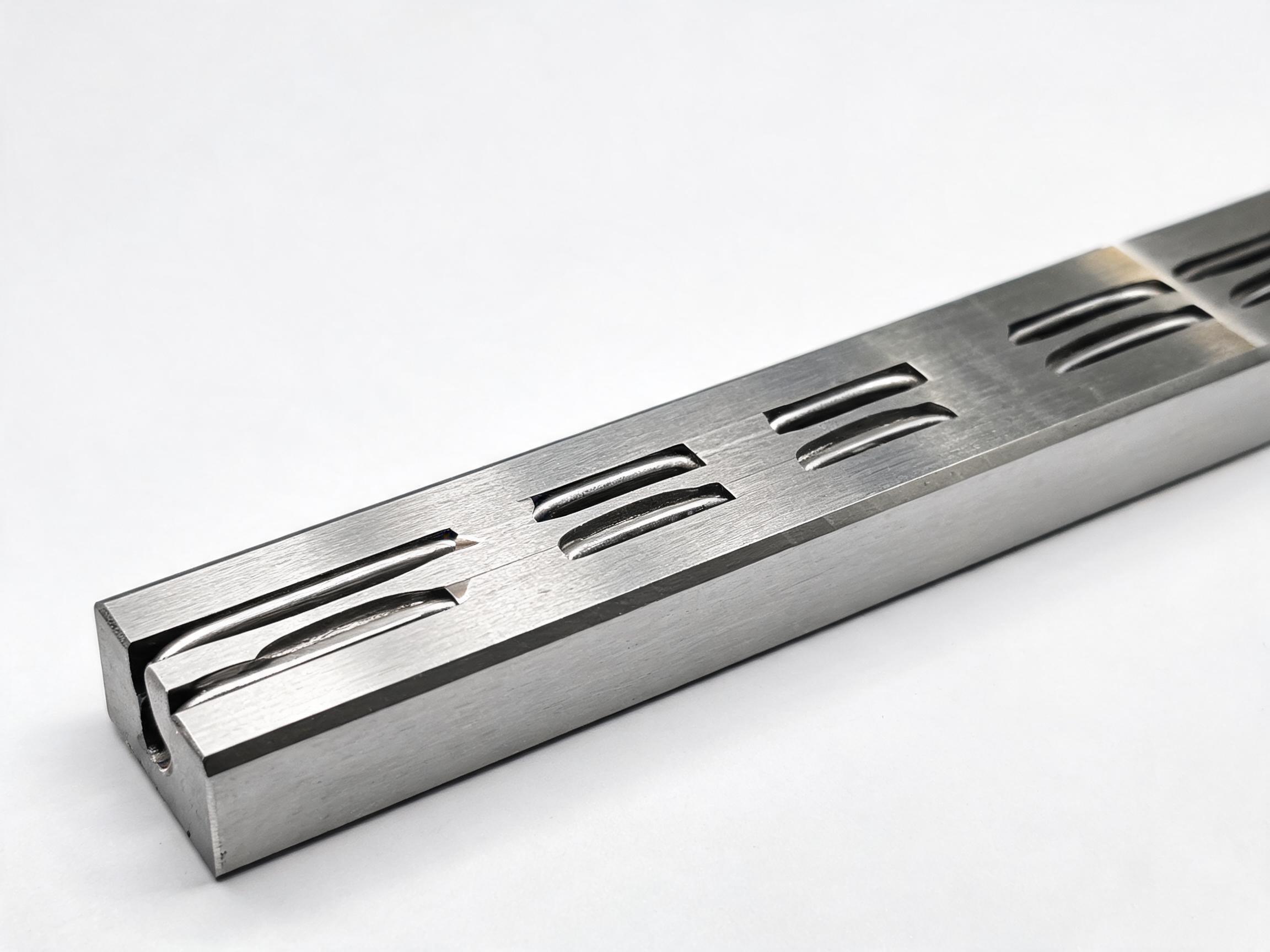
A grade on a guideway datasheet describes the rail and carriage pair, not the finished axis. This guide separates the accuracy grade from the two other inputs that decide real positioning accuracy: carriage preload and mounting surface machining, with a decision path for ground P5 equivalent versus rolled P7 equivalent.
Spec Sheet Reading Guide
The accuracy grade on a guideway datasheet is one of three inputs that decide how accurately an axis actually moves. Buyers often price the grade as if it were the finished result. It is not. What follows is how to read the grade correctly, what it leaves out, and when the cheaper grade is the right one.
What an accuracy grade on a guideway actually describes
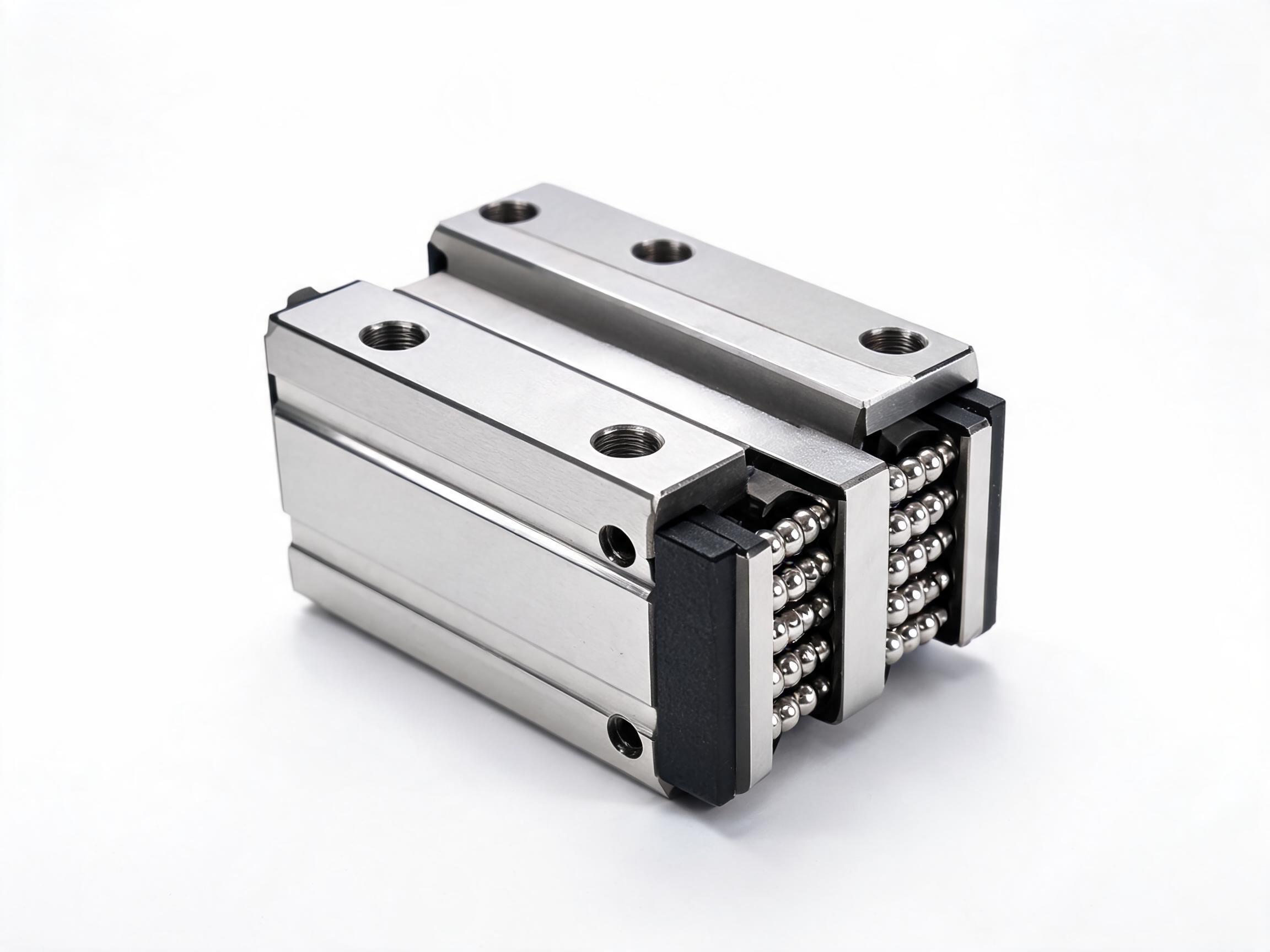
An accuracy grade on a linear guideway datasheet describes the rail and carriage as a matched pair. It covers two things: the running parallelism of the carriage as it travels along the rail, and the dimensional tolerance of the rail and carriage themselves. Running parallelism is the deviation of the carriage path from a reference line over the rail length. The dimensional tolerance covers the rail's cross-section, height and the carriage's mounting references, so a pair of the same grade from one production lot can be swapped without re-shimming.
What the grade does not describe matters more for machine builders. It says nothing about:
- The flatness, straightness or twist of the machine frame the rail is bolted to.
- The stiffness of the axis under load, which is set by carriage preload and ball contact geometry, not by grade.
- Repeatability of the drive, the screw or the encoder.
- Thermal growth of the frame and rail in operation.
In other words, the grade is a promise about a component, not about an axis. A P5-equivalent rail mounted on an unmachined or warped frame will follow the frame, not the grade. A rolled rail on a well-machined, well-supported frame can hold tighter results than a ground rail on a rough one. The grade sets the ceiling; the frame sets how close to that ceiling you get.
The grade labels used on this product family
On the HGR rail series and HGH carriage series, two precision grades are offered. Ground rail and carriage are designated grade H and described as equivalent to P5. Rolled rail and carriage are designated grade N and described as equivalent to P7. Both are surface induction hardened to 58-62 HRC on 55# high-carbon steel, so the grade difference is about geometry and finishing, not material hardness.
Treat these labels as cross-reference, not as a universal standard. Grade naming conventions differ between suppliers, and a P5 from one source is not automatically interchangeable with a P5 from another on every dimension. The datasheet for the exact size governs: check the running parallelism figure, the height tolerance and the carriage reference dimensions for the size you are ordering, not the letter alone. Where a supplier uses a different lettering system, ask for the tolerance table in millimetres rather than a grade name.
The numbers themselves are size-specific, which is why this article does not print a single tolerance table for the whole series. The figures that are published here belong to one size: the HGR45 record states a straightness tolerance of 0.02 mm per metre on ground P5 grade rails and a raceway flatness held to 5 micrometres. Those figures belong to the HGR45 size only. For any other size, request the running parallelism and height tolerance values for that size from the product page or the datasheet before quoting, and attach the returned table to the purchase order.
The rail and carriage are ordered as a pair. The HGR series heavy-duty linear guideway rail and the HGH series flange-type carriage block are matched by size, and the grade applies to both. Mixing a ground rail with a rolled carriage, or two suppliers' parts of the same nominal size, breaks the tolerance relationship the grade assumes. Standard rail length runs to 4000 mm, with custom lengths on request; on long spans the straightness figure carried on the datasheet becomes the limiting number, not the grade letter.
| Grade on this family | Described as equivalent to | Tolerance figures | Typical fit |
|---|---|---|---|
| Ground, grade H | P5 | Size-specific; HGR45 states 0.02 mm per metre straightness and 5 micrometre raceway flatness | Precision axes, long spans where straightness per metre matters, machines where the frame is machined to match |
| Rolled, grade N | P7 | Size-specific; request the value for the exact size | General automation, transfer and handling axes where the frame machining, not the rail, is the dominant error source |
The three inputs that decide final axis accuracy
Final positioning accuracy of a linear axis is the sum of three contributions. Buyers who price only the first one usually overpay.
- Rail grade. Sets the running parallelism and dimensional tolerance of the rail and carriage pair. This is the number on the datasheet.
- Carriage preload grade. Sets stiffness and lost motion. A C0 clearance carriage has a small amount of play by design; a C2 preloaded carriage removes it at the cost of drag torque. This is a separate selection from the accuracy grade and changes under-load positioning, not the datasheet grade.
- Mounting surface flatness and machining. The frame's flatness, straightness and the parallelism of the rail mounting faces. A rail bolted to a surface that is out of flat will be pulled to that surface. No grade compensates for this.
A practical consequence: if your frame is machined to a flatness and parallelism figure that is coarser than the grade's running parallelism, the grade cannot express itself. In that case, buying ground over rolled adds cost without adding accuracy. If the frame is machined to match, the grade becomes the limiting factor and the upgrade earns its price.
Preload as a separate axis from accuracy grade
Preload is often confused with grade. It is an independent choice on the HGH carriage series and should be specified separately on the drawing. Three grades are available: C0 clearance, C1 light preload and C2 medium preload.
- C0 clearance. Designed with a small internal clearance. Lowest drag torque and free running, but with lost motion when the load direction reverses. Suitable where the axis is not asked to hold position against reversing loads and where low friction matters.
- C1 light preload. Removes most of the internal clearance with modest drag torque. A common middle choice for axes that need stiffness without excessive heat or drive load.
- C2 medium preload. Higher stiffness under load and better resistance to vibration and reversing loads, at a higher drag torque. Suits machining and heavier cutting axes where stiffness is the priority.
Those descriptions are qualitative, and the record does not publish a drag torque figure per grade, so the choice is made on the duty and then confirmed with the supplier. In practice the sequence is: state the reversing load the axis must hold, state whether friction heat is a constraint, ask for the drag torque and stiffness values for the three grades at your size, and only then pick. A machine that already runs a C1 carriage and holds position does not need C2 unless something in the duty changed.
The four-row ball contact geometry of these carriages distributes radial, reverse radial and lateral loads simultaneously, and the four-row recirculation carries load in all four directions from a single carriage. That geometry is the same across preload grades; what changes is how tightly the balls are fitted to the raceways. GCr15 chrome steel balls run in hardened steel raceways in all grades.
When ground P5 equivalent is justified, and when rolled P7 equivalent is the right choice
The decision turns on whether your frame and your application can use the extra accuracy. Two branches cover most cases.
Ground P5 equivalent is justified when
- The mounting surface is machined to a flatness and parallelism that is at least as tight as the grade's running parallelism.
- The axis span is long and the straightness per metre on the datasheet is the limiting error. On long rails, this figure matters more than the grade name.
- The machine's positioning requirement is set by the guideway, not by the drive or the frame, for example a precision measuring or inspection axis.
- You are building a repeatable product line and want a single grade across all units so field service and spare parts stay consistent.
Rolled P7 equivalent is the correct and cheaper choice when
- The frame is fabricated or welded and machined to a coarser tolerance than the ground grade can express.
- The dominant error in the axis comes from the drive, the encoder or the frame, not the rail.
- The application is transfer, handling or general automation where the axis is positioned by a sensor or a stop, not by the rail's running parallelism.
- Budget is better spent on carriage preload or frame machining than on the rail grade.
Rolled N rail is not a compromise on material or hardening. It is a finishing choice. The saving is real, and it is spent better elsewhere when the frame cannot hold the tolerance.
What to put on a purchase drawing so the grade is actually delivered
A purchase drawing that states only "P5" invites a substitution. State the grade, the size and the tolerance table explicitly, and reference the datasheet version you reviewed.
- Rail series and size, for example HGR20, with rail length and any custom length.
- Carriage series and size, for example HGH20CA, matched to the rail size.
- Precision grade as both the internal designation and the equivalence, for example ground grade H, P5 equivalent, with the running parallelism and height tolerance figures from the datasheet.
- Preload grade separately, for example C1 light preload.
- Mounting surface flatness and parallelism requirement, so the frame and the rail grade are chosen together.
- Quantity, marking and packaging requirements, and the drawing revision number.
If the size is not confirmed, the tolerance figures cannot be confirmed either. Put the exact size on the drawing, and the datasheet for that size on the purchase order as an attached reference.
For long spans or heavy loads, the HGR45 heavy-duty large linear guideway rail carries the long-span figures quoted above. For smaller sizes, request the equivalent figure for that size before quoting. When you send the inquiry, include the rail size, the carriage size and height code, the required grade and preload, the rail length and the quantity, and ask for the tolerance table for that size to be returned with the quotation so the two documents match.
- Grade is a component promise, not an axis result.
- Preload is a separate selection from grade; specify both.
- Frame machining decides how much of the grade you actually get.
- Ground H (P5 equivalent) only pays when the frame and application can use it.
- Tolerance figures are size-specific; attach the table for your size to the order.
FAQ: grade versus real machine accuracy
Does a higher accuracy grade always give a more accurate machine?
No. The grade sets the running parallelism and dimensional tolerance of the rail and carriage pair. If the frame is machined to a coarser flatness than the grade's running parallelism, the rail follows the frame and the extra grade is not expressed. Match the grade to the frame.
Is preload part of the accuracy grade?
No. Preload is a separate choice on the HGH carriage series: C0 clearance, C1 light preload and C2 medium preload. Preload changes stiffness and drag torque under load. Accuracy grade changes the tolerance of the pair. Specify both on the drawing.
What is the difference between ground grade H and rolled grade N?
On this family, ground grade H is described as P5 equivalent and rolled grade N as P7 equivalent. Both are induction hardened to 58-62 HRC on 55# high-carbon steel. The difference is finishing and the resulting tolerance. Confirm the figures for your size on the datasheet, because grade naming conventions differ between suppliers.
How do I compare a grade from two different suppliers?
Do not compare letters. Compare the tolerance table for the exact size: running parallelism, height tolerance and carriage reference dimensions, in millimetres. The datasheet for the size you are ordering is the authority, not the grade name.
Confirm the grade and the size against the drawing before the order is placed, and request the tolerance table for that exact size so it can travel with the purchase order as the reference.