
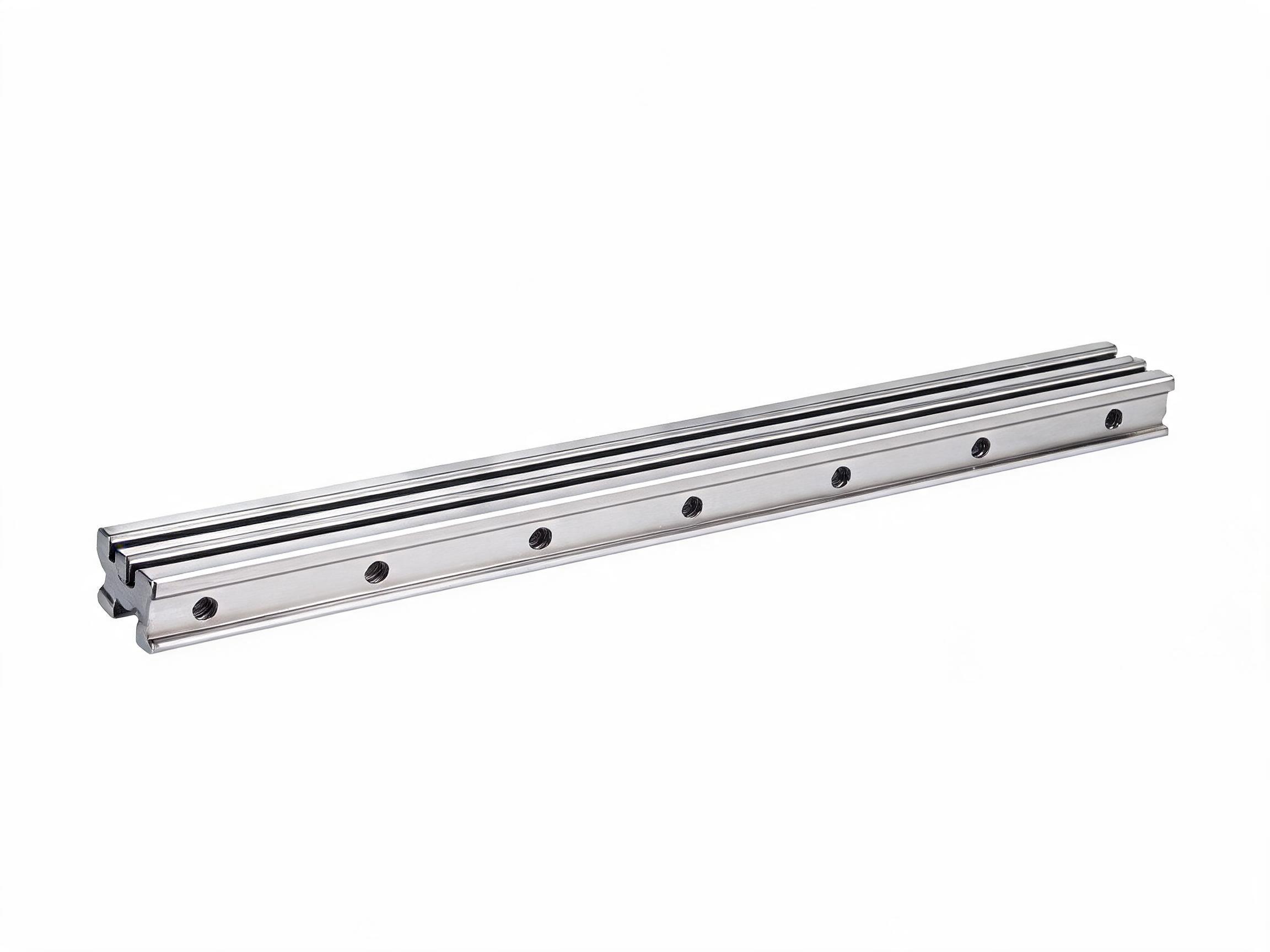
When machine travel is longer than a standard rail, rails have to be joined. This article explains how factory splice joints differ from cutting rails to length, how straightness is held across the joint, what reference marks do, and what to confirm before you order joined linear guide rails.
Linear Guide Rail Joints: How Spliced Rails Hold Accuracy
When a machine needs more travel than a single rail can supply, the rail has to be joined. The buyer's real question is not whether splicing is possible, but whether the joined rail behaves close enough to one continuous rail that the carriage still runs straight and true over the joint. The answer depends on how the joint is made and what you specify when ordering.
For HGR profile rails, the standard maximum length is 4000 mm, and rails longer than 4000 mm are produced as joined sections with precision splice joints. Straightness tolerance across those joints is held to the same grade as the individual rail. That is the core of the answer: a correctly specified splicing rail is not a compromise between two rails, it is a rail assembly built to one accuracy grade.
Key points for buyers
- A factory-made splice joint is held to the same straightness grade as the individual rail, not a looser assembly tolerance.
- HGR rails over 4000 mm are supplied as joined sections; ordering to length is a manufacturing decision, not a field-cutting decision.
- Splice-joint position can be planned around your machine frame, which matters more than the joint itself.
- Reference marks and matched rail ends keep the joint aligned; losing them on the shop floor loses the accuracy.
Factory-matched splice joints vs ordering to length
There are two ways to get a long rail, and they produce different objects. One is to order a rail cut to the exact travel length. The other is to order a joined rail made from shorter standard sections, matched and aligned at the joint. For the HGR series heavy-duty linear guideway rail, standard 4000 mm sections are the base unit, and longer rails are produced as joined sections with precision splice joints rather than as a single extrusion. Custom lengths are available on request.
The distinction matters at the joint for three practical reasons:
- Geometry. A joint created at the factory is machined so that the two ends meet with their raceways and mounting surfaces in the intended relationship. A joint created by cutting a rail in the field does not have that preparation.
- Reference continuity. The two sections come as a matched pair, sharing a reference that lets them be reassembled correctly.
- Responsibility. The straightness grade across the joint is a stated property of the supplied assembly. That is a specification you can hold against the delivery, rather than something to be sorted out during commissioning.
The HGR45 heavy-duty large linear guideway rail shows how this works in practice. Its maximum practical joined length is approximately 8000 mm, formed from two 4000 mm sections. Across that joint the straightness is held to P5 grade, the same as the ground rail grade. HGR45 uses M12 mounting bolts at 60 mm pitch. The HGR series covers sizes HGR 15/20/25/30/35/45, in ground H (P5) and rolled N (P7), so the grade you specify for the individual rail is also the grade that applies across the splice.
How straightness is held across the joint
The joint is the point where a carriage crosses from one rail section to the next, so any step or angular deviation there would feed directly into the block. The way to avoid that is to treat the joint as part of the rail's accuracy budget rather than as an assembly detail. Two things follow from that:
- Straightness is specified at the joint. The tolerance across the splice is held to the same grade as the individual rail. On HGR45 at P5 that is a defined value rather than an informal fit.
- The joint needs a defined position. Where the splice lands on the machine frame determines how much support the joint has, and whether it interferes with mounting-hole pitch or with the carriage's working zone. Custom splice pitch is available for specific machine frame designs so the joint can be placed where you want it, not where a standard rail length happens to put it.
Small rails follow the same logic with a different limit. The MGN12 linear rail has a maximum rail length of 1000 mm, with splicing available. At that scale, aligning the two ends at the joint is the operation that preserves straightness, which is why the butt-joint reference marks matter so much (see below).
| Series | Relevant length limit | Splicing and joint accuracy |
|---|---|---|
| HGR series (HGR15–45) | Standard maximum 4000 mm; custom lengths on request | Rails over 4000 mm supplied as joined sections with precision splice joints; straightness across the joint held to the same grade as the individual rail. Ground H (P5) / rolled N (P7). MOQ 50 pieces per size. |
| HGR45 | Approximately 8000 mm as a joined rail (2 x 4000 mm) | Splice-joint straightness held to P5 grade; custom splice pitch available for specific machine frame designs; M12 mounting bolts at 60 mm pitch. |
| MGN12 | Maximum rail length 1000 mm | Splicing available; butt-joint reference marks must be aligned when splicing rails. |
The table is a summary of what is documented. It does not answer every joint question a machine builder may have; the sections below separate what the records state from what you must confirm for your application.
Reference marks: why the matched pair matters
A splice joint only holds accuracy if the two ends are put back in the relationship they were made in. That is what the reference marks do. On MGN12 rails, the butt-joint reference marks must be aligned when the rails are spliced. On a matched HGR assembly, the same principle applies: the sections are a pair, and the markings identify which end meets which.
This has a direct consequence for how the rail is handled on arrival. Two practical rules keep the joint intact:
- Keep the sections labelled as a set. If a long joined rail is unpacked and the sections are separated on the shop floor, the reference marks are the only way to know which end goes with which.
- Align before tightening. The joint should be brought into its marked alignment before the rail is clamped or bolted down, so that the fastening sequence holds the alignment rather than fighting it.
The reference marks tell you the intended assembly. They do not replace checking the rail's straightness after installation, and how a particular machine frame should be checked at the joint depends on the frame and the measuring method. That is a commissioning decision for your own build.
What to confirm when ordering joined rails
Most of the joint is decided before the order leaves your desk. The supplier can hold accuracy at the joint only for the conditions that were specified. When you request joined rails, state the following:
- Total travel length and the number of sections. For HGR45, a joined rail of approximately 8000 mm means two 4000 mm sections; a different total length changes the section breakdown and the joint position.
- Straightness grade. State P5 or P7 explicitly, so the joint is made and inspected to the grade you need, not to a default.
- Splice position. If the joint must sit at a particular point on the frame, say so. Custom splice pitch is available for specific machine frame designs, and the earlier you specify it, the fewer constraints the joint places on your mounting layout.
- Quantity. HGR series MOQ is 50 pieces per size, which affects how joined rails are quoted and scheduled.
Several points that buyers often ask about at the joint are not covered by the product records, and should be confirmed with the supplier or the datasheet before you commit: the permitted angular misalignment at a joint, whether load ratings are de-rated across a joint, and whether rails that have been cut in the field can be re-matched to restore the joint accuracy. Treat these as open questions for your specific specification rather than assuming a value.
Planning the joint before it reaches the shop floor
Long-travel machines are built around the rail, not the other way round. Deciding early whether you need a joined rail, and where its joint should fall, lets you place mounting features, carriage travel and service access around the splice instead of discovering it during assembly. For HGR sizes up to HGR45, a joined rail made from 4000 mm sections, supplied at the same straightness grade as the individual rail, gives a defined starting point. From there, the splice pitch you request and the grade you state determine how closely the assembled rail matches the machine's accuracy target.
Confirm those two items with your supplier when you quote, and the joint stops being a weak point in the travel length and becomes part of the specification.