
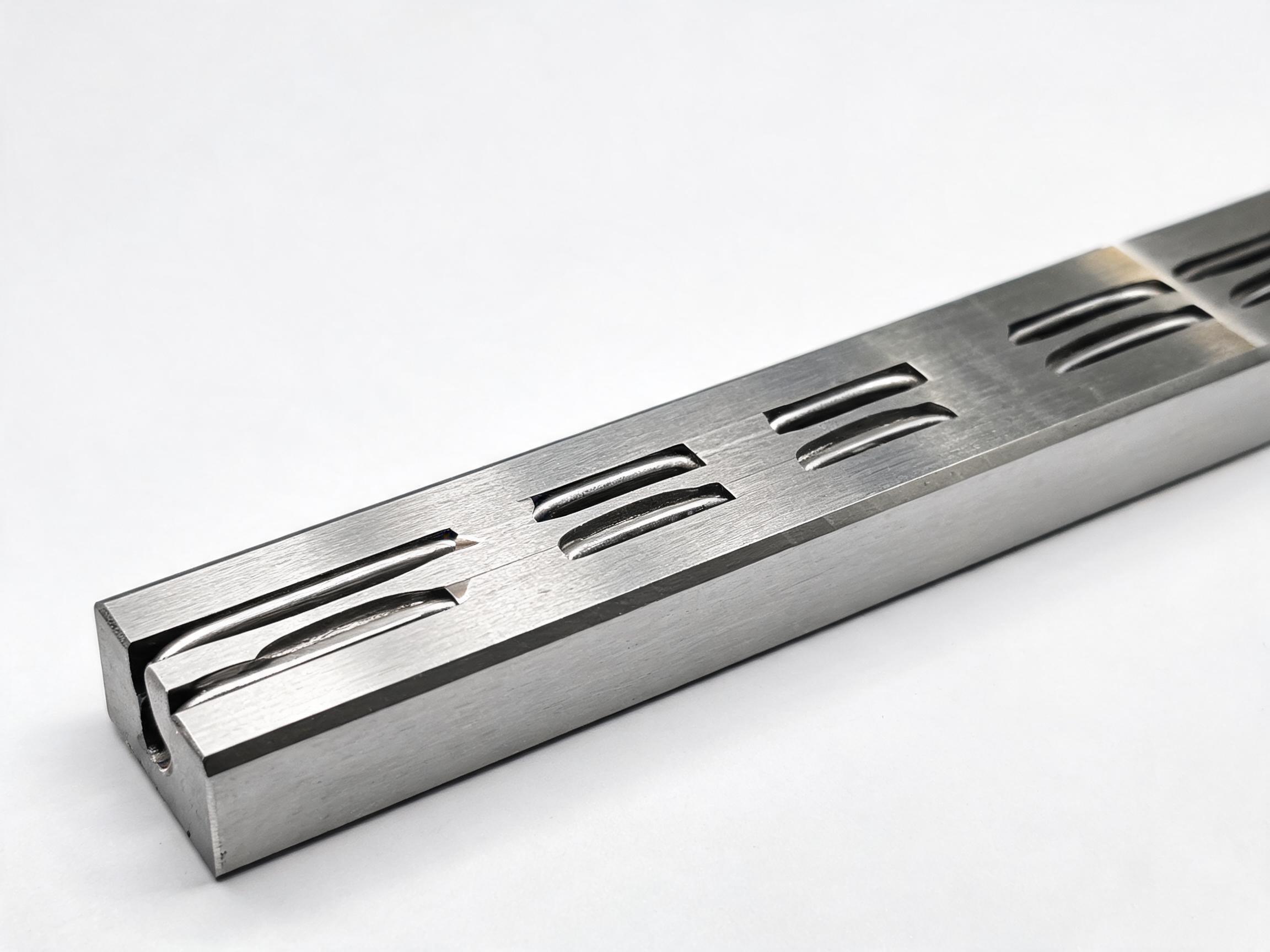
Running parallelism defines how closely the subsidiary rail of a twin-rail linear guide system follows the reference rail over its full travel length. This article explains what the concept means, why the second rail is typically aligned to the first rather than to the machine datum, how height and lateral offset tolerances are specified, how misalignment shows up as binding and uneven wear, how it is checked in practice, and what buyers should confirm with a supplier before ordering matched rails.
Twin-rail linear guide systems
In a two-rail linear guide layout, the carriages on each rail must travel the same path within a tight band. Running parallelism is the value that describes how closely the subsidiary rail follows the reference rail along the full length of travel. When it is out of tolerance, the carriage does not move freely and evenly; the rails start to fight the load.
This article explains the concept, why alignment is referenced to the first rail rather than the machine datum, how specifications are expressed, what misalignment looks like on the machine, how to measure it, and which points to settle with a supplier before ordering matched rails.
Key takeaways
- Running parallelism is a property of the pair, measured over the rail length, not a single-rail flatness value.
- The second rail is usually aligned to the first because the carriage pair transfers load through both rails; the first rail becomes the practical reference for the second.
- Tolerances depend on the series and grade; confirm the applicable values with the datasheet rather than assuming a universal figure.
- Misalignment appears as heavy spots, uneven seal drag and premature wear, not as a single obvious fault.
- Confirm how the supplier checks matched rails, how they are packed as a set, and what reference data is supplied with them.
What running parallelism means in a two-rail layout
A twin-rail system has a reference rail and a subsidiary rail. The reference rail is the one that establishes the direction and position against which the second rail is set. Running parallelism describes how the subsidiary rail tracks that reference over the carriage's travel length, in both the height direction (one rail sitting slightly higher than the other) and the lateral direction (one rail offset sideways).
The value is meaningful only along the usable rail length. A pair that looks aligned over a short section can still drift over several metres of travel, and the carriage will feel the accumulated difference at the far end. For that reason, specifications are normally stated as a tolerance over the rail length rather than as a single point measurement.
This is distinct from the flatness or straightness of the mounting base. A base can be flat and still produce a misaligned pair if the second rail is positioned poorly relative to the first. The two checks answer different questions: one is about the surface the rail sits on, the other is about how the two rails relate to each other once mounted.
Why the second rail is aligned to the first, not the machine datum
Machine designers often assume that each rail should be aligned to the machine's datum. In practice, the carriage pair is what constrains the load, and the carriage pair is constrained by the spacing between the two rails. Aligning the second rail to a machine datum rather than to the first rail introduces the datum's own error into the pair, and the carriage has to absorb it.
The reference rail has already been positioned and fixed. Once it is set, it becomes the practical reference for the second rail, because the carriage must slide along both. The goal is not to make each rail individually perfect against the datum, but to make the pair consistent with each other. This is why matched-rail supply and pair-specific alignment instructions matter.
This does not mean the machine datum is irrelevant. It means the datum sets the reference rail's position, and the second rail follows the first. When the reference rail is correctly placed and fixed, the subsidiary rail is brought into line with it, and the carriage assembly sees a consistent path.
How the specification is usually expressed
Suppliers commonly describe running parallelism with two separate tolerance values: height offset and lateral offset, each expressed over the rail length. The height value controls whether one rail sits above the other; the lateral value controls whether the rails are spaced consistently along their length. Both are needed because a pair can be correct in one direction and wrong in the other.
| Tolerance component | What it controls | What goes wrong if it is exceeded |
|---|---|---|
| Height offset over rail length | Vertical relationship between the two rails | Carriage rocks or loads unevenly between rail pairs; one row of rolling elements carries more load. |
| Lateral offset over rail length | Horizontal spacing consistency between the two rails | Carriage binds laterally, seal drag becomes uneven, and the rolling elements see side loads. |
The actual tolerance values depend on the series and grade. They are not universal, and a figure quoted for one product family should not be applied to another. Confirm the applicable running parallelism values, measurement length and reference conditions with the datasheet for the specific rail you are ordering.
For heavy-duty applications, the HGR Series Heavy-Duty Linear Guideway Rail is one family where matched-rail alignment and pair-specific tolerances are relevant to the specification discussion. Larger sizes, such as the HGR45 Heavy-Duty Large Linear Guideway Rail, carry heavier carriage loads, which makes consistent rail-to-rail geometry more consequential for the rolling elements and the seals.
How misalignment shows up on the machine
Misalignment rarely announces itself as a single failure. It shows up as behaviour that changes along the stroke and accumulates over time.
- Heavy spots. The carriage feels tighter at certain positions along the rail and freer at others. This is the signature of a pair whose spacing changes over the travel length.
- Uneven seal drag. One side of the carriage drags more than the other, or the drag changes as the carriage moves. This points to a lateral offset that the seals are absorbing.
- Premature wear. Rolling elements and raceways on one rail or one side of the carriage wear faster. The load distribution is uneven because the pair is not sharing it evenly.
- Noise and vibration. A misaligned pair can produce periodic noise or vibration as the carriage passes through the tight section of the stroke.
- Positioning error. In systems that rely on the rails for guidance, a misaligned pair can introduce a small path error that shows up as drift or as a need for re-homing.
These symptoms are easy to attribute to the carriage or the load, which is why it is worth checking the pair before blaming individual components.
How running parallelism is checked in practice
Checking a twin-rail pair is a measurement exercise, not a visual one. The usual approach is to establish the reference rail, then measure the subsidiary rail against it at several points along the travel length.
Dial indicators and reference surfaces
A dial indicator mounted on a carriage or a measuring bridge is traversed along the rail, and readings are taken at defined intervals. The indicator traces the rail's position relative to the reference. Height and lateral readings are taken separately, because each maps to a different tolerance value. The instrument setup and the exact measurement method should match the supplier's stated conditions, since the recorded value depends on how the measurement is made.
Straightedge and locating datums
A straightedge can provide a quick reference for the lateral direction, and locating datums on the machine can help establish the reference rail's position. The point of the datum is to place the first rail; the point of the measurement is to confirm the second rail follows it. Where a supplier specifies a particular measurement reference, follow it rather than substituting a different setup, because substituting a different setup changes the result.
Checking along the full length
A reading taken only near the mounting points can miss a drift that develops in the middle of the rail. The check should cover the usable travel length, at enough points to show the trend. This is also the practical reason to ask the supplier how the pair was checked before shipment, and at what length.
What to confirm with the supplier before ordering
Matched rails are not simply two rails of the same part number. The pair has a relationship, and the supplier's process for establishing and verifying that relationship is what the buyer is actually ordering. Before placing the order, settle the following:
- The applicable tolerance basis. Ask for the running parallelism values for the specific series and grade, and confirm whether they are stated as height offset, lateral offset, or both.
- The measurement length and reference. Confirm how the pair is checked, at what length, and against which reference. A tolerance with no measurement basis is hard to accept on the shop floor.
- Matched-pair supply. Confirm whether the two rails are supplied as a matched set with pair-specific data, and how the set is identified and packed so the pairing is preserved in transit.
- Mounting instructions that respect the reference-rail logic. Ask for the alignment guidance that applies to the pair, not a generic mounting note that treats each rail independently.
- Non-standard lengths and joints. If rails are joined or cut to length, confirm how the parallelism specification applies across the joint and the usable travel range.
These questions are not about distrust. They are the practical way to make sure the tolerance that appears on the datasheet is the tolerance that will be delivered, measured the same way the buyer will measure it.
FAQ
Is running parallelism the same as rail straightness?
No. Straightness describes a single rail's geometry. Running parallelism describes how the second rail follows the first over the travel length. A pair can use straight rails and still be misaligned if the second rail is positioned incorrectly.
Can two rails of the same part number be used without matching?
They can be mounted, but the pair's relationship is not established by the part number alone. Whether a matched pair is needed depends on the application's accuracy and load requirements; confirm with the supplier what their matched-pair supply includes.
Why does the carriage feel tight only in some positions?
A pair whose spacing varies along the length will feel tighter where the rails are closer or higher, and freer where they are not. The carriage is absorbing the variation, which is exactly what running parallelism tolerance is meant to limit.
Should the second rail be aligned to the machine datum or the first rail?
In a twin-rail layout the second rail is usually aligned to the first, because the carriage travels along both. The datum helps place the reference rail; the second rail follows the first.
How do I know the tolerance on the datasheet applies to my pair?
Confirm the series, grade, measurement length and reference conditions with the supplier, and check that the stated values are for the specific rail you are ordering. Tolerances depend on the series and grade.
Tolerances and measurement conditions vary by series and grade. Confirm the applicable running parallelism values with the datasheet for the specific rail before ordering.