
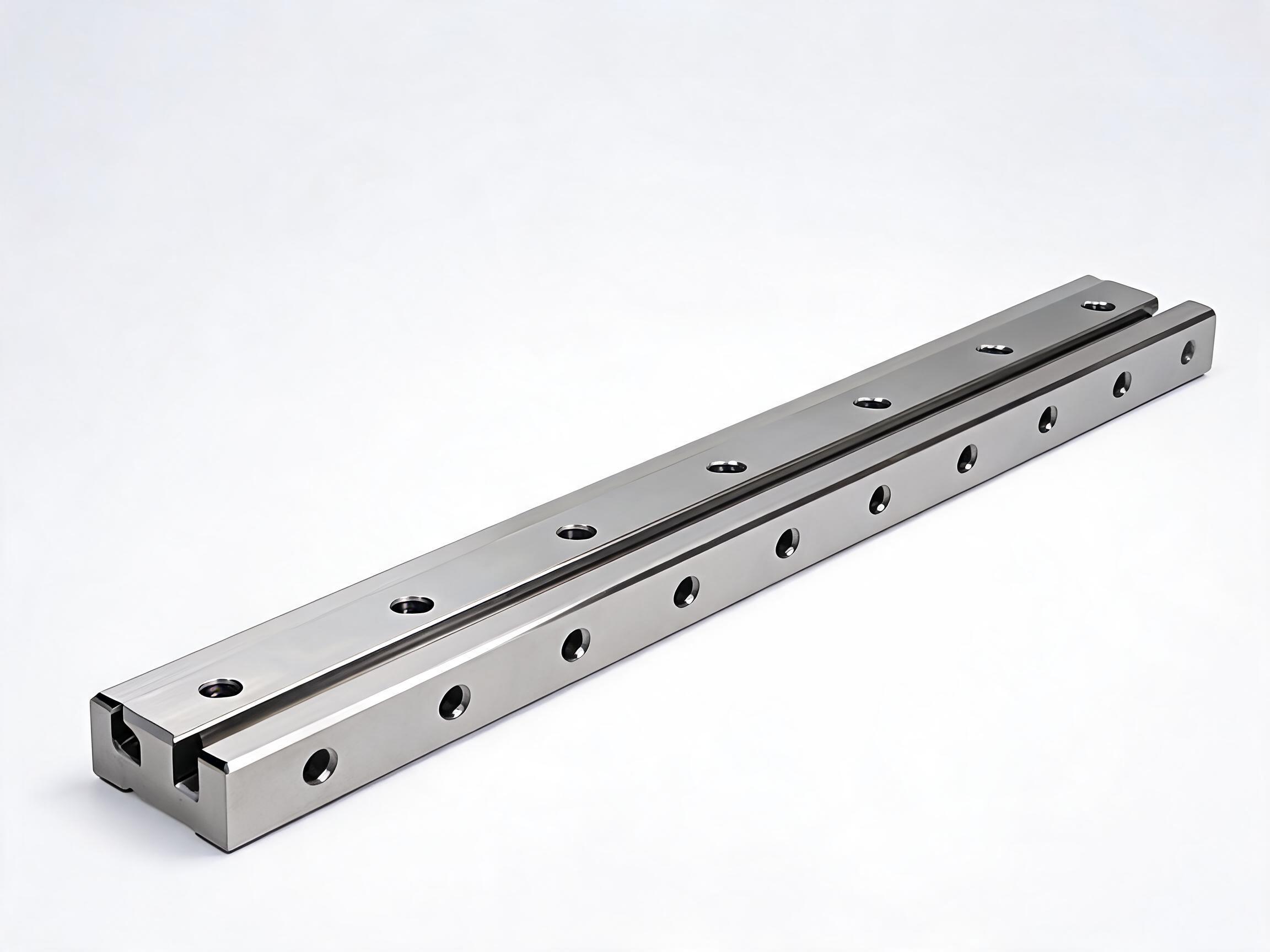
A specification guide for engineers choosing linear guides for small-format semiconductor-adjacent axes. Covers stainless miniature rails, corrosion resistance, low particle generation, miniature precision, load capacity at small scale, and where claims require datasheet confirmation.
Specification Guide
If you are specifying a linear guide rail for semiconductor equipment, the basics of general automation still apply — but a handful of requirements shift, and some of the claims you will see need to be checked against a datasheet rather than assumed.
This guide is for equipment engineers and procurement teams building inspection stations, dispensing axes, and small assembly modules. It sets out what changes for small-format semiconductor-adjacent axes, gives a spec checklist you can work from, and marks the points where the honest answer is "confirm with the supplier."
Key takeaways
• Miniature stainless rails (MGN 9/12/15) suit small-format axes where corrosion resistance and low friction matter.
• Dynamic and static load ratings at small scale are modest — verify them against your actual carriage load and moment.
• Cleanroom class, vacuum, and ESD performance are not established by a steel or hardness spec; ask for test data.
How a semiconductor-adjacent axis differs from general automation
In general automation, the linear guide is usually chosen on load, stroke, speed, and cost. The environment is assumed to be a normal machine shop. In a semiconductor-adjacent machine — an inspection station, a dispenser, or an assembly module sitting near but not necessarily inside a cleanroom — three additional concerns push the selection:
- Corrosion resistance from process chemistry — small amounts of moisture, cleaning agents, or process residue are more common than in a dry automation cell.
- Particle generation — a guide that sheds lubricant or wears at the raceway can contaminate the product being inspected or assembled.
- Miniature precision at small scale — the axis is short, the load is light, and the travel accuracy matters more relative to the size of the part.
These concerns do not automatically mean a special-purpose "semiconductor guide." In many small-format axes, a corrosion-resistant stainless miniature guide with the right preload and lubrication is the starting point. The rest is specifying carefully and confirming what the datasheet actually supports.
The starting point: stainless miniature guides
The MGN series stainless steel miniature linear guide is a common fit for small-format semiconductor-adjacent axes. Listed specifications include:
| Parameter | Listed value |
|---|---|
| Sizes | MGN 9, MGN 12, MGN 15 |
| Rail material | 9Cr18Mo stainless steel (GCr15 optional) |
| Hardness (stainless version) | HRC 54–58 |
| Dynamic load (MGN12C) | 3.7 kN |
| Static load (MGN12C) | 5.4 kN |
| Friction coefficient | 0.002–0.004 (manufacturer MGN series datasheet) |
| Rail max length | 1000 mm, spliceable |
| MOQ | 50 pcs |
Values as listed for the MGN series. Confirm the specific size and preload code you order against the current datasheet.
For a stainless steel miniature linear guide in this size range, the stainless rail is the main corrosion-resistance lever. The GCr15 option is a bearing-steel alternative when corrosion is not the governing requirement. Which one fits depends on what the axis is exposed to; do not assume stainless is always required just because the word "semiconductor" appears in the application.
The MGN12 linear rail is worth calling out because it is the size in the middle of the range where the load numbers above apply. At 3.7 kN dynamic and 5.4 kN static, it can carry a small carriage and tooling, but the rating is for the guide, not for your assembly. The actual load on each block depends on how the carriage is supported, where the center of gravity sits, and how far the tooling overhangs.
Specification checklist for small-format axes
Work through these items in order. The first four are usually decided from the machine design; the last four are where semiconductor-adjacent requirements need a documented answer.
1. Rail size and stroke
MGN 9, 12, and 15 cover short strokes and compact carriages. Rail length is up to 1000 mm and can be spliced for longer travel, but splices add joints that affect smoothness and alignment — check whether your accuracy budget allows a splice before designing around one.
2. Load and moment at the carriage
Use the dynamic and static ratings as a starting point, then calculate the actual load per block including tooling mass and any moment from an offset load. A guide that is comfortable in pure vertical load can be marginal when the same mass sits 100 mm off the rail centerline. Confirm the allowable moment for your specific block type with the supplier.
3. Preload and stiffness
Miniature guides are available in different preload classes. Higher preload reduces deflection under a changing load but increases friction and running temperature. For an inspection axis that must hold position, the preload choice is a design decision, not a default — state it in your request rather than letting it be assumed.
4. Lubrication and particle generation
This is where a general-automation guide and a semiconductor-adjacent axis most often diverge. Grease choice, grease quantity, and the block's sealing arrangement all affect what the axis emits during operation. The datasheet friction coefficient of 0.002–0.004 tells you about sliding resistance, not about particle shedding. If your process is sensitive to particles, ask the supplier what lubrication and sealing options are available and whether they have particle-count data for the configuration you are considering. If they do not, treat particle performance as unconfirmed.
5. Corrosion resistance
9Cr18Mo stainless at HRC 54–58 is the listed stainless option. Hardness and alloy give an indication of wear and corrosion behavior, but they do not by themselves certify performance in a specific chemical exposure. If the axis sees a known cleaning agent or process residue, describe it and ask for a material compatibility statement.
6. Cleanroom and vacuum
A stainless rail and a hardness range do not establish a cleanroom class rating or vacuum compatibility. If your module sits inside a classified cleanroom or a vacuum chamber, those are separate requirements and need to be requested explicitly. The supplier may or may not offer a configuration that meets them; the specification must come from test data, not from the base material.
7. ESD and grounding
Static control is an electrical property of the machine build, not a property implied by the rail material. If your application requires a defined ESD path, specify it as a requirement and confirm how it is achieved. Do not assume a steel guide provides it.
8. Flatness and mounting
Miniature rails are sensitive to mounting-surface flatness. State the flatness and parallelism you can hold on the carriage and base, and confirm the guide's allowable mounting error. A precision rail on a rough surface will not deliver its rated accuracy.
When the axis outgrows the miniature range
Some semiconductor-adjacent modules — gantries, load ports, or larger assembly frames — need longer rails and higher load capacity than the MGN range covers. For those, the HGR series profile rail is the next step: induction hardened to 58–62 HRC, with lengths up to 4000 mm. The trade-off is size and mass; a profile rail is not a drop-in replacement for a miniature guide on a compact axis. Use the HGR series heavy-duty linear guideway rail when the stroke or load genuinely requires it, and keep the miniature range for the compact axes it was designed for.
Where the claims need datasheet confirmation
Several requirements that come up in semiconductor-adjacent projects cannot be settled from a material or hardness specification. They are legitimate requirements, but they need evidence:
- Cleanroom class — ask for particle-count data for the exact block, seal, and lubricant configuration. Do not accept a class rating stated for a different configuration.
- Vacuum compatibility — vacuum use changes lubricant choice and outgassing behavior. Confirm suitability for your pressure level and temperature.
- ESD performance — confirm how grounding is provided and measured, if it is required.
- Chemical compatibility — if the axis is exposed to a specific process chemical, ask for a material compatibility statement.
A supplier that cannot provide data for one of these is not necessarily a poor choice; it may simply mean the requirement is outside the standard product. The point is to know which requirements are confirmed and which are open before you release the design.
Supplier and quality considerations
For procurement, the practical checks are the ones that affect repeatability across orders: whether the rail material and hardness are stated on the drawing, whether the preload class is specified, and whether the supplier can hold the rail length and mounting-hole pattern you need. The manufacturer behind this guide is ISO 9001:2015 certified, holds CE marking, is an SGS-audited factory, offers an 18-month warranty, and exports to more than 50 countries. Those are company-level facts; they do not replace confirming the guide's performance for your specific axis.
Questions that come up in specification review
Can I use an MGN guide in a cleanroom?
The MGN series is a stainless miniature guide with a listed friction coefficient and load rating. Cleanroom suitability depends on the block seals and lubricant, and it needs particle data for the configuration you order. Ask for that data before specifying it for a classified cleanroom.
Is stainless always required for semiconductor-adjacent axes?
No. Stainless is the right choice when corrosion from moisture or process chemistry is a real exposure. Where the axis is dry and clean, the GCr15 option may be adequate. Decide from the environment, not from the application label.
How do I handle a stroke longer than 1000 mm on a miniature axis?
The MGN rail is spliceable, but splices introduce joints. If your accuracy budget does not allow a splice, move to a profile rail in the HGR range rather than forcing a miniature guide beyond its listed length.