A verification-first buying guide to the SBR20 linear rail: how per-block and per-rail load ratings differ, what standard lengths and 50 mm hole spacing mean for your design, how the hardened shaft and aluminum support share the work, and when SBR16 or a profile rail is the better call.
Linear Motion Buying Guide
If you are sizing an SBR20 linear rail for a purchase order, three checks decide whether the rail you pick will survive the application: how the load is counted (per block or per rail), what length and hole spacing the machine frame can actually accept, and how the rail is mounted and supported along its span. Get these wrong and the rating printed on the datasheet will not match what the axis sees.
This guide covers the documented numbers for the SBR20 and the closely related SBR16, and it flags the points that need confirmation from your supplier before the order is placed.
Key takeaways
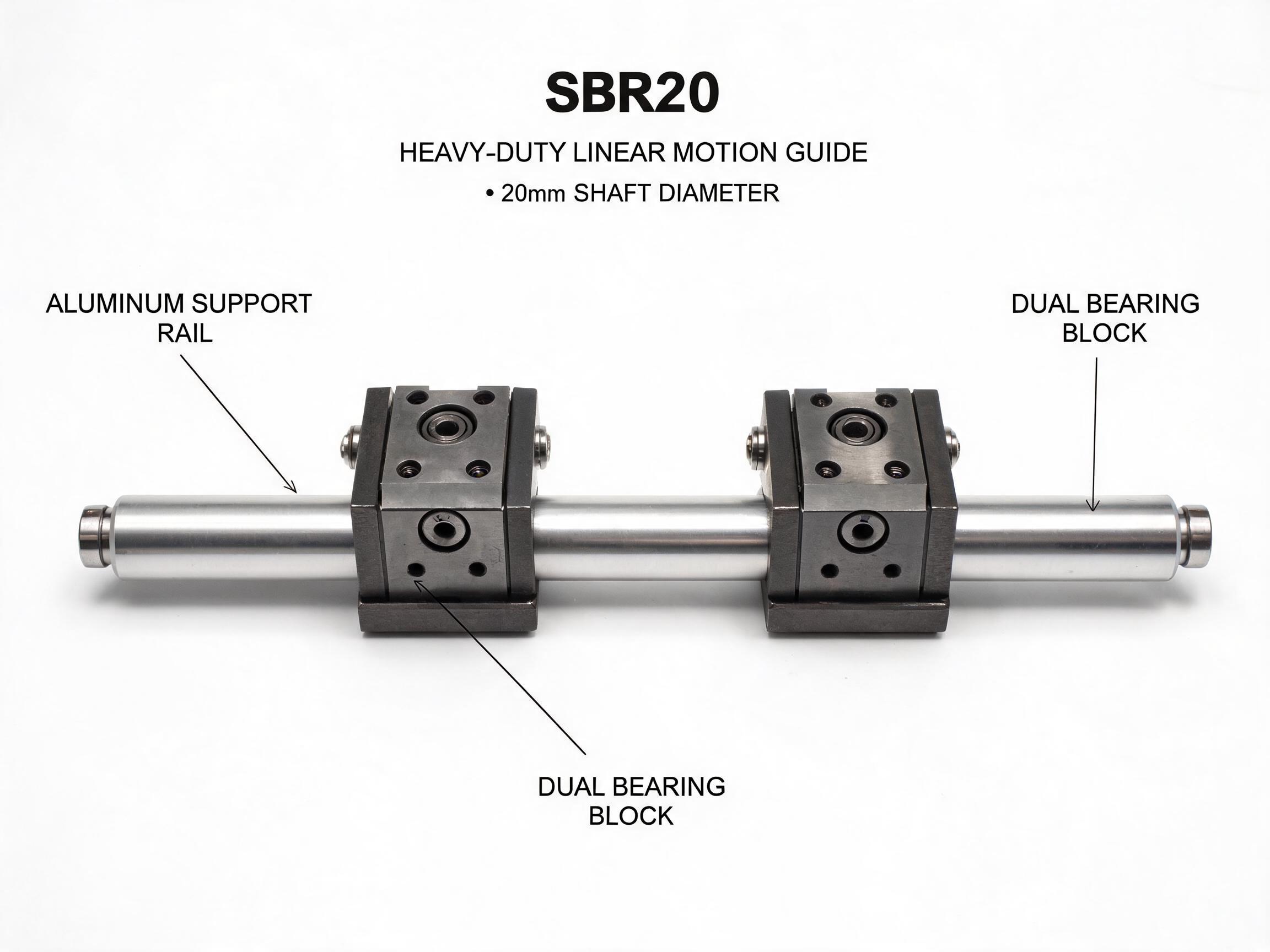
- An SBR20 uses a 20 mm hardened shaft with a 6063-T5 aluminum support profile.
- A single block is rated 11.2 kN dynamic and 17.5 kN static; a dual-block rail is rated 22.4 kN per rail.
- Standard SBR20 lengths run to 3000 mm, with 50 mm hole spacing for mounting.
- If 22.4 kN per rail is more than the axis needs, SBR16 is the step-down candidate at 7.8 kN dynamic / 12.0 kN static with dual blocks, up to 2000 mm.
- Confirm the mounting pitch, frame flatness and shaft support arrangement before you confirm the length.
Load accounting: per block versus per rail
The load figure that matters depends on how many blocks share the load, and on how many rails carry the axis. The SBR20 numbers are stated both ways, and mixing them up is the most common sizing error in a purchase enquiry.
Read the single-block rating as the capacity of one bearing block. When a rail is supplied as a dual-block unit, the two blocks share the moving load, and the documented rail-level rating becomes 22.4 kN dynamic for that rail. If your carriage is carried by two parallel rails, each rail contributes its own rating to the axis capacity — but the distribution between the two rails depends on where the load sits relative to the rails, not on the rating alone.
Why two blocks change the math
A single block on a rail is loaded by the carriage weight and any overhung moment. Add a second block and the same carriage load is split between two contact zones, and the moment arm the blocks must resist is carried as a couple rather than by one block alone. That is why the dual-block configuration is quoted at roughly double the single-block dynamic figure (22.4 kN versus 11.2 kN). The number is not a bonus — it reflects that two blocks are doing the work.
Two practical consequences for buyers:
- Quote your axis load and the number of blocks per rail in the RFQ. A rating quoted for a single block will be misread if your design uses two.
- If your carriage is long and the load sits between the blocks, the pair shares it well. If the load overhangs beyond the block pair, the effective capacity is lower than the catalogue figure regardless of which rating you use.
Static and dynamic ratings are separate limits. The 17.5 kN static figure applies to a stationary or very slow-moving load; the 11.2 kN dynamic figure applies to a moving block. Use the dynamic value for a running axis.
Length and support: what the frame has to accept
SBR20 rails are available in standard lengths up to 3000 mm, with 50 mm hole spacing along the support profile. Those two facts drive most of the mounting conversation.
| Item | SBR20 | SBR16 |
|---|---|---|
| Shaft diameter | 20 mm hardened shaft | 16 mm shaft, GCr15, HRC 58–62 |
| Support profile | 6063-T5 aluminum | 6063-T5 aluminum |
| Single-block rating | 11.2 kN dynamic / 17.5 kN static | — |
| Dual-block rating | 22.4 kN per rail (dynamic) | 7.8 kN dynamic / 12.0 kN static |
| Standard length range | To 3000 mm | To 2000 mm |
| Mounting hole spacing | 50 mm | — |
Fifty-millimetre pitch means the mounting holes land on a fixed grid. Your frame, base plate or extrusion must have corresponding features at that pitch, or you have to plan for a machined transition plate. Check two things before ordering:
- Whether the 50 mm hole pattern aligns with your existing tapped holes or T-slot centres.
- Whether the length you need can be supplied as a standard length or has to be cut to length. Cut-to-length changes the position of the end holes relative to the rail ends, so the drawing you approve has to show the finished hole positions, not just the overall length.
Two shorter rails on separate supports and one long rail supported continuously are not equivalent. Supporting the rail along its length — using the aluminum support profile as a continuous base rather than a pair of end pedestals — keeps the shaft from behaving differently along the stroke. If your stroke is long, ask the supplier how the support profile is expected to be fixed along the span before you freeze the length.
Construction: which part does the work
The SBR20 is a supported shaft system, and the two materials do different jobs.
- The shaft carries the rolling load. It is a 20 mm hardened steel shaft, and it is the surface the bearing block's rolling elements run on. Wear and load capacity are concentrated here.
- The aluminum support adds stiffness. The 6063-T5 aluminum profile is the base the shaft sits in, giving the assembly a continuous mounting surface and adding resistance to bending over the span. It is not the rolling surface.
That split matters when you compare suppliers. Two rails with the same nominal shaft diameter can differ in how the shaft is fixed to the support, how the block is preloaded, and how straight the assembly is over its full length. Those are the points to pin down in a specification — not just the shaft diameter.
If a supplier quotes an SBR20 with a GCr15 shaft at a specified hardness, that is useful information about the rolling surface. The SBR20 reference used in this guide documents a 20 mm hardened shaft without a published hardness band; the SBR16 comparison lists GCr15 at HRC 58–62. Ask for the equivalent material and hardness statement for the SBR20 if that detail matters to your acceptance criteria.
Typical configurations, such as the SBR20 heavy-duty linear motion guide unit with dual bearing blocks, pair the 20 mm shaft with two blocks on one rail — the configuration that produces the 22.4 kN per-rail dynamic figure.
Stepping down to SBR16 or up to a profile rail
Not every axis needs 22.4 kN per rail. The decision comes down to load, stroke and what you are trying to achieve with the bearing system.
When SBR16 is the sensible step down
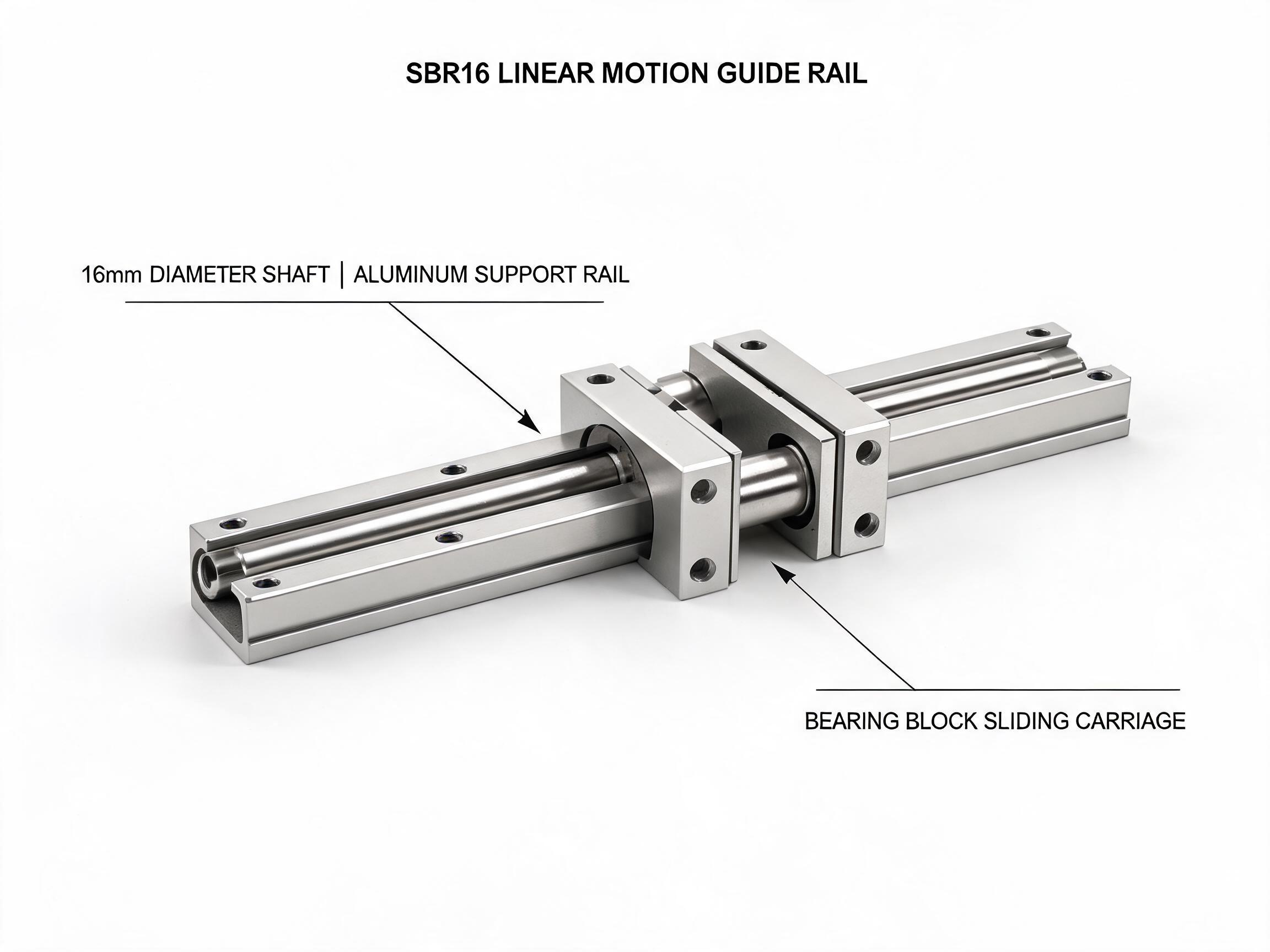
The SBR16 linear motion guide rail unit with bearing block uses a 16 mm shaft with the same 6063-T5 aluminum support, and is documented at 7.8 kN dynamic / 12.0 kN static with dual blocks, in lengths up to 2000 mm. It is the natural candidate when:
- The axis load fits comfortably within 7.8 kN dynamic with the dual-block configuration.
- Your stroke stays inside the 2000 mm length range.
- The smaller 16 mm envelope suits the carriage and housing you already have.
Stepping down saves envelope and mass. The trade-off is lower rated capacity and a shorter maximum length, so the step-down only works if the load and stroke checks both pass.
When a profile rail deserves a look
SBR rails are shaft-based: the block runs on a round shaft supported by an aluminum base. If your application needs higher moment stiffness for a given envelope, tighter running parallelism, or a carriage that resists roll and pitch without relying on two widely spaced rails, a profile rail system is worth evaluating against the SBR20. The SBR20's advantage is straightforward construction and a documented load figure per rail; a profile rail's advantage is a different stiffness geometry. Compare the two against your actual load case rather than the nominal size.
Mounting checks before you order
Pre-order confirmation list
- Load per block or per rail, with the number of blocks per rail stated on the drawing.
- Whether the duty is moving (dynamic) or essentially static, and which rating you are comparing against.
- Required finished length, and whether it is a standard length or a cut-to-length item with a hole-position drawing.
- Mounting hole pitch compatibility: 50 mm on the rail versus your frame features.
- How the aluminum support will be fixed along the span, not just at the ends.
- Straightness and parallelism requirements stated in the units your inspection team uses.
- Whether a dual-block unit is required, and where the blocks sit relative to the load centre.
- Any acceptance documentation you need with the shipment, requested at quotation stage.
The order of these checks matters. Confirm the load case first, because it decides SBR20 versus SBR16. Then confirm length and hole pattern, because they decide whether a standard rail fits or a drawing is needed. Mounting detail is last but not optional — a correctly rated rail that cannot be fixed along its span will not perform to its rating.
FAQ
- Is the 22.4 kN figure the capacity of one block or of the whole rail?
- It is documented as the per-rail figure for the dual-block configuration. A single block is rated 11.2 kN dynamic and 17.5 kN static. Use the figure that matches the number of blocks you will actually install.
- What is the longest standard SBR20 length?
- Standard lengths are available up to 3000 mm. Longer strokes than that require a different arrangement or a different product family; confirm with the supplier rather than assuming a longer standard length exists.
- Can I mount an SBR20 on a hole pattern that is not 50 mm?
- The rail's mounting holes are on a 50 mm spacing. Adapting to a different pitch means a transition plate or new frame features. Check the fit before ordering, not after.
- Should I choose SBR16 instead?
- If your axis load fits within 7.8 kN dynamic with dual blocks and your stroke is within 2000 mm, SBR16 is the smaller, lighter option. If either limit is exceeded, stay with the SBR20 or evaluate a profile rail.
- What do I need to send with an RFQ?
- Load and direction, number of blocks per rail, number of rails, required length, mounting pitch on your frame, and the environment. Those five inputs let a supplier confirm the correct part number and flag any drawing work needed.
Figures in this guide are the documented values for the referenced SBR20 and SBR16 configurations. Where a detail is not published for a given model — for example a shaft hardness band — confirm it with the supplier against your acceptance criteria before the order is released.