
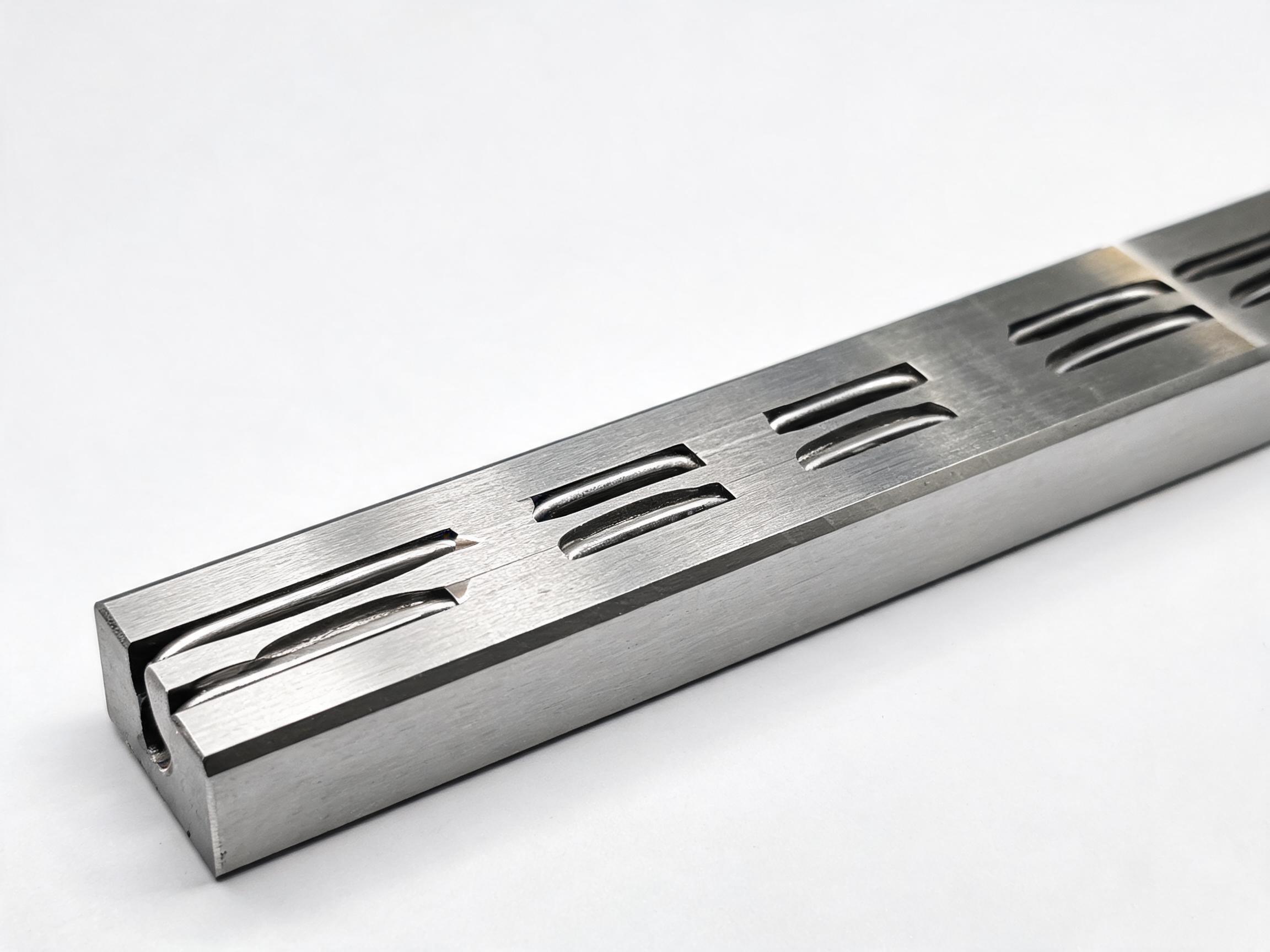
A linear guide is a precision-ground or rolled rail carrying recirculating ball carriages that support and steer a moving load. This explainer covers the anatomy of a carriage, how a guide differs from a round-shaft bushing slide and a ball screw, how HGR, EGH and MGN12 naming works, and the four checks to run before placing a first order.
Linear Motion Basics
A linear guide is a precision-ground or rolled guideway rail paired with one or more carriages that roll along it on recirculating balls. The rail fixes the path; the carriage carries the load and keeps it on that path. Everything else in a first quotation — the size number, the grade letter, the seal code, the rail length and the hole pitch — follows from that pairing.
What a linear guide is — and what it is not
The working principle is simple to picture. Balls circulate inside the carriage, rolling between the rail raceways and the carriage body, then return through the end caps to re-enter the loaded zone. Because the balls recirculate, carriage travel is not limited to the stroke length of any single ball path — the rail length sets the stroke, not the carriage. That is the structural difference between a linear guide and a plain sliding element.
Two boundaries are worth fixing early, because first-time buyers routinely mix them up.
Linear guide versus round-shaft bushing slide
A round-shaft unit, such as an SBR-type assembly, uses a cylindrical shaft held in an aluminium support block, with a bushing-style carriage riding the shaft. A Dongfeng Bearing SBR16 unit, for example, lists a GCr15 shaft, a 6063-T5 aluminium support and a 7.8 kN dynamic rating. The shaft is a round bar; the guideway is a profiled rail with dedicated raceways. The two are different product families, not two grades of the same thing. Sizing, mounting and load direction follow different rules, so a shaft diameter does not translate into a rail size number.
Linear guide versus ball screw
A ball screw drives motion; a linear guide carries and steers it. In a typical axis, the screw converts rotation into linear displacement, and the guide keeps the moving body aligned while absorbing the load and moment. You can build an axis with a guide and no screw (manual or belt-driven), and you can drive a body with a screw on plain ways, but the guide's job does not change: it carries load and guides. Ratings on a guide datasheet are load ratings, not thrust ratings.
Anatomy of a carriage
The carriage is the part that does the work, and it is worth knowing its four functional groups before reading a drawing.
- Carriage body — the block that holds the ball tracks and transmits load to the machine.
- Ball circulation — balls roll in the loaded raceway zone and return through a return path, so the carriage keeps moving without running out of balls.
- End caps — they close the circulation loop at each end of the carriage and redirect the balls from the loaded zone back to the return path.
- Seals — fitted at the carriage ends to keep contaminants off the raceways and to retain lubricant. Seal configuration is an option to specify, not a decoration.
An EGH15CA miniature carriage, for instance, is rated 5.5 kN dynamic and 9.2 kN static. Those figures describe the carriage-and-rail assembly as a unit; they are not a property of the block alone. See the EGH series miniature linear guideway rail and carriage listing for the sizes offered in that family.
How the naming works
Series letters tell you the product family; the size number tells you the rail width family. That number is a designation, not a measurement you can mount against — use the datasheet dimensions to check fit.
- HGR series profile guideway — sizes 15, 20, 25, 30, 35 and 45. Raceways are hardened to HRC 58–62. Listed lengths run up to 4000 mm and MOQ is published as 50 for the series; confirm both for the specific size you order.
- EGH miniature series — sizes 9, 12 and 15, supplied in ground accuracy P5 only.
- MGN12 — a miniature rail in 9Cr18Mo stainless, with GCr15 available as an option. The MGN12C carriage lists 3.7 kN dynamic and 5.4 kN static, and the friction coefficient quoted by manufacturer datasheets is 0.002–0.004 under the datasheet's stated test conditions; actual friction varies with lubrication, preload and load.
A suffix such as C or CA sits inside the carriage code and marks a carriage variant within the family rather than a new series. Always read the full model string as a unit instead of parsing letters one at a time.
Why grades exist
Guideways reach the market through two production routes, and the grade letter records which one the rail came from. HGR rails are offered as Ground H (P5) or Rolled N (P7). The distinction is the rail itself: ground rail gets its running surface from a controlled finishing operation that sets the raceway geometry directly, while rolled rail is formed by a rolling process — which is why the two routes carry different straightness and tolerance figures on the datasheet. Because the rail geometry influences how smoothly the carriage travels, the grade belongs in the order line — a quote that states only "HGR25" has not yet told you which rail you are buying. Which route suits your application is a question the datasheet's straightness and tolerance figures answer, not the grade letter alone.
Hardening is process-specific. HGR rails use a carburized body with induction-hardened raceways, and the finished rail is coated with rust-preventive oil before packing. The base steel is a high-carbon grade; the exact grade is stated per datasheet and should be read from the datasheet rather than inferred from a general description.
First-order checks
Four items separate a workable first order from one that needs to be re-placed. They are not a substitute for the datasheet — they are what to have settled before you request one.
1. Match load and moment to carriage count
A single carriage on a single rail constrains the load in one plane well but resists moment less. Two carriages on one rail, or a pair of rails, distribute moment across more ball contact. Start from the actual load, its line of action relative to the rail, and the moment arm, then check the carriage count against the rail's rated figures. The 5.5 kN dynamic rating of an EGH15CA is the rating of the carriage-rail combination as specified; it is not a licence to assume any mounting arrangement will hold that load.
2. Confirm hole pitch and rail length
The mounting-hole pitch on the rail and the overall rail length are drawing-level details. HGR rails are listed up to 4000 mm, but a requested length that does not land on an existing hole pattern changes the part. Send the drawing with hole pitch marked, and ask for the datasheet of the proposed rail so you can compare dimensions, not just the size number.
3. Confirm grade and seal options
State the grade explicitly — Ground H (P5) or Rolled N (P7) for HGR, and P5 for EGH — and state the seal configuration you need. Seals affect what reaches the raceways, so they belong on the order, not in a post-shipment conversation. If the application runs in a dirty environment, confirm which seal options the supplier actually offers for that size.
4. Request the datasheet for anything not published
Section height, tolerance tables and full dimensional data are not published on every product listing. For MGN12 and similar miniature sizes, the section height and tolerance tables need to be confirmed per datasheet. On HGR sizes 15 through 45, confirm the exact high-carbon steel grade and the dimensional table per datasheet. A datasheet in hand is the difference between ordering from a size number and ordering from a drawing.
| Series | Sizes | Grade | Rated load (one carriage) |
|---|---|---|---|
| HGR profile guideway | 15 / 20 / 25 / 30 / 35 / 45 | Ground H (P5), Rolled N (P7); raceways HRC 58–62 | Per datasheet for the selected size |
| EGH miniature | 9 / 12 / 15 | P5 only | EGH15CA: 5.5 kN dynamic / 9.2 kN static |
| MGN12 | 12 | Per datasheet | MGN12C: 3.7 kN dynamic / 5.4 kN static |
| SBR16 (round shaft, for contrast) | 16 | Not a profiled guideway | 7.8 kN dynamic |
Load ratings are catalog figures for the listed configuration. Mounting arrangement, carriage count and moment arm are separate checks.
What the first order should contain
A first purchase order for a linear guide carries five lines: the full model string (series, size, carriage variant), the accuracy grade, the rail length and hole pitch drawing, the seal configuration, and the required carriage count. The HGR series details, sizes and available lengths are set out on the HGR series heavy-duty linear guideway rail page; miniature options are covered on the MGN12 linear rail page.
Everything above is what a supplier can answer without knowing your machine. What only your drawing answers is whether the proposed rail's section height fits the space you have, whether the hole pitch matches your plate, and whether the moment load is carried as intended. Get those three onto the enquiry and the datasheet becomes a verification step rather than a negotiation.