
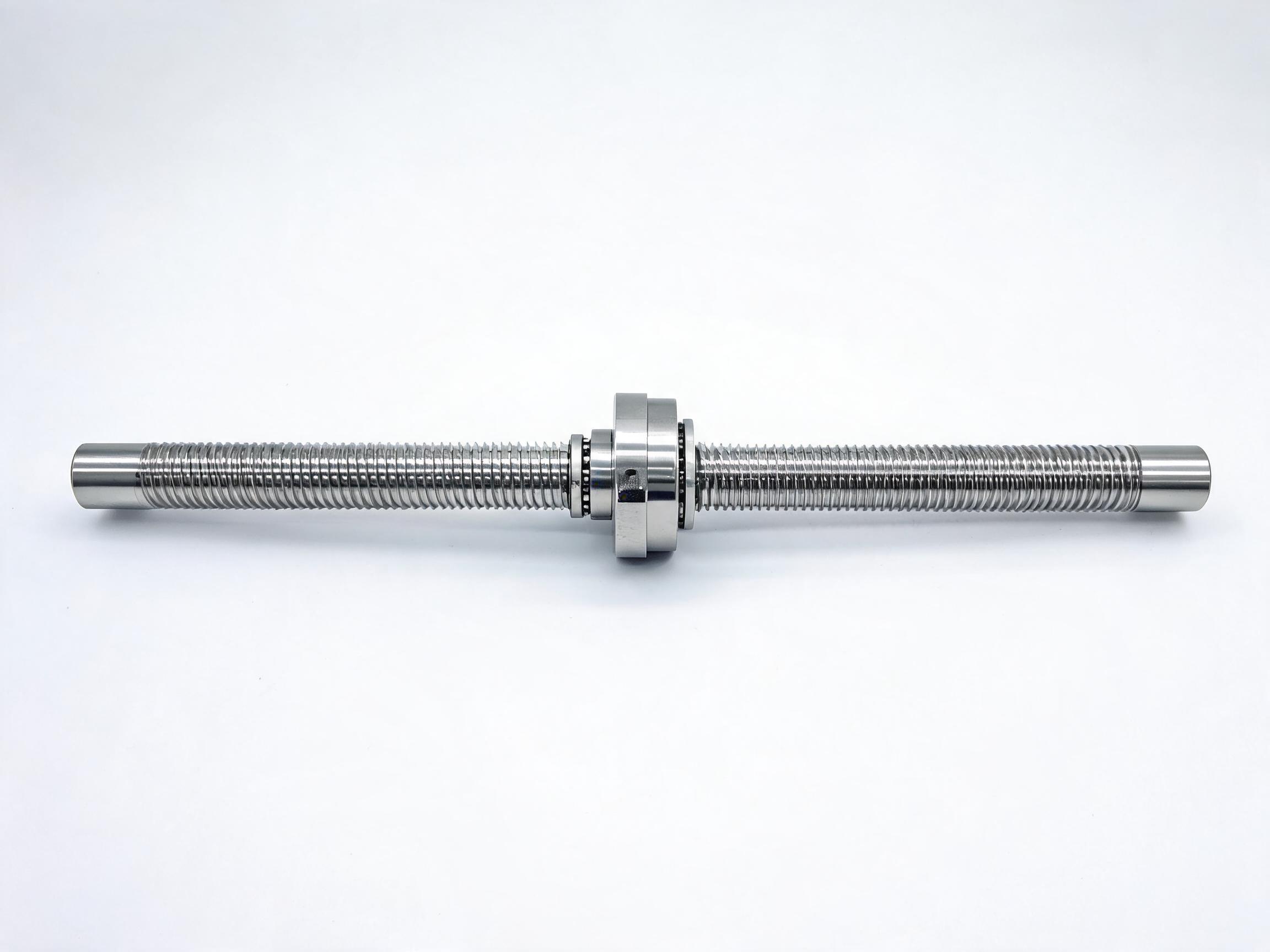
A practical guide for CNC buyers on how to select the right ball screw drive. Covers precision grades (C0–C10), load capacity calculations, preload types, and selection criteria for machining centers, lathes, and linear actuators. Includes a comparison table and common mistakes to avoid.
CNC COMPONENT SELECTION GUIDE
- Precision grade (C0–C10) directly determines positioning accuracy — choose C3–C5 for most CNC applications, C0–C1 only for ultra-precision grinding or EDM machines.
- Load capacity is not just static — dynamic load rating (Ca) governs service life. Always calculate fatigue life in revolutions or hours.
- Preload type (Z, P0–P3) affects stiffness, backlash, and heat generation. Over-specifying preload shortens life; under-specifying causes lost motion.
- Ball screw linear actuator assemblies (screw + nut + housing + motor mount) simplify integration but limit customization. Separate components give more control.
- Always verify end machining (journal diameters, thread runout, shoulder squareness) with the supplier — a perfect screw with poor ends will not hold tolerance.
Why the ball screw drive matters for CNC performance
A ball screw drive is the most common mechanical element for converting rotary motion into precise linear motion in CNC machines. Unlike lead screws, which rely on sliding friction, ball screws use recirculating steel balls between the screw shaft and nut. This rolling contact reduces friction to around 0.01–0.05 coefficient, enabling higher efficiency (85–95%), lower wear, and better repeatability.
For a machining center, lathe, or gantry system, the cnc ballscrews you choose define the machine's positioning accuracy, stiffness, and long-term stability. A wrong selection can cause chatter, thermal drift, or premature failure — all costly in production downtime.
This article covers the three technical dimensions you need to evaluate: precision grades, load capacity, and selection criteria. We also include a comparison table and common mistakes to avoid.
1. Precision grades: from C0 to C10
Ball screw precision is classified by JIS B 1192 or ISO 3408-3 standards. The grade number indicates the allowable travel deviation per 300 mm of screw length. Lower numbers mean higher precision.
| Grade | Deviation per 300 mm (μm) | Typical application | Relative cost |
|---|---|---|---|
| C0 | ±3.5 | Ultra-precision grinders, EDM, coordinate measuring machines | Very high |
| C1 | ±5 | High-precision machining centers, jig borers | High |
| C3 | ±8 | Standard CNC machining centers, lathes, milling machines | Moderate |
| C5 | ±18 | General-purpose CNC, automation, pick-and-place | Moderate-low |
| C7 | ±50 | Low-cost CNC, hobby machines, non-critical positioning | Low |
| C10 | ±210 | Manual positioning, conveying, rough adjustment | Lowest |
Recommendation: For most production CNC machines, C3 or C5 is the practical choice. C0–C1 adds significant cost and requires a thermally stable machine environment to realize the precision. For a ball screw linear actuator used in a pick-and-place or assembly cell, C5–C7 often suffices.
Note: precision grade alone does not guarantee system accuracy. The screw's end supports (fixed or simple bearing blocks), nut mounting, and preload also contribute to the final positioning error.
2. Load capacity: static vs. dynamic rating
Ball screws have two load ratings:
- Basic static load rating (C0a): The maximum axial load the screw can withstand without permanent deformation of the ball contact surfaces. Used for shock loads or stationary conditions.
- Basic dynamic load rating (Ca): The constant axial load under which 90% of a group of identical screws will achieve 10⁶ revolutions without fatigue failure. This is the number you use for life calculation.
Manufacturers publish Ca values in Newtons (N) for each screw diameter and lead combination. A typical 32 mm diameter, 10 mm lead screw might have Ca around 20–30 kN, depending on the nut design (single vs. double nut, number of ball circuits).
Life calculation (L10 life):
L10 (revolutions) = (Ca / Fa)³ × 10⁶
where Fa is the applied axial load. If Fa is 30% of Ca, L10 = (1/0.3)³ × 10⁶ ≈ 37 million revolutions. Convert to hours by dividing by the screw's rotational speed (rpm) and multiplying by 60.
Common mistake: Using static load rating for life calculation. Always use dynamic rating. Also, factor in the actual load profile — most CNC axes see varying loads, not a constant Fa. Use the equivalent dynamic load (Pm) for variable loads.
3. Preload and backlash
Backlash in a ball screw is the axial play between the nut and screw. For CNC positioning, backlash must be eliminated or minimized. Preload is applied by:
- Double-nut preload (Z, P0–P3): Two nuts are preloaded against each other by a spacer or spring. Offers high stiffness and zero backlash. Common in machining centers.
- Oversized ball preload (P0–P3): Balls slightly larger than the groove are used. Simpler, but preload degrades as balls wear. Used in lower-cost assemblies.
- Spring preload: A spring maintains constant force between nut and screw. Used in light-load, low-speed applications.
| Preload symbol | Preload force (as % of Ca) | Typical use |
|---|---|---|
| Z (zero clearance) | 0.5–1% | General positioning, low heat |
| P0 | 1–2% | Light preload, low friction |
| P1 | 2–4% | Standard CNC, moderate stiffness |
| P2 | 4–6% | High stiffness, high-speed machining |
| P3 | 6–8% | Very high stiffness, heavy cutting |
Warning: Higher preload generates more heat. At high speeds, thermal expansion can cause the screw to elongate, reducing preload or causing binding. For a linear screw drive running at high feed rates, P1 or P2 is usually the safe maximum.
4. Selection criteria: a step-by-step approach
When specifying a ball screw drive for a new CNC machine or retrofitting an existing one, follow this process:
- Determine required travel length and stroke. Add 1.5–2× the nut length to each end for safety margin.
- Calculate maximum axial load. Include cutting forces, acceleration/deceleration forces, friction, and gravity (for vertical axes).
- Select screw diameter and lead. Larger diameter = higher stiffness and load capacity, but also higher inertia. Lead affects speed: higher lead = faster linear speed for a given rpm, but lower thrust.
- Check critical speed and buckling load. Long, slender screws can whip (critical speed) or buckle under compression. Use the manufacturer's formulas for maximum allowable rpm and axial load vs. unsupported length.
- Choose precision grade. Match to the machine's positioning accuracy requirement. C3 for most CNC, C5 for automation.
- Select preload type. Based on stiffness needs and speed. Double-nut P1–P2 for machining centers; single-nut oversized ball for lower-cost applications.
- Define end machining. Journal diameters, thread runout (≤0.01 mm for C3), shoulder squareness, and bearing seat tolerances. This is where many projects fail — the best screw is useless if the ends are not concentric.
- Verify lubrication and sealing. Grease vs. oil, wiper rings, bellows covers. Contamination is the #1 cause of ball screw failure.
5. Ball screw linear actuator vs. separate components
For many automation projects, a ball screw linear actuator (a pre-assembled unit with screw, nut, housing, linear guides, and motor mount) simplifies design and procurement. These are available in standard sizes from many suppliers and are often more cost-effective for low-to-medium volume production.
However, for a custom CNC machine requiring specific stiffness, length, or precision, buying the screw and nut separately and designing the housing and end supports yourself gives more control. The trade-off is longer design time and the need for precision machining of the housing.
Which to choose?
- For a standard axis in a machining center or lathe: separate components with a double-nut preloaded screw and fixed-supported bearing blocks.
- For a pick-and-place, assembly, or inspection system: a pre-assembled linear screw drive module is often faster to integrate and cheaper.
6. Common mistakes and how to avoid them
- Undersizing the screw diameter: A 25 mm screw on a 1.5 m stroke machine will likely whip at 2000 rpm. Go to 32 mm or 40 mm.
- Ignoring thermal growth: Steel screws expand ~12 μm per meter per °C. A 1 m screw heated 10°C grows 0.12 mm — enough to lose preload or cause binding. Use fixed-free bearing configuration to allow one end to expand.
- Over-specifying precision: C0 on a standard VMC adds cost without benefit. Match grade to actual machine accuracy requirements.
- Not verifying end machining tolerances: A C3 screw with runout >0.02 mm at the bearing journal will not hold positioning. Specify runout and concentricity in your drawing.
- Using the wrong lubricant: Ball screws require grease or oil with EP (extreme pressure) additives. Standard lithium grease is not enough.
FAQ
Q: What is the difference between a ball screw and a lead screw?
A: Ball screws use recirculating balls for rolling contact, achieving 85–95% efficiency and low wear. Lead screws use sliding friction (20–40% efficiency) and are cheaper but wear faster and generate more heat. For CNC, ball screws are standard.
Q: How do I know if a ball screw is worn out?
A: Symptoms include increased backlash, visible play in the nut, rough or noisy movement, and reduced positioning accuracy. Measure backlash with a dial indicator; if it exceeds 0.02–0.05 mm (depending on grade), replacement is needed.
Q: Can I replace a ball screw without changing the nut?
A: No. The nut and screw are matched sets. Replacing only one component will cause uneven wear, preload loss, and early failure. Always replace both as a pair.
Q: What is the typical lead for a CNC ball screw?
A: 5 mm, 10 mm, 12 mm, 16 mm, and 20 mm are common. 10 mm is a good balance between speed and thrust for most machining centers. 5 mm gives higher thrust but slower speed; 20 mm is for high-speed, low-force applications.
Q: How do I specify a ball screw for a vertical axis?
A: Vertical axes need a brake or counterweight to prevent the load from dropping when power is off. The ball screw itself must be sized for the combined load of gravity + cutting + acceleration. Preload should be higher (P2–P3) to reduce backlash under reversing loads.
Final thoughts
Selecting the right cnc ballscrews is a technical decision that affects machine performance, service life, and total cost of ownership. Focus on the three pillars: precision grade matched to your accuracy needs, load capacity calculated for the actual load profile, and preload chosen for the stiffness-speed trade-off. Always verify the end machining and lubrication with your supplier.
If you are specifying a ball screw linear actuator for a new automation project, ask the supplier for the dynamic load rating, preload type, and maximum allowable speed for your stroke length. For custom CNC builds, provide a detailed drawing of the screw ends and bearing supports.
For assistance with ball screw selection or to request a quotation for your specific application, please contact our engineering team. We can provide technical data sheets, CAD models, and application support.