
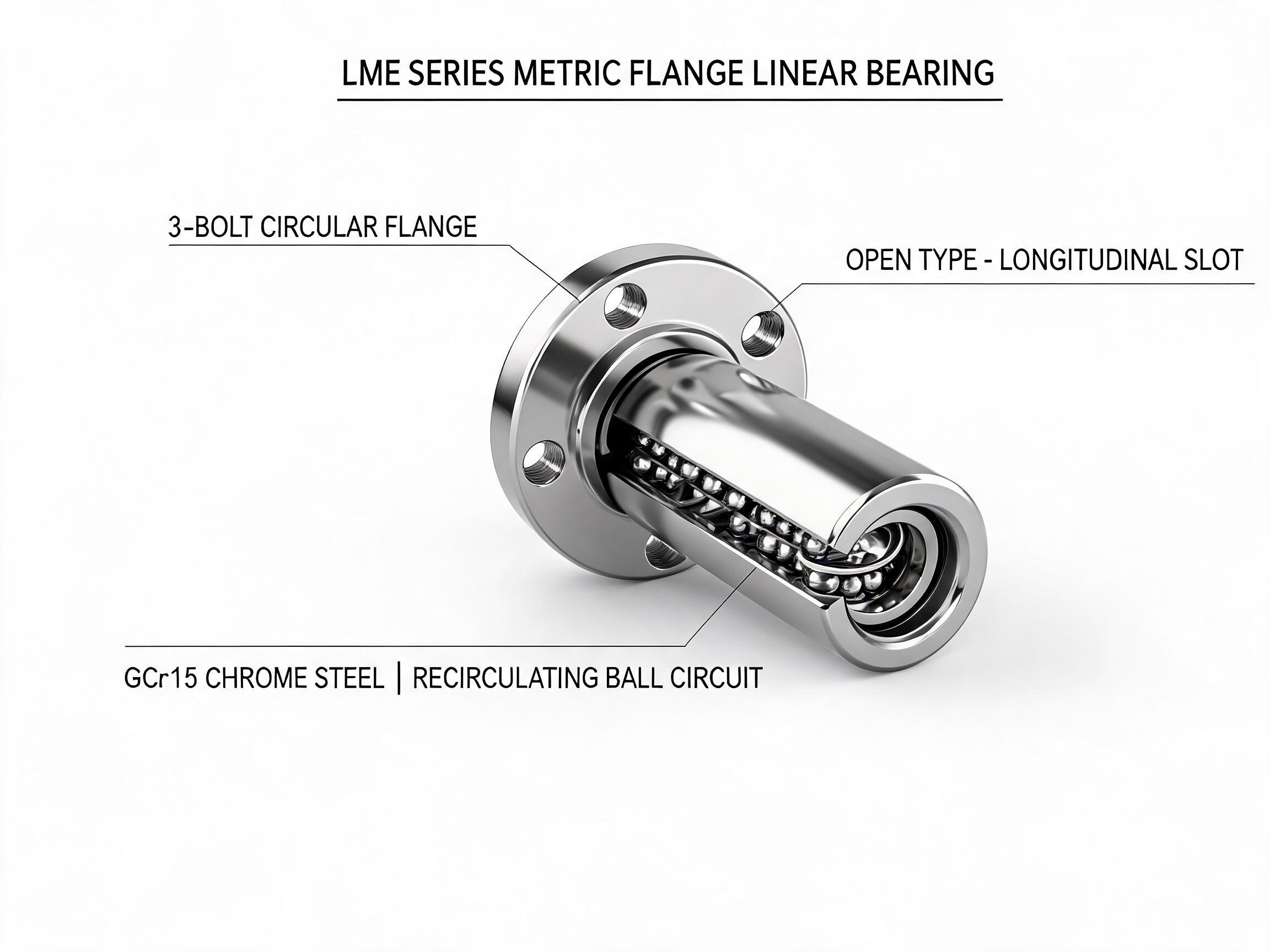
A section-by-section walk through a linear bearing datasheet: what nominal dimensions, load ratings, clearance, seals, shaft tolerance, housing fit and material actually decide, what the document never tells you, and how to turn it into a clear inquiry.
A linear bearing datasheet is the document you read before you commit to a purchase order, and it answers a narrower set of questions than most buyers expect. It confirms geometry and load capacity for a catalogue size. It does not confirm what will arrive in your crate, and it does not predict how long the bearing will last in your machine. Knowing which of those two jobs each line of the datasheet performs is what keeps an inquiry clean.
The same distinction applies when you read a linear bearing datasheet alongside linear guideway or ball screw documentation: nominal values define the part, and inspected values define the shipment. This walkthrough follows the usual section order of a linear bearing datasheet and, for each block, says what decision it drives.
Key takeaways
- Nominal dimensions define interchangeability, not the measured size of the parts you receive.
- Dynamic and static load ratings answer different questions, and neither is a working life figure.
- Clearance, seals, shaft tolerance, housing fit and material together decide whether the bearing runs smoothly or fails early.
- A datasheet does not carry the actual inspection values or the life your application will see; both have to be established separately.
- An inquiry built around shaft diameter, housing bore, load direction and environment gets a faster, more accurate response than a bare part number.
In this article
Nominal dimensions: what the part is designed to fit
The first block gives the bore (shaft diameter), outside diameter, length or width, and often the flange or housing envelope. These are nominal values: they define the design intent of the size and let you compare one supplier's bore and outside diameter against another's.
The decision this drives is interchangeability. If your drawing calls for a given shaft diameter and housing bore, that pair is what you match against the datasheet. Nominal dimensions are also the reference point that the tolerance tables further down work from, which is why they appear first.
Read them as a matching step, not a measuring step. A nominal bore is a designation; actual delivered size is a separate question, covered later in this article.
Dynamic and static load ratings: two different questions
Linear bearing datasheets normally list a dynamic load rating and a static load rating, frequently with separate values for different load directions. The difference is not cosmetic.
| Rating | What it addresses | What it does not tell you |
|---|---|---|
| Dynamic load rating | Load the bearing is rated for while the shaft and housing move relative to each other | How many cycles the bearing will survive in your machine |
| Static load rating | Load the bearing can be subjected to without moving | Whether the housing or shaft will deform first |
| Per-direction values | Whether capacity differs depending on load direction | The combined effect of simultaneous loads in several directions |
The exact figures are in the datasheet for your candidate size; the descriptions above explain what the figures mean, not what they are.
The decision here is sizing and safety margin. Compare your calculated load in each direction against the matching rating, and check whether the datasheet gives a single figure or directional figures. If it gives directional values, note which direction carries your heaviest load. A working life calculation uses these ratings as inputs but also depends on load profile, speed, lubrication and installation, so the rating is a starting point for that calculation, never the result of it.
Internal clearance: how freely it runs
Internal clearance describes the play between the rolling elements and the raceways before any external load is applied. Datasheets often list clearance classes or a clearance range rather than a single number.
The decision it drives is smoothness against stiffness. Lower clearance gives less play and a stiffer, more precise feel, but it demands tighter shaft and housing geometry to avoid preload that is too heavy. Higher clearance tolerates more variation in the surrounding parts but allows more movement under reversing loads. If your application is a positioning axis, clearance affects repeatability; if it is a transport or support function, it may matter less than cost and fit.
Check whether the datasheet states clearance as a class with a defined range or as a single line. A class is the workable basis for an order because it can be inspected against; a lone number with no range is harder to verify.
Seal options: choosing what keeps dirt out
Linear bearing datasheets list seal types, and each type carries a trade-off between protection and running resistance.
- Open bearings run with the least resistance and suit clean, well-lubricated environments.
- Single or double seals add protection against dust and chips at the cost of some friction and drag.
- Specialised seals for particular contamination types appear in some ranges, and the datasheet should identify which option belongs to which part number suffix.
The decision is an environment match. A seal that is right for a dusty conveyor is unnecessary drag on a clean laboratory axis. Check that the seal option you want is a distinct part number, because the suffix is what the supplier will price and ship.
Shaft tolerance and housing fit: where most failures start
This is the section buyers under-use. Most linear bearing datasheets include a recommended shaft tolerance and a recommended housing fit, and sometimes a shaft hardness figure.
These recommendations decide whether the bearing sits correctly after installation. A shaft that is under-tolerance leaves play; one that is over-tolerance forces the bearing onto the shaft and can damage the raceway or the rolling elements. The housing fit does the same on the outer side, and the relationship between the two determines how the clearance in the previous section behaves in the real assembly.
If your housings are already machined, check the datasheet recommendation against your drawing before ordering, not after. If your drawings are still open, the datasheet gives you the tolerance band to machine to. Also note whether the datasheet specifies shaft hardness; a soft shaft wears faster and can carry less load than the rating assumes.
Material: what the bearing and cage are made of
The material block usually identifies the bearing steel and any cage or retainer material, and may note surface treatment or coating. It rarely gives heat treatment detail or measured hardness values.
Material matters for two reasons. First, it sets the environmental boundary: standard bearing steel in a moist or chemically aggressive setting is a different proposition from a coated or stainless variant, and the datasheet should say which variant is which. Second, it affects load and life assumptions, because ratings are tied to a material and heat treatment baseline.
If the datasheet lists a variant, confirm with the supplier that the part number you are quoting corresponds to that variant, not to the standard version.
What the datasheet does not tell you
Two gaps matter most, and both come up in every serious purchase.
Actual delivered inspection values
A datasheet is a catalogue document. It states the tolerances the product is designed to meet, not the measured values of the batch you will receive. Bore size, outside diameter, clearance and runout all have a tolerance band, and where a delivered part sits inside that band is an inspection result. If your assembly is sensitive to that band, ask how the batch is measured and against which values. That is a different question from what the datasheet says, and it is asked with a drawing or a measurement requirement, not with a part number alone.
Application-specific life
Any life expectation depends on load profile, speed, duty cycle, lubrication, alignment and contamination. The load ratings in the datasheet are inputs to a calculation, and the calculation needs your operating conditions. A supplier can only respond usefully if you describe those conditions. Treat any single life number quoted without them with caution.
Also absent from most datasheets, and worth confirming directly:
- Whether the quoted part number includes the seal or is the open version.
- Whether the clearance class is stated as a range or a single figure.
- Whether the shaft tolerance recommendation shifts with the housing fit you plan to use.
- Which documents the supplier can provide for the specific batch.
Using the datasheet in an inquiry
A datasheet-led inquiry gives the supplier enough to quote accurately the first time. Four items carry most of the weight.
- Shaft diameter. State the nominal bore you need and, if your shaft is already machined, the actual tolerance you have.
- Housing bore. Give the nominal bore and fit you plan, or the drawing tolerance if it is fixed.
- Load direction. Say whether the load is radial, axial or combined, and give the magnitude. Direction matters because load ratings are often listed per direction.
- Environment. Note dust, chips, moisture, temperature range and whether the bearing is sealed or open in your design. Lubrication plan is useful too.
With those four points plus the datasheet part number, the supplier can confirm availability, check the seal and clearance variant, and tell you what inspection documentation is available for the batch. Without them, the supplier can only quote a catalogue number and you carry the risk of a fit or life mismatch.
The same discipline applies across the drivetrain of a linear axis. A linear bearing datasheet, a linear guideway drawing and a ball screw specification each define one component against a set of nominal values; the assembly only works when those nominal values and your real geometry agree.
Reading order, one more time
Start with nominal dimensions to confirm the part fits your shaft and housing. Move to load ratings for sizing, clearance for precision versus drag, seals for environment, and shaft and housing tolerances for installation. Check material to confirm the variant. Then set the datasheet aside and ask the two questions it cannot answer: how the delivered batch is measured, and what life your operating conditions support.