A practical procurement guide comparing three common linear bearing series — LM standard, LME flanged, and LMK long types. Covers dimensional standards, sealing options, load ratings, housing fit requirements, and application fit so buyers can specify the right bearing on the first RFQ.
BUYER GUIDE — LINEAR MOTION COMPONENTS
If you are sourcing linear bearings for a new machine design or replacing worn units in an existing assembly, the first decision is rarely about brand. It is about which series — LM standard, LME flanged, or LMK long type. Each has a different housing requirement, seal configuration, and load capacity. Choosing the wrong one means reworking the housing bore or ordering a second batch. This guide lays out the differences in plain terms so you can specify correctly the first time.
- LM and LMK series fit metric housings with a tolerance of G6; LME series uses the same metric shaft but requires a different housing bore dimension.
- LMK long type offers roughly 1.5–2× the dynamic load rating of the standard LM series at the same shaft diameter.
- Seal type (rubber vs. metal scraper) affects friction, speed, and contamination resistance — not just price.
- All three series are available in open (adjustable) versions for applications requiring zero radial clearance.
- Confirm the shaft hardness (HRC 58–64 recommended) and surface finish (Ra 0.4 or better) before placing an order — these determine actual bearing life.
Why the Series Designation Matters
Linear ball bearings (often called linear bushings) are standardized across manufacturers. The designation system tells you three things at a glance: the outer diameter shape, the length, and the seal type. A buyer who understands this system can compare quotes from different suppliers without confusion, because the dimensions are interchangeable across brands that follow ISO 10285 and JIS B 1083 standards.
The three series covered here are the most commonly specified in industrial automation, packaging machinery, and material handling equipment. They share the same internal ball retainer design and recirculating ball principle, but differ in housing fit, load capacity, and sealing options.
LM Series — Standard Type
The LM series is the baseline linear bearing. It has a cylindrical outer diameter that must be pressed into a housing bore. The housing must be machined to the correct tolerance (typically G6) to achieve the proper interference fit. LM bearings are available in closed (standard) and open (adjustable) configurations.
Typical Specifications (LM Series)
| Shaft Dia. (mm) | Outer Dia. (mm) | Length (mm) | Dynamic Load (N) | Static Load (N) |
|---|---|---|---|---|
| 8 | 15 | 24 | 275 | 400 |
| 12 | 21 | 30 | 510 | 780 |
| 16 | 28 | 37 | 770 | 1180 |
| 20 | 32 | 42 | 880 | 1370 |
| 25 | 40 | 58 | 1560 | 2450 |
| 30 | 47 | 68 | 2490 | 3970 |
Representative values for standard LM series — confirm exact ratings with your supplier for the specific size and seal type.
When to Specify LM Standard
- Your housing bore is already machined to the LM standard dimension.
- The application has moderate load and speed requirements.
- You need the widest availability — LM series is the most commonly stocked linear bearing worldwide.
- Cost per unit is the priority; LM is typically the most economical option.
Limitations
- Requires a separate housing with precision bore — adds machining cost.
- Standard rubber seals offer basic protection but are not ideal for heavy dust or metal particle environments.
- Load capacity is lower than the LMK long type at the same shaft diameter.
LME Series — Flanged Type
The LME series is identical in internal design to the LM series but includes an integral flange on the outer diameter. This flange allows the bearing to be bolted directly to a mounting plate or machine frame, eliminating the need for a precision-machined housing bore. The flange has clearance holes for mounting screws, typically socket head cap screws.
Key Differences from LM
- Mounting: Bolt-on via flange — no press-fit housing required.
- Housing tolerance: The bore can be machined to a looser tolerance (H7) since the flange carries the load.
- Alignment: Easier to align and replace — no pressing tools needed.
- Axial retention: The flange prevents axial movement without additional retaining rings.
Typical Specifications (LME Series — Flange Dimensions)
| Shaft Dia. (mm) | Outer Dia. (mm) | Flange Width (mm) | Flange Height (mm) | Mounting Holes |
|---|---|---|---|---|
| 12 | 21 | 42 | 6 | 4 × M4 |
| 16 | 28 | 48 | 6 | 4 × M4 |
| 20 | 32 | 54 | 8 | 4 × M5 |
| 25 | 40 | 62 | 8 | 4 × M5 |
| 30 | 47 | 74 | 10 | 4 × M6 |
Flange dimensions vary slightly by manufacturer — verify against the supplier's drawing before machining the mounting plate.
When to Specify LME Flanged
- You are retrofitting an existing machine and cannot re-machine the housing bore.
- Frequent bearing replacement is expected — bolt-on design reduces downtime.
- You are building a prototype or low-volume machine where custom housing machining is not cost-effective.
- Space is tight — the flange eliminates the need for retaining rings and additional axial fixings.
Limitations
- The flange adds material and machining cost — LME is typically 20–30% more expensive than the equivalent LM size.
- Flange bolts must be torqued evenly to avoid distorting the bearing raceway.
- Load capacity is the same as LM — the flange does not increase load rating.
LMK Series — Long Type
The LMK series is a long-stroke, high-load variant of the standard LM bearing. It has the same outer diameter as the LM series but a significantly longer length, which distributes the load over more recirculating balls. This increases both dynamic and static load ratings — typically by 50–100% depending on size.
Key Differences from LM
- Length: Approximately 1.5–2× the length of the standard LM series at the same shaft diameter.
- Load capacity: Higher dynamic and static ratings due to more balls in contact.
- Stability: Better moment load resistance — the longer bearing resists tilting forces better.
- Housing fit: Same outer diameter as LM — fits the same housing bore dimension.
Typical Specifications (LMK Series)
| Shaft Dia. (mm) | Outer Dia. (mm) | Length (mm) | Dynamic Load (N) | Static Load (N) |
|---|---|---|---|---|
| 8 | 15 | 45 | 430 | 630 |
| 12 | 21 | 57 | 820 | 1230 |
| 16 | 28 | 70 | 1230 | 1860 |
| 20 | 32 | 80 | 1400 | 2160 |
| 25 | 40 | 112 | 2450 | 3900 |
| 30 | 47 | 123 | 3650 | 5880 |
Representative values for LMK long series — confirm exact ratings with your supplier for the specific size and seal type.
When to Specify LMK Long
- The application requires higher load capacity without increasing shaft diameter.
- Moment loads (off-center forces) are present — the longer bearing resists tilting better.
- You want to extend service life — the lower contact pressure per ball reduces wear.
- You are designing for high-speed or high-frequency reciprocating motion.
Limitations
- Longer length means more space required in the assembly.
- Higher cost than LM at the same shaft diameter.
- Requires a longer housing bore — not a drop-in replacement for existing LM housings.
Seal Types: Rubber vs. Metal Scraper
Seals are not an afterthought. They determine how the bearing performs in real-world environments with dust, moisture, and metal particles. Three common seal configurations are available across all series:
1. Standard Rubber Seal (RS / 2RS)
- Nitrile rubber (NBR) lip seal on both ends.
- Good for general industrial environments with light dust.
- Low friction — suitable for high-speed applications.
- Operating temperature range typically −30°C to +100°C.
2. Metal Scraper Seal (ZZ / 2Z)
- Stainless steel or hardened steel scraper ring.
- Designed to scrape off larger particles, weld spatter, and chips.
- Higher friction than rubber — reduces maximum speed.
- Recommended for machining environments, welding stations, and foundry equipment.
3. Contact Seal (LLU / 2LLU)
- Low-friction, low-torque lip seal made of special rubber compound.
- Provides better dust protection than standard RS while maintaining lower friction.
- Good for precision applications like measurement equipment and medical devices.
Load Capacity Comparison at a Glance
The table below compares dynamic load ratings across the three series at common shaft diameters. Values are representative — always confirm with the manufacturer's catalog.
| Shaft Dia. (mm) | LM Dynamic Load (N) | LME Dynamic Load (N) | LMK Dynamic Load (N) | LMK vs LM Ratio |
|---|---|---|---|---|
| 12 | 510 | 510 | 820 | 1.6× |
| 16 | 770 | 770 | 1230 | 1.6× |
| 20 | 880 | 880 | 1400 | 1.6× |
| 25 | 1560 | 1560 | 2450 | 1.6× |
| 30 | 2490 | 2490 | 3650 | 1.5× |
Note that LME and LM have identical load ratings — the flange is a mounting feature, not a load-enhancing feature. If you need higher capacity, you must move to the LMK series or increase the shaft diameter.
Housing Fit and Machining Requirements
One of the most common sourcing mistakes is ordering the correct bearing but failing to machine the housing correctly. Here is what you need to communicate to your machine shop:
For LM and LMK Series
- Housing bore tolerance: G6 (e.g., for 20 mm shaft, the housing bore should be Ø32 +0.009 / +0.025 mm).
- Housing bore surface finish: Ra 0.8 or better.
- Housing material: Steel or cast iron recommended for heavy loads; aluminum acceptable for light loads.
- Retaining rings required on both ends to prevent axial movement.
For LME Series
- Mounting plate bore tolerance: H7 (looser than G6 — the flange carries the load).
- Mounting screws: Use the specified screw size and torque evenly in a crisscross pattern.
- Ensure the mounting surface is flat and perpendicular to the shaft axis — use a dial indicator to check.
Open (Adjustable) Versions
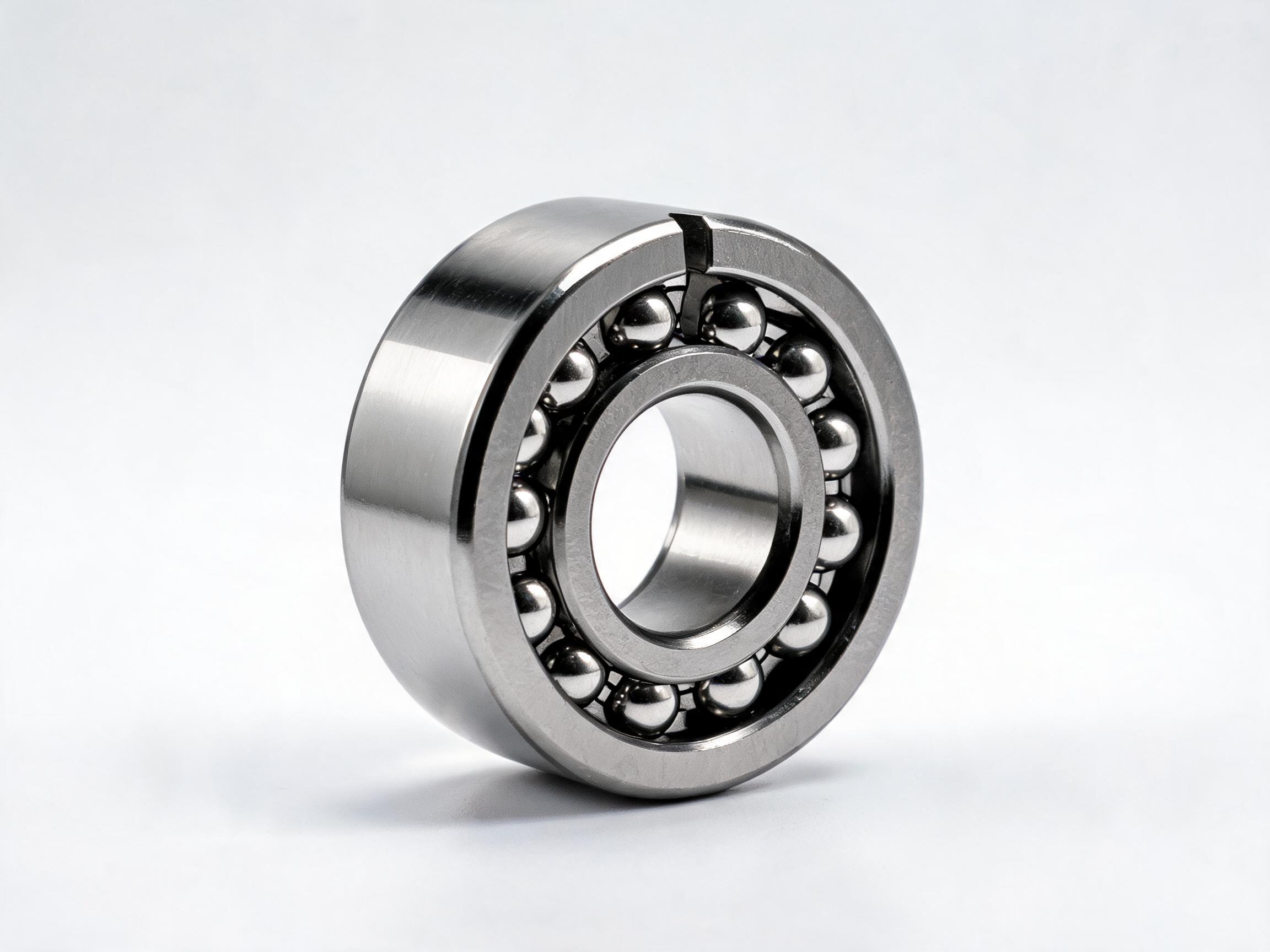
All three series are available in an "open" configuration, where the outer cylinder has a longitudinal slot. This allows the bearing to be adjusted radially using a set screw or eccentric cam. Open types are used when:
- Zero radial clearance is required (e.g., precision positioning stages).
- The shaft and housing have slight misalignment that must be compensated.
- Preload needs to be applied to eliminate play.
Open bearings have slightly lower load capacity than closed types because some balls are removed in the slot area. Factor this into your life calculation.
Shaft Requirements — Often Overlooked
Linear bearings are only as good as the shaft they run on. Before finalizing your bearing selection, verify the following shaft specifications:
- Hardness: HRC 58–64 for induction-hardened or through-hardened shafting. Softer shafts will brinell the raceway and shorten bearing life dramatically.
- Surface finish: Ra 0.4 µm or better. Rougher surfaces increase friction and wear.
- Straightness: Within 0.05 mm per 1000 mm for general applications; tighter for precision stages.
- Diameter tolerance: h6 or tighter (e.g., Ø20 h6 = 0 / −0.013 mm).
A buyer who specifies the bearing but ignores the shaft is buying a premature failure. The shaft is half the bearing system.
How to Write Your RFQ
When sending an inquiry to a supplier, include the following information to get an accurate quote and avoid back-and-forth:
- Series and size: e.g., LM20UU, LME20UU, LMK20LUU (include the seal suffix).
- Seal type: RS (rubber), ZZ (metal scraper), or LLU (contact).
- Open or closed: Specify if you need the adjustable version.
- Quantity: Annual volume and order frequency.
- Shaft details: Diameter, hardness, and surface finish of the mating shaft.
- Application: Brief description (e.g., packaging machine, CNC router, medical device) — this helps the supplier recommend the right seal and clearance.
- Operating conditions: Speed, temperature, dust level, and lubrication method.
Frequently Asked Questions
Can I use an LME flanged bearing in place of an LM bearing?
Yes, if you can accommodate the flange dimensions and bolt pattern. The load capacity and internal design are identical. The LME requires a looser housing bore (H7 instead of G6), so you may need to open up the existing bore.
Is the LMK long type always better than the LM standard?
Not always. The LMK is longer and heavier, and it requires a longer housing. If space is constrained or the load is light, the standard LM is more economical. Use LMK when the load calculation demands it.
What does the "UU" suffix mean in LM20UU?
"UU" indicates the bearing is sealed on both ends with rubber seals. "LUU" indicates a long type with seals. "SUU" indicates an open type with seals. These suffixes are consistent across most manufacturers.
How do I calculate bearing life?
Use the basic dynamic load rating (C) and the applied equivalent load (P) in the formula: L = (C/P)³ × 50 km (for linear bearings). Most suppliers provide a life calculation sheet — ask for it with your quote.
Do you offer custom lengths or special seals?
Many manufacturers can produce non-standard lengths or custom seal materials. Minimum order quantities apply. Contact us with your drawing or specification, and we will confirm feasibility and lead time.
Final Recommendation
For a new design, start with the load calculation. If the required dynamic load is within the LM series rating and you have a precision-machined housing, specify LM. If you want to simplify assembly and maintenance, specify LME flanged. If the load exceeds the LM rating at your chosen shaft diameter, move to LMK long before increasing the shaft size — it is often the more compact and cost-effective solution.
When in doubt, send your application details to your supplier. A good supplier will confirm the bearing size, seal type, and housing tolerance based on your operating conditions — not just sell you the cheapest unit in stock.
If you are sourcing linear bearings for an ongoing project and need specification support, contact our engineering team with your shaft diameter, load, speed, and environment. We will respond with a recommended series, seal type, and a formal quotation.