A practical buyer's guide to the LMUU sealed linear bearing — covering the extended-length housing, double-seal construction, contamination protection, and how these features reduce maintenance in CNC, packaging, and automation equipment. Includes selection criteria, comparison tables, and common application questions.
BUYER GUIDE — LINEAR MOTION COMPONENTS
LMUU Sealed Linear Bearing: Extended Length, Double Seal Design, and Contamination Protection for Industrial Automation Equipment
If you source linear motion components for CNC routers, packaging lines, or automated assembly stations, you already know the failure pattern. A standard open linear bearing runs smoothly for a few thousand cycles. Then dust, metal fines, or coolant mist gets in. The ball tracks wear unevenly. The carriage starts to chatter. You replace the bearing, and the cycle repeats.
This article explains why the LMUU sealed linear bearing — with its extended-length housing and double-seal construction — is designed to break that cycle. We cover the specific engineering details, how they translate into longer service intervals, and what to check before you spec it into your next machine.
- The LMUU uses an extended-length housing, which distributes load over a larger contact area and improves moment rigidity compared to standard short bearings.
- The double-seal design blocks both fine dust and larger debris from entering the ball track — the main cause of premature linear bearing failure in shop-floor environments.
- Contamination protection directly reduces maintenance frequency and unplanned downtime, which matters more than initial part cost in most automation ROI calculations.
- Sealed linear bearings are interchangeable with standard types in most mounting configurations, but you should verify shaft hardness and surface finish before switching.
What Is an LMUU Sealed Linear Bearing?
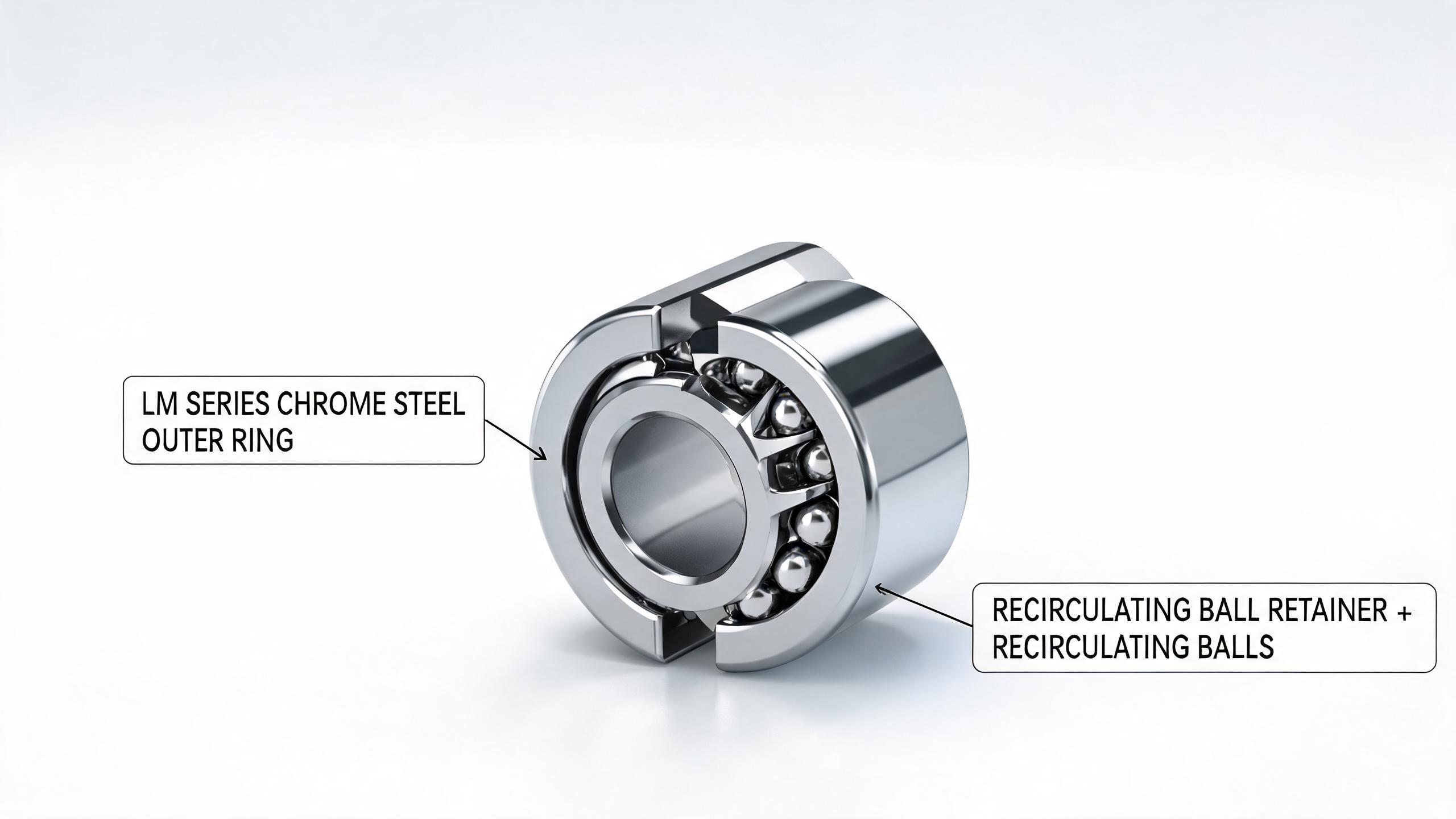
The LMUU is a metric-series linear ball bearing designed to slide along a hardened and ground shaft. It belongs to the broader family of linear bush bearings — cylindrical units that use recirculating balls to provide low-friction linear motion. The "UU" designation indicates the sealed version, meaning the bearing comes with integral seals at both ends to keep contamination out and lubricant in.
What sets the LMUU apart from a standard linear ball bearing slide unit is its extended-length housing. A typical open linear bearing has a length roughly equal to its bore diameter. The LMUU extends that length, providing a larger bearing surface. This is not a cosmetic change — it changes how the bearing performs under load.
Why Extended Length Matters in Linear Bush Bearings
When a linear bush bearing carries a load, the balls in contact with the shaft deform elastically. The load is distributed across the balls that happen to be in the load zone at any given moment. A shorter bearing has fewer balls in that zone, so each ball carries a higher individual load. Over time, this leads to brinelling — permanent indentations on the shaft surface — and premature fatigue of the ball tracks.
The extended-length LMUU puts more balls in the load zone. The benefits are measurable:
- Higher load capacity: More contact points mean the bearing can handle a greater radial load for the same shaft size.
- Better moment rigidity: Longer bearings resist tilting forces better. If your application has overhung loads or off-center thrust, this is critical.
- Smoother motion: With more balls sharing the load, deflection under load is reduced, which translates to more consistent positioning.
| Characteristic | Standard Linear Bearing | LMUU Extended-Length Sealed |
|---|---|---|
| Housing length vs. bore | Approximately 1× bore diameter | Extended — more balls in the load zone |
| Seal configuration | Often open or single seal | Double seal at both ends |
| Load distribution | Fewer contact points | More contact points, lower per-ball stress |
| Contamination resistance | Low to moderate | High — designed for dirty environments |
| Typical service interval | Shorter in dusty conditions | Extended, especially with regular relubrication |
The Double-Seal Design: How It Protects the Ball Track
The most common cause of premature failure in a linear ball bearing slide is not wear from normal use — it is contamination. Dust, grit, metal chips, and even dried coolant residue act as an abrasive paste inside the ball track. Once that paste forms, the balls and the shaft surface wear against each other at an accelerated rate.
The LMUU addresses this with a double-seal arrangement. Each end of the bearing carries two sealing lips rather than one. The outer seal blocks larger particles — chips, fibers, coarse dust. The inner seal catches finer particles that the outer seal lets through. Between the two seals, there is a small cavity that can hold a reservoir of grease, which helps flush particles away from the ball entry point.
This is a meaningful difference from a standard bearing with a single metal or rubber shield. A single shield reduces contamination but does not eliminate it. In a woodworking CNC machine or a metal-cutting environment, the difference between a single and double seal is often the difference between six months and two years of reliable service.
Contamination Protection in Real Industrial Environments
Different industries create different contamination profiles. The LMUU's double-seal design is relevant across most of them, but the specifics vary:
- Woodworking and CNC routing: Fine sawdust is pervasive. It gets into everything, including linear guides. The double seal prevents dust from packing into the ball track, which would otherwise cause rough motion and rapid wear.
- Metal cutting and machining: Coolant mist and metal fines are the main threats. Coolant can wash away lubricant; fines act as an abrasive. Sealed bearings retain grease better and keep fines out.
- Packaging and food processing: These environments often have washdown cycles and airborne particulates. A sealed linear bearing reduces the risk of washdown water entering the bearing and diluting the grease.
- Automated assembly and material handling: Dust from the facility and wear particles from other moving components are common. Sealed bearings extend maintenance intervals in these high-cycle applications.
In a dusty environment, the cost of a sealed linear bearing is usually recovered many times over by avoiding one unscheduled production stop.
How to Select the Right LMUU for Your Application
Selecting a linear bush bearing is not just about bore diameter. Here is a practical checklist for spec'ing the LMUU into your design:
- Confirm shaft diameter and tolerance: The LMUU is available in standard metric shaft sizes. The shaft must be hardened (typically HRC 58–62) and ground to the recommended tolerance (usually g6 or h6) for the bearing to perform correctly.
- Check the load rating: Review the dynamic load rating (C) and static load rating (C0) for the specific size. Compare these against your actual loads, including any shock loads during operation.
- Consider the mounting arrangement: LMUU bearings can be used in a bearing linear slide assembly with a machined housing. Verify that your housing bore tolerance matches the bearing's outer diameter tolerance for a proper fit.
- Plan for lubrication: The seals help retain grease, but the bearing still needs periodic relubrication. Confirm the recommended grease type and interval with your supplier — it varies by speed and duty cycle.
- Evaluate operating temperature: Standard seals are suitable for typical shop-floor temperatures. If your application runs hot or cold, check the seal material compatibility with your supplier.
LMUU vs. Standard Linear Bearings: A Cost Perspective
The LMUU carries a higher unit price than an equivalent open or single-seal bearing. That is expected — the extended housing uses more material, and the double-seal adds manufacturing complexity. But the relevant comparison is not unit price. It is cost per hour of reliable operation.
In a production machine, an unplanned bearing failure costs more than the bearing itself. It costs the labor to diagnose the problem, the downtime of the machine, the replacement part, and the risk of collateral damage — a failed bearing can score the shaft, which then requires shaft replacement as well.
When you calculate total cost of ownership, the sealed extended-length bearing typically wins in any environment with measurable dust or debris. If your machine runs in a clean, climate-controlled setting, a standard bearing may be sufficient. If not, the LMUU is the more economical choice over the machine's life.
Common Questions About Sealed Linear Bearings
Can I replace an existing standard bearing with an LMUU without changing my shaft?
In most cases, yes, provided the shaft is hardened and ground to the correct tolerance. The bore diameter is the same. However, the extended housing is longer, so you must verify that your current housing or carriage has space for the longer bearing.
Do the seals add friction?
Yes, seals add a small amount of drag compared to an open bearing. This is usually negligible in motor-driven applications. In very light, manually operated slides, the added friction may be noticeable — test it before finalizing the design.
How often should I relubricate a sealed LMUU?
It depends on speed, load, and environment. As a general starting point, more frequent relubrication is better in dirty environments. Confirm the recommended interval and grease type with your bearing supplier for your specific operating conditions.
Are LMUU bearings available in inch sizes?
The LMUU is a metric-series designation. If your design uses inch shafts, you would look at the corresponding inch-series sealed bearings. The sealing and extended-length principles are the same.
Final Recommendations for Buyers
If you are sourcing linear bush bearings for equipment that operates in less-than-clean conditions, the LMUU sealed extended-length bearing is a strong candidate. The double-seal design addresses the root cause of most premature failures — contamination — and the extended housing improves load distribution and rigidity.
Before you place an order, confirm the following with your supplier:
- Exact dimensions and tolerances for your shaft size
- Dynamic and static load ratings for your application
- Seal material compatibility with your operating environment
- Recommended lubrication type and relubrication interval
- Lead time and MOQ for your required quantity
If you are evaluating a specific LMUU size for a new machine design or a retrofit, contact us with your shaft diameter, load conditions, and operating environment. We can confirm the correct part number and provide the specifications you need for your design review.