
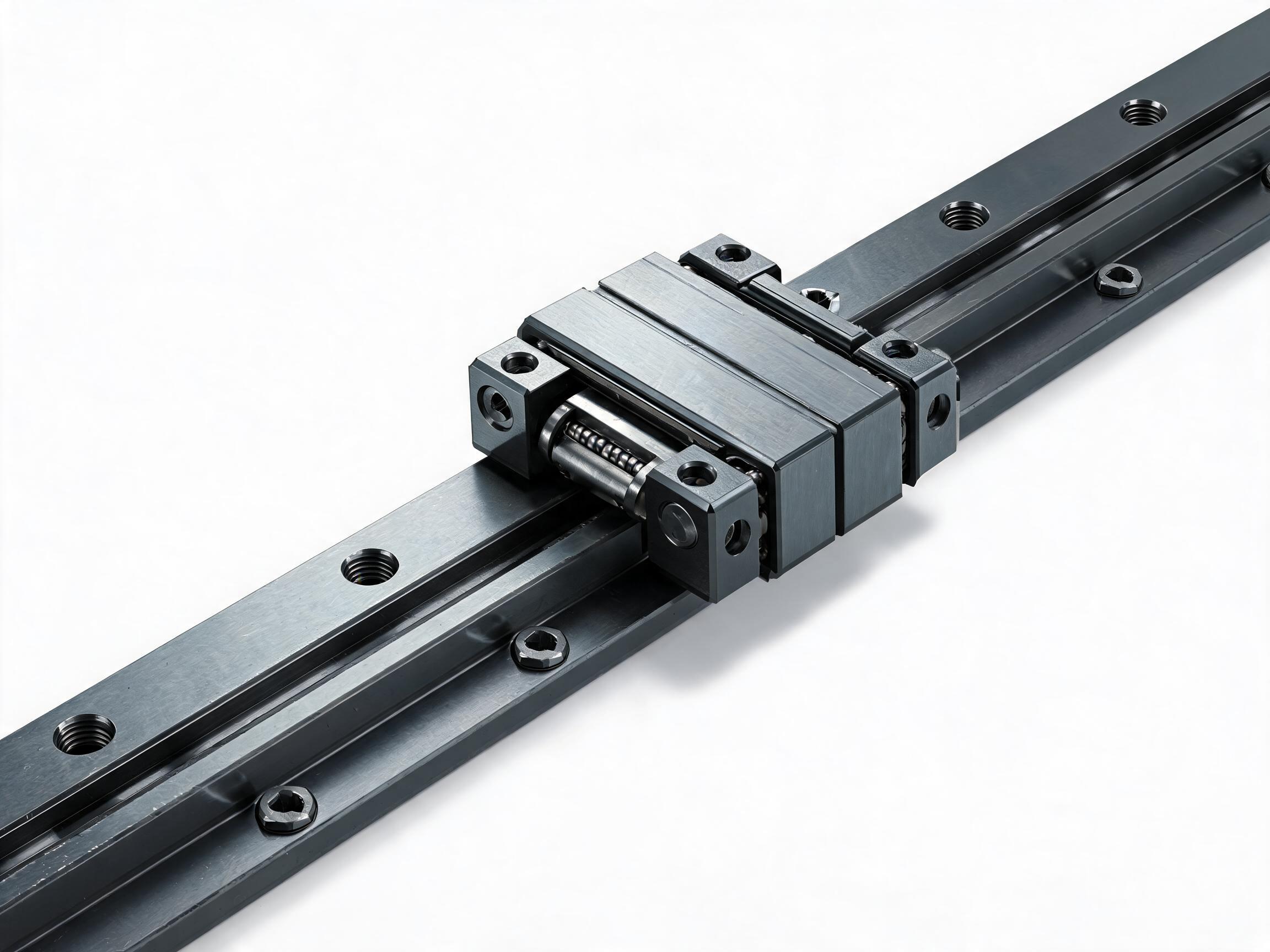
Ordering multiple carriages for one linear guide rail? This guide explains why matching preload, accuracy, and sealing matters, how to handle long spliced rails, and what to confirm about matched pairs—plus a practical order checklist.
When you specify one linear guide rail with multiple carriage blocks, the rail and carriage part numbers alone do not define a working system. Three specification settings—preload class, accuracy grade, and sealing configuration—must be consistent across every carriage on the same rail. On long travel lengths, rail joining becomes a fourth factor. This article explains what to lock down before you place an order, and what to confirm with your supplier about "matched" pairs or sets.
Key takeaways
- All carriages on one rail should share the same preload class, accuracy grade, and sealing configuration unless a deliberate, documented exception exists.
- For rails longer than 4000 mm, confirm that the supplier uses precision-matched splice joints and that straightness at the joint is held to the same grade as the rail.
- "Matched pair" or "matched set" is a commercial and specification term—not a universal standard. Ask the supplier what tolerances they control and request the datasheet values for the parts you are buying.
In this article
Why consistency across carriages matters
A linear guide system distributes load across all carriage blocks on the rail. If carriages differ in preload or accuracy, the load sharing changes and the mounting surfaces may not sit in one plane. The result is not always an immediate failure; more often it is uneven running, higher friction in one block, or a positioning error that appears only under certain loads. For machine builders, that kind of variation is harder to diagnose than a clear defect, and it can turn into field returns if it reaches the end user.
The practical rule is simple: treat the carriages as a set, not as individual line items. That is the basis for ordering matched linear rail carriages rather than a quantity of the same part number without further specification.
The three specifications to align
1. Preload class
Preload defines the internal clearance or interference between the carriage and the rail. In the HGW series marking system, the classes are C0 (clearance), C1 (light preload), and C2 (medium preload). A carriage with C0 mated to a rail ground for C2 will not behave like a matched pair—the clearance removes the stiffness that the C2 block was intended to provide. Order one preload class for the whole rail, and state it on every line of the purchase order.
Preload also affects how the system is mounted. A higher preload requires flatter mounting surfaces and more carefully torqued bolts. If your machine frame cannot hold the flatness that the preload class assumes, a lower preload may be the more consistent choice.
2. Accuracy grade
Accuracy grade covers the running parallelism of the rail and the height tolerance of the carriage. In the HGR series, the available grades include ground H (P5) and rolled N (P7). Mixing a P5 carriage with a P7 rail, or ordering a replacement block in a different grade, breaks the height and parallelism relationship the original design assumed. For a multi-carriage order, specify one grade for all blocks on the same rail.
Where an application needs P5, the rail and the carriage should both be ordered in P5. If the application tolerates P7, ordering one carriage in P5 does not upgrade the system; it only creates a mismatch.
3. Sealing configuration
Seals are selected for the environment, not for the part number. A carriage with a triple-seal configuration, such as the HGW series triple sealing, will have different running friction from a standard-sealed block. On a rail with several carriages, all blocks should use the same seal type so that friction and contamination protection are uniform. If one carriage is in a dusty area and another is not, consider whether the whole rail should be upgraded rather than mixing seal types on one rail.
Long rails: splice joints and accuracy
When the required rail length exceeds 4000 mm, rails are supplied in sections with precision-matched splice joints. The key question for the buyer is not whether the rail is spliced, but whether the joint is held to the same straightness grade as the rest of the rail. For a P5 rail, the splice joint should maintain P5 straightness at the joint; otherwise the carriage will see a step or a kink that no preload setting can compensate for.
If your design uses a spliced rail, confirm the following in the quotation:
- The joint is described as a precision-matched splice, not a field-cut butt joint.
- The straightness grade at the joint matches the rail grade (for example, P5 at the joint on a P5 rail).
- The number of joints and their positions are agreed, because joint position affects where the carriage crosses the seam.
For a multi-carriage system on a long rail, the carriages will pass over the splice repeatedly. The joint condition matters as much as the carriage specification.
What "matched pair" actually means
Suppliers use "matched pair" or "matched set" to describe carriages selected and packed together so that their critical dimensions fall within a controlled band. The term is widely used, but the tolerance band behind it is not universal. Some suppliers control height and preload within a stated range; others simply select from the same production lot. Neither practice is wrong, but they are not the same thing.
Do not assume a matching tolerance from the product name. Ask for the datasheet values for the exact part numbers you are ordering, and confirm:
- Whether the supplier offers a matched-pair or matched-set option, and what dimensions it covers.
- The height difference tolerance between carriages in the set.
- How preload is verified for each carriage in the set.
- Whether the matching is done at the factory and documented on the packing list.
If the datasheet does not state a matching tolerance, that is not a reason to invent one. It is a reason to ask the supplier to confirm in writing.
How this differs from replacement and selection
This article covers the ordering stage of a new multi-carriage system. It does not cover the question of replacing a single worn block versus a pair, which depends on the condition of the existing rail, or the selection comparison between HGH, HGW, and SBS carriage types, which depends on load direction and mounting space. Those are separate decisions. At the ordering stage, the goal is consistency across all carriages on one rail.
A worked example
Consider a machine axis using HGR45 heavy-duty large linear guideway rail with three carriages. The compatible carriage options include HGH45CA, HGW45CA, and HGW45HA. If the design calls for the HGW45CA wide-body block, the order should specify three HGW45CA carriages in the same preload class, the same accuracy grade, and the same seal configuration. The HGR45 + HGW45CA system is rated at 62.8 kN dynamic load and 112 kN static load per carriage. If the three carriages are ordered in mixed grades, the load rating does not change, but the system may not run as one plane.
If the rail length goes beyond 4000 mm, the same order should state that the rail is supplied with precision-matched splice joints and that the joint straightness is held to the rail grade. The carriage specification and the rail joint specification are two parts of one requirement: a matched multi-carriage system on a continuous running surface.
Order confirmation checklist
Use this list before releasing a purchase order for a multi-carriage rail system.
- Rail and carriage part numbers: confirmed against the model and the HGR series heavy-duty linear guideway rail or HGW series wide-body linear guideway carriage block datasheet.
- Preload class: one class (C0, C1, or C2) stated for every carriage on the rail.
- Accuracy grade: one grade (H/P5 or N/P7) stated for the rail and all carriages.
- Seal configuration: one seal type stated for all carriages; triple sealing noted where required.
- Self-alignment: if the application needs it, confirm that the carriage has self-aligning capability (for example, ±0.5° where stated) and that all carriages on the rail use the same type.
- Rail length and joints: for lengths over 4000 mm, confirm precision-matched splice joints and joint straightness grade.
- Matched pair/set option: if ordered, confirm the dimensions covered and request the datasheet tolerance values.
- Packing list: confirm that the carriages are identified as a matched set and that the preload and grade appear on the documents.
If any item on this list is missing from the quote, ask for it before ordering. The cost of a mismatch discovered at commissioning is usually higher than the time spent confirming the specification in writing.