
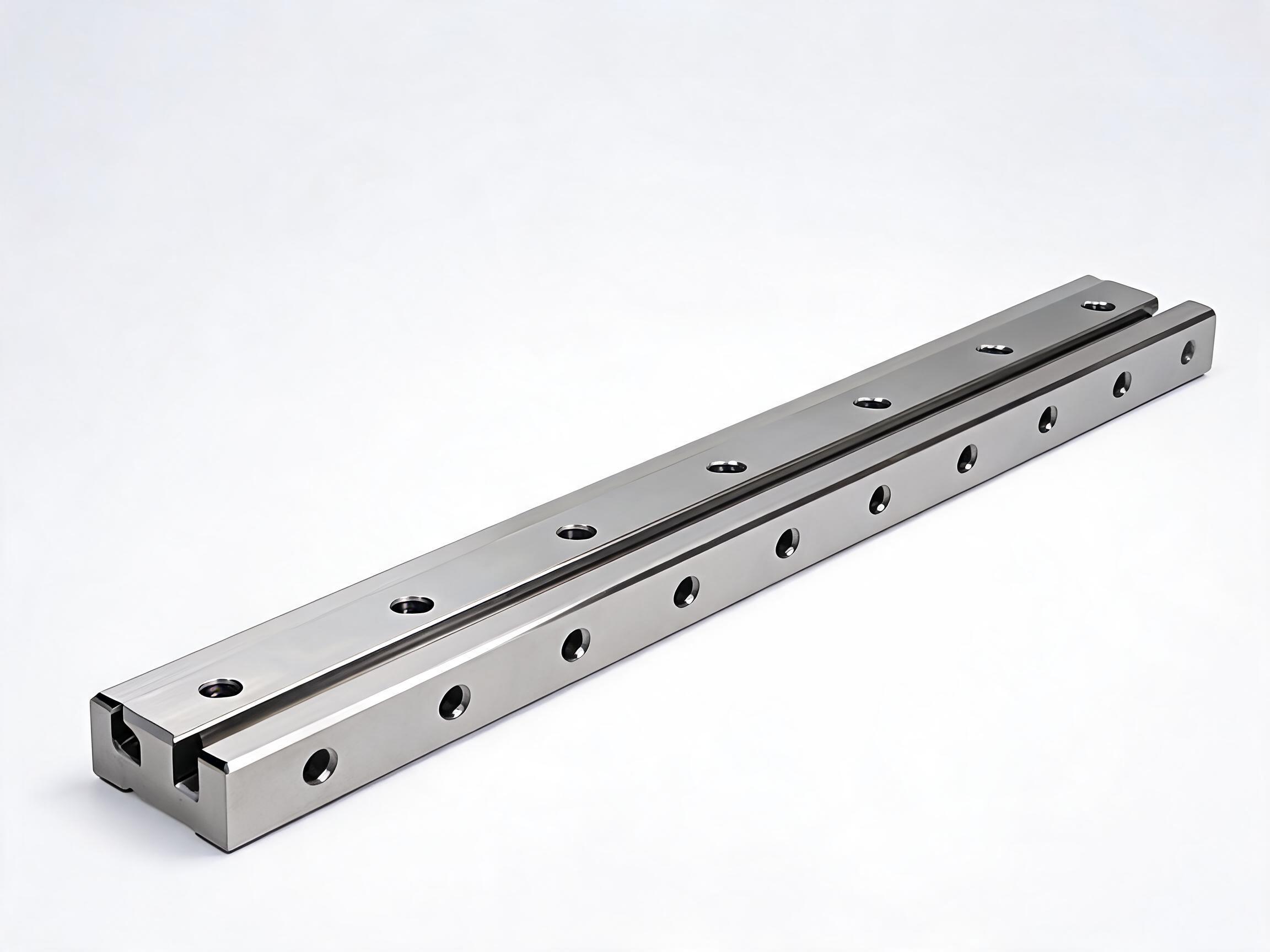
A miniature linear stage is a matched guide-drive-table unit, not a collection of small parts. This buyer's guide walks through the sizing sequence (stroke, envelope, load, resolution) and explains when building from miniature rails is the better route, with real catalog data from Dongfeng Bearing.
Buyer's Guide · Miniature Motion
Miniature Linear Stage: Sizing a Small Positioning Table
A miniature linear stage is a single-axis positioning table engineered as one unit: a guide, a drive, and a moving table selected and matched by the supplier. Buyers searching for a miniature linear stage or a micro linear stage often start by pricing small rails and carriages, then discover that a complete stage is a different purchase with a different set of questions. This article walks through the sizing sequence — stroke, envelope, load, resolution — and explains when assembling from miniature rails is the better route instead of buying a finished unit.
What a Complete Miniature Stage Includes
When a supplier quotes a miniature linear stage, the unit typically bundles four things that must work together:
- Guide: the linear rail and carriage that carry the load and constrain motion.
- Drive: the screw, belt, or other mechanism that moves the table along the guide.
- Table: the moving platform that presents a flat, hole-patterned surface to your payload.
- Interfaces: mounting holes, reference edges, and end connections already aligned by the builder.
Buying those elements separately means you specify each one and take responsibility for alignment, drive coupling, and the flatness of the table that ties them together. A finished stage moves that integration work to the supplier, but it also limits you to the configurations that supplier offers.
The Sizing Sequence: Stroke → Envelope → Load → Resolution
Sizing in the wrong order is the most common reason a small positioning table turns out to be the wrong purchase. The sequence below moves from the requirement you cannot change to the parameter that is easiest to trade off.
1. Stroke first
Stroke is the usable travel of the table, and it usually sets the minimum length of the whole stage. A 50 mm stroke stage is not a 50 mm long stage — the guide, drive, and end blocks add length beyond the travel. State the required travel and whether the application needs travel in one direction from a home position or symmetric travel around center. This single number filters most catalog options before any other discussion.
2. Envelope second
The envelope is the space the stage occupies, including the drive overhang, motor coupling, and cable clearance. A stage that meets the stroke requirement but does not fit the machine envelope is not a candidate. For small tables, the drive choice often drives the envelope more than the guide does, because the screw or belt and its support extend past the table.
3. Load third
Load has two parts: the payload mass and the moment it creates. A centered payload is straightforward; an offset payload adds pitch, yaw, and roll moments to the carriage. When you request a quote, describe the payload, its center of gravity relative to the table center, and whether the load is static or moving. These determine whether a given guide size inside the stage can carry the application.
4. Resolution last
Resolution is how finely the table can position, and it depends on the drive and the feedback or step definition. It is the parameter most often overstated in early conversations. Ask what resolution is specified at the table, not at the motor, and ask what repeatability the supplier states for the complete unit. A resolution figure alone does not describe positioning quality.
When a Complete Stage Is the Better Buy
A finished miniature stage suits buyers who need a defined unit with a single point of responsibility. If your team does not want to design the guide-drive-table interface, align the drive to the rail, and validate the assembly, a complete stage removes that work. It also simplifies spares and repeat orders: the same part number returns the same matched assembly.
At the larger end of precision positioning, factory-built tables show what a matched unit looks like. The XY200 precision cross slide table is a two-axis example: CMM-verified orthogonality of 90°±0.02°, ±0.01 mm repeatability, 200 mm travel per axis, built on HGR15 guide rail and SFU1605 C7 ball screws, with an MOQ of 20. It is a larger precision table rather than a miniature stage, but it illustrates the principle — the guide, screw, and table are specified and verified as one assembly.
When Assembling from Miniature Rails Is the Better Route
Buying components makes sense when the application has a constraint a standard stage cannot meet: an unusual mounting pattern, an integrated drive you already use, a table shape that must match existing hardware, or a volume where the design is worth owning. In those cases, a miniature rail and carriage becomes the foundation, and you build the drive and table around it.
The MGN12 linear rail is a common building block for this route. Listed data includes MGN12C with 3.7 kN dynamic and 5.4 kN static load ratings, 9Cr18Mo stainless steel as standard, maximum rail length 1000 mm, and an MOQ of 50. Those figures describe the rail and carriage, not a completed stage: once you add a drive and table, the load capacity and stiffness of the assembly depend on how you integrate them.
If you go the component route, plan for the integration checks a stage supplier would otherwise perform: rail mounting surface flatness, carriage preload, drive-to-rail parallelism, and the table’s own stiffness. These are the same checks that make a matched stage repeatable.
Build vs. Buy at a Glance
| Factor | Complete miniature stage | Built from miniature rails |
|---|---|---|
| Integration work | Done by supplier | Done by your team |
| Configuration freedom | Limited to supplier options | Open, within component limits |
| Repeat orders | Same part number returns matched unit | Same part number returns component; assembly must be re-checked |
| Best fit | Defined unit, single point of responsibility | Unusual envelope, existing drive, or design worth owning |
Comparison is a decision aid, not a cost or performance ranking. Neither route is universally better.
How to State a Requirement to a Supplier
A quote request for a micro linear stage is most useful when it separates fixed requirements from preferences. State the stroke and envelope as requirements, describe the payload and its center of gravity, and give the resolution and repeatability you need at the table. If you are open to either route, say so — a supplier can then quote a stage and a rail-based alternative against the same requirement.
- Required stroke and direction of travel
- Maximum envelope and mounting orientation
- Payload mass and center of gravity offset
- Required resolution and stated repeatability at the table
- Drive preference, if any, and control interface
FAQ
- Is a miniature linear stage the same as a small linear rail?
- No. A rail and carriage is one component. A stage adds a drive and a moving table, matched and aligned as a unit.
- Can I get a miniature stage with a specific stroke?
- Miniature single-axis stage units are quoted on request, so the stroke is one of the requirements you provide. The usable travel and the overall length differ, so give both if the envelope is tight.
- Does a higher load rating on the rail mean the stage can carry that load?
- The rail rating describes the rail and carriage. A completed stage’s capacity depends on the drive, the table, and how the assembly is built. Ask for the stage-level rating, not only the component rating.