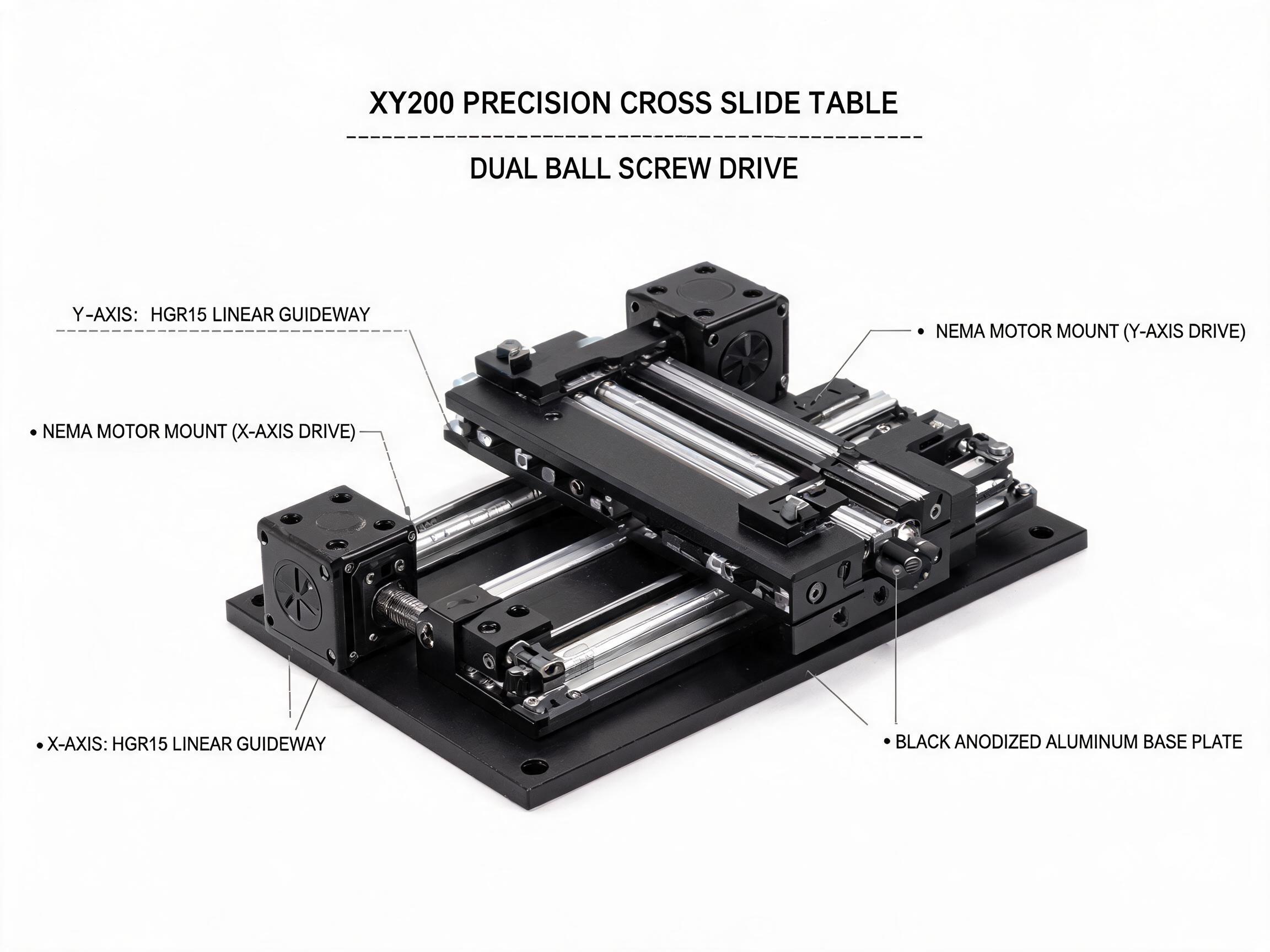
Selecting the right XY stage for automation demands a clear understanding of screw drive linear actuator performance, load capacity, and precision. This guide covers the key criteria for choosing a precision cross slide table with dual ball screw drive, including ball and screw linear actuator types, linear motion screws, and linear slide rail guide selection.
BUYER GUIDE
1. Dual ball screw drive eliminates backlash and improves repeatability to ±1–3 µm for precision automation.
2. Choose a screw drive linear actuator over a belt drive when load capacity, stiffness, and positioning accuracy are critical.
3. The linear slide rail guide type (e.g., crossed roller vs. linear ball guide) directly affects load capacity, travel life, and smoothness.
4. Ball and screw linear actuator preload class (C3, C5, C7) determines the trade-off between cost and positioning accuracy.
5. Application-specific factors — duty cycle, environment (dust, coolant), and mounting orientation — must drive the selection, not just the datasheet.
When you are designing an automated assembly station, a laser processing head, or a precision inspection gantry, the XY stage is the core motion platform. The choice between a belt-driven system and a screw drive linear actuator often comes down to one question: how much precision do you really need?
For applications requiring positioning accuracy under 50 µm, repeatability under ±5 µm, and high stiffness under load, the precision cross slide table with dual ball screw drive is the standard solution. This article walks through the selection criteria, compares common configurations, and explains how each component — the ball and screw linear actuator, linear motion screws, and linear slide rail guide — affects overall performance.
Why Dual Ball Screw Drive for XY Stages?
A single ball screw on each axis is the most common design. However, a dual ball screw drive (two parallel screws per axis, or two screws per gantry) offers distinct advantages for certain automation tasks:
- Higher thrust and load distribution — Two screws share the driving force, reducing wear on each screw and nut assembly.
- Elimination of yaw error — In a gantry configuration, dual screws on the X-axis prevent the moving bridge from twisting under off-center loads.
- Improved dynamic response — The dual-drive system can achieve higher acceleration and deceleration rates without losing positional stability.
- Redundancy for critical applications — In semiconductor or medical device manufacturing, a single screw failure can halt production. Dual drives provide a safety margin.
That said, dual screw drives add cost, complexity, and alignment requirements. For most single-carriage XY stages with a centered load, a single precision ball and screw linear actuator per axis is sufficient. The decision should be based on the specific load profile, travel length, and duty cycle of your application.
Core Component 1: The Ball Screw (Linear Motion Screws)
The linear motion screws — specifically, the ball screw — convert rotary motor motion into linear displacement. The key parameters to evaluate are:
| Parameter | What It Affects | Typical Range for Precision Stages |
|---|---|---|
| Lead (mm/rev) | Travel speed vs. resolution trade-off | 2 mm, 5 mm, 10 mm |
| Accuracy grade (ISO) | Positioning error over travel | C3 (±8 µm/300 mm), C5 (±18 µm/300 mm), C7 (±50 µm/300 mm) |
| Preload class | Backlash elimination and stiffness | P0 (light), P1 (medium), P2 (heavy) |
| Nut type | Load capacity, life, and compactness | Single nut (low cost), double nut (zero backlash), flanged nut |
For a screw drive linear actuator in a precision XY stage, C5 grade is the most common entry-level. If your application demands sub-micron positioning (e.g., wafer alignment, optical inspection), go with C3 or even C2. The trade-off is cost: a C3 screw can cost 2–3 times more than a C7 screw of the same size.
Preload is equally important. A preloaded double-nut ball screw eliminates backlash — the lost motion when reversing direction. Without preload, a standard single-nut ball screw can have 10–50 µm of backlash, which is unacceptable for closed-loop positioning in CNC or automation.
Core Component 2: The Linear Slide Rail Guide
The linear slide rail guide carries the load and determines the straightness of travel. Two common types are used in precision XY stages:
- Crossed roller guide — Uses cylindrical rollers arranged in a crossed pattern. Offers the highest stiffness, load capacity, and accuracy (straightness ≤ 1 µm/100 mm). Preferred for ultra-precision stages (e.g., laser scribing, coordinate measuring machines).
- Linear ball guide — Uses recirculating ball bearings. Lower cost, higher speed capability, and easier to seal. Suitable for general automation, pick-and-place, and inspection.
When selecting a linear slide rail guide, consider the following:
| Criteria | Crossed Roller Guide | Linear Ball Guide |
|---|---|---|
| Load capacity (static) | High (rollers have line contact) | Moderate (balls have point contact) |
| Stiffness | Very high | Moderate to high |
| Straightness | ≤ 1 µm/100 mm | ≤ 3–5 µm/100 mm |
| Travel speed | Moderate (≤ 1 m/s) | High (≤ 5 m/s) |
| Sealing / contamination resistance | Poor (open design) | Good (sealed wiper options) |
| Relative cost | 2–4x higher | Baseline |
For a precision cross slide table used in a clean, temperature-controlled environment (e.g., optics lab), crossed roller guides are the right choice. For a factory floor with coolant mist or dust, a sealed linear ball guide with a bellows cover is more practical.
Putting It Together: XY Stage Selection Checklist
When you evaluate a screw drive linear actuator XY stage for your automation project, use this checklist to compare suppliers:
- Define the load and travel — Total moving mass (table + payload) and required X and Y travel lengths. This determines the screw diameter (e.g., 12 mm, 16 mm, 20 mm) and rail size.
- Specify the accuracy — Positioning accuracy (µm), repeatability (µm), and straightness/flatness (µm). This drives the ball screw grade and guide type.
- Determine the duty cycle — Continuous operation vs. intermittent. High duty cycles require larger screws and preloaded nuts to manage heat and wear.
- Check the environment — Is the stage exposed to coolant, chips, dust, or humidity? If yes, ask for sealed linear guides, bellows, and IP-rated motors.
- Evaluate the drive system — Dual ball screw vs. single screw. Dual is only needed for gantry configurations or very high thrust applications.
- Review the motor integration — Does the stage come with a NEMA or servo motor mount? Is the coupling included? A direct-drive coupling (jaw or bellows) is preferred over a belt reduction for precision.
- Ask about preload and backlash — Request the measured backlash value at the factory. A zero-backlash double-nut ball screw is standard for precision stages, but confirm it in writing.
Common Mistakes in XY Stage Selection
Based on feedback from automation integrators, these are the most frequent errors:
- Overspecifying precision — Buying a C3 ball screw and crossed roller guide for a simple pick-and-place application that only needs ±50 µm repeatability. The extra cost (often 3–5x) adds no value.
- Underspecifying stiffness — Choosing a lightweight linear ball guide for a heavy payload. The result is deflection under load, causing positioning drift. Always check the static load rating vs. the actual load.
- Ignoring thermal expansion — Ball screws generate heat during continuous operation. Without a preload adjustment or cooling, the screw can expand and lose accuracy over time. For high-duty-cycle applications, consider a preloaded nut with a cooling system or a larger lead screw.
- Forgetting the cable management — An XY stage with dual ball screws on the Y-axis requires a cable carrier (drag chain) for the motor cables and sensor wires. Plan the cable bend radius and travel path early.
Frequently Asked Questions
Q: What is the difference between a screw drive linear actuator and a ball and screw linear actuator?
A: These terms are often used interchangeably. A screw drive linear actuator is a generic term for any linear actuator using a screw (ball screw, lead screw, or roller screw). A ball and screw linear actuator specifically uses a ball screw — the most common type for precision automation due to its low friction and high efficiency.
Q: Can I use a linear slide rail guide with a belt drive instead of a ball screw?
A: Yes, but belt drives have lower stiffness and higher backlash (typically 50–200 µm). They are suitable for high-speed, low-precision applications (e.g., packaging, material handling). For positioning under 50 µm, a ball and screw linear actuator is the standard choice.
Q: How do I calculate the required motor torque for a dual ball screw XY stage?
A: The torque required depends on the screw lead, load mass, friction coefficient of the linear guide, and acceleration rate. For a dual screw drive, the torque is split between two motors (or a single motor with a gearbox). Request a torque calculation from the stage supplier — they typically provide a sizing tool or datasheet.
Q: What is the typical lead time for a custom precision cross slide table?
A: Lead times vary by supplier and complexity. Standard configurations with a single ball screw and linear ball guide can ship in 4–6 weeks. Custom designs with dual ball screws, crossed roller guides, or special coatings (e.g., hard chrome, nickel plating) may take 8–12 weeks. Always confirm the lead time and MOQ (minimum order quantity) before placing an order.
Next Steps for Procurement
Selecting the right precision cross slide table with dual ball screw drive requires a clear understanding of your application's load, accuracy, and environment. Start by defining these three parameters, then compare suppliers based on the ball screw grade, linear guide type, and drive configuration.
If you are evaluating a specific automation project and need help with sizing or configuration, contact our engineering team. We can provide a datasheet and a quotation based on your travel lengths, payload, and accuracy requirements.
For more information on related motion components, see our guide on linear motion screws and linear slide rail guides.