
Buyers familiar with recirculating ball bushings often discover the SC plain bushing and wonder when sliding contact is the better choice. This article explains the three failure modes of ball bushings—dust, shock, and oscillating skid—and how the SC bushing addresses each, along with honest trade-offs like higher friction and the need for a PV check. Includes sizing checklist and FAQ.
SC Linear Bushing: When Sliding Beats Ball Recirculation
If you've specified recirculating ball bushings for years, the SC plain bushing might look like a step backward. No rolling elements, no recirculation path—just a sliding sleeve. But in certain conditions, that simplicity is exactly what keeps a machine running. This article explains when sliding contact outperforms ball recirculation and the trade-offs you accept when you make the switch.
- Ball bushings fail early in dust, shock, and oscillating skid conditions.
- The SC bushing's sliding contact tolerates contamination and shock that jam or brinell ball circuits.
- Friction is higher (0.08–0.12 dry), so you must check PV against your application.
- Self-lubricating dry running suits food, textile, and cleanroom environments.
Three common failure modes for ball bushings
Recirculating ball bushings excel in clean, well-lubricated, continuous-motion applications. But in real-world industrial settings, three scenarios repeatedly shorten their life:
1. Dust and particulate contamination
Fine dust, metal chips, or grit that enters the ball raceway acts like abrasive paste. The balls skid instead of roll, the recirculation path clogs, and the bushing seizes or wears rapidly. Once contamination is inside, cleaning rarely restores performance.
2. Shock loads
High-impact loads—common in automation with fast acceleration or abrupt stops—cause brinelling: permanent indentations in the raceway where balls hammer the surface. Even a few severe shocks can ruin a ball bushing.
3. Oscillating or short-stroke motion
When a ball bushing oscillates over a short distance, the balls never complete a full circuit. Lubricant is pushed aside, wear concentrates on a narrow band, and the raceway spalls prematurely. This is the classic “false brinelling” failure.
How the SC bushing answers each challenge
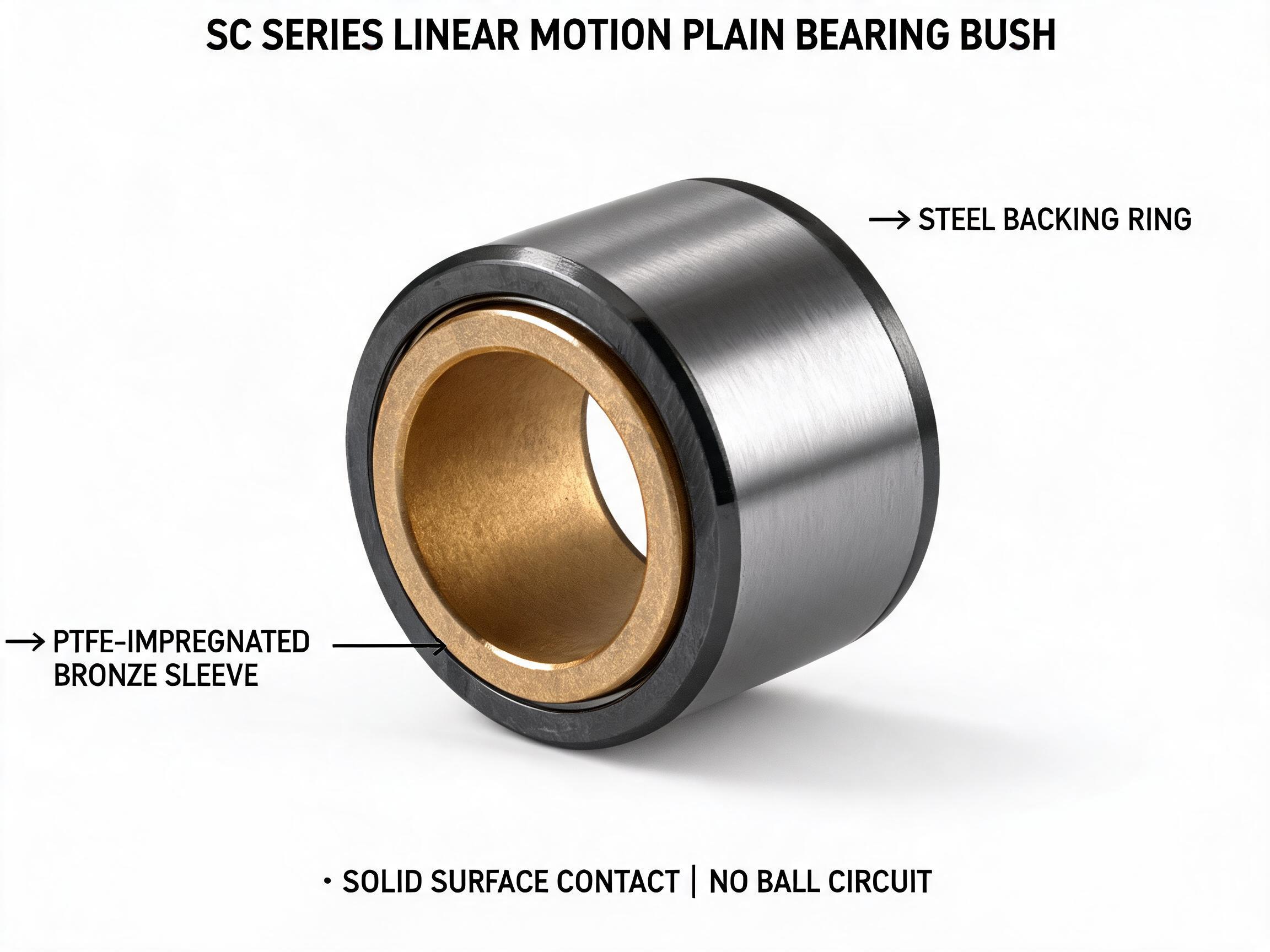
The SC series linear motion plain bearing bush replaces the ball circuit with a solid PTFE-impregnated bronze bushing (DU-type composite) with a steel backing ring, press-fit into the housing. It is available as a closed sleeve (SC) or flanged (SCF), in sizes SC6 to SC60 covering 6–60 mm shafts—11 sizes total. The H7 bore tolerance ensures a secure fit in standard housings.
Against dust and grit
With no balls to jam, the SC bushing simply wipes contaminants aside as it slides. It tolerates dust, metal chips, and grit that would quickly disable a ball circuit. In a supplier-reported case, 20,000 SC20 bushings were supplied to an Indian foundry automation manufacturer averaging 3-year service life in high dust—where ball bearings had failed within 3 months. This is a supplier case, not a guarantee, but it illustrates the difference in harsh environments.
Against shock loads
The sliding surface contact distributes load over a larger contact area than point-loaded balls, which reduces the brinelling risk that hammers ball raceways under shock. This holds within the size's rated static load—check your peak shock load against the rating (for example, 12 kN static for SC20) before selecting.
Against oscillating skid
Because there are no rolling elements to skid or Brinell, short-stroke oscillation does not concentrate wear in the same way. The PTFE-rich sliding layer provides consistent low friction throughout the stroke.
Additionally, the SC bushing operates from -50°C to +200°C—a range that exceeds the typical limits of polymer-caged ball bearings, though the exact comparison depends on the specific bearing type in your application—and can run dry where grease contamination is unacceptable, such as in food, textile, and cleanroom equipment.
The honest trade-offs
Sliding contact is not a free upgrade. It comes with two main compromises:
- Higher friction: The coefficient of friction is 0.08–0.12 dry and 0.04–0.06 greased—higher than ball types. This means more heat generation and potentially higher drive torque.
- PV limit: The maximum PV rating is 2.8 MPa·m/s dry and 5.0 MPa·m/s greased. Exceeding this leads to accelerated wear or failure. You must calculate the PV for your application.
Also note that the maximum static load for the SC20 is 12 kN—check the rating for your specific size. The SC bushing is not intended for high-speed continuous operation; it shines in moderate-speed, high-contamination, or shock-loaded applications.
Sizing and PV calculation checklist
Before selecting an SC bushing, run through this checklist:
- Shaft diameter: Choose from SC6 to SC60 (6–60 mm). Ensure the housing bore meets H7 tolerance.
- Load: Determine the maximum static and dynamic loads. Verify against the size's rating (e.g., SC20 max static load 12 kN).
- Velocity: Estimate the sliding velocity (m/s).
- PV check: Calculate PV = pressure (MPa) × velocity (m/s). Ensure it stays below 2.8 MPa·m/s dry or 5.0 MPa·m/s greased.
- Lubrication: Decide if dry running is acceptable (for food, textile, cleanroom) or if grease can be used for higher PV.
- Temperature: Confirm operating temperature is within -50°C to +200°C.
For detailed specifications and sizing, refer to the SC series linear motion plain bearing bush product page.
FAQ
In many cases, yes—if the housing bore is H7 and the application's PV falls within the SC bushing's limits. However, because friction is higher, you may need to adjust drive torque or cooling.
The SC series covers shafts from 6 mm to 60 mm in 11 sizes, including the SC6 and SC60.
It is not designed for high-speed continuous operation. The PV rating limits its use to moderate speeds, especially under high loads.
Yes, the PTFE-impregnated bronze allows dry running, which is ideal for food, textile, and cleanroom environments. For higher PV, greased operation is recommended.
The SC bushing is a plain sleeve; misalignment should be minimized. The flanged version (SCF) can help with axial location but does not compensate for angular misalignment.
For specific application questions or to discuss your requirements, please contact our technical team.