
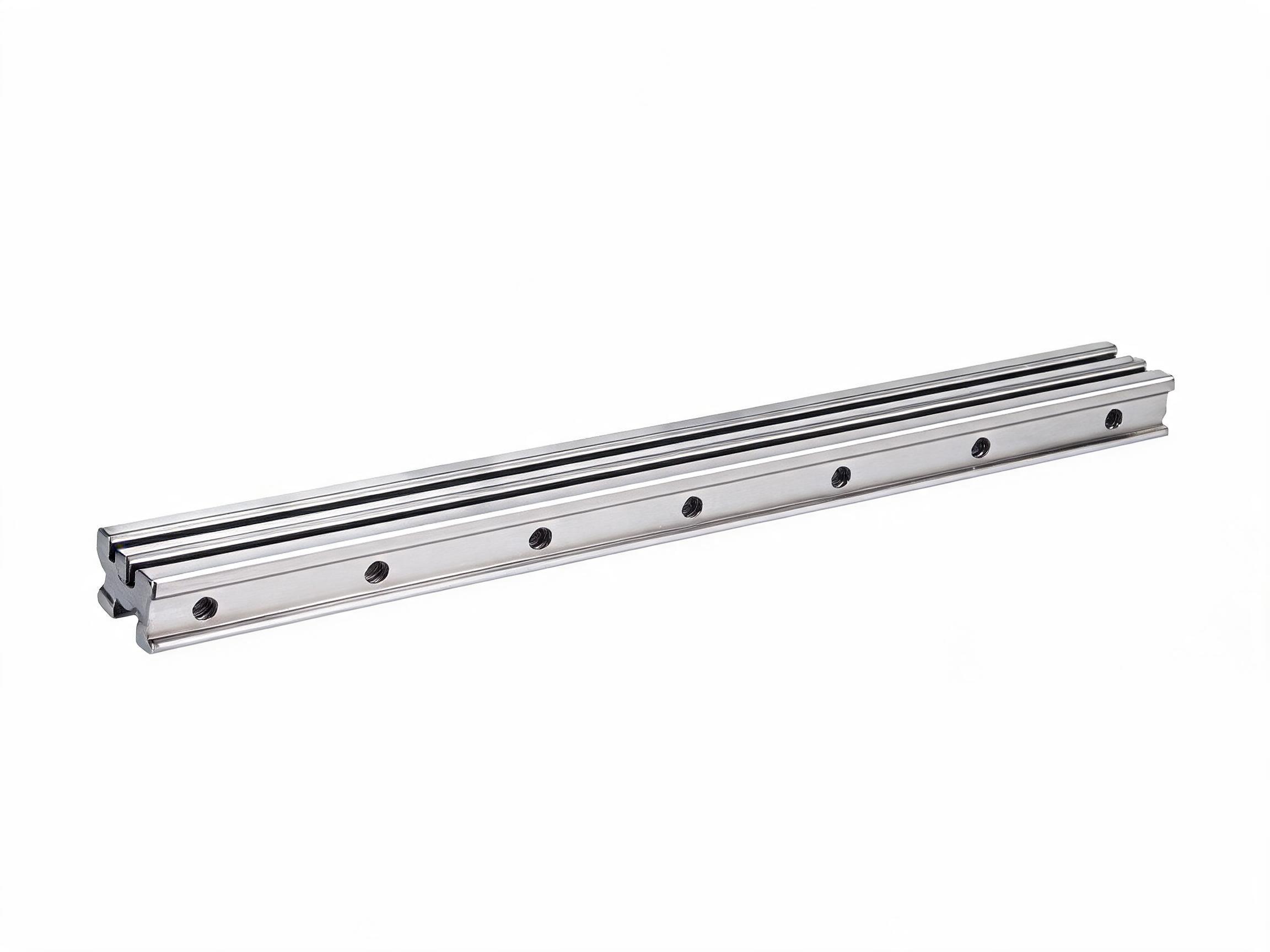
A question-driven spec sheet for buyers specifying a linear stage for vacuum chamber use: what vacuum compatibility actually requires, which questions belong in the RFQ, and which answers you should get in writing.
Building an axis that has to run inside a vacuum chamber changes the purchase from a catalogue selection into a project. A stage that is clean and precise in air may not be acceptable in vacuum for reasons that have nothing to do with its bearing accuracy — the materials, the lubricant, the wiring and the chamber bake cycle all enter the specification. Dongfeng Bearing does not currently publish a vacuum-rated stage; vacuum-compatible versions are arranged per project with suppliers, and the specific ratings — outgassing rates, temperature limits, pressure class — must be confirmed in writing against the datasheet for the exact configuration you receive. This article sets out the questions to put in your RFQ and the answers you should demand in writing before you commit an axis to a chamber.
- Vacuum compatibility is a system property: materials, lubrication, cable routing, bake-out and the chamber's pressure class all interact.
- Stainless construction is not a vacuum rating; a cleanroom-adjacent material option does not by itself make a stage vacuum-qualified.
- Your RFQ should ask for written statements per criterion, tied to the exact datasheet of the quoted configuration.
- Why a good air-stage is not automatically a vacuum stage
- The five compatibility areas to specify
- Questions for your RFQ
- Answers to require in writing
- Where the site's miniature guides fit — and where they stop
- FAQ
Why a good air-stage is not automatically a vacuum stage
In air, the conditions you worry about are load, speed, life and accuracy. Inside a chamber, the environment adds a new set of failure paths. Pressure below atmosphere changes how heat is removed from the drive and bearing; residual gas molecules and condensed volatiles can coat optics or sensors on the process side; a lubricant that performs well in air can evaporate and migrate; and the pump-down and bake cycles impose temperature and thermal-cycle conditions that the standard stage datasheet may never mention.
The consequence for buying is simple: the attributes that make a miniature guide good on the bench — two-row Gothic-arch geometry, precision ground raceways, a stainless material option — tell you about stiffness, running accuracy and corrosion resistance. They are not a statement about vacuum suitability. For a chamber, the suitability has to be established for the specific assembled axis, including the drive, the seals, the cable path and the lubricant.
The five compatibility areas to specify
Materials and surface condition
Every exposed material in the chamber is a potential source of contamination. Specify which materials are acceptable to your process, and ask the supplier to state the materials used in the bearing elements, housing, drive components, seals and any adhesives or potting. Corrosion-resistant stainless is a useful starting point for chamber-adjacent hardware, but the requirement to write down is the material list for the delivered configuration, not the general family name.
Lubrication choice
Grease in a conventional guide is a contamination risk in vacuum. The choice between vacuum-compatible grease, a dry-film coating or a bare-metal arrangement changes life, load capacity and speed, and it must be matched to the pressure class and temperature of your process. Ask which lubricant or coating is used, what it implies for permissible speed and load, and whether the supplier will identify the product by name or by a datasheet reference.
Particles and cleanliness
Particulate generation matters if the axis sits near a wafer, a sample or an optical path. The relevant questions are whether the stage is assembled and cleaned to a defined procedure, what the supplier's cleanliness statement covers, and whether any particle specification applies to the stage as delivered. Be cautious about accepting a cleanliness claim that is not tied to the delivered unit's assembly and test record.
Bake-out and temperature
Bake-out is a process decision, but it constrains the hardware. Specify the maximum temperature the axis will see during bake and the number of cycles, and ask the supplier to state the temperature range of the bearing, the drive and the cable under those conditions. A stage rated for a certain operating temperature in air does not automatically carry the same figure for a bake cycle.
Cables, feedthroughs and the chamber wall
The axis usually does not sit alone in the chamber. The cable, connector and feedthrough form the interface between the stage and the atmosphere side. Specify or ask for the cable insulation and jacket materials, the connector type, the feedthrough arrangement and the in-chamber cable length. A connector that is fine in air can be a virtual leak in vacuum; this is one of the areas where the answer has to be written for the actual assembly, not for a component family.
Questions for your RFQ
Put these in the RFQ as numbered requirements, each answered separately per configuration. The point is not to test the supplier but to make sure the proposal you receive can be checked against your process.
- What is the pressure class the stage is intended for, and is that figure stated for the assembled axis or for the guide alone?
- Which materials are used in the bearing raceways, housing, drive, seals and any adhesives?
- Which lubricant or dry-film coating is used, and what are the resulting speed and load limits?
- What is the maximum bake-out temperature and the permissible number of cycles?
- What are the cable and connector materials, and how is the chamber wall interface handled?
- What cleaning and assembly procedure applies to the delivered axis, and what record accompanies it?
- Which datasheet values are guaranteed for this configuration, and which are typical?
- What is the acceptance test at shipment, and can the record be supplied with the unit?
Answers to require in writing
The form of the answer matters as much as its content. Ask for the statement in the quotation or an attached datasheet, referenced to the exact part number and configuration quoted. Verbal assurances and general catalogue language are not a basis for a chamber installation.
| Requirement area | What to ask for in writing | Why it matters to your decision |
|---|---|---|
| Pressure class | Intended pressure range, stated for the assembled axis | Determines whether the proposal is in the right regime at all |
| Materials | Material list for bearing, housing, drive, seals, adhesives | Contamination and process compatibility |
| Lubrication | Lubricant or coating identified, with speed and load limits | Life and performance trade-off inside the chamber |
| Thermal | Bake temperature and cycle limit for bearing, drive, cable | Whether the axis survives the process cycle |
| Wiring | Cable jacket, connector type, feedthrough arrangement | Virtual-leak risk at the wall interface |
| Quality record | Cleaning procedure, assembly procedure, shipment test record | A claim you can audit against the delivered unit |
If any line comes back blank, treat it as an open point, not as a 'no'. It means the proposal does not yet answer your process condition, and the next question is what information the supplier needs to close it.
Where the site's miniature guides fit — and where they stop
Dongfeng Bearing's current catalogue includes miniature precision guides used in semiconductor-adjacent equipment. The EGH series miniature linear guideway uses a two-row Gothic-arch raceway geometry with P5 ground accuracy, and is available with a 9Cr18Mo stainless option for corrosion and cleanroom-adjacent use; rail widths in the catalogue run 9 to 15 mm, and the EGH15CA is listed at 5.5 kN dynamic load. The MGN series stainless steel miniature linear guide lists 9Cr18Mo stainless as standard.
These are legitimate starting points for a clean, corrosion-resistant axis. They are not vacuum ratings. Stainless-for-cleanroom is not the same as vacuum-rated, and none of the figures above establishes outgassing, bake temperature, pressure class or particle performance. If your project needs a vacuum-compatible stage, the version has to be arranged per project with the supplier, and every vacuum-specific value has to be confirmed in writing against the datasheet of the configuration you will receive.
Send your process conditions — pressure class, bake temperature, cleanliness requirement, cycle count and chamber interface — with the axis envelope and load. The reply you should expect separates what is already specified from what has to be confirmed per project, and gives you the material, lubricant and cable details for the quoted configuration in writing.
FAQ
Is a stainless steel miniature guide automatically vacuum compatible?
No. Stainless construction addresses corrosion and some cleanliness concerns; it does not by itself establish outgassing, bake temperature or pressure-class suitability. For a chamber, the assembled axis — including lubricant, drive and cable — must be assessed and the relevant values confirmed against the datasheet for that configuration.
Can I use a standard air-stage inside a chamber if I add a vacuum pump?
Pumping down does not change what the stage does to the chamber. Lubricant and materials can still migrate, and heat removal and cable interfaces change under vacuum. The specification has to be made for the vacuum condition, not recovered afterwards by the pump.
What should the supplier state about lubrication?
The lubricant or dry-film coating should be identified, and the resulting speed and load limits stated. If the supplier does not name the lubricant, ask for a datasheet reference so the assembly can be checked against your process conditions.
Does the stage's accuracy figure in the catalogue apply to the vacuum version?
Accuracy values should be confirmed for the delivered configuration. A change of lubricant, coating or cable path can affect permissible speed and load, so the quotation should distinguish guaranteed values from typical figures and state which apply to the exact part number quoted.
What is the most useful thing to put in the first RFQ?
Your process envelope, stated numerically: pressure class, bake temperature and cycle count, cleanliness requirement and the chamber interface. Without those, material and lubricant choices cannot be compared between proposals, and price differences will not tell you which axis fits the chamber.