A practical comparison of ball screws, lead screws, and roller screws for industrial buyers. We break down load capacity, speed, precision, cost, and maintenance so you can shortlist the right linear motion screw for your machine design.
BUYER GUIDE
If you are specifying a linear motion system, the screw choice often decides the whole machine's performance. Pick a ball screw drive when you need efficiency and speed. Pick a lead screw when cost and simplicity matter more. Pick a roller screw when the load is heavy and the duty cycle is brutal.
This guide compares the three linear motion screws across the criteria that actually affect your design: load capacity, speed, precision, service life, cost, and maintenance. We keep it practical — no marketing language, just numbers and trade-offs.
- Ball screws are the default for most CNC, automation, and servo-driven axes: 85–90% efficiency, low friction, good precision.
- Lead screws win on cost and simplicity: no recirculating balls, self-locking options, quiet operation — but lower efficiency and higher wear.
- Roller screws carry 3–5× the load of a same-size ball screw and run much longer, at a higher price — for presses, actuators, and aerospace.
- Your operating speed, duty cycle, and required positioning accuracy will narrow the choice faster than any other factor.
What Is a Linear Motion Screw?
A linear motion screw converts rotary motion from a motor into linear movement of a nut or carriage. The three main types — ball screw, lead screw, and roller screw — do the same job but with very different internal mechanics.
The difference matters because it changes efficiency, backlash, load rating, and how long the component survives in your application.
Ball Screw: The Workhorse of Automation
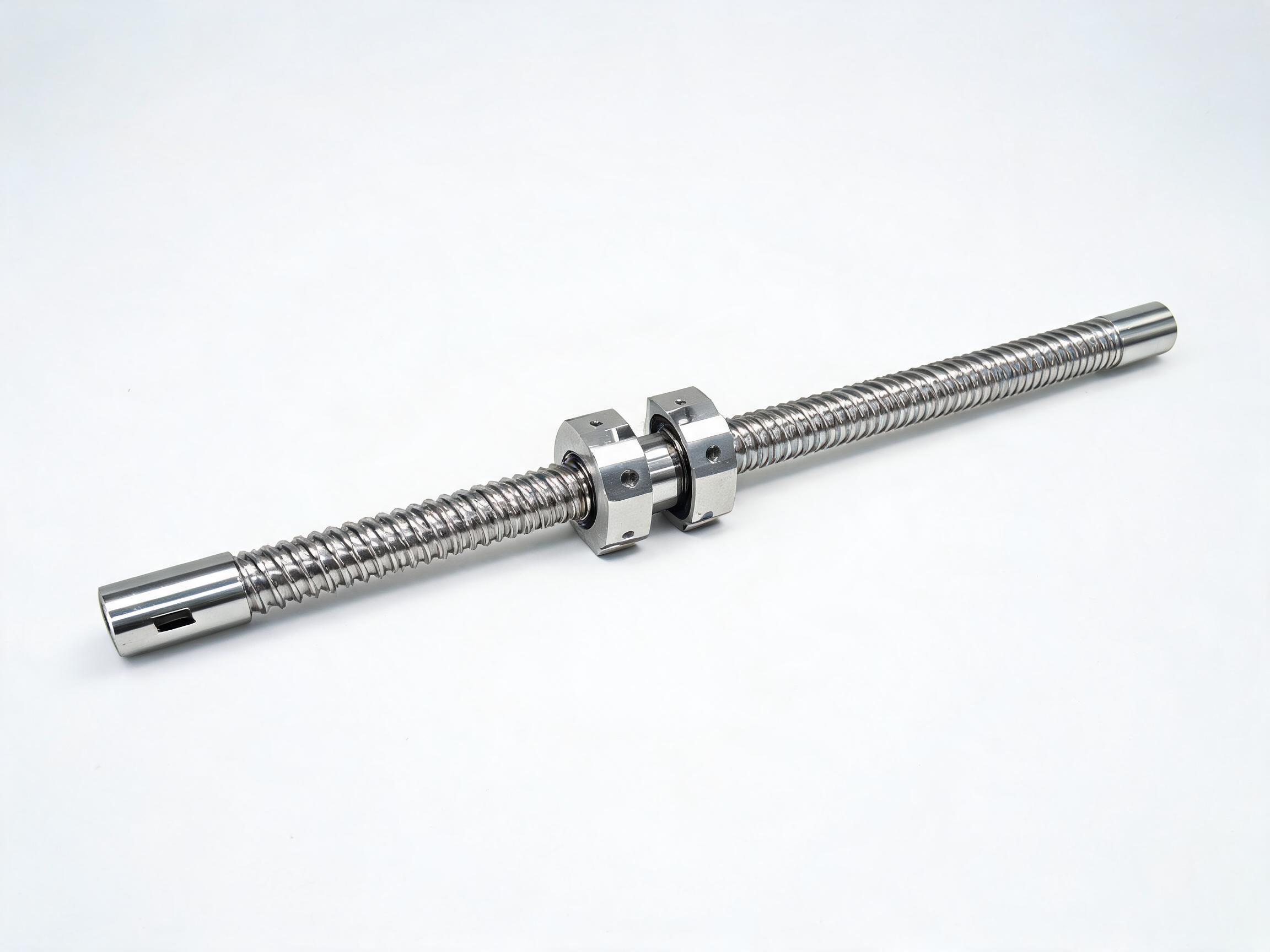
A ball screw drive uses recirculating steel balls between the screw shaft and the nut. The balls roll instead of slide, which is why ball screws achieve mechanical efficiency of roughly 85–90%. That is a big number: it means a smaller servo motor can move the same load, cutting both cost and energy consumption.
Strengths of ball screws
- High efficiency (85–90%) — low friction, less heat, less motor torque required.
- Low backlash — with preloaded nuts, positioning repeatability can reach ±1–2 µm in precision grades.
- High speed capability — suitable for rapid traverse and high feed rates.
- Wide availability — standard diameters from 6 mm to 80 mm+ and any lead you need.
Limitations
- Not self-locking — vertical axes need a brake or counterweight.
- Requires lubrication and periodic maintenance.
- Load capacity is lower than roller screws of the same diameter.
Typical applications
CNC machine tools, industrial robots, semiconductor equipment, packaging machinery, and any servo-driven axis where speed and precision are the priority. If your machine already uses servo motors and linear guides, a ball screw drive is usually the natural match.
Lead Screw: Simple, Quiet, Cost-Effective
A lead screw (also called a trapezoidal screw) uses sliding contact between the nut and the screw thread. There are no balls, so the nut is simpler and cheaper to manufacture. Efficiency drops to roughly 30–60%, depending on lead angle and material.
Strengths of lead screws
- Lowest initial cost — both the screw and the nut are inexpensive.
- Self-locking option — with a small lead angle, the screw holds its position without a brake, which is valuable for vertical axes.
- Quiet operation — no recirculating balls means less noise.
- Vibration damping — sliding contact absorbs some vibration, which can improve stability in light-duty applications.
Limitations
- Lower efficiency (30–60%) — more heat, more motor torque needed.
- Higher wear — sliding friction shortens life, especially with poor lubrication.
- Backlash — harder to eliminate; anti-backlash nuts exist but add cost.
- Speed limit — not ideal for high-speed continuous operation.
Typical applications
3D printers, small actuators, valve positioners, medical devices, and light-duty adjustment mechanisms. If your load is light, your cycle is short, and your budget is tight, a lead screw is often the smart choice.
Roller Screw: Heavy Load, Long Life
A roller screw replaces balls with threaded rollers that mesh with the screw shaft. This creates line contact instead of point contact, which dramatically increases load capacity and stiffness.
Strengths of roller screws
- Load capacity 3–5× higher than a ball screw of the same diameter.
- Longer service life — line contact distributes stress, so fatigue life is much longer under the same load.
- Higher stiffness and shock resistance — better for impact loads and vibration.
- High speed with high load — planetary roller screws handle both simultaneously.
Limitations
- Higher cost — more complex manufacturing, fewer suppliers.
- Longer lead time — often made to order.
- Heavier — more material, more mass.
Typical applications
Hydraulic press replacements, electric actuators for heavy machinery, aerospace flight controls, rail switches, and any application where a hydraulic cylinder is being replaced by an electric linear actuator. If you are seeing premature ball screw failures, a roller screw is the upgrade path.
Direct Comparison Table
| Criteria | Ball Screw | Lead Screw | Roller Screw |
|---|---|---|---|
| Efficiency | 85–90% | 30–60% | 80–90% |
| Load capacity | Medium | Low–Medium | High (3–5× ball screw) |
| Speed capability | High | Low–Medium | High |
| Precision / backlash | Excellent with preload | Moderate; anti-backlash nuts available | Excellent; high stiffness |
| Service life | Good | Moderate | Excellent |
| Self-locking | No | Yes (small lead angle) | No |
| Maintenance | Lubrication required | Lubrication required; wear-prone | Lubrication required; longer intervals |
| Relative cost | $$ | $ | $$$ |
How to Choose: A Practical Decision Framework
Work through these five questions in order. They will eliminate at least one option quickly.
1. What is the required load and duty cycle?
Calculate the dynamic load rating (C value) you need. If the required C value exceeds what a ball screw of your target diameter can provide, jump straight to roller screws. If loads are light and cycles are short, lead screws may be enough.
2. What is the operating speed?
Ball and roller screws handle high RPM with ease. Lead screws generate heat at speed due to sliding friction. Above roughly 500–1000 RPM depending on diameter and lead, lead screws become impractical.
3. What positioning accuracy do you need?
For repeatability under ±0.01 mm, use a preloaded ball screw or roller screw. Lead screws with anti-backlash nuts can reach ±0.05 mm in good conditions, but they wear and accuracy drifts over time.
4. Is the axis vertical?
If yes, consider whether you want self-locking. A lead screw with a small lead angle holds position without a brake. Ball and roller screws require a brake or counterweight for safety.
5. What is your total cost of ownership?
Lead screws have the lowest purchase price but higher maintenance and shorter life. Ball screws balance cost and performance for most applications. Roller screws cost the most upfront but can outlast two or three ball screw replacements in heavy-duty cycles.
Common Mistakes to Avoid
- Oversizing the screw — a bigger screw costs more and needs a bigger motor. Match the screw to the actual load and speed, not to a safety factor of 5.
- Ignoring critical speed — every screw has a maximum rotational speed before it whips. Check the critical speed formula for your unsupported length.
- Forgetting lubrication — all three types need proper lubricant. Ball screws and roller screws fail prematurely when run dry.
- Buying on price alone — a cheap lead screw in a high-cycle machine will cost more in downtime than a quality ball screw would have.
Frequently Asked Questions
Can I replace a lead screw with a ball screw in an existing machine?
Usually yes, but check the motor torque. A ball screw's higher efficiency means less torque is needed, so the existing motor may actually be oversized. The bigger issue is mounting dimensions — ball screw nuts are typically longer. Confirm the envelope before ordering.
When should I choose a roller screw over a ball screw?
When your calculated dynamic load exceeds the ball screw's rating for the diameter you want, or when you are experiencing premature ball screw failures in a high-cycle application. Roller screws also handle shock loads better.
Are ball screws self-locking?
No. Ball screws have very low friction, so they back-drive freely. For vertical axes, always add a brake or counterweight.
What is the difference between rolled and ground ball screws?
Rolled ball screws are formed by rolling, which is faster and cheaper. They offer accuracy classes typically down to C7–C5. Ground ball screws are machined and ground, achieving C3–C1 accuracy. Choose ground for high-precision positioning, rolled for general automation.
Next Steps for Buyers
When you send an inquiry for linear motion screws, include these details so the supplier can quote accurately:
- Required load (dynamic and static, in N or kgf)
- Stroke length (mm)
- Operating speed (RPM or linear speed in m/min)
- Duty cycle (cycles per hour, hours per day)
- Required accuracy class (e.g., C7, C5, C3)
- Mounting arrangement (one end fixed, both ends supported, etc.)
- Operating environment (dust, temperature, washdown)
If you are unsure about the right specification, send us your application details and our engineers will recommend a suitable ball screw drive or alternative. We can provide drawings, load calculations, and samples upon request.
Getting the screw right on the first order saves weeks of rework. Compare the numbers above against your actual machine conditions, and you will make the right call.