A buyer-level comparison of belt-driven linear actuators and ball-screw drives: how each transmits motion, where belt drives fit long strokes and higher speeds, where ball screws hold up on accuracy, load and vertical holding, and which spec-sheet figures to verify before you commit an axis design.
Two drives dominate the small and mid-size linear axis: the belt-driven actuator and the ball-screw slide. They look similar on a catalog page — both move a carriage along a rail — but the way each transmits force changes what the axis can do. The decision usually comes down to stroke length, speed, load, positioning accuracy and whether the axis has to hold position with power off.
This comparison is written from the buyer's side of the table. Dongfeng Bearing builds ball-screw-driven components and slide modules; belt-driven axes are normally supplied by actuator makers, so the belt figures here are qualitative and should be confirmed with the actuator supplier. The aim is to help you decide which drive fits the axis before you request a quotation.
Key takeaways
- Belt drives suit long strokes, higher carriage speeds and lighter loads; they are generally the lower-cost option at long travel.
- Ball screws suit positioning accuracy, heavier loads and vertical axes that must hold position when the motor is off.
- On either drive, check the backlash/repeatability rating on the datasheet rather than the marketing headline.
- For belt axes, belt tension, stretch and duty cycle are the questions to put to the actuator supplier.
In this article
How each drive transmits motion
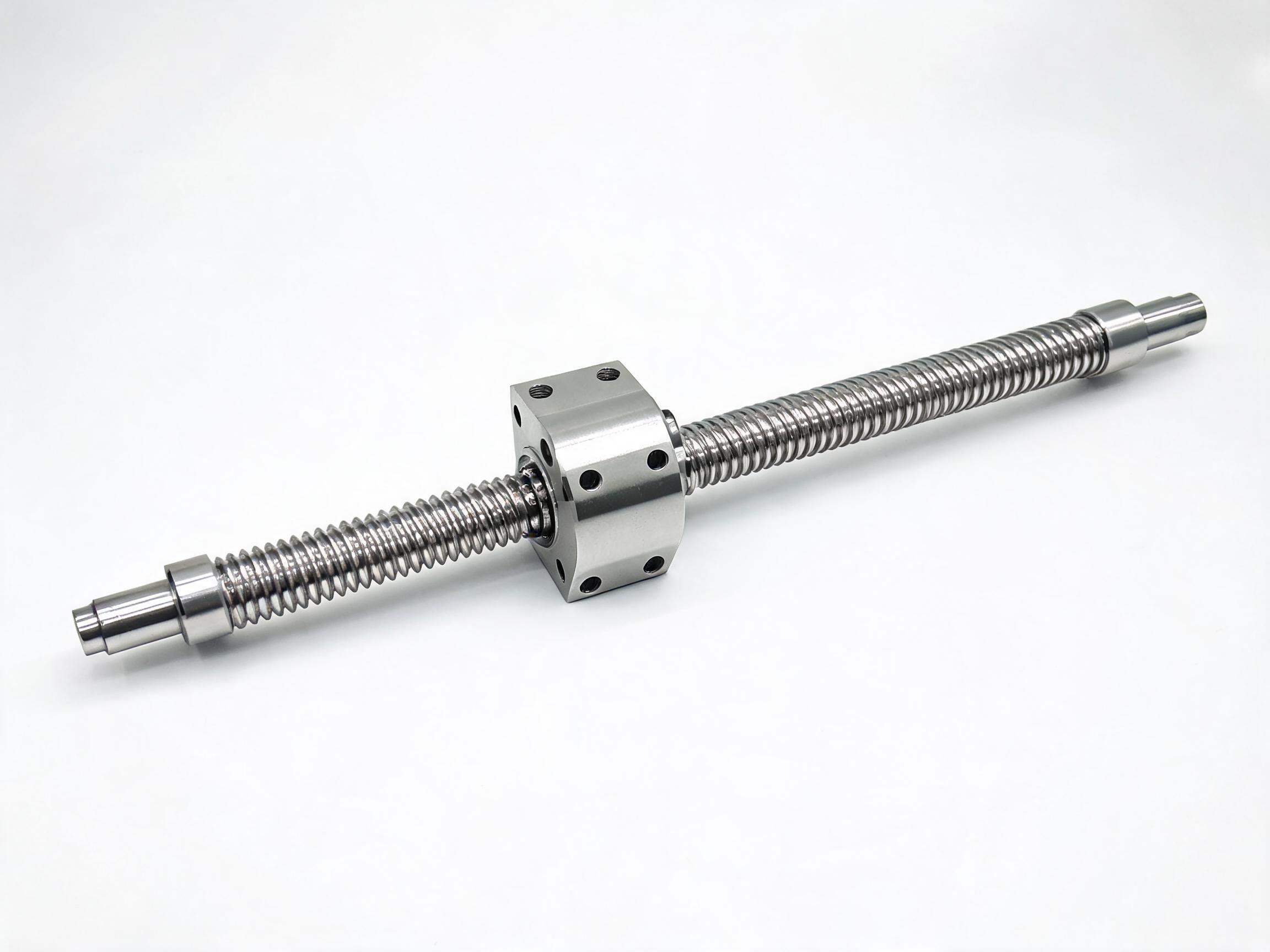
A ball-screw drive converts motor rotation into linear motion through a threaded shaft and a recirculating ball nut. The nut rides on rolling balls between the screw and nut grooves, so the carriage position follows the screw rotation closely and the load path runs largely along the screw axis. A belt drive wraps a toothed belt around a pulley at each end of the axis and clamps the carriage to the belt; rotation of the drive pulley moves the belt and carriage together.
That mechanical difference sets the practical boundaries. The ball screw's limiting factors are screw length (long screws are harder to keep stable at speed), critical speed and the cost of a long precision screw. The belt's limiting factors are belt stiffness, tension and the elasticity that appears over long spans. Each design is a way of trading stiffness against reach.
Where belt drives fit best
A belt-driven actuator makes sense when the axis is long and the load is moderate. The belt is light, so it does not add the rotating inertia of a long screw, and the carriage can be moved quickly over a wide span. Belt linear actuators are common in pick-and-place gantries, transfer axes, packaging lines and test rigs where the carriage travels several meters and speed matters more than micron-level positioning.
- Long strokes: a belt can span distances where a ball screw of the same length would need extra support and a larger diameter to stay stable at speed.
- Higher speed: a light belt and low-inertia drive allow higher carriage velocity than an equivalent screw axis, within the limits the actuator maker states.
- Lighter loads: belt axes are typically sized for lighter carriage loads than ball-screw slides; check the actuator's rated load and moment figures.
- Lower cost at long travel: a belt axis is usually the more economical way to cover a long stroke, though total cost depends on the frame, guide rail and drive package, so compare complete assemblies rather than drive type alone.
The belt's weakness is compliance. A belt stretches under load and its tension changes over time, so positioning accuracy and repeatability depend on how the actuator is built and maintained. Ask the actuator supplier for the repeatability rating and the recommended belt-tensioning method before you commit a process that depends on tight positioning.
Where ball screws fit best
A ball-screw slide is the better fit when the axis has to position accurately, carry a heavier load or hold position with the motor de-energized. The screw's rolling contact gives a stiff, predictable relationship between rotation and carriage position, and a preloaded nut can reduce axial play. Dongfeng Bearing's SFU Series rolled ball screw, for example, is listed as C7 grade per ISO 3408 with lead accuracy of ±0.05 mm/300 mm — a working figure you should read against the accuracy your process actually needs.
- Positioning accuracy: lead accuracy and nut preload determine how closely the carriage follows the commanded position; the datasheet lead-accuracy figure is the place to start.
- Load capacity: the SFU Series single nut is listed with 6.8 kN dynamic load, and the SKF20 slide module's carriage is listed at 11.2 kN dynamic / 17.5 kN static on an HGH15CA guide. These are catalog figures, not tested results for your axis, but they show the load class ball-screw slides are built for.
- Vertical holding: a ball screw can hold a vertical load through the screw and nut when the motor is off, depending on the drive and brake arrangement; a belt axis generally needs a brake or counterbalance to do the same. Confirm the holding method with whoever supplies the axis.
- Shorter strokes: the screw's advantage is clearest where the stroke is short enough that the screw stays stable without extra support.
The trade-off is speed and reach. A long ball screw has to be checked against critical speed (confirm the permissible speed with the screw supplier for your length and mounting), and a long screw adds inertia to the drive. For a long, fast axis, the belt is often the simpler answer.
What to verify on either spec sheet
The datasheet headline is rarely the number that decides the axis. Compare the two drives on the figures below, and where a supplier has not stated one, ask for it in writing.
| Check | Belt-driven actuator | Ball-screw slide |
|---|---|---|
| Backlash / repeatability rating | Confirm the repeatability rating and how belt stretch is compensated; confirm with the actuator supplier | Preload in the nut and lead accuracy set the figure; SFU Series C7 lead accuracy is ±0.05 mm/300 mm |
| Belt tensioning | Confirm the tensioning method and the maintenance interval; confirm with the actuator supplier | Not applicable |
| Duty cycle | Confirm the duty rating for continuous running and the belt service life; confirm with the actuator supplier | Confirm lubrication interval and load rating for your duty |
| Load capacity | Confirm the rated carriage load and moment limits | Check the slide's rated dynamic/static load and the nut's dynamic load |
| Stroke and speed | Long strokes at higher speed; confirm the maximum speed for your span | Check critical speed for the screw length; SKF20 standard travel is 100–500 mm, custom to 1000 mm |
| Vertical holding | Needs a brake or counterbalance; confirm the method | Can hold through the screw and nut; confirm brake/drive arrangement |
Belt-side entries are qualitative; no numeric belt specifications are stated here because they depend on the specific actuator and must be confirmed with its supplier. Ball-screw figures above are catalog specifications as listed by Dongfeng Bearing.
One practical rule: compare complete axes, not just the drive element. A belt axis and a ball-screw axis with the same nominal stroke can differ in guide rail, frame stiffness, motor mount and encoder — all of which affect final accuracy and speed more than the drive label alone.
Ball-screw components and modules at Dongfeng Bearing
Where the axis calls for a ball screw, Dongfeng Bearing supplies both the screw assembly and a slide module built around it.
The SFU Series rolled ball screw assembly uses a GCr15 chrome steel shaft hardened to HRC 58-62, comes in standard lengths of 300–1500 mm, and ships with an end-machined shaft and preloaded flange nut. It mounts with BK12/BF12 support blocks. The listed C7 grade and ±0.05 mm/300 mm lead accuracy are the figures to weigh against your positioning requirement; if your process needs tighter, ask what the next accuracy grade involves rather than assuming a standard part covers it.
The SKF20 aluminum profile linear motion slide module pairs an SFU1605 ball screw (5 mm lead) with an HGH15CA guide on a 2020 T-slot aluminum base, with a NEMA 17/23 motor mount. Standard travel is 100–500 mm, custom to 1000 mm. Its carriage dynamic load is listed at 11.2 kN and static load at 17.5 kN. A 5 mm lead means the carriage advances 5 mm per screw revolution, so motor speed and gearing follow from that directly.
Choosing between the two drives
- Long stroke, higher speed, lighter load, cost-sensitive: start with a belt-driven actuator and confirm repeatability, tension and duty with the supplier.
- Accuracy, heavier load, vertical holding: ball-screw slide or screw assembly.
- Both: compare complete axes on the datasheet checks above before ordering.
- For a ball-screw axis, review the SFU Series assembly and the SKF20 slide module, and confirm critical speed for your stroke length.
FAQ
Is a belt drive or a ball screw more accurate?
A ball screw is generally the more accurate option because its rolling contact gives a stiff, predictable rotation-to-position relationship, and lead accuracy is a stated datasheet figure. Belt positioning depends on belt stiffness and tension, so repeatability is a property of the specific actuator and must be confirmed with its supplier. Neither label alone settles your axis — check the actual rating on the datasheet.
Can a belt-driven actuator handle a vertical axis?
A vertical belt axis needs a brake or counterbalance to hold the carriage when the motor is off. Whether the actuator you are considering has one, and how it is rated, has to be confirmed with the actuator supplier. A ball-screw slide can hold a vertical load through the screw and nut when the motor is off, but the brake/drive arrangement should still be confirmed.
What does the 5 mm lead on the SKF20 module mean for motor selection?
The carriage moves 5 mm per screw revolution, so carriage speed follows directly from motor rpm and any gearing. Load torque also depends on the lead, the load and the friction. Motor sizing is a separate exercise — confirm the motor and drive against the load profile with whoever supplies the complete axis.
Can I replace a ball screw with a belt on an existing machine?
Sometimes, but the frame, guide rail, motor mount and control tuning all have to be rechecked. A belt axis has different stiffness and inertia, and the carriage may not accept the same load or the same acceleration. Treat it as a redesign of the axis, not a drop-in swap, and get the belt tension and duty details from the actuator supplier before you commit.