
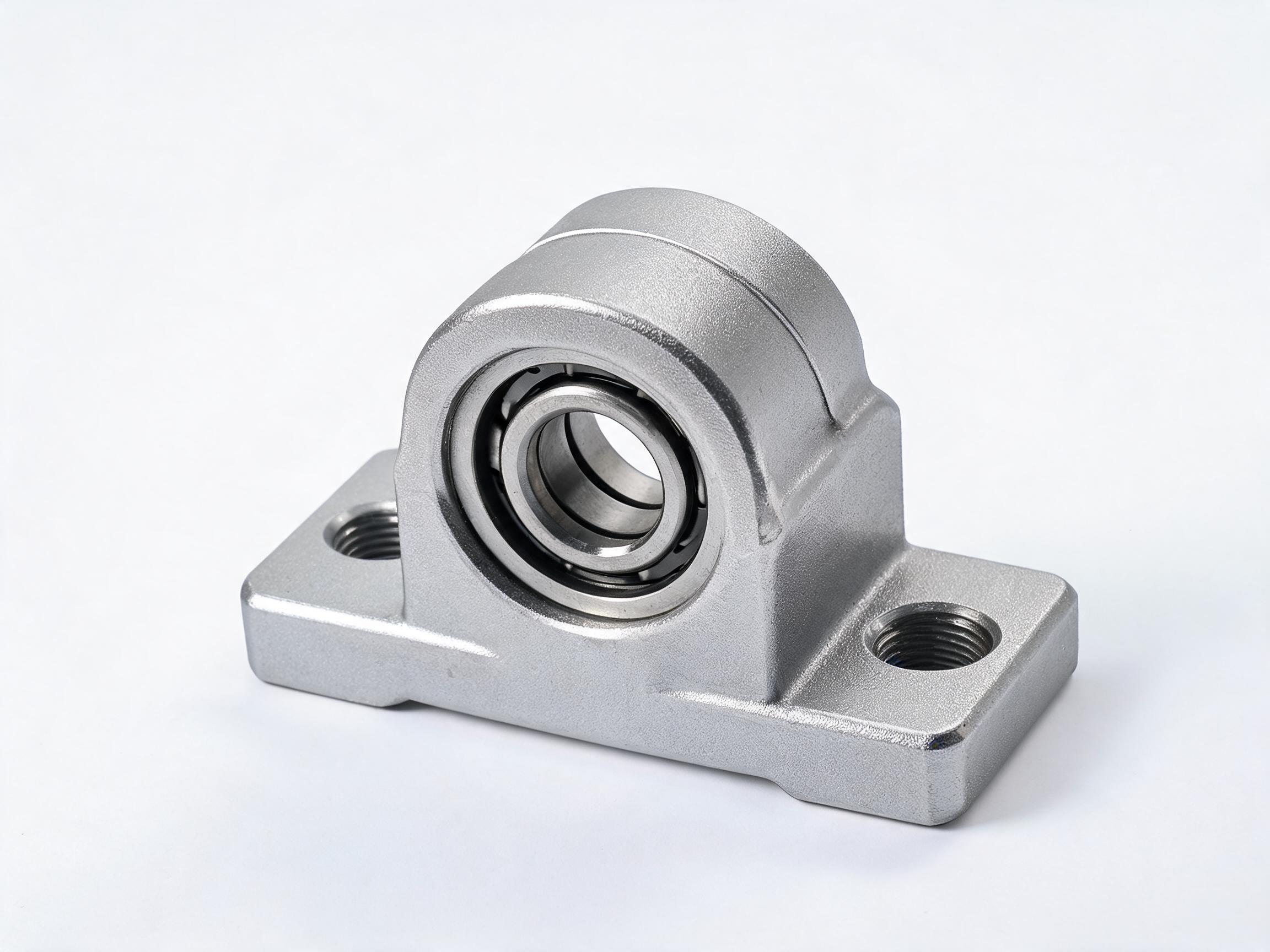
A working guide for OEM engineers on custom linear bearings: which changes Xiamen Dongfeng can make as routine options on LM bushes and KH pillow block units, which requests need drawing review before anyone can commit, and how the drawing-to-inspection workflow actually runs.
OEM customization guide
Most requests to change a linear bearing come down to one question: is this a configuration we already build, or is it a new design that needs an engineer to look at your drawing first? This page draws that line for LM series ball bearing bushes and KH series pillow block housing units, and explains the sequence from RFQ to shipped inspection documents.
- Bore size, length, tolerance class, cage material, housing material, mounting pattern, stainless construction and packaging are routinely handled as configuration options.
- Custom load ratings, hardness outside the catalog range, and dimensions not in the catalog are not quoted from an email — they go through drawing review.
- Every custom order follows the same path: drawing and RFQ, engineering review, sample, then full inspection documents with the shipment.
The line between a configuration change and a new design

Buyers searching for linear bearing custom supply often mean very different things. One engineer needs an H5 bore tolerance on an otherwise standard bush. Another needs a bearing package rated for a load that is not on any datasheet. The first can usually be confirmed in a quotation. The second cannot be answered honestly until someone has reviewed the drawing, because the load path, the housing wall, the shaft support and the mounting all move together.
Keeping those two categories separate saves both sides time. Below is how this factory treats them on its LM and KH ranges.
What can be changed as a routine option
These items are within the normal build range and can be specified on a quotation without a design study. They are still written onto the drawing and confirmed in the order, but they do not require a new engineering conclusion.
Bores, lengths and fits on the LM bush
The LM series linear ball bearing bush covers bores from 6 mm to 60 mm in GCr15 chrome steel, hardened to HRC 60–64, with a PA66-GF cage as standard. Bore tolerance class H5 is available on request; other tolerance classes should be raised in the RFQ so the inspection plan can be matched to them. Bushing length and the shaft/housing fit are specified on the drawing and confirmed against the datasheet for the size.
Housing material, mounting and bearing replacement
The KH series pillow block linear bearing housing unit is built on a cast aluminum ADC12 housing with an LM bearing pre-installed. It takes shaft sizes from 8 mm to 50 mm and offers ±3° self-alignment. Because it is a bolt-on unit, no press fitting is needed at assembly, and where the surrounding structure allows direct access the bearing can be replaced in about five minutes — the actual time depends on the installation. Mounting hole pattern and housing-side interface details are the practical customization points here, and they should be shown on the drawing rather than described in text.
Material and finish choices
Stainless construction is available for the LM bush where the application calls for it. Cage material is specified as PA66-GF as standard; where an alternative is required, it belongs in the RFQ so the engineering team can confirm what is supported for that bore and speed regime. Surface treatment requests on the housing should be stated with the required specification, not just a finish name.
Packaging, labeling and branding
OEM and ODM customization covers packaging and labeling: box printing, part marking, label content and carton configuration. For the MGN stainless miniature guide, the minimum order quantity is 50 pcs. Packaging changes are usually the fastest customization to confirm, and they are best agreed together with the part drawing so that the label data matches the released revision.
Routine — confirm in quotation
- Bore size within 6–60 mm (LM), shaft 8–50 mm (KH)
- Length and fit per drawing
- H5 bore tolerance on request
- Stainless construction (LM)
- Housing material and mounting pattern
- Packaging, labeling, brand marking
Needs drawing review
- Custom dynamic or static load ratings
- Hardness outside the catalog range
- Dimensions not in the catalog
- Tolerance classes beyond H5
- Certified performance figures
- Application-specific life claims
What cannot be promised from an email
Some requests reach a supplier as a single line: “need higher load” or “need HRC 66.” These are legitimate engineering goals, but they are not order-line items. Changing them changes the bearing's internal geometry, the raceway hardness profile, or the housing wall section, and the result has to be checked against the drawing and the application.
- Custom load ratings. The KH16 unit's catalog dynamic load is 980 N. A request for a different rating is subject to drawing review; no figure can be quoted until the design has been assessed.
- Non-catalog hardness. The LM bush is supplied at HRC 60–64. Requests for values outside that band are subject to drawing review, because hardness interacts with raceway geometry and cage fit.
- Non-catalog dimensions. Any bore, length or housing envelope outside the standard range requires a drawing review before a quotation is issued.
- Tolerance classes beyond H5. Refer to the datasheet for what is standard, and raise the requirement in the RFQ so the inspection plan can be agreed.
- Certified performance. Statements about measured life, friction or speed limits in a specific application are not made on the basis of a catalog page. Performance claims tied to a test protocol need to be agreed as part of the project.
How a custom request actually runs
- Drawing and RFQ. Send the part drawing with revision number, the quantity, the shaft and housing interface, the environment (temperature, contamination, cleaning regime) and any packaging or marking requirements. A dimension sketch is not enough for a review of a non-catalog item.
- Engineering review. The team checks the request against the build range: bore and shaft size, tolerance class, material, cage, housing wall and mounting. Requests that fall outside the routine options are answered with what can be confirmed and what needs a design change — not with a figure pulled from a similar model.
- Sample. Once the drawing is agreed, a sample is produced for fit and function checks by the customer. Sample approval is the gate for the production order, and any change after approval restarts the drawing revision.
- Full inspection documents. Each shipment is accompanied by inspection documentation: CMM reports, hardness data and material certificates. Where a drawing calls for a specific inspection item, that item is added to the plan at the review stage, not after production.
The manufacturing system behind this process is certified to ISO 9001, and the company offers OEM/ODM customization with a 24-month warranty. The same inspection-document package ships with standard and custom parts, which matters when a customized bearing has to be traceable through the customer's own incoming inspection.
Matching the request to the product
| Request | LM linear ball bearing bush | KH pillow block housing unit |
|---|---|---|
| Size range | Bore 6–60 mm | Shaft 8–50 mm |
| Core material | GCr15 chrome steel, HRC 60–64 | Cast aluminum ADC12 housing, LM bearing pre-installed |
| Standard cage | PA66-GF | As supplied in the installed LM bearing |
| Tolerance option | H5 on request | Refer to the datasheet for the installed bearing |
| Alternate construction | Stainless construction available | Mounting and housing interface per drawing |
| Assembly at the customer | Pressed or fitted per design | Bolt-on, no press fitting; bearing replaceable in about 5 minutes where access allows |
| Alignment | Per shaft and housing design | ±3° self-alignment |
The KH16 unit's catalog dynamic load rating is 980 N. Any other rating for a customized unit is subject to drawing review.
Practical notes for the RFQ
A custom request moves faster when the drawing answers the questions an engineer would ask anyway. Include the shaft diameter and tolerance, the housing bore and its material, the mounting hole positions, the load direction and magnitude, the stroke and speed, and the environment. If the bearing will be replaced in service, say so — the KH housing's bolt-on design and five-minute bearing replacement are useful only if the surrounding structure allows access for it.
State the tolerance class and the inspection items you need on the certificate. If a drawing calls out hardness measurement points or a CMM report format, put that on the drawing so the sample is inspected the same way as production.
For a standard LM bush configuration, the LM series linear ball bearing bush page gives the size range and material baseline. For a bolt-on unit, start from the KH housing page and mark up the mounting interface on the drawing.
Frequently asked questions
Can I get a non-standard bore or length?
Bores from 6 mm to 60 mm are the standard LM range. Anything outside the catalog is subject to drawing review; send the drawing with the revision number and quantity.
Can the load rating be increased for my application?
Custom load ratings are not quoted from a catalog or an email. The request is subject to drawing review, which considers the housing, shaft support and mounting together.
Is H5 the only tolerance option?
H5 bore tolerance is available on request on the LM bush. Other tolerance classes should be specified in the RFQ; refer to the datasheet and confirm the inspection plan during engineering review.
What documents ship with a custom order?
Full inspection documents per shipment: CMM reports, hardness data and material certificates.
What is the minimum order for the stainless miniature guide?
The MGN stainless miniature guide has an MOQ of 50 pcs. Packaging and labeling customization can be combined with the same order.
Next step: send the part drawing with its revision number, the quantity and the operating conditions. Routine options can be quoted directly; anything outside them comes back with a clear answer after engineering review.