
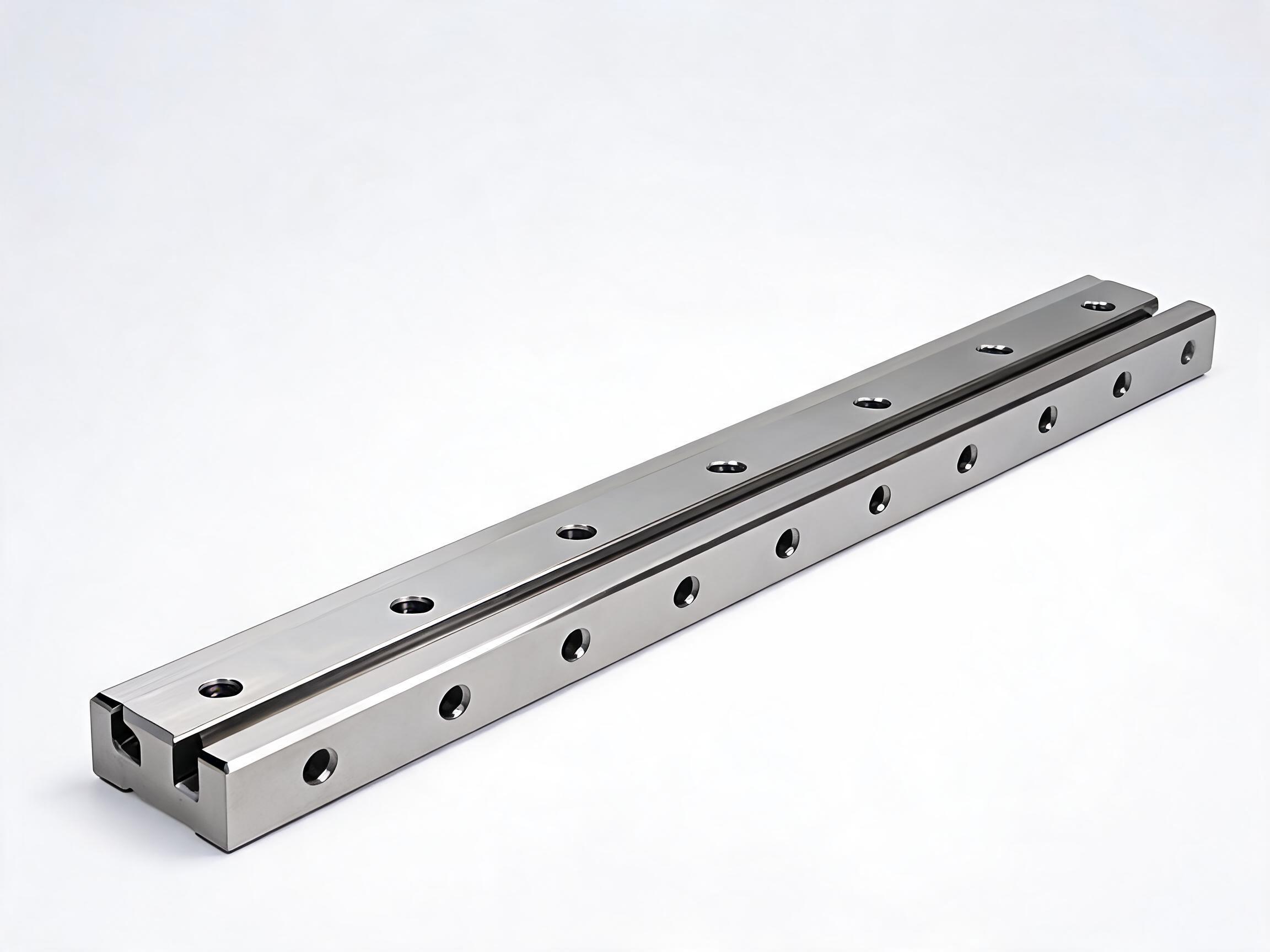
Miniature profile rails (MGN 9/12/15) and low-profile shaft slide units (SBS16) both serve desktop 3D printer axes, but they differ in material, load capacity, envelope height, mounting pattern, and order terms. This guide compares the listed specifications so builders can specify the right option for each axis.
When you specify a linear guide rail for a 3D printer axis, the decision usually comes down to two families: miniature profile rails such as MGN 9, MGN 12 and MGN 15, or a low-profile shaft slide unit such as SBS16. Both move a carriage along a straight axis, but they differ in material, load rating, friction behavior, installed height, mounting pattern, and minimum order terms. The comparison below uses listed product data, so you can see where the two designs actually diverge instead of treating them as interchangeable.
Key takeaways
- MGN miniature profile rails use 9Cr18Mo martensitic stainless steel as standard, with a GCr15 chrome steel option for indoor, cost-sensitive builds.
- MGN 12C carriage lists 3.7 kN dynamic and 5.4 kN static load; SBS16 lists 5.2 kN dynamic and 8.0 kN static.
- SBS16 total system height is 18 mm, about 40% lower than SBR16.
- MGN rails ship up to 1000 mm with MOQ 50 pieces per size and sample sets of 5–10 pieces; SBS16 standard lengths are 150/200/300/500 mm, custom up to 1000 mm.
- Friction coefficient for the MGN rail is listed at 0.002–0.004 under clean, lubricated, low-speed conditions; the SBS16 datasheet is compared on load and envelope, not on a stated friction figure.
Two families, two design intents
Miniature profile rails were developed for compact precision axes. The MGN series is specified for 3D printers, desktop CNC and medical devices, and it uses a two-row Gothic-arch ball circuit inside a profiled carriage. The rail and block both have machined raceways, so the carriage is captured in four directions rather than riding on top of a round shaft.
SBS16 belongs to the shaft-and-support-rail family. A 16 mm GCr15 induction-hardened shaft (HRC 58–62) is mounted on an anodized aluminum 6063-T5 support rail, and a single low-profile block slides over it. The result is a lower, wider assembly that suits gantry and bed axes where vertical clearance is the binding constraint.
Material: stainless standard versus hardened chrome steel
The MGN series uses 9Cr18Mo martensitic stainless steel as the standard rail material, hardened to HRC 54–58. That standard matters on desktop machines because the rail often sits close to the print bed and may see humidity or condensation. A GCr15 chrome steel option is also listed, hardened to HRC 58–62, for indoor and cost-sensitive use where corrosion exposure is controlled.
SBS16 is a different combination: a GCr15 induction-hardened round shaft at HRC 58–62 running on an aluminum support rail. The aluminum rail carries the mounting pattern and stiffness; the hardened shaft carries the rolling load. Material selection therefore affects not just surface hardness but how the part behaves in a humid room and how much of the assembly is structural aluminum rather than steel.
Load capacity on desktop axes
Listed load ratings are a starting filter, not a sizing calculation. The MGN12C carriage is rated at 3.7 kN dynamic and 5.4 kN static. The SBS16 single low-profile block is rated at 5.2 kN dynamic and 8.0 kN static. On paper the SBS16 carries more load, which is consistent with its 16 mm shaft diameter versus the MGN 9/12/15 profile sizes.
For a 3D printer, the actual load is rarely the limit — the toolhead, hotend assembly and printed part mass are low relative to either rating. The rating matters more as a margin indicator: how much stiffness and overload capacity the rail has beyond normal axis forces, and how the block behaves if a belt tension or a crash event applies a transient load. Which size is appropriate still depends on the axis, the carriage mass and the belt arrangement, so the machine should be tested rather than sized from the catalog alone.
Friction: what the number covers
The MGN rail’s listed friction coefficient is 0.002–0.004, measured under clean, lubricated, low-speed conditions. That description is part of the number: the value assumes the rail is clean and greased and the carriage is moving slowly. It is not a prediction of friction in a dusty enclosure or after a long production run without re-greasing. Rails in this series ship pre-greased, which sets the starting condition the figure describes.
The SBS16 data provided here does not state a friction coefficient, so this comparison does not claim one. In practice, shaft-based slide units and profile rails both rely on recirculating balls and both need lubrication to stay in their intended range. Where friction force affects motor sizing or print surface finish, the honest approach is to measure it on the assembled axis, not to transfer an MGN figure to an SBS unit.
Envelope height and mounting
SBS16’s defining number is its 18 mm total system height, about 40% lower than the SBR16 reference. That vertical saving is the reason the family exists: on a printer where the gantry sits above the bed or where the toolhead stack is tight, a lower rail can free space for the carriage, the hotend and the belts without raising the frame.
MGN rails are compact in section but install as a flat profiled rail with a block on top. The MGN-C carriage is the standard length and MGN-H is the long carriage, so carriage length can be traded for mounting footprint and load distribution. For either family, the mounting-hole pattern is the constraint that decides whether a rail drops into an existing extrusion or requires a new plate.
- MGN series: MGN 9, MGN 12 and MGN 15 sizes, with MGN-C standard and MGN-H long carriages.
- SBS16: mounting holes every 25 mm along the support rail, with the block arriving pre-assembled on the shaft.
- MGN rails: maximum rail length 1000 mm; standard grade running parallelism approximately 0.02 mm per 300 mm, with P grade 0.01 mm per 300 mm or better.
- SBS16: standard lengths 150/200/300/500 mm; custom lengths up to 1000 mm.
Side-by-side comparison
| Item | MGN 9/12/15 miniature profile rail | SBS16 low-profile shaft slide unit |
|---|---|---|
| Rail / shaft material | 9Cr18Mo martensitic stainless steel, HRC 54–58; GCr15 chrome steel option, HRC 58–62 | 16 mm GCr15 induction-hardened shaft, HRC 58–62 |
| Support structure | Profiled steel rail | Anodized aluminum 6063-T5 support rail |
| Rolling element | Two-row Gothic-arch ball circuit | Recirculating ball block on round shaft |
| Listed load, MGN12C / SBS16 | 3.7 kN dynamic / 5.4 kN static | 5.2 kN dynamic / 8.0 kN static |
| Total system height | Profile rail plus block height | 18 mm, about 40% lower than SBR16 |
| Friction coefficient | 0.002–0.004, clean, lubricated, low speed | Not stated in the provided data |
| Carriage options | MGN-C standard, MGN-H long | Single low-profile block |
| Lengths | Up to 1000 mm | 150/200/300/500 mm standard; custom up to 1000 mm |
| Mounting | Profiled rail bolt pattern | Holes every 25 mm on support rail |
| Running parallelism | Standard ~0.02 mm per 300 mm; P grade 0.01 mm per 300 mm or better | Not stated in the provided data |
| Delivery condition | Ships pre-greased | Arrives pre-assembled |
| Order terms | MOQ 50 pieces per size; samples 5–10 pieces | Not stated in the provided data |
Precision grade and what it buys
MGN rails are listed with two parallelism grades. Standard grade is approximately 0.02 mm per 300 mm; P grade is 0.01 mm per 300 mm or better. On a 3D printer axis, parallelism affects how consistently the carriage tracks along the rail, which can matter for layer alignment over long travel. Whether P grade changes visible print quality depends on the axis, the frame stiffness and the rest of the motion system, so it should be validated on the machine rather than assumed from the grade alone.
The SBS16 data supplied here does not state a parallelism figure, so the two cannot be ranked on that dimension from these records. If an axis requires a specific parallelism, ask for the number and the measurement method before choosing between families.
MOQ, sampling and prototype builds
For builders moving from a prototype to a small production run, order structure is part of the comparison. MGN rails are listed with an MOQ of 50 pieces per size and sample sets of 5–10 pieces, which supports a build that needs a handful of rails for validation before committing to larger quantities. SBS16’s provided data does not state an MOQ or sample policy, so that term needs to be confirmed with the supplier if sampling matters to your schedule.
Because MGN rails ship pre-greased and SBS16 arrives pre-assembled, both reduce the assembly steps at the bench. Neither condition removes the need to check the rail after installation: alignment, bolt torque and the behavior of the axis under belt tension still determine how the final machine performs.
How to choose between them on a desktop axis
The choice is usually driven by the axis, not by a general preference. Use the envelope as the first filter: if vertical clearance is the binding constraint, SBS16’s 18 mm system height is a concrete advantage. Use the mounting pattern as the second filter: an MGN rail needs a matching bolt pattern on the carriage plate or extrusion, while SBS16 offers holes every 25 mm along its support rail, which can simplify integration with a drilled plate along a gantry.
Then compare material exposure and load margin. A machine in a humid room benefits from the stainless standard on MGN; a controlled indoor build can use the GCr15 option. Where load margin and a wider support rail suit the axis, SBS16’s higher listed dynamic and static ratings are relevant. Where a specified parallelism grade is required, MGN’s standard and P grades give a number to work against.
For the specific products behind this comparison, see the MGN12 linear rail, the broader MGN series stainless steel miniature linear guide, and the SBS16 single-axis slide unit with low-profile carriage. Each page lists the dimensions, load ratings and delivery condition for that model.
What to validate on the machine
Catalog data filters options; the assembled axis decides. Before locking a rail into a design, check the installed parallelism on the frame, confirm the bolt pattern matches the carriage plate, and run the axis under the actual belt tension and carriage mass. Print-quality outcomes, acceleration limits and noise behavior depend on the whole motion system, not on the rail alone, and should be measured on the built machine rather than predicted from a datasheet.