A practical guide for B2B buyers on selecting linear motion shafts and rods. Covers material grades (chrome-plated steel, stainless, aluminum), hardness standards (HRC, case depth), precision classes (g6, h6), surface finish, and how to match these specs to your application’s load, speed, and environment. Includes a comparison table and supplier evaluation checklist.
BUYER GUIDE
• Material choice (chrome-plated steel, stainless, aluminum) determines corrosion resistance, load capacity, and cost.
• Hardness specs (HRC 58-62 typical) and case depth (0.8–1.5 mm) directly affect wear life and shaft straightness retention.
• Precision class (g6, h6) and surface finish (Ra ≤ 0.4 µm) dictate fit accuracy and smoothness in linear motion systems.
• Always verify supplier hardness test reports and surface roughness measurements — not just a datasheet claim.
Why Linear Motion Shafts and Rods Matter for Your Application
Every linear motion system — whether it's a CNC router, a packaging machine, a medical scanner, or an automated assembly line — relies on a few critical components. Among them, linear motion shafts (also called linear rods or rail linear guides) are the backbone that supports load, guides movement, and determines system accuracy and lifespan.
As a buyer sourcing these components, you face a common problem: the market offers hundreds of options, from budget-grade induction-hardened shafts to precision-ground stainless rods. The wrong choice can lead to premature wear, loss of positional accuracy, or even catastrophic failure in the field. This article gives you the specific criteria — material, hardness, precision — to evaluate suppliers and select the right product for your application.
1. Material Selection: What Each Grade Delivers
The material of a linear shaft defines its mechanical properties, corrosion resistance, and cost. Below are the three most common categories used in industrial linear rods and rail linear systems.
Chrome-Plated Steel (CF53 / 1045 / 1060)
This is the workhorse material for general-purpose linear shafts. The base steel (typically C45 or 1045) is induction-hardened, then chrome-plated to a thickness of 20–30 µm. The chrome layer provides corrosion resistance and a low-friction surface. Typical applications: packaging machinery, textile equipment, general automation. Cost-effective, but the chrome layer is thin — in abrasive or highly corrosive environments, it can wear through.
Stainless Steel (AISI 304 / 316 / 440C)
For food processing, medical devices, marine environments, or any application requiring wash-down or exposure to chemicals, stainless steel linear rods are the standard. 304 offers good corrosion resistance; 316 adds molybdenum for chloride resistance. 440C can be hardened to HRC 58-60, making it suitable for load-bearing applications where corrosion resistance is also needed. Expect higher cost — roughly 2–3x chrome-plated steel — but longer service life in aggressive environments.
Aluminum (6061 / 6082) with Hard Anodizing
Lightweight applications — such as pick-and-place robots, 3D printers, or inspection equipment — often use aluminum shafts. The hard anodized coating (40–60 µm) provides wear resistance and corrosion protection. Aluminum shafts are about 1/3 the weight of steel, but their load capacity is lower. They are not suitable for high-load or high-speed linear motion systems.
| Material | Hardness (HRC) | Corrosion Resistance | Relative Cost | Typical Load |
|---|---|---|---|---|
| Chrome-plated steel (CF53) | 58–62 (case) | Moderate (chrome layer) | 1x (baseline) | High |
| Stainless 304 | Not hardened (~20 HRC) | Excellent | 2–3x | Low–Moderate |
| Stainless 440C | 58–60 (through) | Good | 3–4x | High |
| Aluminum 6061 (hard anodized) | N/A (coating ~60 Rockwell) | Good (anodized) | 1.5–2x | Low |
2. Hardness Specifications: What to Look For
Hardness is the single most important factor determining the wear life of a linear motion shaft. A shaft that is too soft will develop grooves under the ball bearings of a linear bushing, causing vibration, noise, and loss of accuracy. A shaft that is too hard may be brittle and prone to cracking under shock loads.
Induction-Hardened vs. Through-Hardened
Most chrome-plated steel shafts are induction-hardened — only the surface layer (case depth 0.8–1.5 mm) is hardened to HRC 58–62. The core remains softer (HRC 20–30), providing toughness. This is the standard for linear shafts used in general automation. Through-hardened shafts (e.g., 440C stainless) are fully hardened throughout, offering higher wear resistance but less impact toughness.
Case Depth
For induction-hardened shafts, the case depth must be sufficient to support the contact pressure of the linear bearing. A minimum case depth of 1.0 mm is recommended for shafts up to 20 mm diameter; for larger diameters (25–50 mm), 1.5–2.0 mm is typical. Ask your supplier for a hardness profile report — not just a surface reading.
Hardness Testing Standards
Reputable suppliers test hardness using Rockwell C (HRC) on the surface, and Vickers (HV) for case depth profiling. Acceptable range: HRC 58–62 for induction-hardened shafts. Below HRC 55, expect accelerated wear. Above HRC 64, the risk of cracking increases.
"Always request a hardness test certificate from your supplier. A datasheet that says 'HRC 60' without a test report is not a specification — it's a hope."
3. Precision Classes: g6, h6, and What They Mean
The precision of a linear rod is defined by its diameter tolerance and straightness. These directly affect the fit with linear bushings and the smoothness of motion.
Diameter Tolerance
- g6 class (e.g., 20g6 = -0.007 / -0.020 mm): Standard for general-purpose linear shafts. Provides a light interference fit with most linear bushings. Suitable for packaging, textile, and general automation.
- h6 class (e.g., 20h6 = 0 / -0.013 mm): Tighter tolerance, used for high-precision applications like CNC machines, medical equipment, and measuring instruments.
- f7 or h7 class: Looser tolerance, typically used for less demanding applications or where thermal expansion is a concern. Not recommended for high-speed or high-load systems.
Straightness
Straightness is measured as the maximum deviation over a given length. For standard linear shafts, straightness of 0.05 mm per 300 mm is typical. For precision rail linear applications, specify 0.02 mm per 300 mm. Always confirm the straightness measurement method — some suppliers measure only at the ends, while others use a continuous laser scanner.
Surface Finish
The surface roughness of a linear motion shaft affects friction, noise, and wear. A typical spec is Ra ≤ 0.4 µm (≤ 16 µin). For high-speed or quiet applications, specify Ra ≤ 0.2 µm. The surface should be free of scratches, pits, or chrome peel. A simple visual inspection under good lighting can reveal defects — but a profilometer measurement is the only reliable verification.
| Precision Parameter | Standard Grade (g6) | Precision Grade (h6) |
|---|---|---|
| Diameter tolerance (20 mm shaft) | -0.007 / -0.020 mm | 0 / -0.013 mm |
| Straightness (per 300 mm) | ≤ 0.05 mm | ≤ 0.02 mm |
| Surface finish (Ra) | ≤ 0.4 µm | ≤ 0.2 µm |
| Typical applications | Packaging, textile, general automation | CNC, medical, measurement |
4. Matching Shaft Specifications to Application Requirements
Choosing the right linear shaft is not about picking the most expensive option — it's about matching specs to your operating conditions. Here is a quick decision framework:
- Load & speed: High load or high speed → chrome-plated steel, HRC 58–62, g6 tolerance. For extreme loads, consider through-hardened stainless 440C.
- Environment: Wet, wash-down, or chemical exposure → stainless 304 or 316. For dry, clean environments, chrome-plated steel is sufficient.
- Accuracy: Positioning error < 0.01 mm → h6 tolerance, straightness ≤ 0.02 mm/300 mm, Ra ≤ 0.2 µm.
- Weight sensitivity: Moving mass is critical → aluminum with hard anodizing, but verify load capacity with your linear bushing supplier.
5. Supplier Evaluation Checklist
When evaluating a supplier of linear motion shafts or linear rods, ask for the following documentation and verification:
- Material certification — mill test report (MTR) showing chemical composition and mechanical properties.
- Hardness test report — surface HRC reading and case depth profile (HV 0.3 or equivalent).
- Dimensional inspection report — diameter measurement at three points along the length, plus straightness measurement.
- Surface finish measurement — Ra value from a calibrated profilometer.
- Chrome plating thickness (for chrome-plated shafts) — typically 20–30 µm, verified by magnetic induction or XRF.
- Sample evaluation — request a short sample (e.g., 300 mm length) to test fit with your linear bushing and run a basic motion test.
"A supplier who cannot provide a hardness test report or a dimensional inspection certificate is not a supplier — they are a trader. For critical applications, insist on traceable documentation."
Frequently Asked Questions
Q: Can I use a chrome-plated steel shaft in a food processing environment?
Not recommended. The chrome layer can be damaged by caustic cleaning agents, and the underlying steel will rust. Use stainless steel (304 or 316) for food-contact or wash-down areas.
Q: What is the difference between a linear shaft and a linear rail?
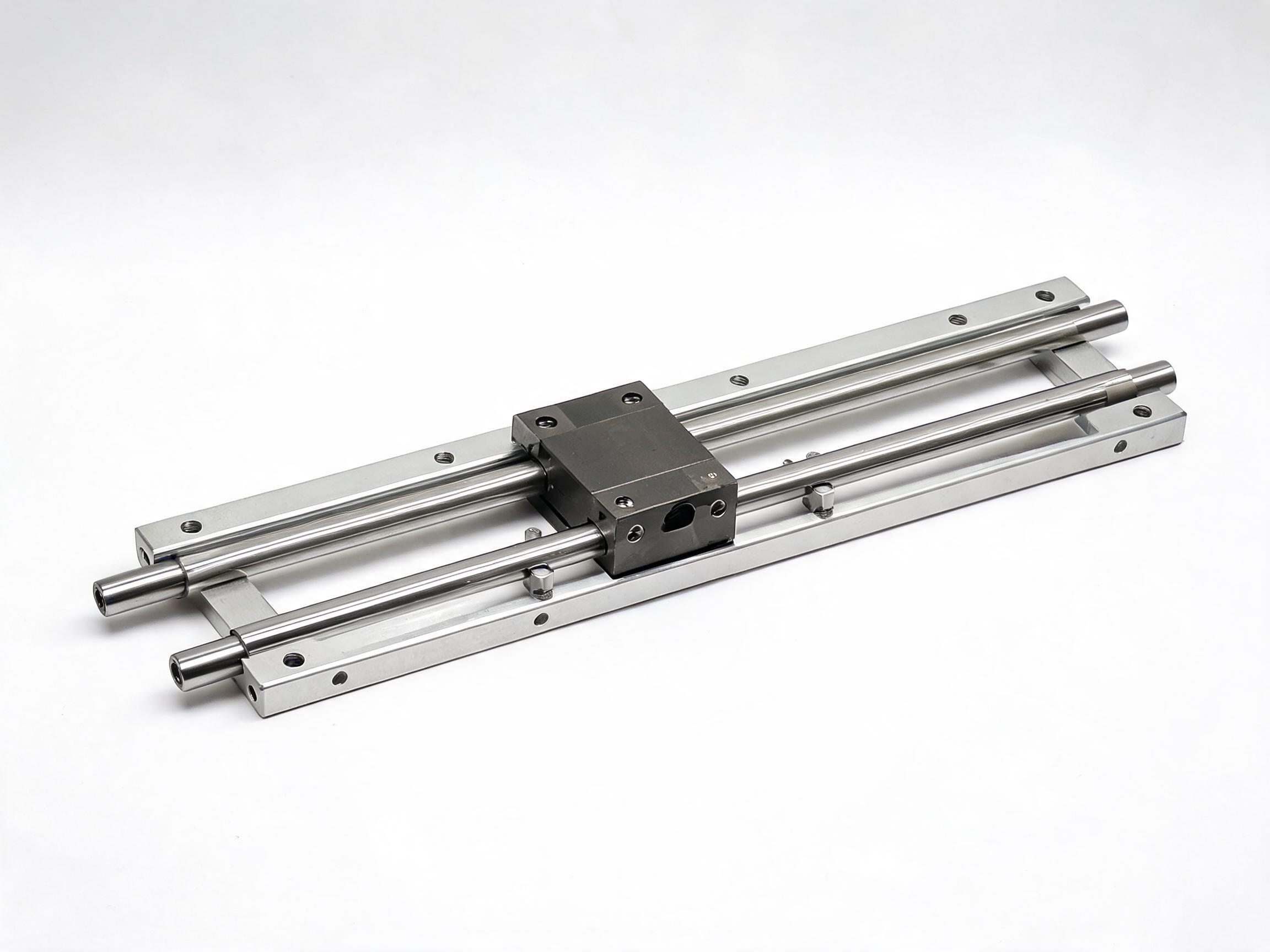
A linear shaft (or rod) is a cylindrical component that works with linear bushings. A linear rail (or rail linear guide) is a profiled rail with a carriage that uses recirculating ball bearings. Shafts are simpler and lower cost; rails offer higher load capacity and stiffness. Choose based on load, speed, and accuracy requirements.
Q: How long will a chrome-plated steel shaft last?
Service life depends on load, speed, lubrication, and contamination. Under typical conditions (moderate load, clean environment, proper lubrication), expect 5,000–10,000 km of travel before surface wear becomes significant. Hardness and surface finish are the primary determinants.
Q: Can I cut a linear shaft to length myself?
Yes, but you must ensure the cut end is chamfered and deburred to avoid damaging the linear bushing during installation. Cutting also removes the chrome layer at the cut end — apply anti-corrosion protection if the environment is humid.
Next Steps for Buyers
Selecting the right linear motion shaft or linear rod is a technical decision that affects your machine's performance, reliability, and total cost of ownership. Start with a clear specification sheet for your application — load, speed, environment, and accuracy — then match it to material, hardness, and precision class.
If you need assistance with shaft selection, custom lengths, or special tolerances, contact our engineering team. We can provide hardness test reports, dimensional inspection certificates, and sample shafts for evaluation. Request a quote or technical consultation.