An honest comparison of roller guide rails and ball-recirculating profile rails: how contact geometry changes load capacity, rigidity, friction and speed, where each type fits, and a decision checklist for buyers. This manufacturer's own guideway range is ball recirculating, and the article says so plainly.
Guideway Selection
Buyers comparing roller guide rails with ball-recirculating profile rails usually already know both exist. What they need is a straight answer on which contact geometry suits their load and duty, and where the cheaper, easier-to-source option is actually sufficient. This article gives that answer without a catalogue pitch, and it is upfront about one thing: the guideway range described at the end is ball recirculating, not roller.
Key takeaways
- Roller guide rails use cylindrical rollers with line contact; ball guides use balls with point contact. That single difference drives most of the trade-offs.
- Line contact gives roller guides higher load capacity and higher rigidity in a similar envelope, which matters for heavy cutting and heavy static loads.
- Ball recirculation gives lower friction, higher running speeds, quieter operation and wider sourcing availability.
- The right question is not which is better, but whether your duty actually requires line contact.
What buyers usually mean by roller guide rails
"Roller guide rails" and "linear roller guides" are used loosely in procurement. Most of the time the buyer is describing a profile rail system in which the carriage runs on cylindrical rollers instead of balls, and the point of interest is load capacity and stiffness under cutting or pressing forces. Occasionally the term refers to a different roller-based linear product altogether, such as a cam-follower arrangement on a flat track. It is worth confirming which construction a quotation is for before comparing prices, because the two are not interchangeable mechanically.
This article compares the first type: roller-type profile guideways against ball-recirculating profile guideways, the kind built from a hardened rail and a recirculating carriage block.
Contact geometry in plain language
A ball touching a raceway touches it at a very small area. A cylindrical roller touching a raceway touches it along a line. Under the same load, the ball contact sees a much more concentrated stress, and the roller spreads that load over a longer footprint.
That is the whole mechanism behind the usual engineering statements:
- Line contact gives roller guides higher load capacity and higher rigidity within a similar envelope.
- Point contact gives ball guides lower friction and simpler, more predictable recirculation at speed.
Neither is a defect. They are two different answers to the same question, and each one pays for its strength somewhere else.
Where roller guides win
Roller-type guideways are the natural choice when the load path is the dominant design constraint.
- Heavy cutting. Machine tools taking deep cuts, or cutting hard materials, put large, fluctuating forces through the carriage. Higher rigidity in line contact reduces deflection under those forces, which helps hold geometry at the tool tip.
- Heavy static loads. Presses, fixtures, gantries and handling equipment that sit under load for long periods benefit from the load-spreading behaviour of line contact.
- Stiffness-critical structures. Where the frame is designed around a tight deflection budget, a roller system can meet it in a smaller envelope than a ball system of comparable rating.
- Shock and momentary overload. Line contact is generally more tolerant of short excursions above nominal load, though the supplier's rating method should still be checked for the specific series.
What buyers should not assume is that this translates into a fixed advantage. The magnitude depends on series, preload, roller count, mounting and lubrication. Ask the roller supplier for the rating basis rather than comparing headline numbers from two different catalogues.
Roller guides also carry costs: generally higher friction than ball recirculation, lower permissible speeds, more sensitivity to lubrication condition, and fewer qualified sources in most regions. Those are procurement realities, not marketing points.
Where ball recirculation wins
Ball-recirculating profile rails cover the majority of general linear motion duty, and there is a reason they dominate the market.
- Lower friction. Rolling balls with low-friction recirculation keep drive sizing modest and reduce heat at the carriage.
- Higher speeds. Recirculating ball systems sustain higher travel speeds and acceleration than roller equivalents, which suits pick-and-place, automation and high-cycle positioning.
- Quieter running. Ball recirculation is generally the quieter of the two, useful in enclosed or operator-adjacent equipment.
- Wider sourcing. Ball guideway series are made by many manufacturers in standard sizes and interchangeable footprints, which shortens lead times and eases second-sourcing.
- Sufficient in most applications. Many machines described as "heavy" in conversation are, in load terms, well inside the capacity of a correctly sized four-row ball carriage.
A decision checklist by load, speed, environment and budget
Work through the four lines below before choosing a contact type.
| Factor | Questions to answer | Leans roller | Leans ball |
|---|---|---|---|
| Load | What is the maximum working load per carriage, in each direction, including moment loads? What is the static load during dwell or clamping? | Load close to or above the ball option's rating, or continuous heavy static load | Load comfortably inside the ball rating with margin |
| Duty and speed | Travel speed, acceleration, cycle rate, and how many hours per day? | Slow, force-dominated duty | Fast cycling, high acceleration, continuous reciprocation |
| Environment | Chips, coolant, dust, washdown, temperature? Who maintains lubrication and how often? | Protected, well-lubricated, stiff machine structure | Chip and coolant exposure where sealed ball carriages are supported by widely available spares |
| Budget and supply | Is second-sourcing required? What is the acceptable lead time and cost of a replacement carriage? | Roller supply can be secured for the machine lifetime | Multiple sources and short lead times matter |
If the load line and the duty line both point the same way, the decision is usually clear. When they conflict, size the system for load first and then check that the chosen type can handle the speed. A marginally oversized ball system is often a better answer than an undersized roller system.
An honest note on this manufacturer's guideway range
The guideway range this site sells is ball recirculating. There are no roller guide rails in the catalogue, and no claim here that ball recirculation beats roller construction in heavy cutting. It does not; that is exactly the duty where line contact has the engineering advantage.
The ball range is built as follows.
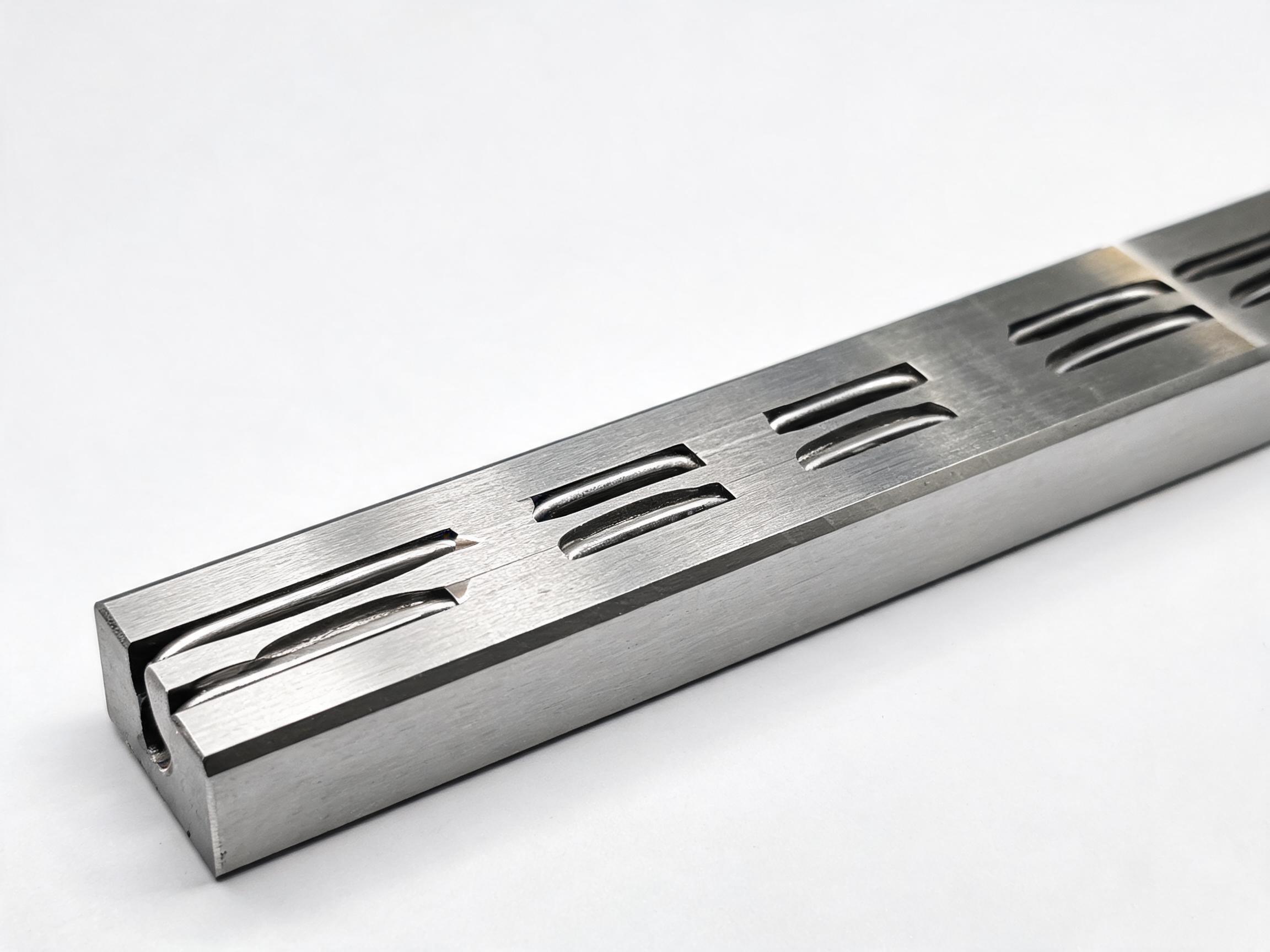
HGR series profile rails (HGR heavy-duty linear guideway rail): 55# high-carbon steel, induction hardened to 58-62 HRC at the raceway, in sizes HGR15, HGR20, HGR25, HGR30, HGR35 and HGR45. Ground H (P5) and rolled N (P7) grades are available. The four-row ball contact geometry distributes radial, reverse-radial and lateral loads. Maximum standard length is 4000 mm, with precision splice joints for longer runs. For HGR20, dynamic load rating is 16.7 kN and static load rating is 26.7 kN.
HGH series flange carriages (HGH flange-type linear guideway carriage block): four-row ball recirculation carrying load in all four directions with a single carriage, self-aligning tolerance of ±0.5°, end seal plus side seal strip against chips and coolant. For HGH20CA, dynamic load is 18.0 kN and static load is 29.5 kN.
Those figures are the ones to size against. If a preliminary calculation shows your worst-case load sitting at or beyond them, that is the honest signal to look at a roller specialist, not to push the ball rating.
When to go to a roller specialist anyway
Approach a roller-guideway supplier directly when any of the following is true:
- The required load per carriage, including moment loading, exceeds what the available ball sizes can carry with sensible margin.
- Deflection under cutting force is a design constraint you cannot meet with a ball system.
- The application has long static dwell under heavy load, such as clamping or pressing stations.
- You already run roller guideways on similar machines and want fleet consistency in spares.
When you ask, request the rating basis, preload class, lubrication requirement and permissible speed for the series, not just the headline load number. That is what makes a comparison between two catalogues meaningful.
FAQ
Are roller guide rails always stronger than ball guides?
In load capacity and rigidity terms, line contact generally gives roller guides the advantage in a similar envelope. But the practical difference depends on series, preload and mounting, so compare ratings from the same basis rather than assuming a fixed gap.
Can a four-row ball carriage handle heavy cutting?
It can handle substantial load, and many machines use it successfully. The question is whether your worst-case load and deflection budget sit comfortably inside the rating. Check the numbers for the specific size before deciding.
Why does ball recirculation dominate the market?
Lower friction, higher speeds, quieter running and many interchangeable sources make it the practical default for general automation. Roller systems are more specialised, which also explains the narrower supply base.
Do you sell roller guide rails?
No. Our guideway line is ball recirculating: HGR profile rails and HGH flange carriages. If your duty clearly requires line contact, we will say so rather than propose a ball system that is marginal.
What information do you need to size a ball guideway?
Load per carriage in each direction, moment loads, travel speed and acceleration, cycle rate, mounting orientation, environment, and required rail length. With those, the HGR and HGH ratings can be checked against your duty.