
L10 life is a statistical rating, not a replacement schedule. Here is what it does and does not tell you about round-shaft linear ball bushings, which conditions shorten real service life, and a practical no-teardown order for deciding when a bearing actually needs to come out.
Linear Motion Maintenance
L10 life is the number most bearing datasheets lead with, and it is also the number most often misread as a replacement schedule. It is not. Used correctly, L10 is a comparison tool and a language for talking to your supplier; it does not tell you the date a linear bushing should come off the shaft.
What the L10 Rating Actually Means
L10 is a rating convention, not a measured service life. It expresses the load at which a defined population of identical bearings, run under identical reference conditions, is expected to reach a defined fatigue point for 90% of that population. The remaining 10% may reach it earlier. That single number carries three assumptions that almost never hold on a real machine: clean lubricant, correct alignment, and a load applied in the direction and manner the rating assumes.
The practical consequence for a round-shaft linear bushing is this. Two bearings with the same L10 figure can run for very different periods on two different machines, and neither result contradicts the rating. The rating describes a population under reference conditions. Your machine is one case, with its own contamination level, lubrication practice, load direction, and shaft condition.
This is why L10 is useful for comparing candidate bearings at the design stage — and unreliable as a maintenance calendar.
Where Real Linear Bushing Life Gets Shortened
Most linear ball bushing failures that arrive as complaints are not fatigue failures at the rated load. They are caused by conditions the rating does not model. Four appear again and again.
Contamination on the Shaft
Abrasive dust, chips, and dried coolant on the shaft enter the ball circuit and are rolled between balls and raceway with every stroke. The damage is mechanical, not load-driven, and it accumulates with travel distance rather than with load. A sealed extended-length type with double-lip NBR seals and a labyrinth groove resists this far better than an unsealed unit, but it does not make the shaft self-cleaning. Shaft wipers or bellows upstream of the bearing usually do more for life than upgrading the bearing alone.
Lubrication Starvation
Linear ball bushings need a film between balls, raceway, and shaft. Once the film breaks down, metal-to-metal contact begins and the surface degrades quickly. Long-stroke, high-speed, and vertically oriented applications are the hardest on lubricant retention, because the lubricant migrates away from the loaded zone. Re-lubrication intervals matter more than the initial grease choice.
Load Direction and Edge Loading
The L10 figure is quoted for a defined load direction. In practice, a bushing mounted in a housing that is slightly out of parallel with its partner, or carrying a moment load that rocks the bushing on the shaft, concentrates force on a narrow band of balls. Edge loading can dominate the real load even when the nominal applied load is modest. Two bushings sharing a shaft must be aligned to each other, not just each to its own housing.
Shaft Hardness, Finish, and Fit
The bushing raceway is hard, but the shaft is half of the rolling contact. A soft shaft will Brinell and wear before the bearing does; a rough shaft accelerates ball and raceway wear; an undersized shaft reduces the effective contact and allows the bushing to shift under load. Shaft hardness, surface finish, and diameter tolerance are therefore life variables, not installation details. Check them against the shaft supplier's data before blaming the bearing.
The L10 Limits: What It Will Not Tell You
L10 does not account for contamination, lubrication interval, mounting misalignment, shaft condition, vibration, or duty cycle with frequent direction reversals. It cannot be converted into a replacement date for a specific machine without additional data on those variables.
Any supplier who answers “how often do bearings need to be replaced” with a fixed number of months is either quoting an average from an unrelated application or guessing. The honest answer is that replacement timing is judged from condition, and the L10 figure only sets the design-stage expectation.
LM Series and LMUU Sealed Types: What the Numbers Cover
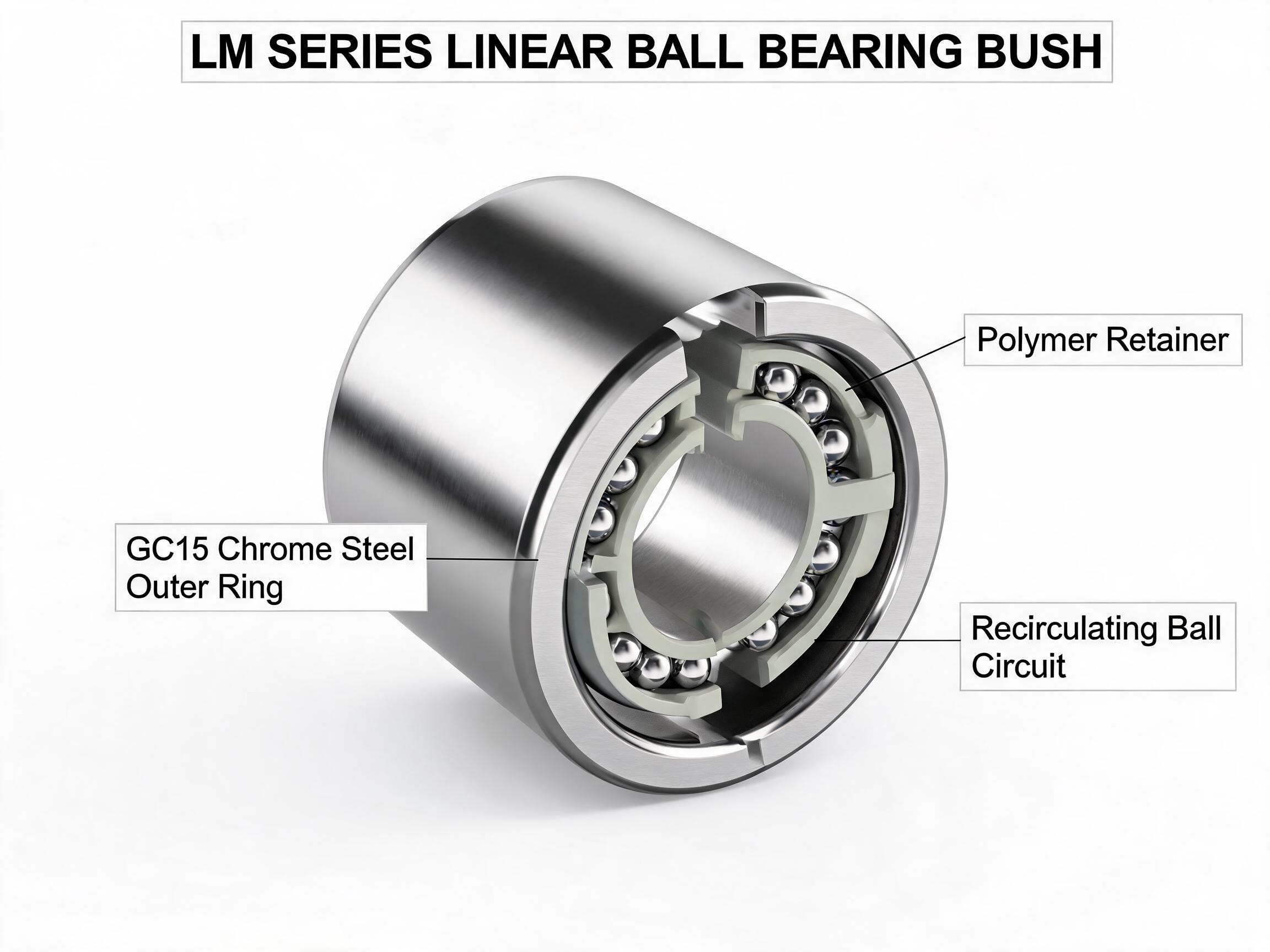
For reference, the LM series covers shaft diameters from 6 mm to 60 mm, with GCr15 chrome steel outer ring and balls hardened to HRC 60–64 and a PA66-GF retainer. Closed (UU) and open (OP) types share an identical envelope per JIS B 1185 / ISO 10285, so a housing machined for one accepts the other. The LM series linear ball bearing bush is the standard envelope option; the LMUU series sealed extended-length linear bearing uses an extended sleeve carrying 40% more balls, plus double-lip NBR seals and a labyrinth groove.
| Type | Dynamic load | Static load | Sealing |
|---|---|---|---|
| LM16UU (standard envelope) | 980 N | — | UU closure |
| LMUU sealed extended-length, 16 mm | 1,580 N | 2,450 N | Double-lip NBR + labyrinth groove |
Two notes on reading that table. First, the higher rating of the sealed extended-length type comes from the additional ball rows in the longer sleeve, not from the seals — the seals protect the rating from contamination, they do not raise it. Second, NBR seal material is rated from -30°C to +110°C. Outside that band, seal performance and therefore contamination protection change, even though the load rating does not.
Because the two types share a mounting envelope but not a sleeve length, check the housing bore length and shaft support spacing before substituting one for the other.
A No-Teardown Check Order for Deciding on Replacement
You do not need to disassemble the axis to judge whether a linear bushing is close to the end of its useful life. Work through these checks in order and stop at the first clear fault.
- Listen and feel under slow hand travel. With the drive disconnected and the carriage moved slowly by hand, listen for a periodic click or rasp and feel for a repeated tight spot. A single rough zone that repeats once per ball circuit rotation indicates local raceway or ball damage.
- Inspect the ball tracks on the shaft. Even, faint polishing marks are normal. Discrete parallel grooves, a visible step where the loaded zone ends, or fretting discoloration under the bushing mean the contact surface has already changed and a new bushing will wear faster on the same shaft.
- Check seal condition. On sealed types, a torn, hardened, or displaced lip allows contamination directly into the ball circuit. Lip damage is often the actual start of the failure, not a symptom of it.
- Compare against the travel log. If the axis is logged for stroke count or running hours since installation or last replacement, compare current condition against the point where roughness first became noticeable. The trend matters more than the absolute number.
- Confirm the load case before replacing. If the failed bushing shows wear concentrated on one side, replacing it with the same type in the same housing will reproduce the failure. Check alignment and load direction first.
Ask Your Supplier for a Load-Life Calculation
The most useful thing you can do instead of guessing a replacement interval is to supply the actual application data and ask for the load-life calculation. That conversation should include: the applied load and its direction relative to the bushing; stroke length and cycle rate; whether the load is centered or creates a moment; the shaft material, hardness, and finish; and the environment, particularly airborne contamination and temperature.
With that data, a supplier can tell you which of the two constructions is appropriate, whether the standard envelope rating covers your load case, and whether the sealed extended-length type is justified by the environment. What they cannot honestly give you is a calendar date. Use the calculation to select and to set an inspection interval, and use the inspection checks above to decide when to actually replace.
FAQ
Is L10 the same as the bearing's expected life?
No. L10 is the point at which 90% of a population under reference conditions is expected to have reached a defined fatigue criterion. Individual bearings in real machines reach it at different times, and most real failures are caused by contamination, lubrication, or misalignment rather than by the load case the rating models.
How often do linear bearings need to be replaced?
There is no universal interval. Replacement is judged from condition — roughness under hand travel, ball track condition on the shaft, and seal integrity — combined with your own travel log. The L10 rating sets a design-stage expectation, not a maintenance schedule.
Does the sealed extended-length type last longer than the standard type?
It resists contamination better because of the double-lip NBR seals and labyrinth groove, and it carries a higher load rating because of the additional ball rows. In a clean, well-lubricated axis, the difference is modest. In a dusty or coolant-exposed axis, the sealed type has a clear advantage — provided it fits the housing bore length.
Can I replace a standard bushing with the sealed extended-length type directly?
Both use the JIS B 1185 / ISO 10285 envelope for the same shaft diameter, but the sealed extended-length sleeve is longer. Verify housing bore length and shaft support spacing before substituting.