
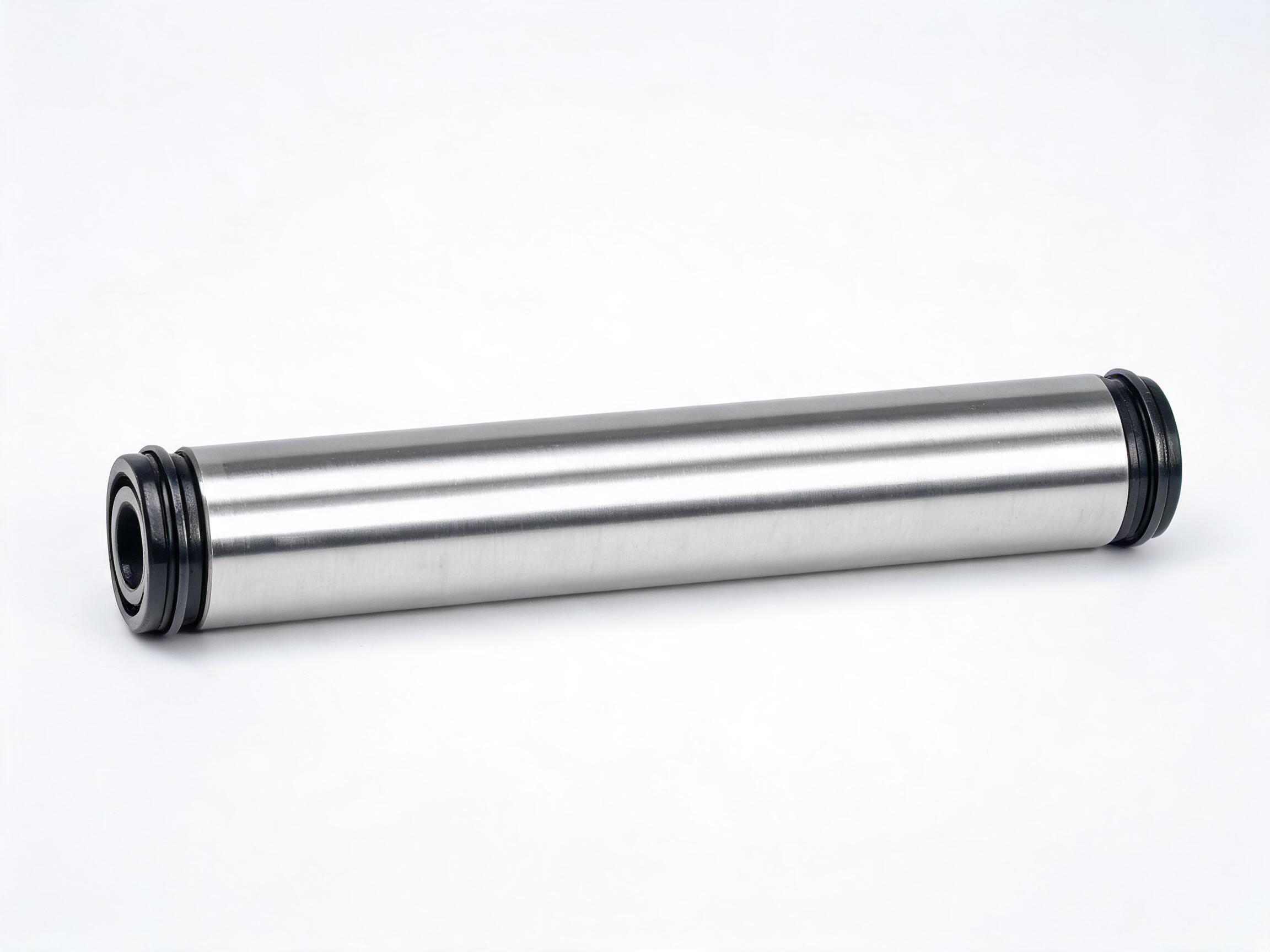
When a sealed linear ball bearing runs near an oven, dryer, engine compartment or hot-forming line, the temperature ceiling is almost always set by the seal and the grease — not the steel. This article walks through the figures our product records actually confirm: NBR seals at −30°C to +110°C, an FKM option up to 200°C, and the ADC12 aluminum KH pillow block housing at −20°C to +80°C, plus what to put on a specification sheet.
Linear Bearing High Temperature: Seals, Grease and Limits
If you are putting a sealed linear ball bearing near an oven, a dryer, an engine compartment or a hot-forming line, the question that matters is not how hot the steel can get. It is how hot the seal and the grease can get before the bearing stops doing its job. In the configurations we list, those two components carry the practical temperature ceiling.
This article is about sealed linear ball bearing bushes and the housing units they go into. For the different component that runs as a linear guide rail and carriage assembly, the limits and the reasoning are separate; do not carry figures across from one to the other.
What this article confirms
- NBR double-lip seals: operating range −30°C to +110°C (sealed extended LMUU series record).
- FKM (Viton) seal option: available for high-temperature applications up to 200°C; FKM seals are available for 500+ piece orders.
- KH pillow block housing: ADC12 aluminum, operating temperature −20°C to +80°C (housing record).
- Raceway: GCr15 chrome steel, induction hardened HRC 60–64.
Those are the only temperature figures confirmed in the product records. For anything outside them, the datasheet for the specific configuration is the source to ask for.
Why the seal, not the raceway, decides the ceiling
The raceway is GCr15 chrome steel, induction hardened to HRC 60–64. It is the load-carrying surface, and buyers often assume it is also the temperature-limiting surface. In a sealed bearing, it usually is not the first thing to fail. The seal sits at the interface where the shaft, the rolling elements and the outside air meet, and it is made of an elastomer with its own operating band. Once the seal passes its limit, it hardens, loses lip contact or takes a set, and the bearing starts losing lubricant and admitting contamination long before the steel is affected.
So the honest way to read a temperature requirement is component by component: seal first, grease second, housing third. The steel is the least likely of the four to be the constraint, and the records do not give a steel maximum, so no steel number should appear on your specification sheet.
Seal material limits
Two seal materials appear in the sealed LMUU configuration and its options. They are not interchangeable across the whole temperature range, and the gap between them is the single most important choice in a hot application.
| Component | Material / configuration | Confirmed operating range | Source |
|---|---|---|---|
| Seal | NBR double-lip | −30°C to +110°C | Sealed extended LMUU series record |
| Seal | FKM (Viton), high-temperature option | up to 200°C | FKM option record; available for 500+ piece orders |
| Housing | ADC12 aluminum pillow block (KH) | −20°C to +80°C | KH pillow block housing record |
| Raceway | GCr15 chrome steel, induction hardened HRC 60–64 | no separate temperature figure in the records | Product specification |
The NBR seal is the standard double-lip arrangement on the sealed extended LMUU series. The double lip is what keeps grease in and contamination out, and it is also the part closest to the heat. At +110°C the NBR seal is at the top of its stated band. A process that sits at or near that figure with any excursion above it belongs on the FKM option, not on the standard seal.
The FKM option carries the bearing up to 200°C. It is a selective configuration, available for 500+ piece orders, so it is worth deciding early whether the requirement is real: an FKM specification converts an ordinary replacement part into a configured order with its own lead time.
Grease behavior near the seal limit
The grease is the second component to watch, and its behavior is a matter of mechanism rather than a published number. As temperature rises toward the seal limit, three things happen that you should plan for:
- Softening. The grease thickens less and flows more freely. In a horizontal or lightly loaded bush this can be tolerable; in a vertical application it can mean the grease drains away from the loaded zone.
- Migration. Softer grease moves along the shaft and toward the seal lip, where it can accumulate, weep past the lip or leave the rolling path under-lubricated even though grease is still present inside the bearing.
- Shorter re-lubrication interval. The hotter the running condition, the faster the grease degrades, so the interval that worked at ambient temperature needs to be reviewed rather than carried over.
None of these has a Celsius figure attached in our records, and none should be given one. The practical move is to specify the lubricant grade together with the seal material and state the running temperature the grease will see at the bearing, not the temperature of the oven wall or the exhaust stream.
Grease selection, fill quantity and re-lubrication interval for a specific hot application should be confirmed with the datasheet for the specific configuration. The seal limit and the grease limit are separate decisions and can resolve to different numbers.
The housing can be the tightest limit
A sealed bearing does not always arrive as a bare bush. When it is supplied in a KH series pillow block unit, the housing joins the temperature chain — and in that configuration the housing record is the narrowest band of all: ADC12 aluminum, −20°C to +80°C.
This catches buyers out. Someone selects an FKM-sealed bearing for a 150°C zone, then mounts it in an aluminum pillow block, and the assembly is limited to +80°C by the housing rather than by the seal. The bearing itself may be fine; the unit is not. If your application is above +80°C, the housing material becomes a question in its own right, and it should be raised with the datasheet or with the supplier before the order is placed.
The same logic applies on the cold side. A cold-store or outdoor installation near −20°C is within the KH housing band but close to its edge, while the NBR seal is comfortable to −30°C. The lowest figure in the chain governs the assembly.
What to put on the specification
A temperature requirement that says only “high temperature” gets a generic answer. A requirement that names the components gets a configuration. State the following:
- Measured temperature at the bearing, not at the heat source, including any excursion above normal running.
- Bearing type and series — sealed extended LMUU, or the LM series linear ball bearing bush where the open configuration suits the mounting.
- Seal material — NBR as standard, FKM where the application needs the higher band, with the order quantity noted since FKM is a 500+ piece option.
- Housing — whether the bearing is used bare or in a KH pillow block, because that decides whether the +80°C housing limit applies.
- Lubricant and re-lubrication plan — grade, fill, and the interval you expect to maintain at the stated temperature.
- Motion and load — stroke, speed, orientation and load direction, since grease migration and re-lubrication depend on how the bearing is mounted and used.
With those six points, a supplier can tell you which component in the chain is the limit and whether the configuration you want exists. Without them, any temperature answer is a guess about which part of the assembly is being discussed.
Where the records stop
The confirmed figures in this article are narrow and specific: −30°C to +110°C for the NBR double-lip seal, up to 200°C for the FKM option, and −20°C to +80°C for the ADC12 KH pillow block housing. The raceway is GCr15 chrome steel hardened to HRC 60–64, and the records do not give it a separate temperature figure. There is no single “maximum temperature” for the product line, and quoting one would misstate how a sealed bearing fails.
For a running temperature above +110°C with a standard seal, above +80°C in a KH housing, or for a lubricant question at any temperature, the answer depends on the exact configuration. Ask for the datasheet for that configuration and compare it against the measured temperature at the bearing, including excursions. That is the number the seal and the grease actually see, and it is the number the selection should be made on.