
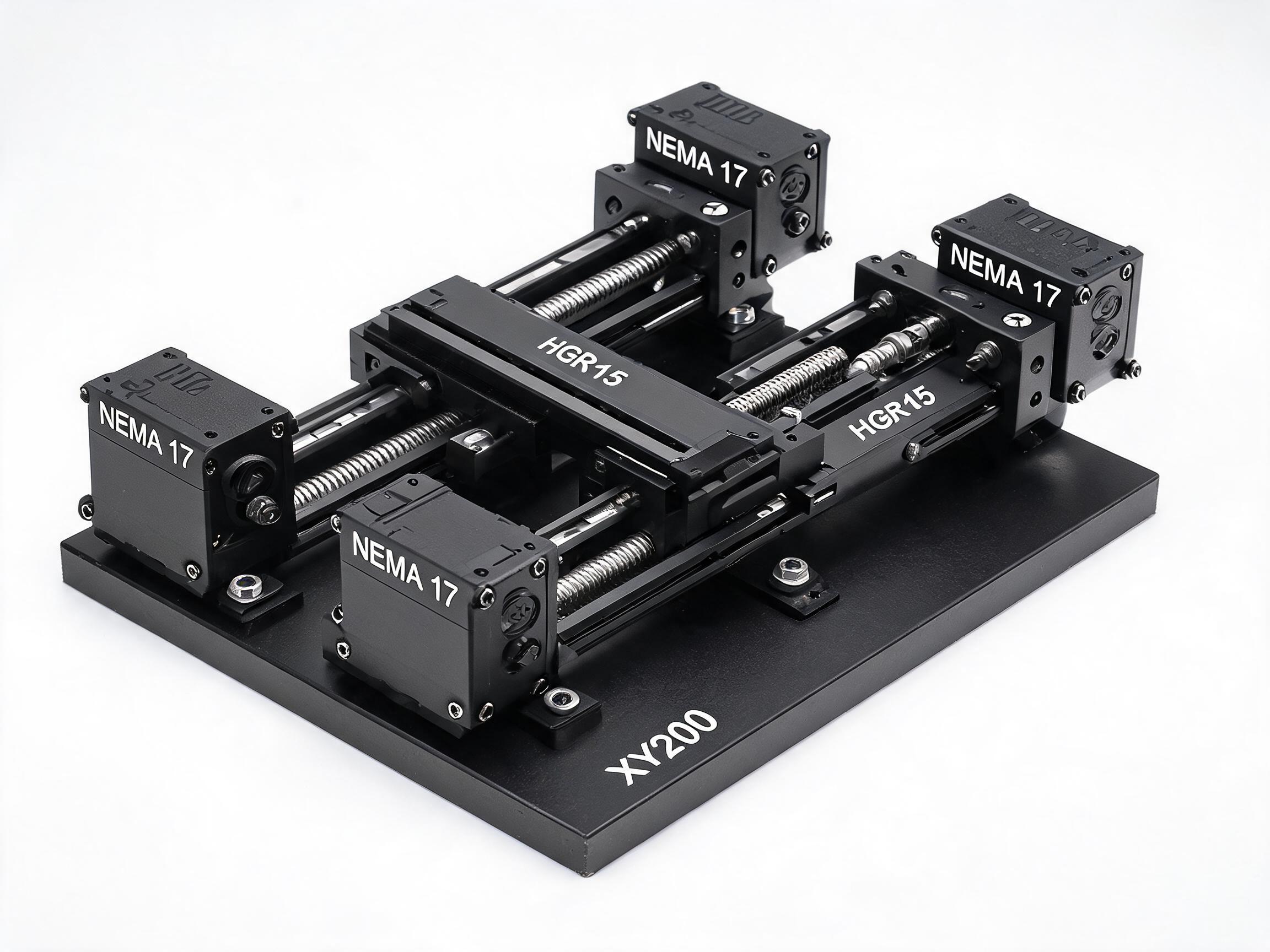
A buyer's decision framework for choosing between servo and stepper motors on a linear motion system: speed and torque profile, positioning accuracy, closed-loop feedback, stall and resonance behavior, drive and wiring complexity, cost and maintenance — and how the motor choice interacts with the ball screw or module and the controller.
Motor selection guide
Most linear motion system decisions come down to a handful of measurable questions, and the motor is one of them. A stepper motor gives you open-loop position control at low cost and simple wiring. A servo motor gives you closed-loop feedback, tolerance to changing load, and an easier path to higher speed. Neither is a default. The right answer depends on what your axis must do over its whole working envelope — and on the ball screw or module and the controller you are driving it with.
This article is a decision framework, not a sizing formula. If you have already fixed the ball screw lead and need to check torque and speed, that is a separate calculation. Here the question is narrower: which motor category fits the way your axis actually moves.
Key takeaways
- Stepper motors win on cost, simplicity and repeatable small moves where load and speed stay modest and predictable.
- Servo motors win when the load varies, when speed and acceleration change across the cycle, or when a stall must be detected rather than silently held.
- Closed-loop feedback changes the failure mode: a stepper loses position when it is overloaded; a servo can report the error instead of hiding it.
- Resonance and mid-band instability are stepper characteristics you have to manage; a servo's feedback loop absorbs most of them.
- The motor is only half the system. Screw lead, screw preload and controller architecture decide whether the motor choice can deliver what you expect.
What this article covers
- Speed and torque profile
- Positioning accuracy and repeatability
- Closed-loop feedback and what it changes
- Stall and resonance behavior
- Drive and wiring complexity
- Cost and maintenance
- How the motor choice interacts with the screw, module and controller
- When each option wins
- FAQ
Speed and torque profile: where each motor is comfortable
A stepper motor is a torque device. Its useful torque falls off as step rate rises, and the fall-off is controlled by the driver's supply voltage, current setting and microstepping configuration. For a linear motion system stepper motor axis that runs short moves with dwell time between them, that behavior is manageable — the processor moves, stops, and the next move starts from rest.
A servo motor is a power-and-control device. It is designed for continuous motion with varying speed, and its controller closes the loop on position and velocity. If your cycle is a long traverse at speed followed by a controlled decel into a cutting or inspection position, the servo is the natural fit, because the profile is the point.
The practical test is not the peak requirement but the shape of the curve. Write down, for one full cycle, the speed at each point and the load at each point. If both are roughly constant, the stepper case is strong. If either varies by a large factor, the servo case strengthens — and you should confirm the motor's continuous and peak capability with the datasheet rather than assume it.
Positioning accuracy: repeatability versus absolute correctness
These are different claims and buyers often conflate them. Repeatability is how closely the axis returns to the same commanded point; accuracy is how close that point is to where you wanted it in the first place.
- A stepper system accumulates position in the controller's step counter. If it never loses a step, repeatability can be excellent. Accuracy then depends on screw lead error, backlash, thermal growth and referencing.
- A servo system reads actual position from an encoder. The controller can correct for lost motion and load-induced error, provided the encoder and the mechanical reference are themselves sound.
Neither motor rescues a mechanically loose axis. Backlash in the ball screw nut, a compliant coupling, or a frame that flexes under load will show up on both. And neither motor choice repeals the resolution limit set by the screw lead and the encoder or step angle — check those numbers on the datasheet for the specific motor and driver.
Closed-loop feedback: the structural difference
Feedback does not make a system more accurate in the abstract. It changes what the system can know and what it can do when something goes wrong.
With a linear motion system servo motor, the drive receives position information continuously. That enables three things a stepper cannot offer in the same way: correction during the move, controlled response to a load change mid-stroke, and a detectable fault when the following error exceeds a limit. Those matter in a system that pushes against a variable force — a drill breaking through material, a probe contacting an uneven surface, a gripper closing on parts of different size.
With a stepper, the loop lives in the controller's assumptions. That is acceptable and often preferable when the load is genuinely predictable and the cost of a missed step is small. It becomes unacceptable when a missed step is silent and expensive.
Stall and resonance behavior
A stepper motor that is overloaded stalls without necessarily telling anyone. The controller keeps counting steps; the axis stops moving. Depending on how the machine is built, this can produce scrap, a jammed mechanism, or a datum shift that is only discovered later. If your process cannot tolerate a silent stall, you need either a stall-detection scheme or a closed-loop motor.
Mid-band resonance is a well-known stepper characteristic: certain speed ranges can excite oscillation. It is managed with driver settings, microstepping, mechanical damping or by avoiding the affected band in the motion profile. A servo controller's loop generally damps these disturbances, which is one reason servo axes are easier to tune across a wide speed range.
This is a behavior, not a defect, and the design response is usually a motion-profile decision rather than a motor swap. If your required speed range overlaps a band you cannot manage, that is a real selection input.
Drive and wiring complexity
A stepper axis is typically a driver board, a DC supply and step/direction signals, plus enable and possibly fault lines. Cabling is short and low-count, and commissioning is largely setting current and microstepping.
A servo axis adds encoder feedback wiring, a servo drive that must be configured to the motor, and tuning of position and velocity loops. It also usually means a regulated supply or a shared DC bus and attention to grounding and shielding, since encoder signals are sensitive to noise. That is more engineering hours at design and commissioning, and it is the price of the behavior described above.
The comparison is not "complicated versus simple." It is "complexity now versus behavior later." A retrofit onto an existing machine often inherits the existing wiring, which is a strong pull toward the motor type the cabinet was built for.
Cost and maintenance
Stepper systems generally carry lower component cost: motor, driver and supply are commodity items with broad availability. Servo systems cost more per axis at the motor, drive and cabling level, and they require more engineering time. Total cost depends on how you count commissioning, scrap from undetected faults, and the value of uptime.
Maintenance follows the same split. A stepper axis has fewer components to configure and fewer parameters to drift, but a stall or a lost step may only surface as a quality problem. A servo axis has more settings to protect — tuning parameters, encoder alignment, drive configuration — and should be documented so a replacement motor or drive can be re-commissioned without guesswork. Neither category needs a warranty claim to justify the choice; what matters is whether your maintenance team can diagnose the failure modes you are exposed to.
How the motor choice interacts with the screw, module and controller
The motor does not set system performance on its own. Three mechanical and control choices interact with it directly.
The drive element: ball screw or module
The screw lead converts rotation to linear motion, and it sets how much motor torque buys how much thrust at a given speed. A fine lead needs less torque for the same thrust but more speed for the same traverse rate. Beyond sizing, the mechanics matter: a preloaded ball screw reduces axial play, and a stiffer frame and coupling reduce the error a closed loop has to correct. On a SFU series rolled ball screw assembly the lead, diameter and nut configuration are specified per assembly, so pair the motor to the specific assembly you are ordering rather than to the series name.
A complete module packages the screw, guide and bearing block together. The XY200 precision cross slide table with dual ball screw drive is an example: two axes of ball-screw-driven travel on one table. The motors mounted on that table in the cover photo are NEMA 17 flange steppers, which shows the flange standard the mounting accepts. The allowable motor torque, current, speed and inertia for each axis must be confirmed with the datasheet and the table's own specifications — the flange size alone does not fix the motor choice, and NEMA 17 steppers are used on this frame because they fit, not because a servo cannot be fitted in the same flange class.
The controller
The controller decides what the motor's behavior actually becomes. On a stepper axis, the controller owns position, the motion profile and any stall detection. On a servo axis, the drive owns the inner loop and the controller issues targets and supervises. If your controller architecture already assumes pulse-and-direction output, adding a servo axis means changing that layer, not just the motor.
When each option wins
| Condition | Stepper is the stronger fit | Servo is the stronger fit |
|---|---|---|
| Load over the cycle | Predictable, near-constant | Varies significantly, or changes mid-stroke |
| Speed profile | Short moves with dwell, modest traverse rate | Continuous or high-speed motion across a wide range |
| Consequence of a lost step | Low or self-correcting on the next cycle | High — scrap, jam, datum shift |
| Feedback | Not required by the process | Required: correction during the move, fault reporting |
| Wiring and cabinet | Existing pulse/direction architecture, limited space | Room for encoder cabling, shielded routing, servo drives |
| Resonance exposure | Speed band can be avoided or damped | Speed range is wide and tuning must cover it |
| Budget and engineering time | Cost-sensitive, fast commissioning | Higher component and engineering spend is acceptable |
A workable rule: if the process never needs to know where the axis is between commands, and the load cannot surprise it, use a stepper. If the process must hold position against a changing force, follow a varying profile, or fail loudly instead of silently, use a servo. Everything in between is a judgment call you should settle with a written motion profile for one cycle.
FAQ
Can I replace stepper motors with servo motors on the same table?
Mechanically, a servo can be fitted where the flange and coupling suit it. Electrically and in software it is a different system: encoder wiring, a servo drive and a controller layer that issues targets rather than step pulses. Check the mounting and coupling on the table and the motor's datasheet before assuming a drop-in swap.
Does a servo motor make my linear motion system more accurate?
It makes the system able to correct and to report error. Final accuracy still depends on screw lead error, backlash, coupling stiffness, frame rigidity and encoder quality. A servo on a loose axis will not outperform a stepper on a tight one.
Why does my stepper axis sometimes end up in the wrong position?
Most often it is a lost step from overload or from acceleration the motor could not deliver at that speed. The controller counted a step the axis did not complete. Compare the commanded profile against the motor's torque-speed curve on its datasheet at your supply voltage and current setting.
Is a stepper still acceptable for a precision axis?
Yes, when the load is predictable and the motion profile avoids the speeds where the motor is weakest. Precision comes from the whole assembly: screw, nut preload, guide and referencing. The motor's job is to follow the commands reliably.
How does screw lead change the motor decision?
A finer lead reduces torque demand but raises the speed needed for the same traverse rate. That shifts the operating point on the motor's speed-torque curve. Evaluate the motor against the specific screw lead you are using, not against a generic assumption.
Specifying the decision
Write down three things before you ask for a quote: the motion profile for one cycle (speed and load at each point), the tolerance that matters (repeatability, accuracy, or both), and the consequence of a missed step or stall. Then match each candidate motor against those three items using its datasheet, and check that the screw or module and the controller support the same answer. That is the entire decision — the rest is configuration detail.