
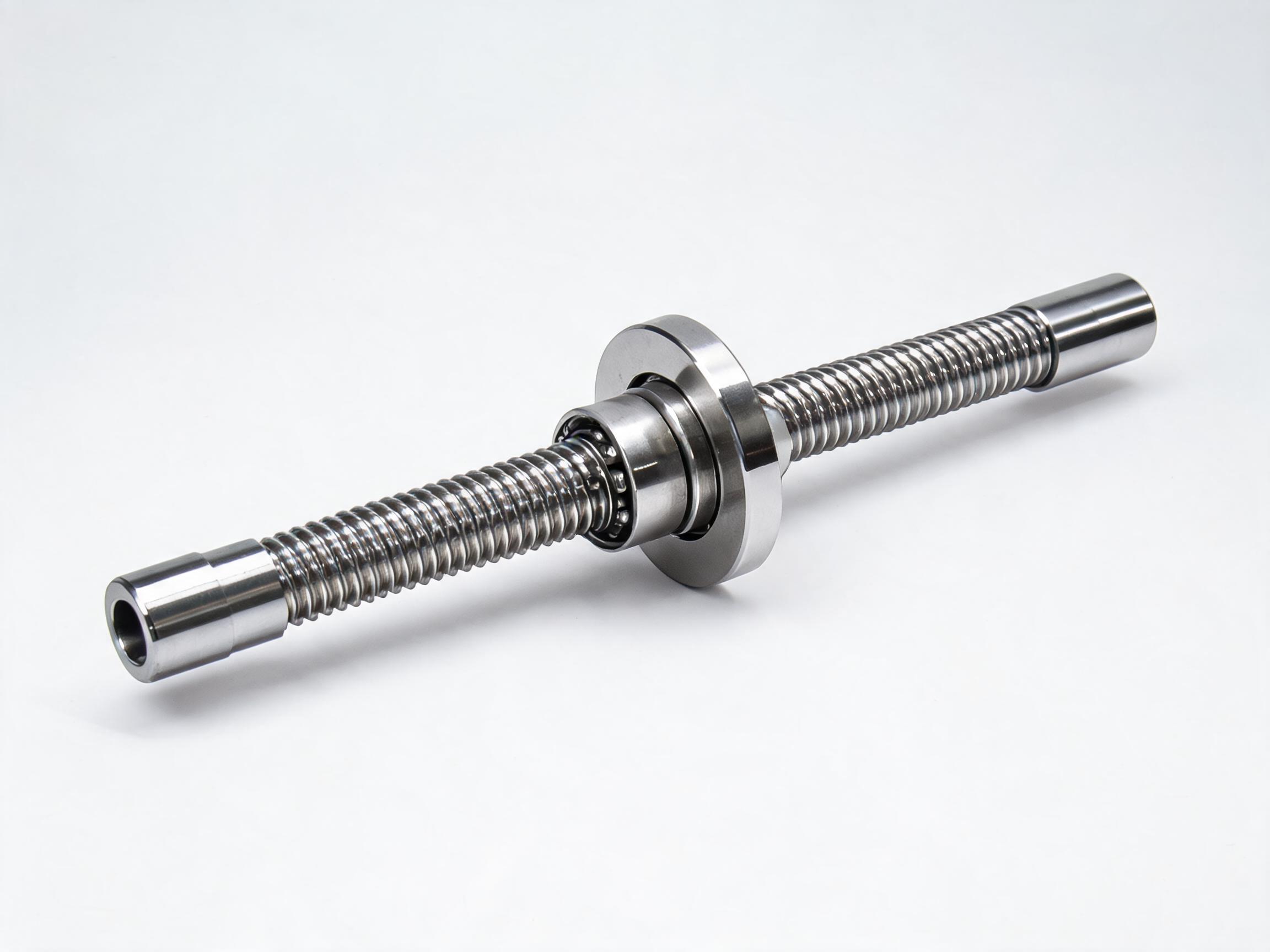
A practical guide for machine tool builders and B2B buyers on CNC ballscrews — covering precision grade selection (C3, C5, C7), mounting configurations (fixed-fixed, fixed-supported, fixed-floating), preload types, and maintenance practices that extend ball screw drive service life.
MACHINE TOOL BUYER GUIDE
If you build or specify CNC machines, the ball screw drive is one of the first components you evaluate. It determines positioning accuracy, repeatability, feed rate, and how long the axis holds tolerance under load. A poorly matched ballscrew — wrong precision grade, wrong mounting, wrong preload — will show up as scrap parts and field failures, not as a line item you can easily swap later.
This guide covers the three decisions that matter most when sourcing CNC ballscrews: which precision grade to specify, which end-mounting configuration fits your axis, and what maintenance program keeps the drive accurate over its service life. We also cover common specification mistakes we see from buyers who are new to ballscrew sourcing.
- Precision grade (C3, C5, C7) defines lead error per 300 mm — match it to your machine's real positioning requirement, not to a marketing spec.
- Mounting configuration (fixed-fixed, fixed-supported, fixed-floating) changes critical speed, thermal growth behavior, and stiffness. It is not a free choice.
- Preload type (Z, ZA, ZB) trades positioning accuracy against heat generation and efficiency — select per axis duty cycle.
- Lubrication and contamination control, not wear, are the top causes of premature ballscrew failure in the field.
- Ask your supplier for lead error charts and backlash data per unit, not just a grade label.
Why the ball screw drive is the accuracy bottleneck
On a CNC machine, the ballscrew converts rotary motor motion into linear axis travel. Every error in that conversion — lead error, backlash, thermal growth, elastic deflection — lands directly on the workpiece. Unlike a rack-and-pinion or linear motor, a ball screw drive has mechanical transmission elements that must be matched to the machine's accuracy class.
That is why machine tool builders do not buy "a ballscrew." They buy a screw with a specified lead accuracy, a nut with a specified preload, and end journals machined to match a specific bearing arrangement. The three are inseparable.
Precision grades: what C3, C5, and C7 actually mean
Precision grade is the single most quoted spec on a ballscrew datasheet, and the most misunderstood. The grade defines the maximum allowable lead error over a given travel length, measured at a reference temperature (usually 20 °C).
Industry-standard grades follow ISO 3408-3 and JIS B 1192, commonly expressed as C0, C3, C5, C7, C10. Lower numbers are more accurate. For machine tool applications, C3 and C5 dominate; C7 is common for general automation and positioning tables where micron-level repeatability is not required.
| Grade | Typical lead error (per 300 mm) | Typical application | Relative cost |
|---|---|---|---|
| C3 | ±0.008 mm (8 µm) | Precision machining centers, EDM, high-end grinding | Highest |
| C5 | ±0.018 mm (18 µm) | Standard CNC lathes, milling machines, most machine tools | Mid |
| C7 | ±0.050 mm (50 µm) | General automation, transfer lines, positioning tables | Lowest |
Two practical notes here. First, the grade number alone does not tell you the cumulative lead error over a long travel. A 1,200 mm axis with C5 grade will have a larger total error than a 300 mm axis with the same grade. Ask your supplier for the full lead error chart, not just the grade label.
Second, grade interacts with compensation. Many modern CNC controls implement lead-error compensation tables. If your control can compensate, a C5 screw with good compensation can outperform a C3 screw without it — at lower cost. But compensation cannot fix backlash or periodic error from a poorly manufactured nut raceway. It only corrects systematic lead error.
How to choose the right grade
Work backward from the machine's positioning tolerance. If the spec says ±0.01 mm over 300 mm, a C3 screw is the safe choice. If the spec is ±0.02 mm, C5 is usually sufficient and considerably cheaper. Do not overspec: C3 grinding and inspection add cost and lead time, and the benefit is invisible on a machine that does not need it.
Mounting configurations: fixed-fixed, fixed-supported, fixed-floating
The way you support both ends of the screw determines three things: critical speed (maximum safe RPM), axial stiffness, and how thermal growth is managed. There are four standard configurations, but three matter for machine tools.
Fixed-fixed (both ends fixed)
Both ends are mounted in bearing blocks with angular contact bearings arranged to take thrust in both directions. This gives the highest axial stiffness and the best positioning accuracy, because the screw is held rigidly at both ends. It also allows the screw to be put in tension, which improves stability.
The tradeoff: thermal growth has nowhere to go. As the screw heats up from friction and motor heat, it expands, and that expansion changes the lead — unless the control compensates or the screw is pre-tensioned. Fixed-fixed is the standard for precision machining centers and any axis where stiffness is critical.
Fixed-supported (one end fixed, one end free to float axially)
One end is fixed with thrust bearings; the other end rides in a plain or needle bearing that allows axial movement but prevents radial runout. This configuration lets the screw grow thermally without building up stress, which is why it is common on longer axes where heat is a concern.
Stiffness is lower than fixed-fixed, and critical speed is lower because the free end can whip. This is a good choice for medium-length axes (roughly 500–1,500 mm) on standard CNC lathes and milling machines.
Fixed-floating (one end fixed, one end unsupported)
The free end is simply unsupported — no bearing at all. This is the cheapest and least stiff option, used only for short, light-duty axes or vertical axes where gravity helps. Critical speed is low, and the unsupported end is prone to vibration. We do not recommend it for machine tools that need repeatable accuracy.
| Configuration | Axial stiffness | Thermal growth handling | Critical speed | Typical use |
|---|---|---|---|---|
| Fixed-fixed | Highest | Poor (must pre-tension or compensate) | Highest | Precision machining centers, high-speed axes |
| Fixed-supported | Medium | Good (free end expands) | Medium | Standard CNC lathes, mills, long axes |
| Fixed-floating | Lowest | Good | Lowest | Short, light-duty axes only |
Critical speed: the limit nobody checks until it vibrates
Every ballscrew has a critical speed — the RPM at which it starts to whip like a jump rope. It depends on length, diameter, and end mounting. Exceeding it causes violent vibration and rapid failure.
As a rule of thumb, the longer the unsupported span and the smaller the diameter, the lower the critical speed. Fixed-fixed mounting roughly doubles the critical speed compared to fixed-floating for the same screw. If your application needs high feed rates on a long axis, you either increase diameter, change mounting to fixed-fixed, or both. Ask your supplier to calculate critical speed for your exact screw length and mounting before you finalize the design.
Preload: the tradeoff between accuracy and heat
Preload removes the axial clearance (backlash) between the ball nut and the screw shaft. Without preload, the nut has a small dead zone where it can move without turning the screw — that dead zone is backlash, and it destroys positioning repeatability.
Preload types are commonly designated Z (light), ZA (medium), and ZB (heavy). Higher preload gives stiffer, more accurate positioning but generates more heat and reduces mechanical efficiency. Heat is the enemy: it expands the screw, changes the lead, and can degrade lubricant.
- Z (light preload): Minimal backlash removal. Good for light-duty positioning where heat is a concern.
- ZA (medium preload): Standard for most CNC machine tools. Balances stiffness and heat.
- ZB (heavy preload): For high-stiffness, high-precision axes where some heat is acceptable. Common on grinding machines and precision boring.
One point buyers often miss: preload is not permanent. As the nut raceways wear, preload decreases. A machine that was tight when new may develop backlash after thousands of operating hours. That is why preload measurement should be part of your maintenance routine.
Maintenance: what actually kills a ball screw drive
In our experience servicing machine tools, the vast majority of premature ballscrew failures are not from wear. They are from lubrication failure and contamination. Here is what to plan for.
Lubrication
A ballscrew needs a continuous, correct lubricant film. Grease is typical for general machine tools; oil circulation is used for high-speed or high-duty axes. The wrong grease — wrong viscosity, wrong base oil — will cause increased friction, heat, and eventually brinelling of the raceways.
Regrease intervals depend on duty cycle, not calendar time. A machine running three shifts needs far more frequent lubrication than a prototype shop running a few hours a day. Follow the ballscrew manufacturer's recommended interval, and use only the specified grease type. Mixing incompatible greases can cause the thickener to break down.
Contamination
Ball screws are precision components. A single chip or grain of abrasive swarf in the nut can score the raceway and destroy accuracy. This is why wipers (scrapers) on the nut are not optional — they are the first line of defense.
Check wipers regularly. A worn or damaged wiper lets contamination in. On machines that cut cast iron, graphite, or composites, consider additional protection: bellows, telescopic covers, or positive-pressure air seals. The cost of a cover is trivial compared to a replacement ballscrew.
Preload and backlash checks
Include backlash measurement in your periodic machine inspection. A simple dial indicator on the axis, with a known reversal, will show backlash growth. If backlash exceeds the machine's spec, the nut may need replacement or re-preloading. Catching this early avoids scrapped parts.
Alignment
The screw must be parallel to the guide rails. Misalignment puts side loads on the nut, accelerating wear and reducing life. On new machine builds, verify parallelism during assembly; on existing machines, check it after any crash or major repair.
Common specification mistakes we see
- Overspecifying grade: C3 on a machine that only needs C5 adds cost and lead time with zero benefit.
- Ignoring critical speed: Specifying a long, small-diameter screw for a high feed rate, then wondering why it vibrates.
- Choosing mounting without thermal analysis: Fixed-fixed on a long axis without pre-tension or compensation leads to thermal drift.
- Forgetting the nut's dynamic load rating: The screw diameter is not the only life factor — the nut's load rating and the applied axial load determine service life (L10).
- Skipping wipers to save cost: False economy. Contamination will kill the screw far sooner than normal wear.
Sourcing checklist for machine tool builders
When you request a quote for CNC ballscrews, make sure the supplier provides:
- Lead error chart (not just grade label) for the exact length you need.
- Backlash or preload value per nut, with measurement method.
- Critical speed calculation for your mounting configuration.
- Dynamic load rating (Ca) and static load rating (C0a) for the nut.
- Shaft straightness spec and surface hardness (typically 58–62 HRC for the raceway).
- Lubrication recommendation and regrease interval.
If a supplier cannot provide these, treat it as a red flag. A ballscrew is a precision component; the data should be available per unit, not as a generic brochure value.
Bottom line
The ball screw drive is the mechanical heart of your machine's axis. Getting the precision grade, mounting configuration, and preload right at the design stage is far cheaper than fixing a vibration problem or a backlash complaint in the field. And once the machine is running, a disciplined lubrication and contamination-control program is the best insurance for long, accurate service life.
If you are specifying a new machine or replacing a worn axis, work through the checklist above with your supplier. The answers will tell you whether the screw is matched to your real requirements — or just to a price point.
Need help selecting the right CNC ballscrews for your machine? Contact us with your axis length, load, speed, and accuracy requirements, and we will provide a specification recommendation with lead error data and critical speed calculation.