A practical guide for automation equipment buyers on selecting the right linear ball bearing bush. Covers types (open, closed, adjustable), seal options (rubber, metal scraper, contact), and how to interpret dynamic/static load ratings. Includes a comparison table of common series and actionable tips for avoiding premature failure in high-cycle applications.
BUYER GUIDE
Linear Ball Bearing Bush Selection Guide: Types, Seals, and Load Ratings for Automation Equipment
- Choose open-type bushes for supported shafts; closed-type for unsupported or cantilevered setups.
- Rubber seals reduce friction but tolerate less contamination; metal scrapers handle debris but increase drag.
- Dynamic load rating (C) is the primary life predictor for reciprocating motion — always check it against your application's duty cycle.
- Self-aligning or adjustable bushings compensate for misalignment in multi-rail assemblies.
- For high-speed or high-cycle automation, a linear ball bearing slide with preloaded bearings often outperforms individual bushings on a shaft.
If you are sourcing components for a pick-and-place gantry, a packaging machine, or a CNC router, the linear motion system is often the first point of failure. Choosing the wrong linear bush bearing means downtime, replacement costs, and missed delivery deadlines. This guide cuts through the catalog noise and gives you the selection criteria that matter for automation equipment.
1. Understanding the Basic Types
The first decision is whether you need an open, closed, or adjustable bush. Each serves a different mechanical layout.
Open-Type Linear Bush Bearing
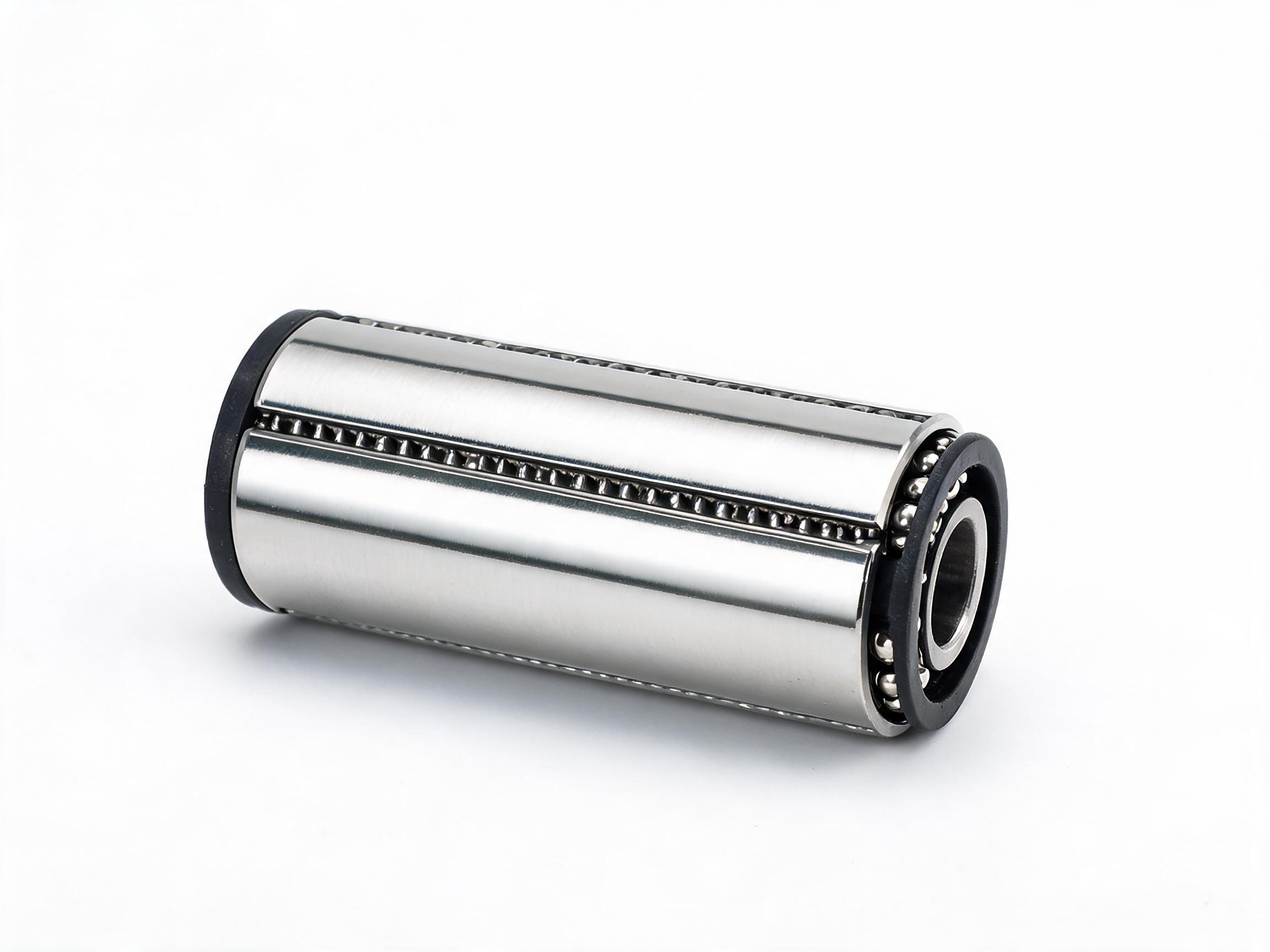
The open type has a longitudinal slot along the outer sleeve. This slot allows the bearing to be mounted on a shaft that is already supported by end brackets or a housing. The open design also provides some clearance adjustment when the housing is clamped.
- Best for: Supported shafts, long stroke applications, multi-rail systems.
- Typical series: LM-OP, LME-OP (metric), or SBO (inch).
- Caution: The open slot can collect debris if not sealed properly.
Closed-Type Linear Bush Bearing
A closed bush is a full cylinder with no slot. It must be slid onto the shaft from the end before the shaft is fixed. It offers the highest radial load capacity for a given size because the sleeve is continuous.
- Best for: Cantilevered loads, single-shaft systems, short strokes.
- Typical series: LM, LME (standard metric), SB (inch).
- Caution: Requires shaft-end access for installation.
Adjustable and Self-Aligning Types
Some automation applications demand compensation for misalignment or thermal expansion. Self-aligning bushes have a spherical outer ring that tilts within the housing. Adjustable bushes (sometimes called "clearance-adjustable") allow the user to reduce radial play by tightening the housing.
- Best for: Multi-rail assemblies where parallelism is hard to hold, or high-temperature environments.
- Typical series: LM-ADJ, LME-SL (self-aligning).
2. Seal Options: What Works in Your Environment
The seal is the first line of defense against dust, chips, and coolant. It also affects friction and running speed. Here are the common seal types found on a linear ball bearing slide or individual bush.
| Seal Type | Material | Friction Level | Contamination Resistance | Typical Application |
|---|---|---|---|---|
| Rubber lip seal (contact) | NBR or FKM | Medium | Good (dust, light splash) | Packaging, light assembly |
| Metal scraper seal | Stainless steel | High | Excellent (chips, weld spatter) | CNC, woodworking, metal cutting |
| Non-contact labyrinth seal | Nylon or PTFE | Low | Moderate (dry dust only) | Cleanroom, high-speed pick-and-place |
| Double seal (rubber + scraper) | NBR + steel | High | Best (heavy debris + coolant) | Machining centers, wet environments |
A common mistake is choosing a standard rubber seal for a machining environment with cast-iron dust. The dust embeds into the rubber, acts as abrasive, and wears the shaft in weeks. For that scenario, a metal scraper seal is the correct choice — even though it increases drag by 20–30%.
3. Load Ratings: C, C0, and How to Use Them
Every linear bearing slide rail or bush is rated with two numbers: dynamic load rating (C) and static load rating (C0). These are not the same as the maximum load you can apply.
Dynamic Load Rating (C)
C is the load at which the bearing achieves a rated life of 50,000 meters of travel under standard conditions. It is the number you use to calculate service life.
Life calculation (basic):
[ L = \left( \frac{C}{P} \right)^3 \times 50,000 \text{ meters} ]
Where:
- L = rated life in meters
- C = dynamic load rating (N)
- P = equivalent dynamic load (N)
Example: A bush with C = 1,200 N running under P = 400 N gives a theoretical life of 1.35 million meters. That is about 2.7 million cycles at 500 mm stroke.
Static Load Rating (C0)
C0 is the load that causes a permanent deformation of 0.0001 times the ball diameter. It is the limit for stationary or very slow-moving applications. Do not exceed C0 under shock or mounting loads.
Practical Rule of Thumb
- For reciprocating motion: Keep P ≤ 0.2 × C for a safety factor of 5.
- For rotating or indexing motion: Keep P ≤ 0.1 × C (higher shock risk).
- Never exceed C0, even for static positioning.
4. Matching the Bush to the Shaft and Housing
The bush is only as good as its mating surfaces. A bearing linear slide assembly fails prematurely if the shaft hardness or housing tolerance is off.
- Shaft hardness: Minimum 58 HRC for standard linear bushes. Softer shafts wear quickly and reduce life by 50% or more.
- Shaft surface finish: Ra 0.2–0.4 µm. Rougher finishes increase friction; smoother finishes reduce oil retention.
- Housing tolerance: H7 or J7 for standard bushes. A loose housing allows the bush to spin; a tight housing pinches the outer sleeve and reduces ball clearance.
If you are assembling a linear bearing slide rail system, always verify that the shaft and housing are from the same tolerance class as the bush. Mixing metric bushes with inch shafts is a common sourcing error.
5. Common Pitfalls in Automation Equipment
Even with correct load ratings and seals, field failures happen. Here are the three most frequent issues we see in packaging and assembly lines.
1. Edge Loading from Misalignment
When the shaft and housing are not perfectly parallel, the load concentrates on one side of the bush. This causes uneven ball wear and rapid clearance increase. Solution: use a self-aligning bush or a floating bearing mount.
2. Lubrication Starvation
Many automation systems run at 80–100 cycles per minute. Standard grease relubrication intervals (every 100 km of travel) are too long for these speeds. For high-cycle applications, use an oil lubrication system or a grease with a higher base oil viscosity (ISO VG 100–220).
3. Overlooking the Seal's Effect on Speed
A metal scraper seal can reduce maximum travel speed by 30–40% compared to a non-contact seal. If your application requires 5 m/s linear speed, a rubber lip seal may be the practical limit. For higher speeds, switch to a labyrinth seal or an oil-lubricated linear ball bearing slide with recirculating oil.
6. When to Choose a Complete Linear Ball Bearing Slide vs. Individual Bushes
For simple, single-axis motion, individual bushes on a shaft are cost-effective. But for multi-axis gantries or high-precision positioning, a pre-assembled linear ball bearing slide offers advantages:
- Factory-set preload eliminates clearance.
- Integrated seal systems prevent contamination.
- Matched rail and carriage ensure parallelism.
- Load ratings are given for the whole assembly, not just the bush.
If your automation equipment requires repeatability under ±0.01 mm, a complete slide unit is usually the safer choice.
FAQ
Q: Can I use a linear bush bearing on a vertical shaft? A: Yes, but you need a positive retainer or a flange to prevent the bush from sliding off. Also, lubrication must be maintained because gravity drains oil from the balls.
Q: What is the difference between LM and LME series? A: LM series uses metric dimensions and is common in Asian and European equipment. LME series is also metric but has a larger outer diameter and higher load capacity for the same shaft size.
Q: How often should I replace seals? A: Inspect seals every 500 km of travel. Replace them when the lip shows wear, cracking, or when contamination enters the bearing.
Q: Is a linear bearing slide rail quieter than a bush on a shaft? A: Generally yes, because the rail carriage distributes load over more balls and the seal design is optimized for low noise. Individual bushes can be noisy if the shaft is not perfectly straight.
Final Selection Checklist
Before you place an order, confirm these five points with your supplier:
- Shaft diameter and tolerance (h6 or h7?)
- Dynamic load rating (C) and actual applied load (P)
- Seal type matched to your environment (dust, coolant, chips)
- Housing bore tolerance (H7 or J7?)
- Lubrication method (grease fitting, oil hole, or sealed-for-life)
For custom automation projects, we offer linear bushings with modified seals, special clearances, and non-standard materials. Contact our engineering team with your load and stroke requirements — we can provide a life calculation and a recommended part number within 24 hours.