Choosing the right linear slide rail guide system is critical for automation builders. This article compares SBR, TBR, and SBS configurations, covering load capacity, precision, speed, and application fit. We provide real specs, selection criteria, and practical advice to help you make an informed purchasing decision.
AUTOMATION COMPONENT SELECTION GUIDE
- SBR (round rail) is a cost-effective solution for medium-load, moderate-speed applications like packaging and material handling.
- TBR (square rail) offers higher load capacity, rigidity, and precision, ideal for CNC, machining, and high-speed pick-and-place.
- SBS (compact slide) is a pre-assembled, space-saving unit for light-duty, short-stroke automation.
- Selecting the wrong configuration can lead to premature wear, reduced accuracy, or system failure — match the rail type to your load, speed, and environment.
Introduction: Why Rail Configuration Matters
When building or retrofitting an automated system — whether it's a gantry, a pick-and-place unit, or a conveyor transfer station — the linear slide rail guide is the backbone of your motion axis. The wrong choice means higher friction, shorter service life, and unpredictable positioning.
For automation builders sourcing from international suppliers, three configurations dominate the market: SBR, TBR, and SBS. Each has a distinct mechanical profile, performance envelope, and cost structure. This article gives you the facts to compare them side-by-side, so you can specify the right linear bearing slide rail for your project.
What Is a Linear Slide Rail Guide System?
A linear slide rail guide system consists of a rail (track) and a carriage (block) that moves along it, guided by recirculating ball bearings. The linear ball bearing slide inside the carriage reduces friction, enabling smooth linear motion under load.
The three configurations — SBR, TBR, and SBS — differ primarily in rail profile, bearing arrangement, and mounting method. These differences directly affect load capacity, rigidity, precision, speed, and installation complexity.
SBR (Round Rail) Configuration
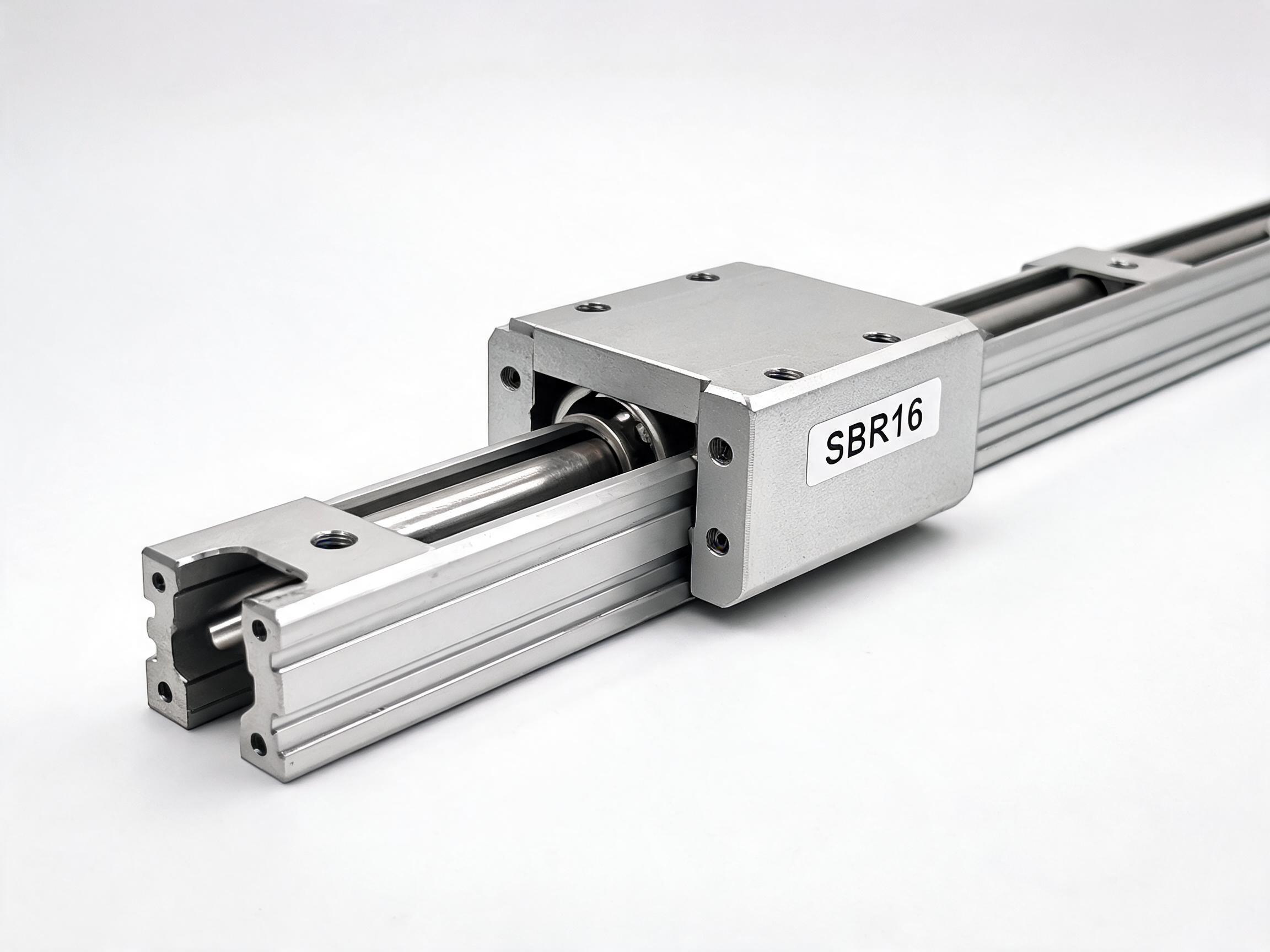
SBR stands for "Support Block Round" rail. It uses a cylindrical steel shaft as the rail, supported by an aluminum or steel base block. The carriage rides on the shaft via recirculating ball bearings.
Key Characteristics
- Rail profile: Round shaft, typically 12mm to 40mm diameter.
- Load capacity: Moderate. Suitable for medium loads (e.g., 50–500 kg per carriage, depending on diameter).
- Precision: Moderate. Positioning accuracy typically within ±0.05 mm to ±0.1 mm over 1 meter.
- Speed: Up to 3–5 m/s with proper lubrication.
- Mounting: Simple. The base block is bolted to a flat surface. Self-aligning to some degree.
- Cost: Lower than TBR. A cost-effective entry point for many automation projects.
Common Applications
- Packaging machinery (carton erectors, case sealers)
- Material handling (conveyor transfer units, lift tables)
- Light-duty CNC routers (non-production)
- Automated storage and retrieval systems
When to Choose SBR
Choose SBR when your application requires moderate load capacity, acceptable precision, and a lower budget. It is also a good choice if you need a self-aligning system that can tolerate minor mounting misalignment — the round shaft design allows a small angular deflection without binding.
TBR (Square Rail) Configuration
TBR stands for "T-Block Rail" or "Square Rail." It uses a rectangular steel rail with four ball raceways ground into the sides. The carriage contains multiple rows of recirculating balls that contact the raceways at a 45° angle.
Key Characteristics
- Rail profile: Square or rectangular, typically 15mm to 65mm width.
- Load capacity: High. Can handle 500–5000+ kg per carriage, depending on rail size.
- Precision: High. Positioning accuracy can reach ±0.01 mm to ±0.03 mm over 1 meter.
- Speed: Up to 5–10 m/s with recirculating ball bearings.
- Mounting: Requires precise alignment. The rail must be bolted to a machined surface with a straightness tolerance of 0.02 mm/m or better.
- Cost: Higher than SBR. Premium for precision and load capacity.
Common Applications
- CNC machining centers (milling, lathe, grinding)
- High-speed pick-and-place robots
- Precision measurement and inspection equipment
- Automated assembly lines (electronics, automotive)
When to Choose TBR
Choose TBR when your application demands high load capacity, rigidity, and precision. If your system operates at high speeds, requires repeatable positioning within microns, or carries heavy payloads, TBR is the standard choice. It is also preferred for environments with vibration or shock loads.
SBS (Compact Slide) Configuration
SBS stands for "Slide Block Slide" or "Compact Slide." It is a pre-assembled unit where the rail and carriage come as a single integrated component. The rail is typically a hardened steel shaft, and the carriage contains a ball bushing or a recirculating ball bearing arrangement.
Key Characteristics
- Rail profile: Round shaft, typically 6mm to 30mm diameter.
- Load capacity: Low to moderate. Suitable for light loads (e.g., 10–200 kg per unit).
- Precision: Moderate. Positioning accuracy typically within ±0.05 mm to ±0.1 mm.
- Speed: Up to 2–4 m/s.
- Mounting: Very simple. The pre-assembled unit is bolted directly to the machine frame. No alignment required.
- Cost: Low. Often the most economical option for light-duty applications.
Common Applications
- Small pick-and-place units (e.g., for electronics assembly)
- Laboratory automation (sample handling, liquid dispensing)
- Light-duty sliding doors or gates
- Short-stroke positioning (less than 500 mm)
When to Choose SBS
Choose SBS when you need a compact, pre-assembled solution for light loads and short strokes. It is ideal for applications where space is tight and installation time is critical. The pre-assembled nature eliminates the need for alignment, reducing labor costs.
Side-by-Side Comparison: SBR vs TBR vs SBS
| Parameter | SBR (Round Rail) | TBR (Square Rail) | SBS (Compact Slide) |
|---|---|---|---|
| Rail Profile | Round shaft | Square/rectangular | Round shaft |
| Load Capacity | Moderate (50–500 kg) | High (500–5000+ kg) | Low to moderate (10–200 kg) |
| Precision (±/m) | ±0.05–0.1 mm | ±0.01–0.03 mm | ±0.05–0.1 mm |
| Max Speed | 3–5 m/s | 5–10 m/s | 2–4 m/s |
| Rigidity | Moderate | High | Low to moderate |
| Self-Alignment | Yes (some angular tolerance) | No (requires precise alignment) | Yes (pre-assembled) |
| Mounting Complexity | Simple | Requires machined surface | Very simple |
| Cost per Axis | Low to medium | Medium to high | Low |
| Best For | Medium loads, moderate precision | Heavy loads, high precision, high speed | Light loads, short strokes, compact spaces |
How to Choose the Right Configuration
Ask yourself these four questions before specifying a linear bearing slide rail:
- What is the maximum load per carriage? If it exceeds 500 kg, TBR is the only option. For 50–500 kg, SBR is a strong candidate. Under 50 kg and short stroke, SBS works.
- What positioning accuracy do I need? If you need ±0.03 mm or better, go with TBR. If ±0.05 mm is acceptable, SBR or SBS can work.
- What is the operating speed? For speeds above 5 m/s, TBR is preferred. For moderate speeds, SBR is fine.
- How much space and alignment capability do I have? If your mounting surface is not perfectly flat, SBR's self-alignment is a big advantage. If you have a machined surface and can invest in alignment, TBR delivers higher performance.
Common Mistakes to Avoid
- Using SBR for high-precision CNC: The round rail cannot provide the rigidity needed for heavy cutting forces. The carriage will deflect, causing chatter and poor surface finish.
- Using TBR on an uneven surface: Without a machined mounting surface, the square rail will bind, increasing friction and wear. You may also crack the rail.
- Oversizing the system: A TBR 65 rail rated for 5000 kg is overkill for a 10 kg payload. You pay for material and precision you don't need.
- Ignoring environmental factors: In dusty or wet environments, round rails (SBR, SBS) need wipers or bellows. TBR rails typically come with integral seals.
FAQ
Q: Can I replace an SBR rail with a TBR rail on an existing machine?
A: Not directly. The mounting hole patterns and rail dimensions are different. You would need to redesign the mounting plate or machine new holes. It is usually more practical to replace with the same type.
Q: How do I calculate the required load capacity for my application?
A: Consider the static load (weight of the payload) plus dynamic loads (acceleration, deceleration, and any external forces). A safety factor of 1.5–2.0 is typical. For example, if your payload is 100 kg, choose a rail with a rated dynamic load of at least 150–200 kg per carriage.
Q: What is the typical lifespan of a linear slide rail guide?
A: Lifespan depends on load, speed, lubrication, and contamination. A well-maintained system can last 10,000–20,000 km of travel. Manufacturers provide L10 life calculations (distance at which 90% of a population will survive). Ask your supplier for this data.
Q: Do you offer custom rail lengths or pre-drilled mounting holes?
A: Many suppliers, including us, offer custom lengths and hole patterns. Minimum order quantities (MOQs) typically range from 10 to 50 pieces per specification. Contact us with your rail length, hole spacing, and required carriage count for a quote.
Final Recommendations for Automation Builders
If you are sourcing a linear slide rail guide for a new automation project, start by defining your load, precision, and speed requirements. Then match them to the configuration:
- For general-purpose automation with moderate loads and budgets: SBR is your workhorse.
- For high-precision, high-speed, or heavy-load applications: TBR is the standard.
- For compact, light-duty, short-stroke tasks: SBS offers simplicity and low cost.
Always request a datasheet from your supplier that includes dynamic load ratings, static load ratings, and L10 life calculations. A reliable supplier will provide these numbers without hesitation.
If you need assistance selecting the right linear ball bearing slide for your project, contact our engineering team. We can help you match the configuration to your application, provide custom lengths, and offer competitive pricing for volume orders.