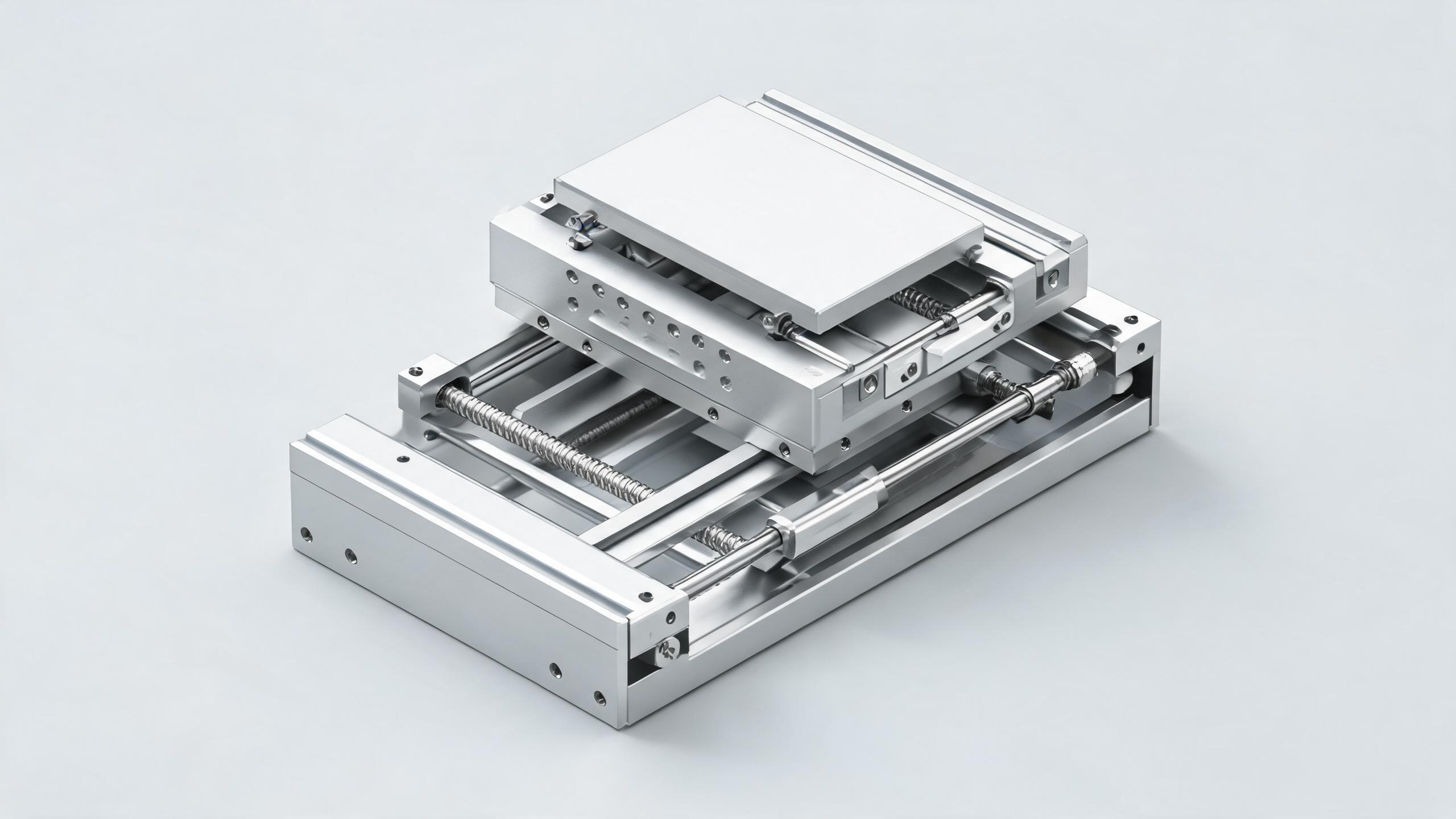
A practical buyer's guide to track rollers and guide rails. We break down V-groove rollers, cam followers, and support rail systems—how they differ, where each works best, and what to specify when you source them for linear motion applications.
BUYER GUIDE — LINEAR MOTION COMPONENTS
Track Rollers and Guide Rails: What Buyers Need to Know Before Sourcing
If you are sourcing linear motion components, you have likely seen three terms used interchangeably: track rollers and guide rails, rail bearings, and slide bearing systems. They are not the same thing. Choosing the wrong one means rework, premature wear, or a machine that never hits its rated speed.
This guide is written for procurement engineers and purchasing managers who need to compare options quickly. We cover the three main roller/rail families, how to match them to load and speed, and what to specify on your RFQ.
- V-groove rollers + round rail are the lowest-cost solution for light-to-medium loads with moderate speed and accuracy requirements.
- Cam followers (stud-type or yoke-type) are load-rated rollers designed to run on flat or profiled tracks—not on round rails.
- Support rail systems (profiled steel rails with roller-bearing carriages) deliver the highest load capacity, rigidity, and accuracy, at a higher price point.
- Specify load per roller, running speed, duty cycle, and environmental conditions (dust, washdown, temperature) before requesting a quote—these four inputs determine the correct size and material.
What Is a Track Roller and Guide Rail System?
A track roller and guide rail system is a linear motion assembly where a rolling element (the roller) travels along a fixed path (the rail). The roller carries the load and transfers it to the machine frame through the rail. The system's performance depends on three things: the roller's profile, the rail's profile, and the fit between them.
Unlike a slide bearing—which relies on sliding contact and needs a lubricant film between surfaces—track rollers use rolling contact. Rolling friction is typically 5 to 10 times lower than sliding friction. That means lower drive torque, less heat, and longer service life. But rolling contact also means higher point or line contact stress, so material hardness and surface finish matter more.
The Three Main Systems Compared
1. V-Groove Rollers and Round Guide Rails
How it works: A V-groove roller has a 90° V-shaped channel machined around its circumference. It rides on a round rail (usually hardened and ground steel). The V shape centers the roller on the rail, providing self-centering and resisting lateral forces.
Best for: Light to medium loads, speeds up to moderate (typically under 2 m/s), and applications where some deflection is acceptable. Common in packaging machinery, conveyor diverters, automated storage, and light assembly lines.
Advantages:
- Lowest cost of the three systems
- Tolerant to misalignment—the V profile self-centers
- Simple mounting; rails can be cut to length on-site
- Works well in dirty environments if sealed properly
Limitations:
- Lower load capacity than profiled rails
- Less rigid—round rails deflect more under bending
- Accuracy depends on rail straightness and mounting surface
Specify on your RFQ: roller OD, V-angle (90° standard), rail diameter, material (typically 52100 bearing steel or 440C stainless), hardness (HRC 58–62 is common), and whether the roller needs seals.
2. Cam Followers (Track Rollers)
How it works: A cam follower—also called a track roller—is a roller with an integral stud (threaded shaft) or a yoke (through-bore). It is designed to run on the outside of a flat track, a profiled rail, or even a cam plate. The roller's outer ring has a crowned or cylindrical profile, and it is supported by needle or cylindrical roller bearings inside.
Best for: Higher loads per roller, oscillating motion, and applications where the roller must handle both radial and thrust loads. Cam followers are everywhere in CNC tool changers, cam drives, conveyor systems, and press feeding equipment.
Advantages:
- High radial load capacity in a compact package
- Stud mounting simplifies design—no separate shaft needed
- Available with seals, heavy-duty options, and various outer profiles (cylindrical, crowned, eccentric)
- Replaceable without removing the entire assembly
Limitations:
- Requires a hardened, machined track—a flat steel plate is not enough
- Not self-centering like a V-groove; alignment depends on the track and mounting accuracy
- The stud can bend under high side loads if undersized
Specify on your RFQ: stud diameter and thread pitch, roller OD and width, outer ring profile (cylindrical vs. crowned), dynamic and static load ratings, and whether you need an eccentric stud for adjustability.
3. Support Rail Systems (Profiled Rails with Roller Carriages)
How it works: A support rail system uses a precision-ground steel rail with a specific cross-section profile (often V-shaped or flat with a V groove). A carriage—equipped with multiple rollers or recirculating ball bearings—runs along the rail. The carriage transfers load through several contact points, distributing stress.
Best for: Heavy loads, high speed, high accuracy, and long travel lengths. This is the system of choice for CNC machines, robotic gantries, automated guided vehicles (AGVs), and heavy material handling.
Advantages:
- Highest load capacity and rigidity
- Consistent accuracy over long travel—rail straightness is factory-controlled
- Smooth motion with low noise
- Long service life when lubricated properly
Limitations:
- Highest cost per meter
- Requires precise mounting—the rail must be shimmed and aligned to the machine base
- Rail sections must be joined with precision splice joints for long travel
Specify on your RFQ: rail profile and height, carriage width and length, number of rollers per carriage, dynamic load capacity (C) and static load capacity (C0), preload class, and rail mounting hole spacing.
Track Rollers and Guide Rails vs. Rail Bearings vs. Slide Bearings
Buyers often confuse these terms. Here is a clear distinction:
- Track rollers and guide rails is the umbrella term for the complete system—roller + rail.
- Rail bearings usually refers to the rolling elements inside a carriage or the roller units themselves. In some catalogs, "rail bearing" means a linear bearing block that rides on a rail.
- Slide bearing (or plain bearing) is a completely different technology—no rolling elements. A slide bearing uses a low-friction material (bronze, PTFE, polymer) sliding against a shaft or rail. It is cheaper, quieter, and absorbs vibration, but has higher friction and wears faster under continuous use.
| Parameter | V-Groove + Round Rail | Cam Follower | Support Rail System | Slide Bearing |
|---|---|---|---|---|
| Contact type | Rolling (V-groove on round) | Rolling (crowned/cylindrical on track) | Rolling (multiple rollers on profiled rail) | Sliding (surface-to-surface) |
| Relative load capacity | Low–medium | Medium–high per roller | Highest | Medium (depends on material) |
| Accuracy | Moderate | Moderate (track-dependent) | High | Moderate |
| Relative cost | Lowest | Low–medium | Highest | Lowest |
| Typical speed | Low–moderate | Moderate–high | High | Low–moderate |
| Lubrication need | Periodic | Periodic | Periodic (or sealed-for-life) | Frequent (unless self-lubricating) |
| Typical applications | Packaging, conveyors, light automation | CNC tool changers, cam drives, presses | CNC machines, gantries, heavy automation | Low-speed guides, oscillating joints, bushings |
How to Choose: Four Questions to Ask Before You Specify
1. What is the actual load per roller?
Do not send a "machine weight" figure. Calculate the load at each roller under worst-case conditions—including dynamic forces from acceleration and deceleration. A rule of thumb: the dynamic load rating (C) of the roller should be at least 3 to 5 times the actual applied load for continuous operation. For impact loads, use a safety factor of 6 to 10.
2. What speed and duty cycle?
Continuous high-speed operation generates heat. If your line speed exceeds roughly 2 m/s, V-groove rollers on round rails will struggle. Cam followers and support rail systems handle higher speeds, but you must check the limiting speed (n·dm value) for the bearing inside the roller. Exceeding it causes premature failure.
3. What environment?
- Dust and debris: Sealed rollers (with contact or labyrinth seals) are mandatory. V-groove rollers on round rails handle dust better than profiled rails because debris can fall through the V-gap.
- Washdown (food, pharma): Use 440C stainless steel rollers and rails, and check whether the seals are food-grade. Avoid cam followers with unsealed needle bearings.
- Temperature: Standard bearing steel (52100) is rated for roughly -30°C to +120°C. Above that, you need high-temperature grease and possibly different materials. Confirm the operating range with the supplier.
4. What accuracy and rigidity?
If your application requires repeatability under 0.1 mm, a support rail system is the safe choice. V-groove rollers on round rails can achieve this only with a rigid, well-machined mounting surface and short travel. Cam followers are the least accurate of the three because the track itself is usually a machined plate, not a precision-ground rail.
Common Mistakes When Sourcing Track Rollers and Guide Rails
Mistake 1: Using a cam follower on an unmachined flat plate. The outer ring of a cam follower is hardened, but the track must be too. A soft steel plate will wear grooves into the track, and the roller will fail quickly. Specify a hardened, ground track (HRC 55+).
Mistake 2: Overloading a V-groove roller. The V-groove creates two contact points, which doubles the contact stress compared to a cylindrical roller on a flat surface. If you need higher load, move up to a cam follower or support rail system rather than just upsizing the V-groove roller.
Mistake 3: Ignoring the mounting surface. A rail is only as straight as the surface it is bolted to. If your machine frame has a tolerance of 1 mm over a meter, the rail will follow that. For precision applications, specify a machined reference surface or use adjustable shims.
Mistake 4: Forgetting about lubrication. Sealed-for-life rollers exist, but most cam followers and V-groove rollers require periodic relubrication. If your application is in a hard-to-reach area, choose a sealed-for-life option or plan a maintenance schedule.
What to Put on Your RFQ
To get an accurate quote, provide the supplier with:
- Load per roller (N or kgf) — dynamic and static
- Speed (m/s or rpm) and duty cycle (continuous vs. intermittent)
- Travel length (mm) and required accuracy
- Environment (temperature, dust, washdown, chemicals)
- Mounting constraints (space envelope, stud vs. yoke, rail length)
- Material preference (bearing steel vs. stainless)
- Quantity and target lead time
If you are unsure about any of these, ask the supplier for a selection worksheet. Most manufacturers will calculate the correct size for you if you provide the application details—but they need the real numbers, not a vague description.
FAQ
Q: Can I use a V-groove roller on a flat rail? A: No. The V-groove is designed to match a round rail. Running it on a flat surface creates two line contacts with high edge stress and poor load distribution. Use a cylindrical or crowned roller for flat tracks.
Q: What is the difference between a stud-type and yoke-type cam follower? A: A stud-type cam follower has a threaded shaft (stud) that bolts directly into the machine. It is simpler to mount and is the more common choice. A yoke-type cam follower has a through-bore and is mounted on a separate shaft, allowing higher load capacity and better alignment for heavy-duty applications.
Q: How do I know if I need a support rail system instead of rollers on round rails? A: If your load per roller exceeds roughly 1,000 N, if you need repeatability better than 0.05 mm, or if your travel length exceeds 3 meters with high speed, a support rail system is the safer engineering choice. For lighter, slower, shorter-travel applications, V-groove rollers on round rails will save you money.
Q: Are track rollers and guide rails interchangeable with linear ball bearings (rail bearings)? A: Not directly. Linear ball bearings run on round shafts and are a different mounting envelope. Track rollers run on rails or tracks. Check the mounting dimensions and load ratings before substituting one for the other.
Q: What is the typical lead time for custom-length rails? A: It depends on the supplier and the rail profile. Standard lengths are usually in stock. Custom lengths with drilled mounting holes typically add 1 to 2 weeks. Hardened and ground rails with special coatings (e.g., hard chrome) may take longer. Confirm lead time at the RFQ stage.
Final Advice for Buyers
Start with the application, not the product. Draw a simple sketch of your machine, mark the load points and travel direction, and estimate the forces. That sketch is worth more than any catalog specification.
Then, compare the three systems against your numbers. If you are still unsure, send the supplier your sketch and load calculations and ask for a recommendation. A competent supplier will tell you if you are oversizing or undersizing—and that saves you money and downtime.
For sourcing, request samples before committing to volume. Test the roller on your actual track material, measure the running torque, and check for noise. Linear motion components are mechanical, not electronic—real-world testing still beats theoretical calculations.