
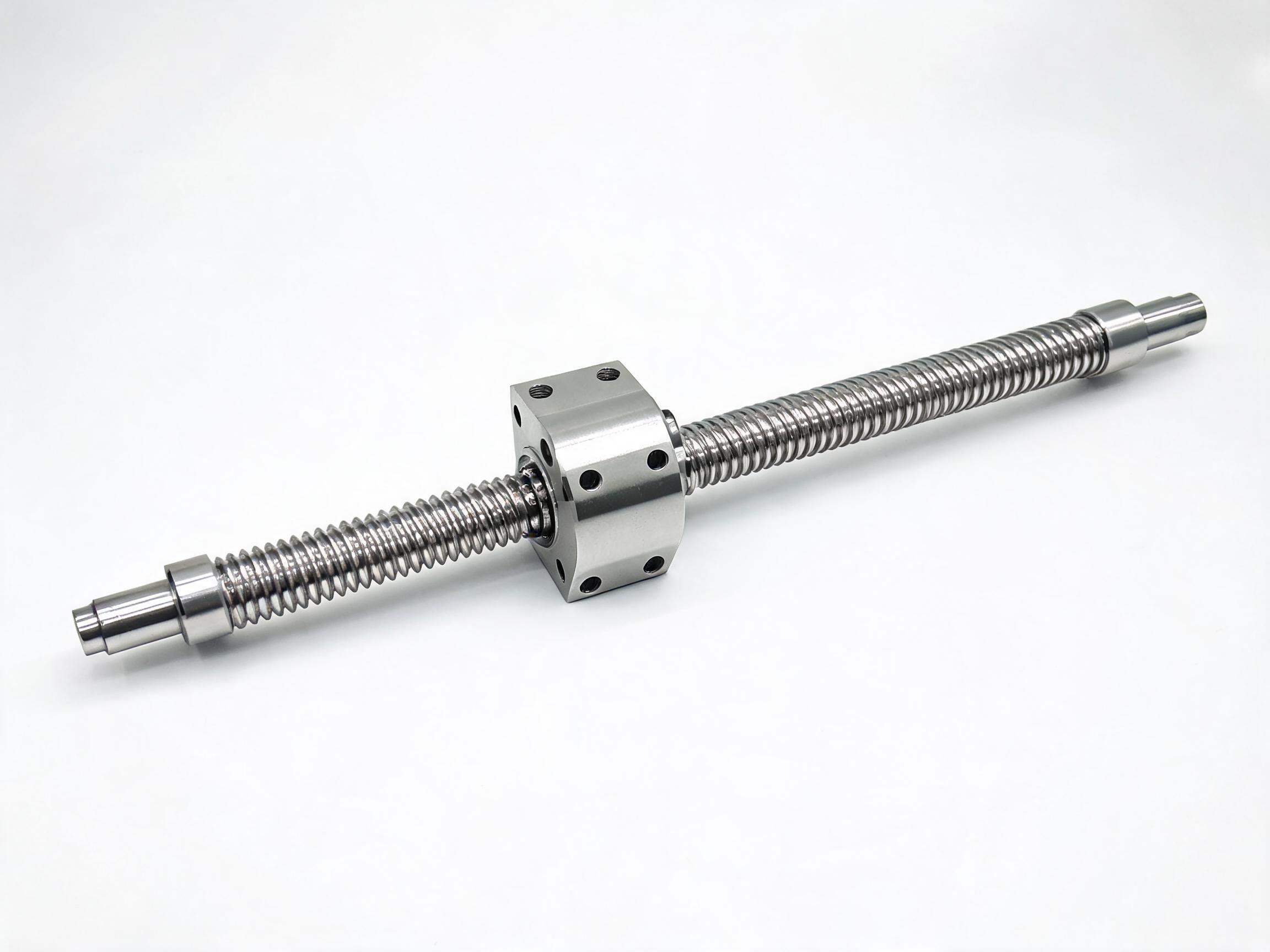
A symptom-reading guide for maintenance engineers and buyers: work from the easiest checks (lubrication, contamination, mounting, preload feel) toward conclusive findings such as raceway spalling or a bent shaft, and learn what information a supplier needs to quote a correct replacement.
When a CNC machine starts cutting out of tolerance, the ball screw is often the first component blamed and the last one actually checked. A rough feel, a growing backlash or a change in motor load can come from several places, and only some of them justify a new screw. This guide orders the checks from the ones you can confirm with basic tools and observation to the ones that end the discussion, so you spend money on a replacement only when the evidence points to the screw itself.
Start with what the machine is telling you
Before dismounting anything, write down what changed. A ball screw failure rarely appears as a single event. Most reports from machine operators fall into four observable groups:
- Rough running or an uneven feel — vibration, a stick-slip sensation, or a change in sound at a particular part of the stroke.
- Growing backlash — the axis no longer returns to the same position, or the backlash value in the controller drifts upward over weeks.
- Visible damage — marks, discoloration or material loss on the raceway or on the shaft outside the nut.
- Ball circuit symptoms — the nut feels notchy, the return tube is loose, or balls have escaped.
Each group leads to a different check. Recording where along the travel the symptom appears is useful in every case: a fault confined to 200 mm of a 1,000 mm stroke points to a local cause, while a symptom that follows the whole length points to preload, alignment or a bent shaft.
Check 1: Lubrication and contamination (the easiest to confirm)
Pull the wiper and look at the film on the raceway. A screw that has run dry, or has been fed grease contaminated with fines, will feel rough before any measurable damage exists. Check for:
- dry, discolored or gummy grease on the raceway and inside the nut;
- metal particles or grinding swarf caught in the wiper lip;
- coolant ingress — emulsion that has mixed with grease makes a milky paste;
- a blocked or missing grease nipple, or a lubrication line that was never reconnected after a repair.
If contamination is the only finding, clean, re-lubricate with the grade specified for the machine and re-check the feel. Document the grease type and quantity used, because a later claim about the screw will depend on whether lubrication was actually maintained.
Check 2: Mounting and alignment
A screw that is correctly made but badly mounted will show symptoms that look like internal failure. Check the bearing supports, the nut bracket and the coupling. Look for loose locknuts, worn angular-contact bearings, a shimmed or tilted nut housing, and a coupling that has slipped on the shaft. On a machine that has recently been repaired or moved, confirm the screw is running true against the bearing journal.
Mounting error produces a characteristic pattern: the torque rises toward the ends of travel, or the axis binds at one end only. That pattern is a reason to look at alignment before opening the nut. It is not proof of a screw defect either — confirm the alignment with a dial indicator against the supplier or machine builder's specified tolerance for that machine.
Check 3: Nut preload feel
With the screw cleaned and lightly lubricated, turn the nut slowly by hand or with a light torque wrench along its full travel. A properly preloaded nut should feel consistent from one end to the other — the drag should not rise sharply in a section, and there should be no point where it suddenly releases. A supplier can usually tell you the expected running torque for the size and preload class; use that as the reference rather than an arbitrary feel.
Inconsistency along the travel has two common explanations: contamination or wear inside the nut, or a shaft that is no longer straight. Measuring the shaft for straightness separates the two. If you do not know the straightness limit for your screw, ask the supplier for the value that applies to that model and length before condemning it.
The SFU1605 rolled ball screw assembly is listed with a preloaded single flange nut and raceways induction-hardened to HRC 58-62 on GCr15 chrome steel, so the nut feel is one of the properties that can be checked directly on arrival and again during service.
Check 4: Raceway condition
This is where the diagnosis stops being reversible. Look at the raceway under good light, with the nut moved aside if the design allows it, or through the gap at each end of the nut. What matters is the raceway surface, and understanding the heat treatment explains why.
On induction-hardened rolled screws, only the raceway surface is hardened to HRC 58-62. The shaft core stays softer. A dent or mark on an unhardened journal surface — for example where a bearing or pulley seats — is a different finding from damage on the hardened raceway. A journal mark may justify inspection of the bearing fit but does not by itself condemn the screw. Raceway damage does.
- Spalling or flaking: a patch where surface material has broken away. This is conclusive; the raceway cannot be restored by polishing.
- Indentation or brinelling: repeated ball spacing marks, often caused by shock loading or by balls sitting under load in one position for a long time.
- Scoring or galling along the ball path: usually the result of running with inadequate lubrication or with contamination present.
- Discoloration or a blued patch: possible evidence of heat, worth a closer look at preload and lubrication.
If you find raceway spalling or flaking, plan for replacement. Polishing out a spall is not a repair.
Check 5: Ball circuit and the conclusive checks
A nut that has lost balls, or whose return tube has loosened, will feel notchy or may jam. Do not run the axis under power in that condition — the balls can migrate into the wrong part of the circuit and damage the raceway further. Check that the return tube is seated and that the ball count is as specified. Ball loss is not something to operate through.
Two findings end the repair-versus-replace question:
- Raceway spalling or flaking, as above.
- A bent shaft, confirmed by a straightness measurement against the value the supplier specifies for that screw. A bent shaft that is straightened will not recover the original lead accuracy reliably; replacing it is the sounder route when the screw carries positioning duty.
What the check order tells you
| Finding | Typical cause | Usual action |
|---|---|---|
| Dry or contaminated grease; swarf at the wiper | Lubrication lapse or coolant ingress | Clean, re-lubricate, re-check the feel |
| Torque rises toward one end; binding at one end | Mounting or alignment error | Check bearings, locknuts, nut bracket and coupling; confirm against the machine builder's tolerance |
| Uneven drag along the travel | Nut contamination, wear, or a bent shaft | Measure straightness; compare running torque with the supplier's value |
| Spalling or flaking on the raceway | Surface fatigue or a lubrication-related event | Replace the screw |
| Notchy feel, loose return tube, missing balls | Ball circuit damage | Stop operation; replace the screw or nut assembly |
| Bent shaft confirmed by measurement | Shock load or mishandling | Replace the screw |
Key takeaways
- Confirm lubrication and contamination before touching the nut; it is the cheapest check and the most common reversible finding.
- Only the raceway is induction-hardened to HRC 58-62; damage on an unhardened journal is judged differently from raceway damage.
- Raceway spalling or flaking and a measured bent shaft are the findings that justify replacement.
- Match the replacement to the original grade and accuracy class, not to the nearest size on a shelf.
Before you order a replacement
A replacement screw that arrives with the wrong end machining costs as much time as the original failure. Collect the following and send it with the enquiry:
- Model or drawing number from the machine builder's parts list, plus the original screw's markings if legible.
- Diameter, lead and overall length, measured on the screw itself rather than taken from the manual alone.
- Accuracy grade as specified by the machine builder. Rolled C7 screws are commonly listed at ±0.05 mm per 300 mm lead accuracy, but confirm the value that applies to your model rather than assuming it.
- End machining drawing, including journal diameters, lengths, thread details, keyways and bearing seat fits.
- Nut type and preload class, and whether the replacement is screw only or screw with nut.
- Application details such as load direction, maximum speed, duty cycle and whether the axis is vertical.
Photos of the failed raceway help the supplier understand the failure mode, but they are supporting evidence, not a substitute for the dimensional data. For custom end machining, the end drawing is the controlling document.
Where the duty is heavier, or the screw is used on a machining centre axis, look at a model with the corresponding verification record. The SFU3205 heavy-duty rolled ball screw is listed with laser interferometer lead measurement per shaft, shaft straightness ≤0.03 mm/m, nut running torque verified at three positions along the travel, and dynamic load validation at 1.2x the rated value — data you can compare against your own acceptance requirements.
Dongfeng Bearing supplies rolled ball screw assemblies in the SFU series and can machine ends to a customer drawing. If you are unsure whether the screw is the cause of the problem or the victim of it, send the symptom description and the measurements above; a supplier familiar with the model can often tell you which numbers still deserve a second look.
Frequently asked questions
Can a worn nut be reballed instead of replaced?
Reballing is feasible when the raceway and the nut body are undamaged and only the balls are worn or lost. If there is spalling on the raceway, or if the preload was set by grinding the nut components, a reball may not restore the original preload. Confirm with the supplier which of these applies to your nut before deciding.
Does a small backlash value always mean the screw is worn?
No. Backlash can come from bearing play, coupling slip or the nut bracket. Measure backlash at the nut and at the bearing support separately to localize it before replacing the screw.
Should a bent screw be straightened?
Straightening can be done, but it does not guarantee recovery of the original lead accuracy. For positioning axes, replacement is the more predictable route.