
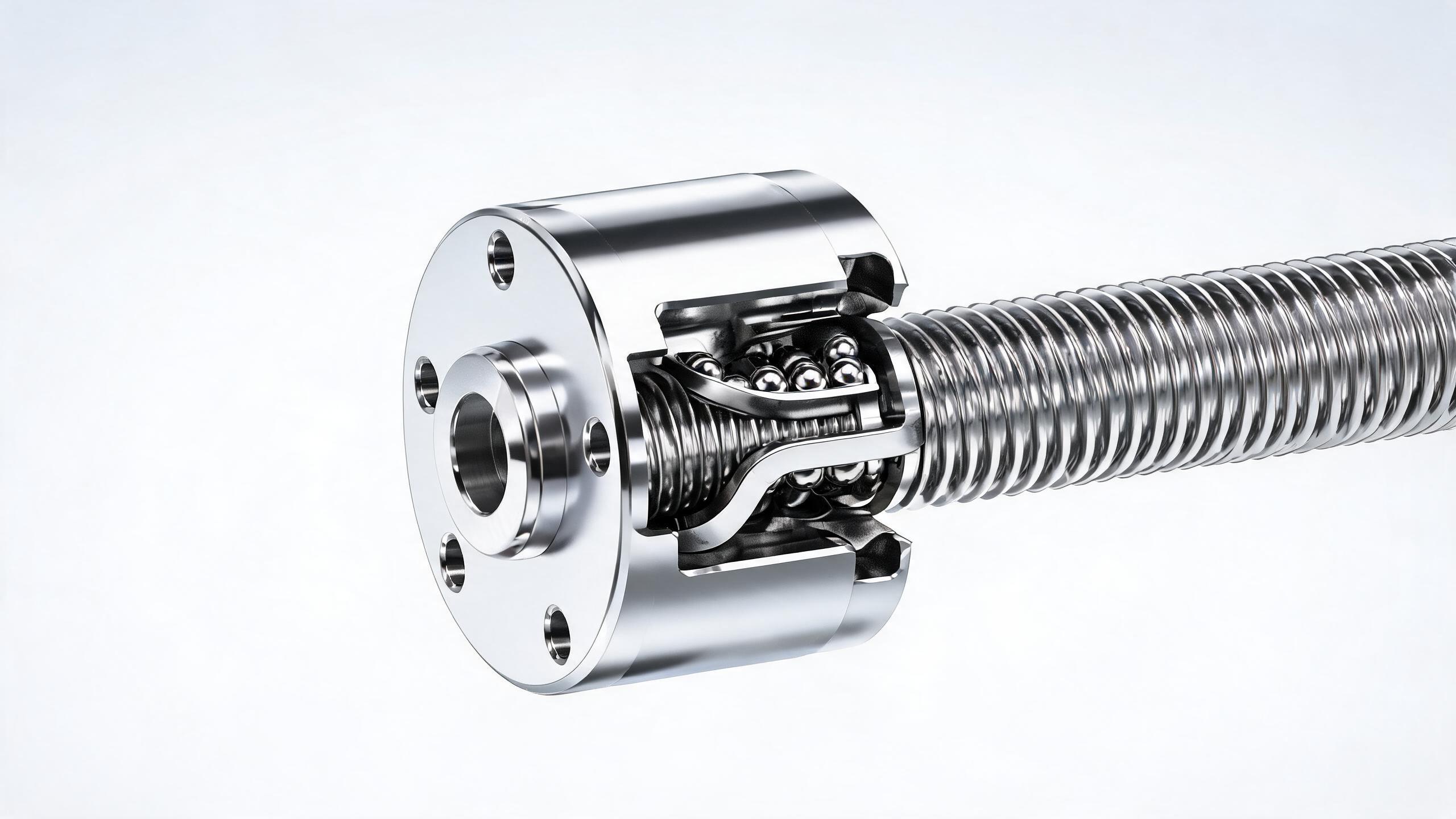
A practical buyer's guide to selecting the right ball screw nut for CNC and automation applications. Learn how preload, backlash, and precision grades interact, how to match them to your machine's real requirements, and what to verify with your supplier before ordering.
BUYER GUIDE · CNC & AUTOMATION
Why the Nut Matters More Than You Think
Most machine builders spec a ball screw by shaft diameter, lead, and length. Then they order a matching nut almost as an afterthought. That is a mistake. The nut is where positioning accuracy, rigidity, and service life are actually decided.
A ball screw and nut pair with the wrong preload will show up on the machine as lost motion, vibration during contouring, or premature wear. The fix is not a stronger servo motor. It is selecting the nut correctly from the start.
This guide covers the three decisions that matter most when choosing a ball screw nut for CNC and automation equipment: preload, backlash, and precision grade. Each one interacts with the others, so we will look at them together, not as isolated specs.
- Preload eliminates backlash but adds heat and reduces life — match it to the duty cycle, not to a "maximum" number.
- Backlash is only one part of positioning error. Thermal growth and lead error often dominate in real machining.
- Precision grade (C3, C5, C7) must be matched to the machine's feedback resolution and the customer's tolerance requirements.
- Always confirm preload method (ball oversize vs. lead shift) and the resulting torque with your supplier — it affects motor sizing.
Backlash: What It Actually Costs You
Backlash in a ball screw nut is the axial play between the nut and the screw shaft when the direction of travel reverses. In a mechanical system, that play translates directly into positioning error. If your machine has 0.05 mm of backlash and you are drilling a hole pattern, every reversal point will be off by roughly that amount.
For CNC milling, backlash shows up as a visible step or "witness mark" on circular interpolation. For automation pick-and-place, it means the final position of the end effector drifts on every reversal. Neither is acceptable in a precision application.
The solution is preload. By applying an internal axial force inside the nut, the balls are forced into contact with both the screw groove and the nut groove. This removes the play. A preloaded nut has zero or near-zero backlash by design.
Preload: The Trade-Off You Cannot Avoid
Preload is not free. It creates friction, and friction creates heat. Heat causes the screw to expand, which changes the lead and therefore the positioning accuracy. There is a reason every ball screw catalog lists preload and torque values together.
The two most common preload methods in industrial ball screws and nuts are:
- Oversized ball preload — the balls are selected slightly larger than the groove space. Simple, low cost, used in most general automation. Preload is not adjustable after assembly.
- Lead shift preload (double nut) — two nuts are mounted with a spacer or shim between them, shifting the leads relative to each other. Higher rigidity, adjustable, but longer overall length and higher cost. Used in CNC machining centers.
| Preload Type | Typical Preload Ratio | Rigidity | Heat Generation | Typical Application |
|---|---|---|---|---|
| Oversized balls (single nut) | 3–8% of dynamic load | Moderate | Low–moderate | General automation, pick-and-place, packaging |
| Lead shift (double nut) | 5–10% of dynamic load | High | Moderate–high | CNC milling, lathes, grinding machines |
| Zero / light preload | <3% | Low | Very low | Measurement stages, low-friction positioning |
For a CNC milling spindle axis, a double-nut lead shift preload in the 5–8% range is typical. For a high-speed pick-and-place gantry running continuously, a lighter preload with oversize balls is often the better choice because heat build-up will be the limiting factor, not static rigidity.
Rule of thumb: if the axis reverses direction more than a few times per minute, heat from preload will matter more than the static stiffness you gain.
Precision Grade: Matching the Number to the Machine
Precision grade is the manufacturing tolerance of the screw lead. It is expressed as a positional deviation over a travel length. The most common grades in industrial ball screws and nuts are C3, C5, and C7 (per ISO 3408-3), with C3 being the most precise of the three.
Here is what the grades mean in practice:
- C7 — deviation around 50 µm per 300 mm. Suitable for general automation, conveyors, and applications where the servo motor and encoder can compensate for lead error.
- C5 — deviation around 23 µm per 300 mm. The standard for most CNC machines and precision automation. A good balance of cost and accuracy.
- C3 — deviation around 8 µm per 300 mm. Used in high-precision machining, grinding, and measurement equipment. Expect higher cost and longer lead times.
| Grade | Deviation per 300 mm (typical) | Typical Machine Type | Feedback Requirement |
|---|---|---|---|
| C7 | ~50 µm | General automation, material handling | Open loop or low-resolution encoder |
| C5 | ~23 µm | CNC routers, lathes, standard machining centers | Rotary encoder on motor, or linear scale for tight parts |
| C3 | ~8 µm | Grinding, EDM, precision measuring, high-end CNC | Linear scale recommended |
Many buyers make the mistake of over-specifying. They order a C3 precision ball screw for a machine that runs with a rotary encoder and a 10 µm positioning tolerance. The C3 screw is wasted because the feedback system cannot resolve the difference between C3 and C5. The machine performs identically, and the buyer pays 30–50% more for the screw.
Conversely, under-specifying is worse. A C7 screw in a CNC lathe will force the controller to compensate for lead error, and the compensation is never perfect. The better path is to match the grade to the feedback resolution and the customer's tolerance requirement.
How Preload, Backlash, and Grade Work Together
These three parameters are not independent. Here is how they interact in a real machine:
- High preload + C3 grade — maximum rigidity and accuracy, but significant heat. Only justified if the duty cycle is intermittent (e.g., a machining center that cuts for 30 seconds, then dwells).
- Low preload + C5 grade — the workhorse combination for continuous automation. Low heat, adequate rigidity, and the servo loop handles the small residual error.
- Zero preload + C7 grade — acceptable for non-critical positioning where a mechanical stop or sensor defines the final position.
There is also the question of backlash vs. lead error. A nut with zero backlash but a C7 lead will still position poorly over long travel because the lead error accumulates. Conversely, a C3 screw with 0.03 mm of backlash will show a visible step on every reversal. You need both: low (or zero) backlash and an appropriate lead grade.
Practical Selection Steps for Buyers
If you are sourcing ball screws and nuts for a new machine, work through these steps in order:
- Define the positioning tolerance of the finished part or motion profile. This is the starting point for everything else.
- Calculate the required lead accuracy over the full travel length. Convert the per-300 mm grade deviation to your actual stroke.
- Determine the duty cycle — how often the axis reverses, and for how long it runs continuously. This decides the preload level.
- Check the feedback resolution of your motor encoder or linear scale. Do not buy a screw that is more accurate than the feedback can measure.
- Confirm the preload torque with your supplier. This number is needed for motor sizing and for the coupling selection.
- Ask about the preload method — oversize balls vs. double nut. This affects the nut length, the mounting arrangement, and the adjustability.
Questions to Ask Your Supplier
When you send an RFQ for precision ball screw assemblies, include these questions. The answers will tell you whether the supplier actually understands the application:
- What is the actual measured backlash at assembly, and what is the test method?
- What preload method is used, and what is the preload value in Newtons or as a percentage of dynamic load?
- What is the starting torque and the dynamic torque at the rated speed?
- What precision grade is being supplied, and what is the measured lead deviation over the full stroke?
- Is the nut and screw matched as a set, or are they interchangeable?
- What is the maximum operating temperature before preload loss occurs?
These are not theoretical questions. A supplier who cannot answer them with numbers is likely supplying commodity-grade components without application engineering support. For CNC and automation equipment, that is a risk you do not want to take.
Common Mistakes We See in Machine Builds
After reviewing many machine designs, a few patterns repeat:
- Over-preloading for rigidity — the machine is stiff when cold, but loses accuracy after 30 minutes of running as the screw heats up. The fix is a lighter preload, not a bigger motor.
- Ignoring the nut length — a double-nut preload arrangement adds 40–60 mm to the axis length. Designers who forget this end up with a shorter effective stroke.
- Mixing grades — a C5 screw with a C7 nut (or vice versa) is a common mismatch. The lower grade component determines the system accuracy.
- No thermal compensation — even a C3 screw will grow 10–15 µm per meter for every 10°C rise. If the machine runs warm, the screw grade alone will not hold the tolerance.
Final Recommendation
For most CNC and automation applications, a C5 grade screw with a light-to-moderate preload (3–5% of dynamic load) is the sensible default. It gives you predictable accuracy, manageable heat, and reasonable cost. Step up to C3 only when the application genuinely requires it, and step down to C7 only for non-critical axes.
Before you place an order, request the measured backlash and torque data for the actual nut you will receive. A reputable supplier will provide these numbers as part of the inspection report. If they cannot, consider that a warning sign.
If you are currently sourcing ball screws and nuts for a CNC or automation project and need assistance with preload selection or precision grade matching, contact our engineering team with your axis layout and duty cycle. We can help you specify the correct assembly and provide the relevant test data for your review.