
Standard ball screws do not self-lock, so a vertical axis needs a hold or brake strategy. This article explains why low rolling friction defeats self-locking, lists vertical anti-drop options with their applicable conditions, and shows when a trapezoidal screw is the right substitute.
A vertical ball screw axis raises a direct question for any buyer or machine builder: if the drive loses power or the motor is unbraked, will the load stay where it is? The short answer is no. A standard ball screw does not self-lock. Once the drive stops exerting torque, the nut can be moved by the load it is carrying, and on a vertical axis that means the load can travel downward.
This is not a defect. It is a consequence of why ball screws are used in the first place. The design decision is therefore not whether to make the screw self-locking, but which hold or brake arrangement keeps the axis safe under your actual load and safety requirements.
- Standard ball screws do not self-lock. Rolling friction is low, so an external load can back-drive the nut.
- Vertical axes need an explicit hold or brake strategy; you cannot rely on the screw to stay put.
- Brake motors, counterweights, safety brakes, and mechanical locks are options, each with different trade-offs.
- A trapezoidal (lead) screw is the usual self-locking alternative, but it is a different performance trade.
- Any anti-drop decision must be confirmed with your supplier and evaluated against real load and safety requirements.
Why a ball screw does not self-lock
Self-locking depends on friction. In a sliding screw such as a trapezoidal screw, the nut and screw rub against each other, and that friction can be high enough that a vertical load cannot push the nut back down. A ball screw replaces sliding contact with recirculating balls. The rolling motion gives the low friction that makes ball screws efficient and precise, but it also removes the friction that would otherwise hold the load. With friction reduced, the load can drive the screw backward whenever the motor is not holding position.
That is why the answer to "is a ball screw self-locking" is no for standard assemblies. It is also why no practical geometry adjustment makes a standard ball screw into a reliable self-locking device. A self-locking behavior you need on a vertical axis has to come from the drive, a brake, or an added mechanism.
What happens on a vertical axis when the drive stops
When power is removed from the motor, the motor may still have holding torque if it is designed as a brake motor. If it does not, or if the brake is not engaged, the vertical load acts on the screw through the nut. Since the screw can be back-driven, the load can start moving. Movement may be gradual or sudden depending on load, inertia, and the rest of the axis.
This is a safety concern, not just a positioning concern. The question buyers should ask is: if the power drops, what stops the load, and is that component rated for the load and the required safety level? That question should be answered before the axis is specified, not after it is assembled.
Vertical-axis anti-drop options and when each applies
There is no single correct anti-drop measure. The options below are arranged from common drive-side solutions to mechanical safeguards. Their suitability depends on load, speed, duty cycle, required stopping category, cost, and how much space the axis can accommodate. Treat the "typical use" column as a starting point, not a certification. Each option should be checked against the actual load and safety requirement with the supplier and, where relevant, the machine safety integrator.
| Option | How it holds the load | Typical use and conditions | Points to check |
|---|---|---|---|
| Brake motor | Spring-applied brake holds the motor shaft when power is removed | Common default for vertical axes where the brake can be sized to the load | Brake holding torque rating, release time, duty cycle, and whether it functions as a safety device or only a parking brake |
| Counterweight or balance | A weight or spring balances part of the vertical load so the drive sees less gravity load | Heavy moving masses, long vertical strokes, axes where a brake alone would be heavily loaded | Added mass and inertia, space, and whether residual load still requires a brake |
| External safety brake on the load or guide | A separate brake acts on the carriage, guide, or load path rather than on the screw | Applications with a defined safety category, or where the motor brake is not rated as a safety function | Safety category and stopping performance, mounting, and release logic |
| Mechanical lock or clamp | A pin, clamp, or locking nut physically prevents movement at rest | Parking and maintenance positions, slow axes, or as a backup where movement must be prevented | Engagement position, backlash, and whether it can be engaged under load |
| Self-locking screw (trapezoidal) | Sliding friction in the thread resists back-driving | Low-speed vertical axes where self-locking is the primary requirement | Efficiency loss, heat, wear, backlash, and speed limits |
Brake motors and counterweights often appear together on the same axis, and that is reasonable. A counterweight reduces the load the brake must hold, which can allow a smaller brake or a longer brake life. An external safety brake may be required where the machine's risk assessment demands a safety-rated stopping function that a standard motor parking brake does not provide.
When a trapezoidal screw is the right substitute
If self-locking is a hard requirement and adding a brake or counterweight is not acceptable for space, cost, or simplicity reasons, a trapezoidal screw is the usual alternative. Sliding friction in the thread resists back-driving, so the nut tends to stay in place when the drive is idle. The trade-off is real: lower efficiency means more motor torque and more heat for the same thrust, and sliding wear affects life and repeatability. Trapezoidal screws also generally run at lower speeds and can have more backlash than ball screws.
A trapezoidal screw is not automatically safe for every vertical load, either. Self-locking behavior depends on the thread, the load, and vibration, and it should not be assumed without confirming the specific screw and application with the supplier. For axes that need high efficiency, high speed, and precise positioning, keeping the ball screw and adding a proper hold or brake arrangement is usually the better route.
How to specify a vertical ball screw axis
Bring the load and safety context to the supplier at the quotation stage. A practical request includes the vertical load, the moving mass, the speed and acceleration profile, the stroke, the duty cycle, and the required stopping or holding behavior if power is lost. It should also state whether the machine's risk assessment requires a safety-rated brake or whether a parking brake is sufficient. The screw's own specifications should be taken from the datasheet, and any anti-drop component should be confirmed against its own rating rather than assumed from the screw size.
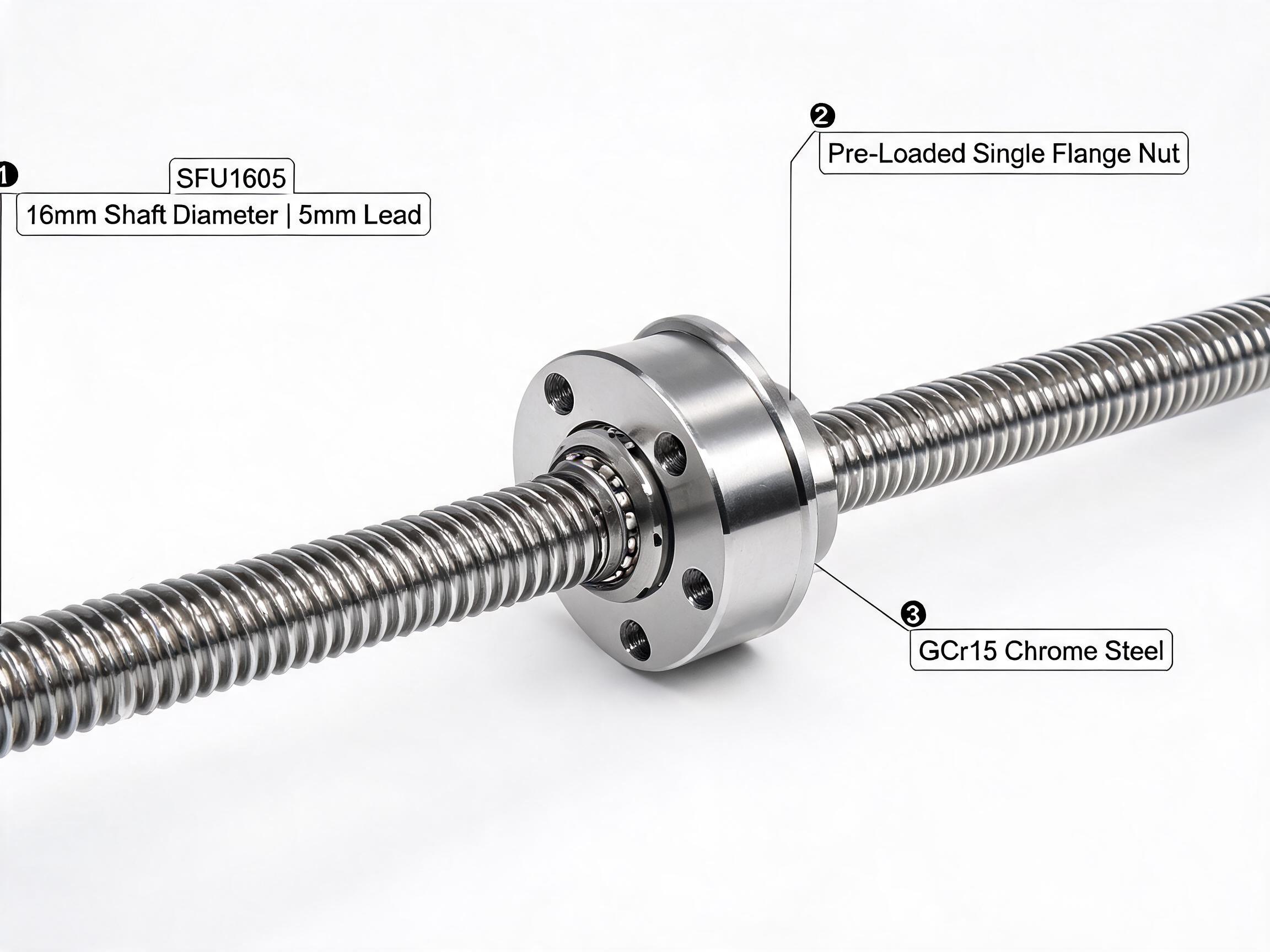
For rolled ball screw assemblies used in vertical axes, review the listed configuration and confirm the brake and hold arrangement separately with the supplier. The SFU series rolled ball screw assembly page is a starting point for the screw itself; the anti-drop decision sits with the drive and safety design around it.
Frequently asked questions
Can a ball screw be made self-locking by choosing a different lead?
Changing the lead changes speed and thrust relationships, but a standard ball screw remains a low-friction rolling device. Self-locking is not a reliable design assumption for a ball screw, regardless of lead choice. Use a brake, counterweight, or safety device instead.
Is a brake motor enough for every vertical axis?
Not necessarily. A brake motor is a common and practical solution when it is sized for the load, but whether it satisfies the machine's safety requirement depends on the risk assessment and the brake's rating. Check with the supplier and the safety integrator.
Does a counterweight remove the need for a brake?
A counterweight reduces the gravity load the drive must hold. It does not necessarily replace a brake, because the remaining load, friction, and safety requirements still apply. Confirm the combination against the actual load.