
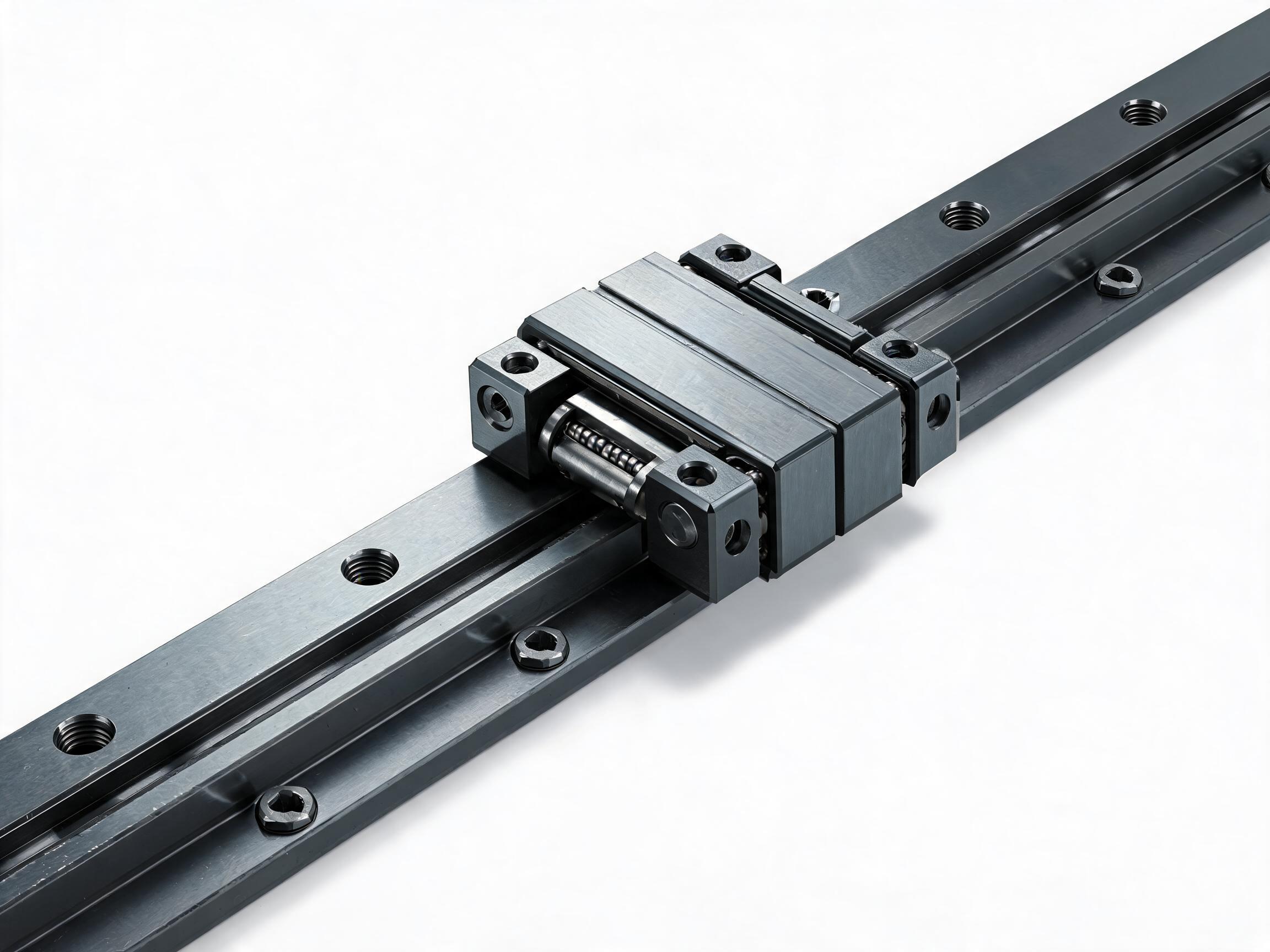
A buyer's decision guide on when an axis genuinely needs a heavy-duty linear guide rail rather than a standard profile rail: what changes in cross-section, case depth, bolt pattern and carriage ratings, and how to read your own per-carriage load and moment figures before stepping up a rail class.
The decision to move from a standard profile rail to a heavy-duty large-size rail is not a matter of machine weight. It is a matter of the load each carriage has to carry, the moment it has to resist, and whether the rail cross-section can accept the mounting pattern and stiffness the axis needs. This guide sets out what actually changes between the two, and how to tell from your own load figures whether the step up is justified.
Key takeaways
- A heavy-duty rail class is defined by cross-section size (width and height), hardened case depth, bolt size and pitch, and the load ratings of the carriage it is paired with — not by a marketing label.
- Judge the need from per-carriage static and dynamic load plus moment load, not from total machine mass.
- Stepping up changes the mounting pattern, so the base structure must be checked at the same time.
- Many axes do not need the step up: if a standard size carriage already has the static headroom and moment capacity, a larger rail adds cost and rework without buying useful capacity.
In this article
- What a “heavy-duty” rail actually means in a catalog
- Rail cross-section class: width and height series
- Case depth after hardening
- Mounting bolt size and pitch
- Carriage load ratings do more work than rail size
- How to judge from your own load calculation
- When you do NOT need to step up
- What to confirm before stepping up
- Where the heavy-duty rail class fits
What a “heavy-duty” rail actually means in a catalog
Buyers often read “heavy-duty” as a single property. In practice it is a bundle of four separate specifications that happen to move together as size increases. The HGR series illustrates the pattern: sizes run HGR15, 20, 25, 30, 35, 45, and the higher numbers are the ones treated as heavy-duty.
Across the series, the raceways are induction-hardened to 58–62 HRC. The HGR series page lists the rail body as 55# high-carbon steel, while the HGR45 page lists a 45# steel body for that size — the material record differs between sizes, so confirm the body material for the exact size you order against its own datasheet rather than assuming one steel grade covers the series. Ground H (P5) and rolled N (P7) grades are available, and standard rails run to a maximum length of 4000 mm, with longer rails supplied as precision splice joints with straightness held to the same grade. Those are shared characteristics. What separates a heavy-duty rail from a standard one is the scale at which they are applied.
The important consequence: two rails from the same series, made of the same steel to the same hardness, can behave very differently in an application because their cross-sections and bolt patterns differ. Comparing “heavy-duty” against “standard” without looking at the specific size is therefore not a comparison at all.
Rail cross-section class: width and height series
The first separator is the size series itself. HGR45 measures 45 mm across the rail width and 38 mm in height, and weighs 6.2 kg/m. Smaller sizes in the series are lighter in every dimension; confirm the exact weight per metre for each size against its datasheet rather than estimating. The cross-section drives section modulus, so a taller and wider rail deflects less under the same moment. That stiffness is much of what buyers are paying for when they move up a class.
The cross-section also determines the mounting footprint. A larger rail occupies more of the base, and its fixing holes are spaced for larger hardware. If the machine base was designed around a smaller series, the step up is not a drop-in substitution.
Case depth after hardening
Surface hardness is quoted for the whole HGR range at 58–62 HRC, so hardness alone does not distinguish the classes. Case depth is the more decision-relevant figure, because it governs how much hardened material sits below the running surface and therefore how the raceway behaves under repeated rolling contact and high contact stress.
HGR45 is listed with an effective case depth of 2.0–2.5 mm and, per its own product record, a 45# steel body. That depth is a property of the large cross-section — a small rail cannot provide the same hardened layer simply because there is less material available beneath the raceway. For other sizes, confirm case depth against the datasheet rather than assuming it scales proportionally.
Mounting bolt size and pitch
The bolt pattern is where the decision becomes practical and immediate. HGR45 takes M12 mounting bolts at 60 mm pitch. Smaller sizes in the series use smaller bolts and tighter pitch.
Two things follow. First, the base structure must be thick enough and strong enough to accept M12 fixings and to distribute the bolt preload without local deformation — a rail is only as stiff as the surface it is bolted to. Second, the hole pattern in the base has to match the new pitch. Retrofitting a heavier rail onto an existing plate usually means re-drilling or replacing the mounting surface, not just swapping the part.
The wider pitch on a larger rail does help in one respect: fewer bolt positions along a given length can still carry the higher preload each bolt provides. That is a design trade-off to confirm with the supplier against your base plate, not a rule to apply blind.
Carriage load ratings do more work than rail size
Here is where buyers most often guess wrong. The rail is one half of a rolling guide; the load is carried by the carriage. Capacity comes from the pair, and the carriage specification can be the dominant number.
| Paired assembly | Dynamic load per carriage | Static load per carriage | Note |
|---|---|---|---|
| HGR20 rail with matched carriage | 16.7 kN | 26.7 kN | Standard-class reference point |
| HGW25CA carriage | 28.4 kN | 42.1 kN | Reference for a mid-size wide-body carriage |
| HGR45 rail with HGW45CA carriage | 62.8 kN | 112 kN | Heavy-duty class, per carriage |
Read that table as a ladder. Moving from an HGR20-class assembly to an HGR45 assembly with an HGW45CA carriage raises dynamic capacity per carriage from 16.7 kN to 62.8 kN and static capacity from 26.7 kN to 112 kN. That is roughly a 3.8× increase in dynamic rating and a 4.2× increase in static rating, per carriage. For intermediate sizes and other carriage variants in the HGW carriage range, confirm rated figures against the datasheet.
Because these are per-carriage figures, the number of carriages on the axis multiplies the available capacity. In ideal load sharing, four HGW45CA carriages on an HGR45 rail give a theoretical combined capacity of four times the per-carriage rating — roughly 251 kN dynamic and 448 kN static — but actual sharing depends on carriage spacing, base stiffness and moment distribution, so treat those multiples as a calculation starting point, not a guaranteed axis rating. This is precisely why the decision should be made on a load calculation rather than on a marketing impression of “heavy-duty.”
How to judge from your own load calculation
Start with the loads that act on each carriage, not on the machine. For an axis carrying a moving mass, the calculation needs five inputs:
| Input | What it feeds | Why it matters |
|---|---|---|
| Moving mass and any payload | Gravity and acceleration load per carriage | Divided across the carriages, not the whole machine weight |
| Acceleration and deceleration | Dynamic load peaks | Transients can exceed the steady-state figure |
| Centre of gravity offset from the rail line | Moment load (pitch, roll, yaw) | Moment capacity, not just load capacity, governs the size class |
| Carriage count and spacing | Load sharing between carriages | Optimum spacing changes the reaction forces |
| Duty cycle and stroke | Rating basis selection | Dynamic rating is the correct basis for moving axes |
Work out the per-carriage static reaction first, including the moment contribution from any off-centre load. Compare it against the static rating of the candidate pair. Then work out the peak dynamic reaction during acceleration and compare it against the dynamic rating. If either comparison comes close to the rated figure, that axis is a candidate for the next size class up — and the moment load is often what forces the step, not the vertical load.
A useful sanity check: a single HGR20-class carriage is rated 26.7 kN static. If your static reaction per carriage is in the low single-digit kN, the standard size is far from its limit and the question of “heavy-duty” does not arise on load grounds. If the reaction per carriage runs into the tens of kN and there are significant moment loads, the standard size is being asked to do something it was not rated for.
Do not skip the moment check because the vertical load looks comfortable. An axis with a cantilevered head can generate a roll moment large enough to dominate the selection even when the pure weight is modest.
When you do NOT need to step up
This is the part that saves money. A larger rail class is not automatically better; it costs more, weighs more per metre, forces a larger bolt pattern and may not fit the base you already have.
You do not need to step up if:
- The per-carriage static reaction, including moment contributions, sits comfortably below the static rating of the standard carriage pair — with margin you can state explicitly.
- The peak dynamic reaction during acceleration stays within the dynamic rating of the standard carriage, accounting for the duty cycle rather than a single ideal cycle.
- The moment loads are within the carriage’s rated moment capacity, and the base plate under the standard rail is thick enough to take the smaller bolt preload without local deflection.
- The extra stiffness of a larger cross-section is not needed for the accuracy target. A stiffer rail can matter on a long span, but on a short, well-supported axis a standard rail at P5 grade may already deliver the straightness the application needs.
In those cases the honest answer is that the standard rail is the correct rail. Adding weight, cost and a new mounting pattern to buy capacity you are not using is the wrong trade.
What to confirm before stepping up
Once the load calculation points to a larger class, three things need checking before the order goes out.
The load calculation itself. Re-run it with the new carriage count and any revised spacing, because the larger rail may change how many carriages fit along the axis or how they are distributed. Confirm the moment capacity of the candidate carriage, not just its load ratings.
The carriage count. More carriages spread the load and reduce the reaction per carriage, but they also change the moment reactions. Sometimes a slightly larger carriage count in the existing size class solves the problem without a class change; sometimes it just moves the problem to the base stiffness.
The base structure. The base must accept the new bolt size and pitch, carry the preload without deformation, and preserve the flatness and straightness the rail grade calls for. If the rail is supplied as a precision splice joint for a long travel, confirm that the joint arrangement and the base support under it are designed together.
The cleanest way to close the loop is to give the supplier your computed per-carriage static and dynamic reactions, moment figures, stroke length and mounting surface details, and ask for the rated pair that fits — rather than asking for the largest size on the page.
Where the heavy-duty rail class fits
The applications where the larger class earns its place share a pattern: high static or dynamic reaction per carriage, substantial moment loading, or both. Typical applications for the HGR series include CNC machining centres, grinders, laser cutting gantries and injection moulding platens; the HGR series record cites large-format router tables and injection moulding platens where static load exceeds 60 kN per axis as situations that push the selection into the heavy class.
For a laser cutting gantry carrying a heavy cutting head at speed, the dynamic reaction and the roll moment together are the deciding numbers. For an injection moulding platen, it is often the static reaction — the platen sits loaded at rest, so the static rating governs. Both cases point the same way, but for different reasons, which is why the calculation matters more than the label.
The HGR45 heavy-duty rail sits at the top of the standard HGR size range, with M12 fixings at 60 mm pitch, 2.0–2.5 mm case depth and 6.2 kg/m rail weight. It is the size the calculation points to when standard-class assemblies run out of static headroom, and it is the size to specify when the base plate can accept its mounting pattern.
Frequently asked questions
- Should I choose the rail size from the machine weight?
- No. Weight is an input to the load calculation, not the answer. The selection is driven by the reaction force on each carriage and the moment the axis applies about the rail line. A heavy machine with many carriages can load each carriage lightly; a lighter machine with a cantilevered head can load a carriage heavily.
- Is a bigger rail always stiffer and therefore better?
- A larger cross-section does raise stiffness, but it also adds weight and forces a larger bolt pattern. The rail only performs as well as the base under it allows. On a short, well-supported axis, a standard rail at ground P5 grade may already meet the accuracy requirement.
- What is the difference between static and dynamic rating for choosing a class?
- Static rating is the correct basis for axes that sit loaded without moving, such as a moulding platen. Dynamic rating is the correct basis for moving axes subject to acceleration and duty cycles. Both comparisons use the per-carriage figure, not the total.
- Can I keep my existing mounting holes and just fit a bigger rail?
- Usually not. The HGR45 uses M12 bolts at 60 mm pitch, while smaller sizes use smaller hardware at a tighter pitch. A size change normally requires a matching change in the base plate, so confirm the mounting pattern before committing to the step up.
- Are long rails available beyond the standard maximum length?
- HGR rails are listed with a maximum standard length of 4000 mm. Longer rails are supplied as precision splice joints with straightness held to the same grade, which means the joint design and the base support under it should be planned together.
Load ratings and dimensions quoted above are catalog figures for the listed sizes. For carriage variants, intermediate sizes and case depth on sizes other than HGR45, confirm the values against the datasheet for the exact pair you intend to order.