
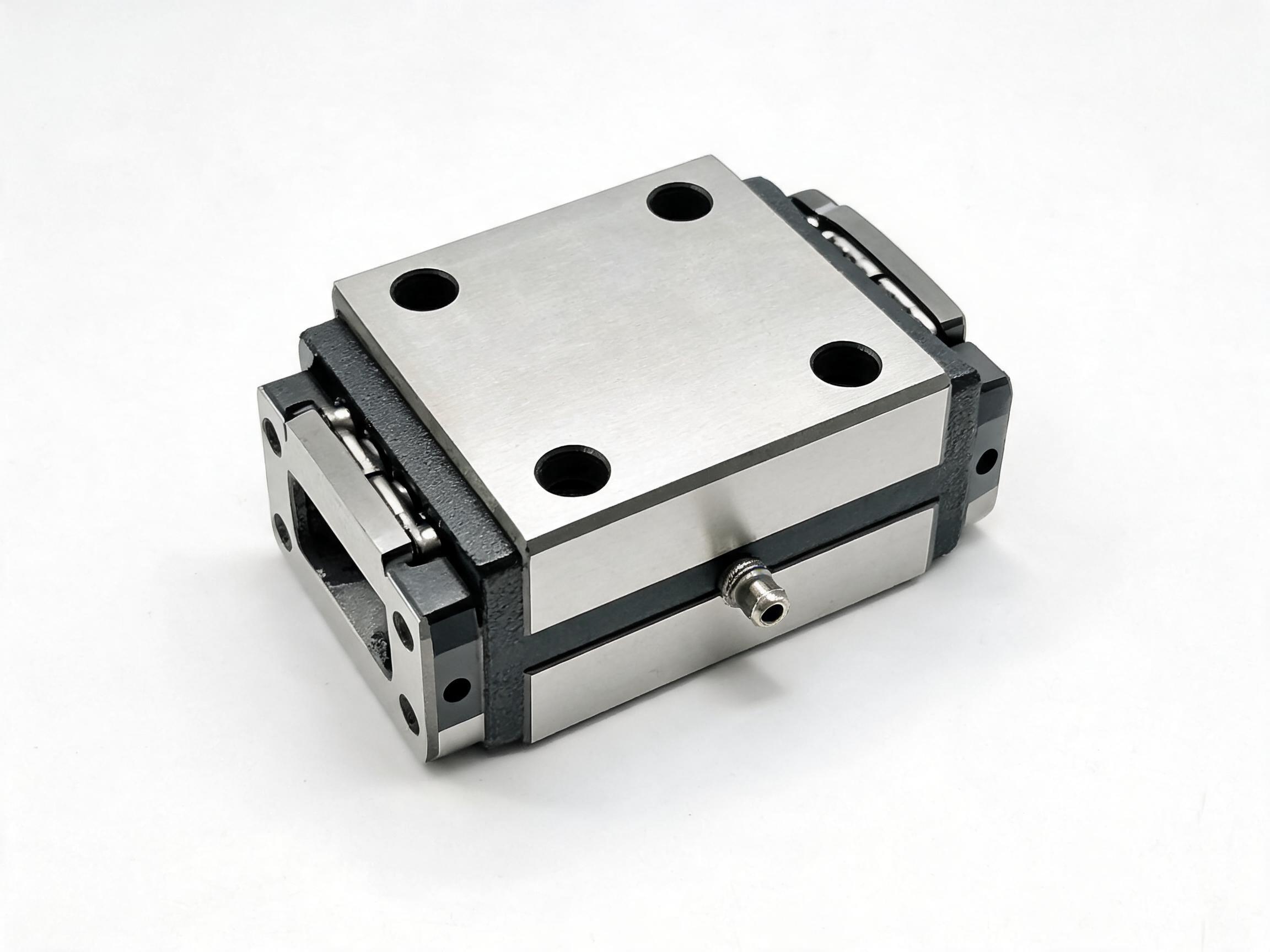
A carriage block only fits if four dimension groups match your machine: overall assembly height (including the CA or HA height code), body width and footprint, bolt pattern, and rail size number. This guide shows how to read a linear guide rail carriage dimensions table, verify it against the envelope and the original part marking, and what to confirm from the dimensional drawing before ordering.
A linear guide rail carriage block only fits your machine when four dimension groups line up: overall assembly height, body width and footprint, bolt pattern, and rail size number. Reading a carriage table means checking each group against the space and holes you already have, rather than picking the block by its series name or load rating alone.
Before you start: dimension tables vary by brand and by series. Read the specific millimeter values from the supplier's dimensional drawing or datasheet for the exact model and height code you intend to order. This article explains which columns decide a fit and how to read them; it does not quote each model's dimensions.
Why a carriage table is a fit tool, not a catalog page
Buyers usually choose a carriage by series and load rating, then check dimensions afterwards. That order creates the common failure: a block that carries the load but will not bolt onto the machine, or one that bolts on but raises the assembly height and moves the work plane. A carriage dimension table exists to close that gap before the order. When you read it, you are answering one question: does this block occupy the same space and present the same bolt positions as the part it replaces or the design it must satisfy?
The four groups below decide that answer. The first two are about the envelope; the second two are about connection and rail compatibility.
Group 1: overall assembly height and the height code
Overall assembly height is the vertical distance that matters for the machine envelope and, in many designs, for the position of the carriage relative to the work plane. A carriage has its own stated height, and it mounts on a rail of a given size, so the assembly height is what you compare with the available clearance and the height of the original part.
Height is also encoded in the model name. For HGH-type carriages, the suffix CA indicates standard height and HA indicates high height. Two blocks of the same rail size can therefore sit at different heights, and the original part marking is the most reliable way to tell which one the machine was built around. Before ordering, confirm both the rail size number and the height code from the marking on the existing block or from the machine drawing. If either is uncertain, treat the height as unconfirmed until the supplier's drawing settles it.
For the specific millimeter height of a given model, read from the dimensional drawing or datasheet. Do not assume a height from the series or from a neighboring model number.
Group 2: body width and footprint shape
Body width decides whether the block clears the surrounding structure and whether its footprint matches the mounting surface. The footprint is not only the block's width; it is the area the block presents to the machine, including the flange and the bolt positions around it.
Two common shapes behave differently here. A flange-type carriage such as the HGH series flange-type carriage has a full-width flange footprint and four mounting holes on the top face. A wide-body carriage such as the HGW series wide-body carriage has a mounting footprint roughly 20–30% wider than the equivalent HGH flange type. That extra width is useful when the machine needs a broader base, and it is also the first thing to check against a narrow envelope.
If your machine was designed around a flange-type block, a wide-body block of the same rail size is not a drop-in substitute: it may be wider than the clearance and present side bolts the original mounting surface does not have. The reverse is also true. Compare footprint shape before comparing anything else on the drawing.
Group 3: bolt pattern, top face and side
The bolt pattern is the group most often skimmed and most often wrong. Count holes, note which face they are on, and check the spacing and thread size against the machine's mounting plate. A block with the right width can still fail if its holes do not line up with the plate.
The flange-type HGH carriage has four top-face mounting holes. The wide-body HGW carriage has four top-face bolts plus two side bolts. Those side bolts are part of the fit decision: they require matching locations in the mounting structure, and a machine built for a flange-type block will not have them. For the exact hole positions, pitch and thread, read the dimensional drawing; the drawing, not the model name, is the authority.
The SBS16 single-axis slide unit is a useful reminder that whole-unit dimensions differ from carriage-only dimensions. Its carriage mounts with four M4 top-face bolts, and the unit's total system height is 18 mm. That 18 mm is the height of the complete unit, not the carriage alone, so it must not be used as a carriage dimension when comparing against a block table.
Group 4: rail size number matching
Rail size number (the 15, 20, 25 and similar designation in the model name) ties the carriage to the rail it runs on. The carriage must match the rail size already installed on the machine, or the rail and carriage must be changed together. When reading a table, check that the block's rail size number equals your rail's, then read the dimensions within that size.
Within a rail size, the other codes still matter: height code and body shape. A 20-size block in HA height is a different fit from a 20-size block in CA height, even though the rail number matches. Treat rail size as a filter, not as a complete identity.
A worked reading of the same series in two shapes
The table below shows how the four groups line up for the two shapes discussed, using the facts that are fixed for these series. The millimeter values for each model are read from the dimensional drawing or datasheet, so the cells say what to read rather than quoting a number that varies by model.
| Fit group | HGH flange-type | HGW wide-body |
|---|---|---|
| Overall height | Read from drawing; height code CA (standard) or HA (high) | Read from drawing; height code confirms height |
| Body width / footprint | Full-width flange footprint | Mounting footprint about 20–30% wider than HGH flange type |
| Bolt pattern | Four top-face mounting holes | Four top-face bolts plus two side bolts |
| Rail size number | Must match installed rail size | Must match installed rail size |
The load figures that often appear alongside dimension tables are a separate decision. For reference, an HGH20CA lists a dynamic load rating of 18.0 kN and a static rating of 29.5 kN, and an HGW25CA lists 28.4 kN dynamic and 42.1 kN static. Those ratings help choose a size for the load; they do not tell you whether the block bolts onto your machine. Read the ratings after the four groups above have passed.
Verify against the machine envelope and the original marking
The table tells you what the block is. The machine tells you what it will accept. Verification is a comparison between the two, not a second reading of the catalog.
- Read the original part marking. The marking on the existing block or a machine drawing usually records the series, rail size, and height code. This is the single most useful piece of information when ordering a replacement or a spare.
- Measure the envelope. Check clearance above the block, width available at the footprint, and access to every bolt location. A wide-body block needs more lateral clearance and side-bolt access than a flange-type block of the same rail size.
- Compare the bolt pattern to the mounting plate. Hole count, face (top or side), spacing and thread must match the plate; if any of these is unknown, the plate drawing or a physical check decides it, not the model name.
- Confirm the rail size. The carriage must match the rail that is present. If the machine uses a different rail size, the carriage and rail are a pair and should be specified as one change.
- Ask for the dimensional drawing of the exact model and height code. Dongfeng Bearing can provide dimensional drawings on request so the values can be checked against your machine before ordering.
Pre-order checklist
- Original part marking recorded: series, rail size number, height code (CA or HA).
- Overall assembly height checked against the machine clearance and work-plane position.
- Body width and footprint shape checked; wide-body or flange-type decided, not assumed.
- Bolt pattern matched: hole count, top-face or side bolts, spacing and thread.
- Rail size number matched to the installed rail.
- Dimensional drawing for the exact model reviewed before the order is placed.
For machine-tool and automation builders, this check is routine and worth doing every time a model changes. It prevents the most expensive kind of carriage error: a correct load rating that does not fit the machine. Dongfeng Bearing lists the flange-type HGH series, the wide-body HGW series, and the SBS16 slide unit; each dimensional drawing should be read against the machine before ordering.
FAQ
Can I use the load rating to choose between CA and HA height?
No. Height code is a dimensional choice, not a load-rating choice. Confirm CA (standard height) or HA (high height) from the original part marking or machine drawing, then choose the rail size for the load.
Is a wide-body carriage a drop-in replacement for a flange-type block?
Only if the machine envelope and bolt pattern support it. The wide-body HGW footprint is about 20–30% wider than the HGH flange type and adds two side bolts, both of which must be checked against the mounting surface.
Which values should I compare first against my machine?
Start with the rail size number and the height code from the original marking, then check body width and the bolt pattern against the envelope and mounting plate. Use the supplier's dimensional drawing for the exact model to confirm millimeter values.
Does the SBS16 unit height apply to the carriage alone?
No. The SBS16 unit has a total system height of 18 mm, which is the complete unit, not the carriage block. Use carriage dimensions only for carriage comparisons.
Read the table in this order: height code, body width, bolt pattern, rail size number. Confirm each against the machine and the original part marking, and take the millimeter values from the dimensional drawing for the exact model you will order.